
PMPublic media
3 records
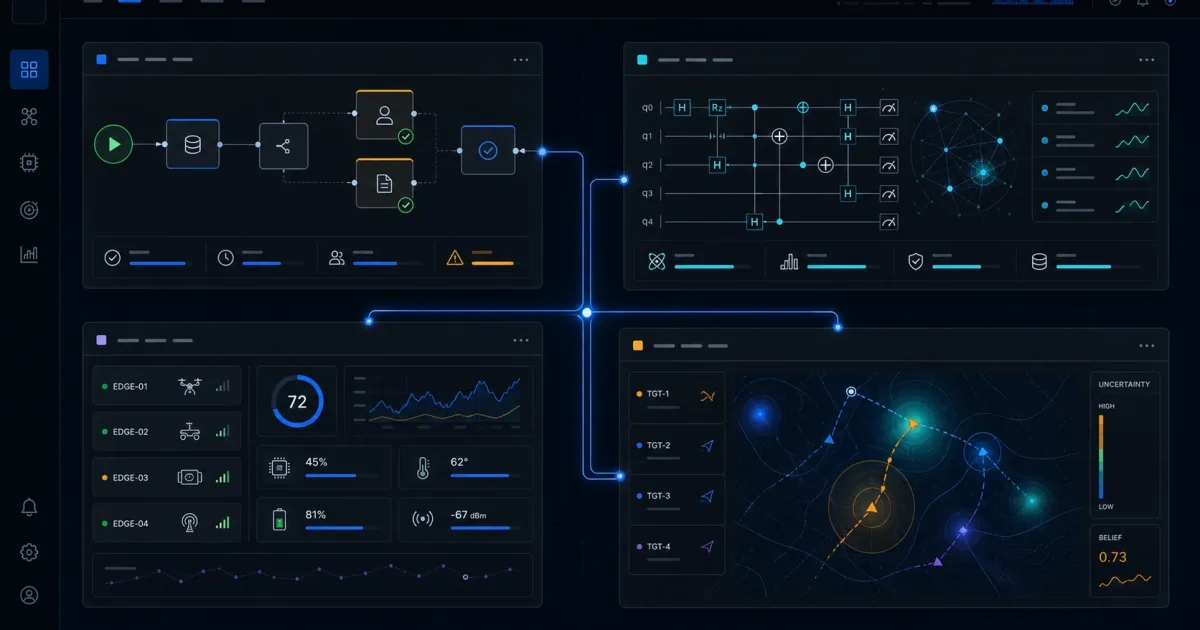
Evidence-aware shared situational context
CONCEPT MODEL — Observations remain connected to source, recency, uncertainty, disagreement, and decision impact.

Accountable human authority
CONCEPT ASSURANCE SURFACE — Recommendation, authorization, execution, and outcome remain distinguishable in the operating record.
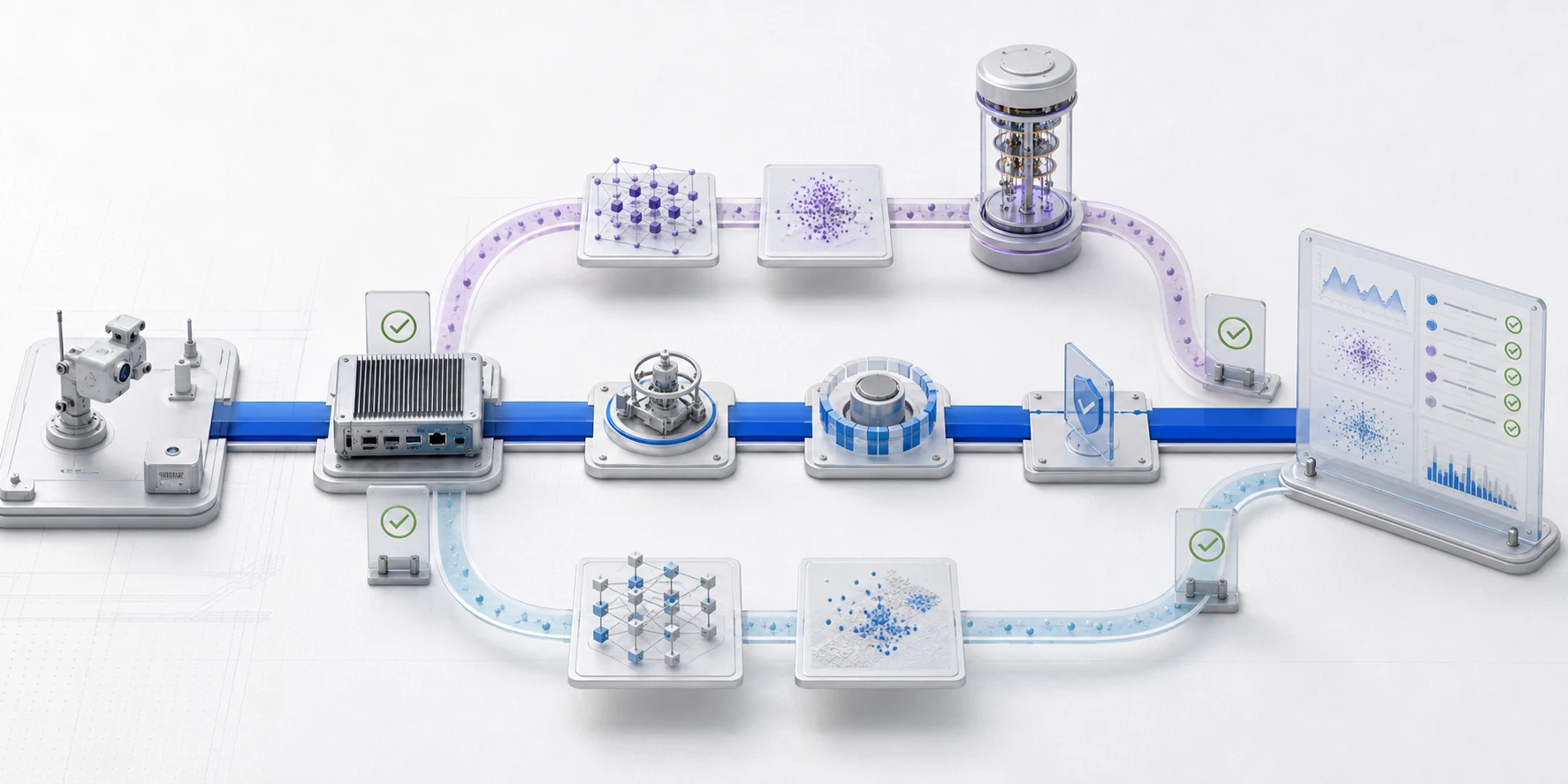
Classical-first hybrid evaluation path
CONCEPT EVALUATION PATH — The classical core remains continuous while alternative methods are measured through explicit evidence gates.
NODERIQ advances as an AI-first applied programme
Neura Parse is setting out the public programme and productisation direction for NODERIQ: verifiable distributed intelligence for resilient autonomous systems operating with uncertain observations, changing team composition, and constrained connectivity.
The direction begins with a useful classical AI and edge-compute core. Shared situational context, distributed coordination, verification, human escalation, and bounded local operation must stand on their own before any alternative compute path is considered.
Five product pillars keep the programme understandable
The public NODERIQ surface is organised around five capability pillars: resilient operational context, distributed coordination, assurance and human authority, interoperable edge operation, and evidence-gated hybrid compute research.
This framing explains what the programme is trying to make useful without publishing model architecture, data schemas, message protocols, security implementation, routing rules, operating thresholds, or mission-specific configurations.
BD · Full bulletin7 supporting sections and the operational checklist.Read deeper
AI Core first, measured extensions second
Stage one is the NODERIQ AI Core: classical shared-context intelligence, communication-aware coordination, assurance, human escalation, edge integration, and repeatable resilience evaluation. This is the primary product path and must remain useful without quantum hardware or continuous cloud access.
Stage two adds a Hybrid Intelligence Layer for selected planning or belief-estimation workloads. Each workload receives a common definition, a strong classical baseline, reproducible comparisons, and a shared evidence record. Stage three remains conditional: quantum execution advances only when simulation, hardware, and complete operating measurements justify a bounded advisory role.
- Stage 01 — AI Core: standalone, classical, edge-operable value.
- Stage 02 — Hybrid Intelligence Layer: controlled comparison across methods.
- Stage 03 — Conditional quantum pathway: opened only by evidence.
Define, prove, verify, integrate, pilot, scale, and explore
The productisation path starts with the user problem and authority boundary, then proves the smallest useful AI core in simulation. It advances through repeatable testing, evaluation, verification, and validation under uncertainty and degraded conditions before integration into edge runtimes and operator workflows.
A bounded pilot then answers a named research or adoption decision. Scale follows only with configuration control, training, support, updates, monitoring, and incident learning. Hybrid and quantum exploration remains a parallel evidence track rather than a dependency on the core product.
Hybrid compute must earn promotion through four gates
Hard real-time safety, platform control, and essential local behaviour stay classical. Only bounded, latency-tolerant, non-safety-critical planning or inference questions are eligible for alternative-compute evaluation.
The public gate method is direct: define the same measurable problem and baseline; validate the method in simulation; verify that available hardware preserves the necessary information and constraints; then qualify whether accuracy, reliability, latency, cost, integration effort, and review burden produce operational value. Failure at any gate leaves the classical path in place.
- Define — one problem, one output contract, one credible classical baseline.
- Simulate — controlled validity before scarce or paid hardware time.
- Preserve — hardware output retains decision-relevant information.
- Qualify — end-to-end value survives the full operating review.
A clear public record without protected implementation detail
The NODERIQ programme page and field-note series explain the problem, principles, productisation method, evidence categories, and relationship to NeuraOS, NowFlow, QFlow Studio, and QANTIS. They intentionally do not publish detailed architecture, proposal material, operational topology, security mechanisms, private test scenarios, decision thresholds, provider settings, or unverified performance figures.
Failure modes the roadmap is designed to prevent
The first failure mode is architecture before problem. A team can spend months describing a universal distributed-intelligence platform without identifying the first operator, the first decision, or the evidence required for acceptance. NODERIQ's productisation path therefore begins with a bounded user problem and a complete operating loop.
The second failure mode is demonstration confidence. A nominal scenario can make coordination look complete while hiding stale evidence, brittle links, ambiguous authority, and no recovery path. Degraded-condition TEVV belongs in the core programme rather than at the end of a pilot.
The third failure mode is quantum dependency. If the commercial story requires an experimental method to win, the evaluation is no longer neutral. Keeping the AI Core classical and useful makes negative hybrid-compute results safe to report and valuable to the roadmap.
- Universal architecture with no first user or decision.
- Nominal demonstrations presented as resilience evidence.
- Human-in-the-loop language with no authority model.
- A quantum label promoted before a common workload and baseline exist.
- Provisional targets repeated publicly as achieved performance.
Instrument the evidence chain before optimizing the model
The first instrumentation target is the evidence chain: what the system observed, what it inferred, what it recommended, which policy applied, who authorized the next step, what the runtime executed, and what outcome followed. If those events do not share identity and time context, later replay becomes reconstruction by guesswork.
The second target is degradation. Link state, missing observations, staleness, contradictory evidence, platform membership, operator intervention, and recovery should be named factors in each evaluation run. The programme needs to know which factor changed the recommendation and why.
Only after that foundation exists should teams optimize model accuracy, communication efficiency, or alternative compute. Better algorithms are useful when their effect appears in a complete, comparable operating record.
What a credible next update should contain
The next useful public record is not a larger list of intended capabilities. It is a status-labelled evaluation artifact: the bounded scenario, which stage was tested, which evidence dimensions were measured, what limitations remain, and which next decision the result supports.
Public reporting can remain safe by publishing method and claim boundary without disclosing operational topology, detailed scenarios, thresholds, security controls, or partner-confidential material. A negative or held gate is also worth publishing when it narrows the programme honestly.
Operational checklist
Programme checklist: turning the NODERIQ direction into measurable work
Public-safe actions for an applied autonomy programme. Each step should produce a reviewable artifact before the next gate opens.
- 01
Name one user problem, one operating envelope, and one consequential authority boundary.
- 02
Define the classical baseline and the smallest AI Core that remains useful without external specialist compute.
- 03
Keep observation, belief, recommendation, authorization, execution, and outcome distinct in the evidence model.
- 04
Create repeatable nominal and degraded-condition simulations before expanding platform or scenario scope.
- 05
Measure world-model quality, coordination quality, assurance, edge resilience, recovery, and operating fit as separate dimensions.
- 06
Move runtime identity, configuration, telemetry, update, and rollback state into the evaluation record before an edge pilot.
- 07
Give a bounded pilot a named user, explicit exclusions, acceptance evidence, and a decision waiting at the end.
- 08
Keep quantum and quantum-inspired work on a separate comparison track with a classical fallback at every gate.
- 09
Publish only verified status and evidence; keep proposal, security, threshold, and operational configuration detail controlled.
BA · Bulletin annexDefinitions, recurring questions, source notes, and publication tags.Inspect
Terminology
Terms used in this bulletin.
- AI-first
- A programme rule that core capability is built and evaluated through classical AI and edge computing before any alternative compute route is considered.
- Shared situational context
- A common operational view that retains source, recency, uncertainty, disagreement, and decision relevance rather than showing fused coordinates alone.
- Distributed coordination
- Coordination across heterogeneous participants that does not assume a permanently available central service or stable communication link.
- Human authority
- The explicit assignment and record of who may authorize a consequential action, under which policy and operating conditions.
- TEVV
- Testing, evaluation, verification, and validation: a lifecycle process for producing evidence about whether a system behaves as intended under defined conditions.
- Classical fallback
- The conventional computing path that remains available when an experimental or external compute route is unavailable, invalid, too slow, too costly, or otherwise unsuitable.
- Evidence gate
- A review point where measured validity, reliability, latency, cost, integration burden, and operating value decide whether a workload advances, repeats, or stays classical.
- Public-safe
- A publication boundary that explains purpose, method, status, and supported claims while withholding protected proposal, architecture, security, configuration, threshold, and operational detail.
Field questions
Questions program teams ask.
Q01Is NODERIQ now a released product?
No. This update defines an applied research and productisation programme: its problem, public capability pillars, evaluation method, stages, and claim boundaries. It does not announce production availability, a deployed customer system, certification, or operational validation.
Q02What is the first productisation priority?
A useful AI Core that operates through classical AI and edge computing: shared uncertainty-aware context, communication-aware coordination, assurance, human escalation, and repeatable resilience evaluation. It must create value without quantum hardware or continuous cloud access.
Q03Does NODERIQ depend on quantum computing?
No. Quantum is an optional research route for selected latency-tolerant, non-safety-critical planning or belief-estimation workloads. Every candidate is compared against a strong classical baseline, and the classical path remains available if any evidence gate fails.
Q04What does verifiable mean in the public NODERIQ description?
It means traceable and reviewable: a recommendation should remain connected to its evidence, uncertainty, policy state, authority decision, runtime response, and outcome. It does not mean formal mathematical verification, certification, or guaranteed performance unless a separate public record establishes that status.
Q05Why are implementation details and numerical targets not published here?
The public surface is intended to explain the operating idea and progress method without exposing protected architecture, proposal material, operational configurations, security mechanisms, routing thresholds, private test scenarios, or provisional targets that have not been independently established as results.
SNSource notes
6 recordsTags