
Grover-AA on POMDP Belief Oracle
Under the paper's oracle model, amplitude amplification changes rare-evidence query scaling from O(P(e)⁻¹) to O(P(e)⁻¹ᐟ²). This is a logical sample-complexity result, not a wall-clock hardware claim.
00Quantum decision research
QANTIS studies hardware-calibrated rare-evidence estimation and planner-facing POMDP belief updates on IBM Heron. The quantum processor returns an ordinary posterior; policy and action remain classical.
2 public arXiv preprints · arXiv:2607.06760v1 · IBM Heron · MIT (Community Edition)
01Research model
The public surface explains the method, reported results, reproducibility record, and limits. It does not turn a controlled hardware study into a production claim.
Under the paper's oracle model, amplitude amplification changes rare-evidence query scaling from O(P(e)⁻¹) to O(P(e)⁻¹ᐟ²). This is a logical sample-complexity result, not a wall-clock hardware claim.
Across the reported sequential Tiger POMDP checks, the hardware-derived posterior and exact Bayes posterior selected the same immediate action. Policies and action execution remain with the classical planner.
The foundational paper casts multi-target data association as a QUBO and reports an 11-variable FPC-QAOA hardware feasibility case. Classical Hungarian and GNN baselines remain faster and exact on the tested small instance, so this is not an advantage claim.
Across the foundational study, ZNE helped reported circuits below roughly 100 ISA gates and hurt examples above roughly 1,000. The result is a circuit- and backend-specific operating map, not a universal mitigation rule.
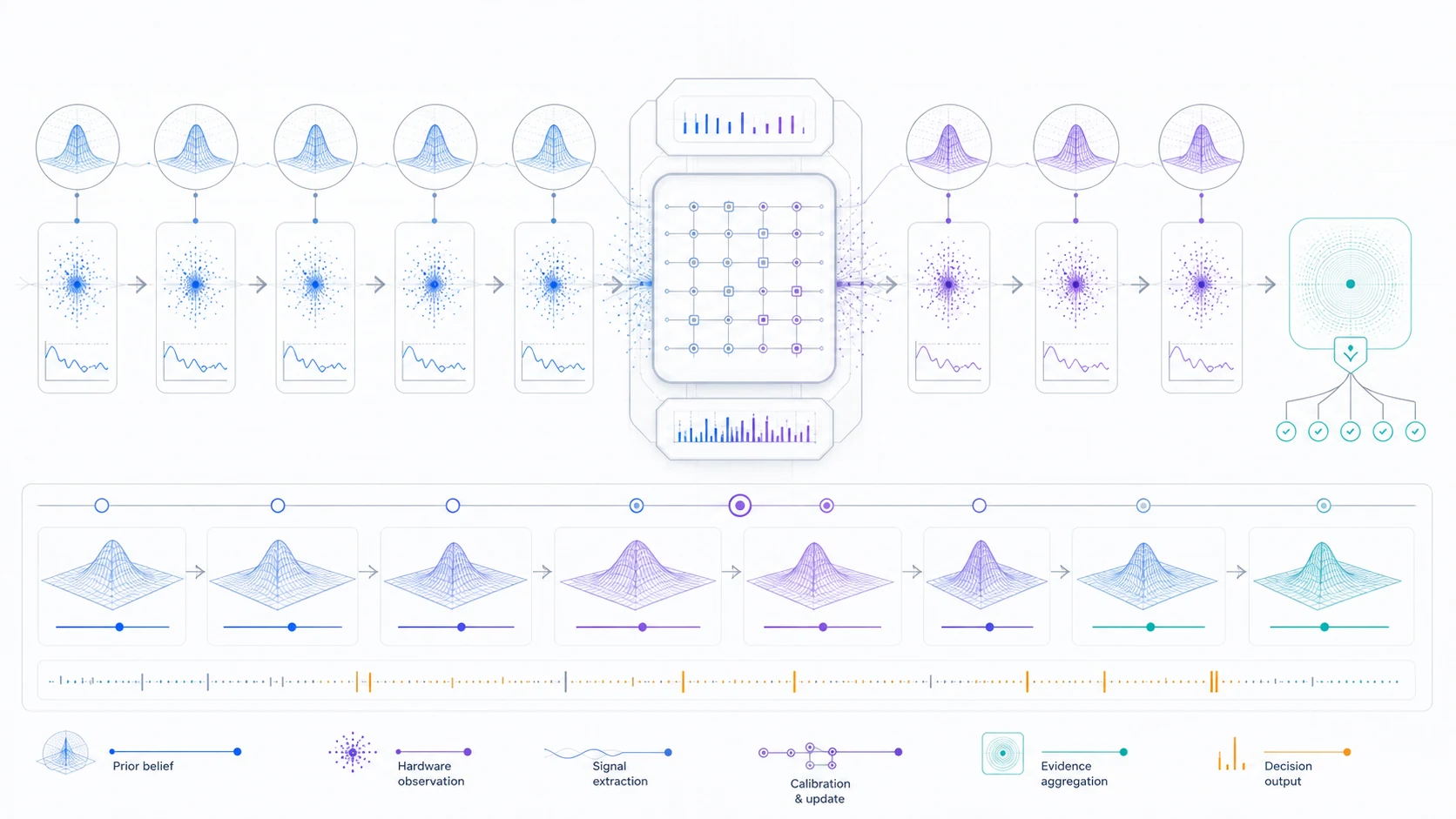
A prior belief and observation model define the update requested by the planner.
IBM Heron circuits estimate the rare-event evidence term under a calibrated operating envelope.
The service returns a classical posterior rather than replacing the planner or policy layer.
The study compares the resulting immediate action with the action selected by exact Bayes.
02Public records
The 2026 records separate foundational hardware feasibility from the later sequential belief-update study.
Public arXiv preprint · February 28, 2026
arXiv:2603.00785v1
31 pages · 4 figures · 12 tables · quant-ph + cs.AI
The foundational QANTIS paper reports a hardware campaign counted as 45 experiments across POMDP belief conditioning and multi-target data association on three IBM Heron backends; the count is not 45 independent replications.
Public arXiv preprint · July 7, 2026
arXiv:2607.06760v1
10 pages · 6 figures · cs.AI + quant-ph
CC BY 4.0
A controlled hardware case study that treats the quantum processor as a calibrated belief-update service: it receives a prior and observation model, estimates rare-event evidence, and returns an ordinary posterior to a classical planner.
Attribution
Author and citation details are maintained in the linked arXiv records.
Keywords
Quantum computing · POMDP · Amplitude amplification · Fixed-point amplitude amplification · BIQAE · Sequential belief updating · QAOA · Multi-target tracking · Data association · NISQ · Error mitigation · IBM Heron
03Explore and access
The interactive surface is didactic. It helps explain evidence routing; it is not the research implementation or an autonomous decision system.
Turn noisy, partial, or rare observations into a calibrated posterior belief — the single source of truth that every downstream step depends on.
Grover-AA on POMDP belief
O(P(e)⁻¹) → O(P(e)⁻¹ᐟ²) query-complexity change under the paper's oracle model; not a wall-clock result
BIQAE
Boundary-aware Bayesian quantum amplitude estimation under bounded depth
Hellinger distance ≤ 0.0149
vs ideal distribution across T=8 hardware steps (Tiger POMDP)
Inputs
Outputs
Stack
Can compose with qmesh → signed run manifest → offline-verifiable provenance chain.
Click a step above to inspect inputs, outputs, and the techniques QANTIS uses at that stage.
The public repository carries the inspectable community surface. Collaboration scope is discussed separately and does not change the public claim boundary.
| Feature | Community Edition · public · MIT | Collaborator Edition · private · partners only |
|---|---|---|
| Backend abstraction layerframework | Public connectors | Hardened, multi-vendor, optimised |
| Configuration & reproducibilityframework | Included | Included |
| Error mitigation pipelineframework | Baseline (ZNE, Pauli twirling) | Full mitigation & calibration stack |
| Benchmarking infrastructureframework | Illustrative | Full experimental harness |
| Infer — calibrated beliefengine | Basic surface | Calibrated, production-grade |
| Risk — event & tail-riskengine | Basic surface | Calibrated, production-grade |
| Optimise — feasible decisionsengine | Basic surface | Calibrated, production-grade |
| Verify — trust & diagnosticsengine | Basic surface | Calibrated, production-grade |
| POMDP planning (Tiger reference)applications | Included | Included |
| Multi-Hypothesis Tracking (MHT)applications | Included | Included |
| Quantum-Bio Intelligenceapplications | Not included | Included |
| CRISPR moduleapplications | Not included | Included |
| Sensor fusion · adversarial robustness · mission orchestrationapplications | Not included | Included |
| Hardware campaign artefactsops | Aggregate results in cited preprints; raw campaign artefacts not bundled | Available by governed engagement |
| Comparative benchmarks vs classical SOTAops | Not included | Included |
| Confidential datasets & mission profilesops | Not included | Included |
| Supportops | Community, best-effort | Dedicated engineering |
| Licenceops | MIT | Commercial / partner agreement |
04Hardware evidence
Results below are reported observations from controlled IBM Heron studies. They are not wall-clock speedup, production readiness, or quantum-advantage claims.
Validated route
Problem → Simulation → Hardware → Public record
Reported backends
ibm_torino · ibm_fez · ibm_marrakesh
2 arXiv preprints · IBM Heron QPUs · Sequential posterior checks
B01The foundational study found ZNE useful below ~100 ISA gates
B02The same study found ZNE harmful above ~1000 ISA gates
B0311-variable FPC-QAOA hardware case; quality degraded at 19 variables
05Code and reading
Three packages keep shared infrastructure, POMDP research, and tracking research composable. QANTIS can also use qmesh as an experiment-substrate layer without merging their claims.
Shared utilities, circuit primitives, error mitigation (ZNE, Pauli twirling), and backend abstraction layer for IBM Qiskit Runtime.
POMDP belief-state oracle construction, Grover amplitude amplification, closed-loop hybrid planning loop, and Tiger POMDP reference implementation.
Multi-target data association via QUBO formulation, FPC-QAOA solver, classical MHT baseline, and cost-matrix construction for tracking scenarios.
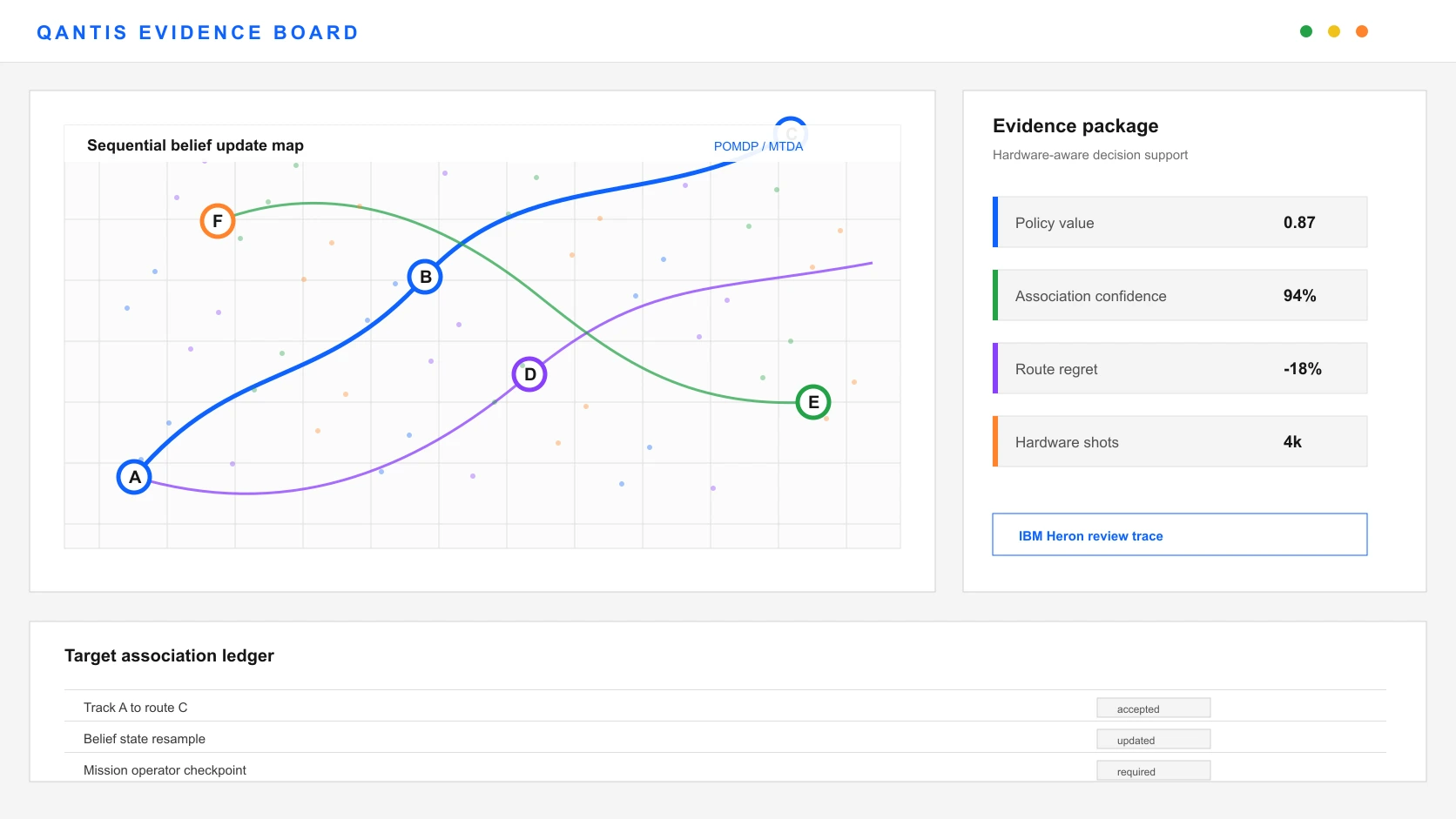
QANTIS moved from a cross-backend campaign reported as 45 experiments to a controlled sequential belief-update service. Reading both papers together shows what survived hardware testing, what was narrowed, and what still needs stronger evidence.
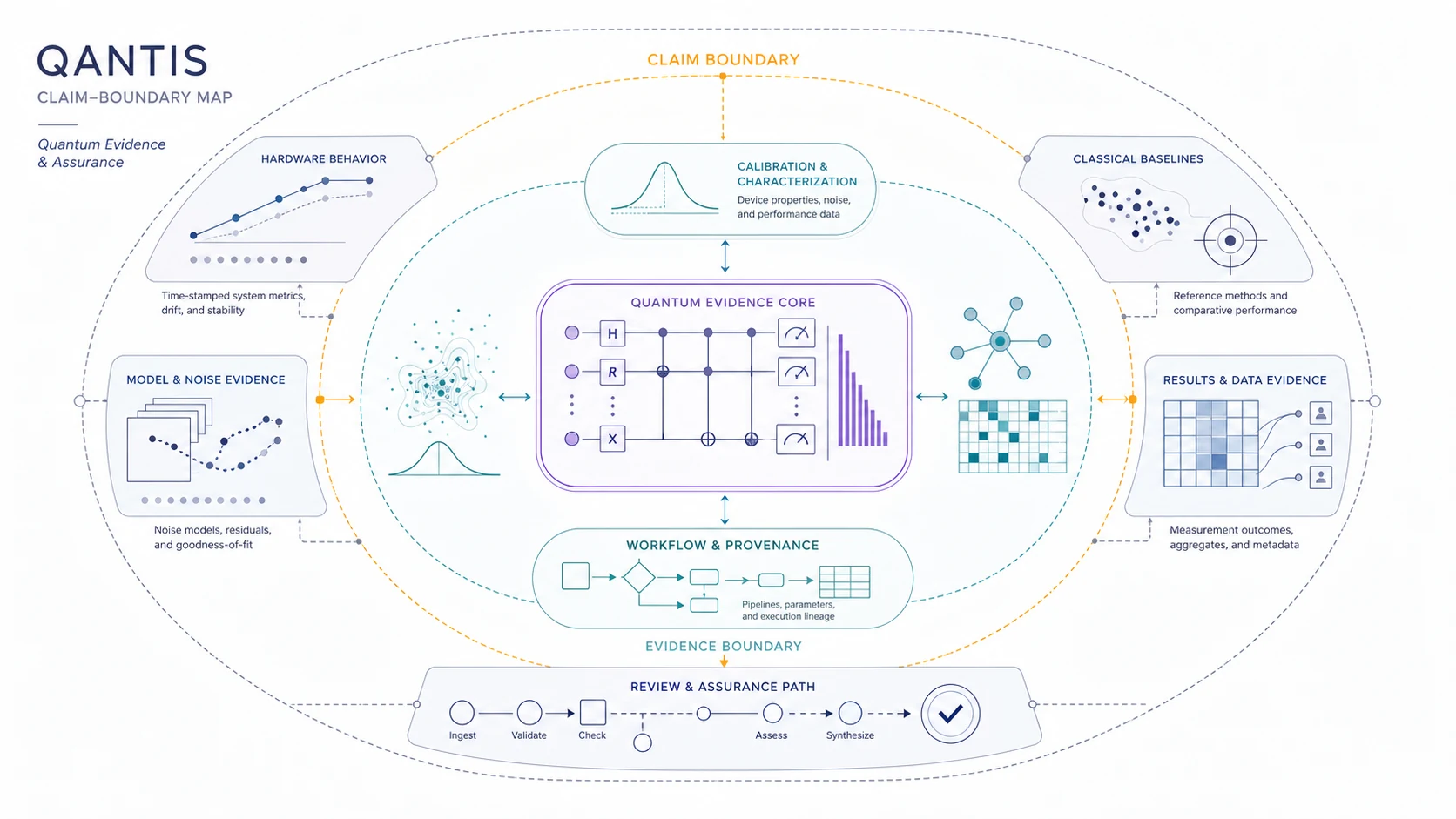
The QANTIS result is credible when read narrowly: calibrated shallow belief updates can remain close to exact Bayes in controlled hardware runs. The evidence does not establish wall-clock advantage, general scale, or end-to-end autonomy.
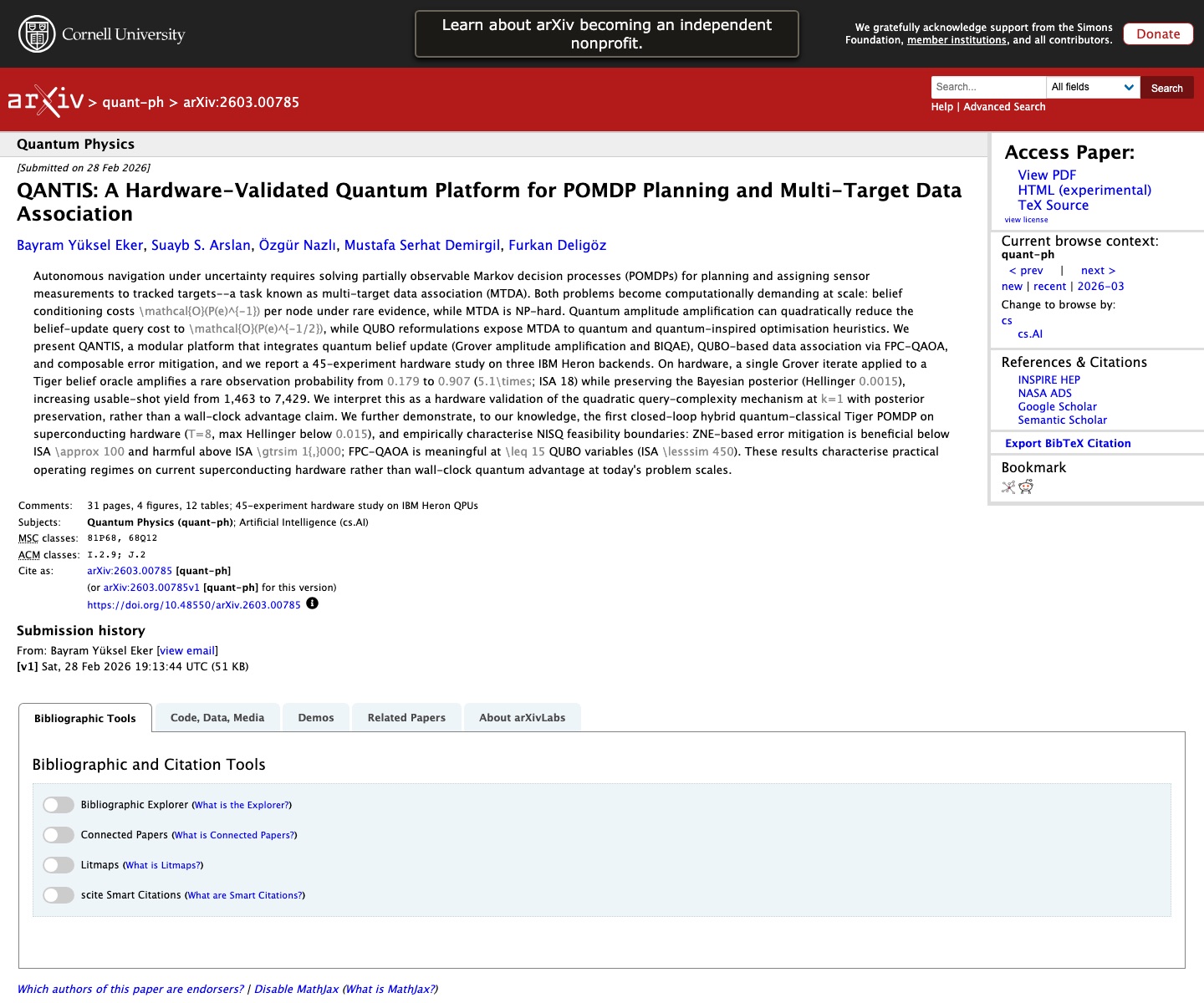
The right reproducibility unit is not a notebook screenshot or a best metric. It is a versioned campaign bundle that reconstructs the posterior, its hardware context, its classical reference, and the decision it affected.
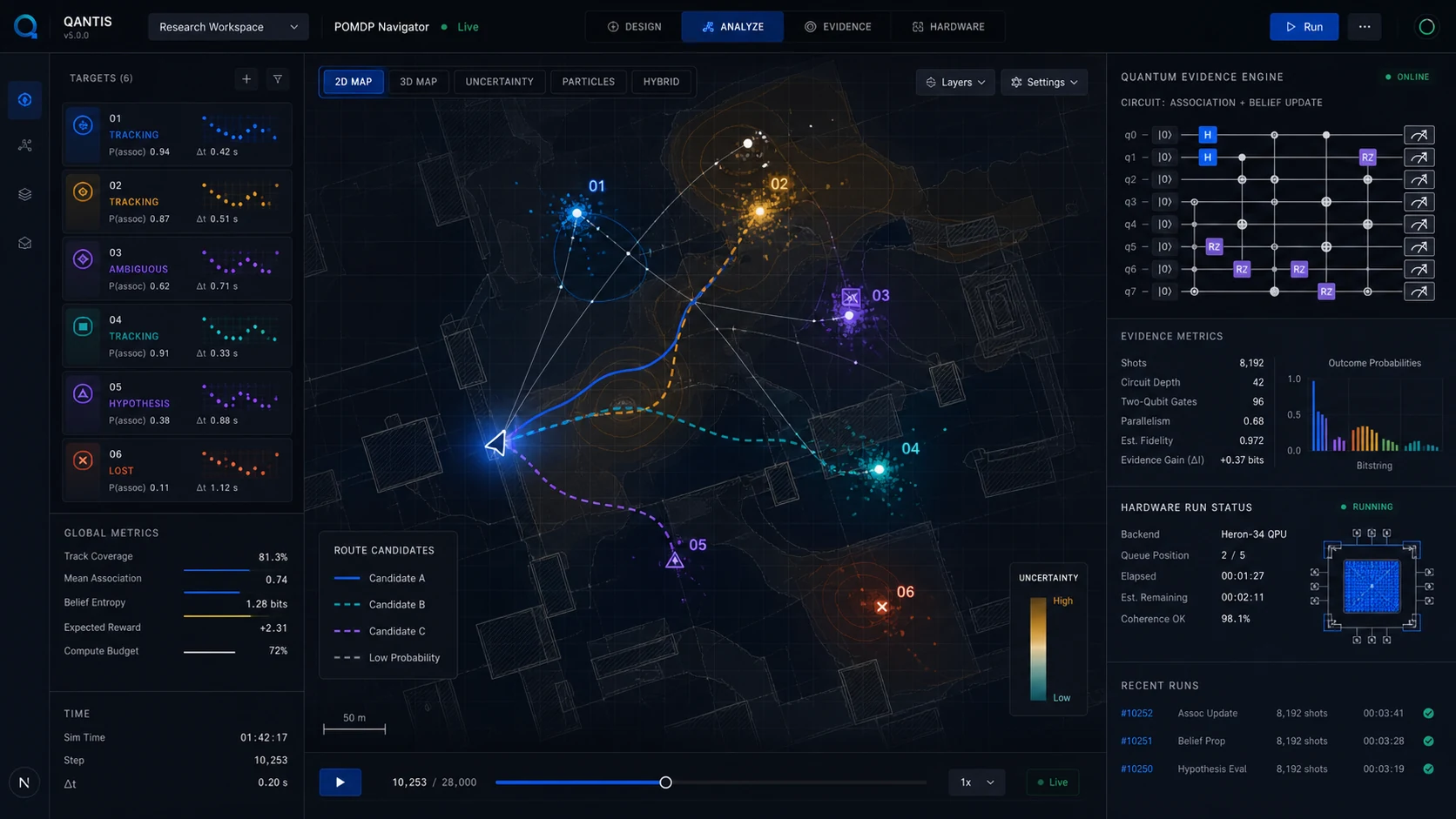
The credible role for near-term quantum hardware is not an autonomous brain. It is a replaceable inference service inside a classical perception-to-action loop, invoked only when its calibration and depth gates pass.
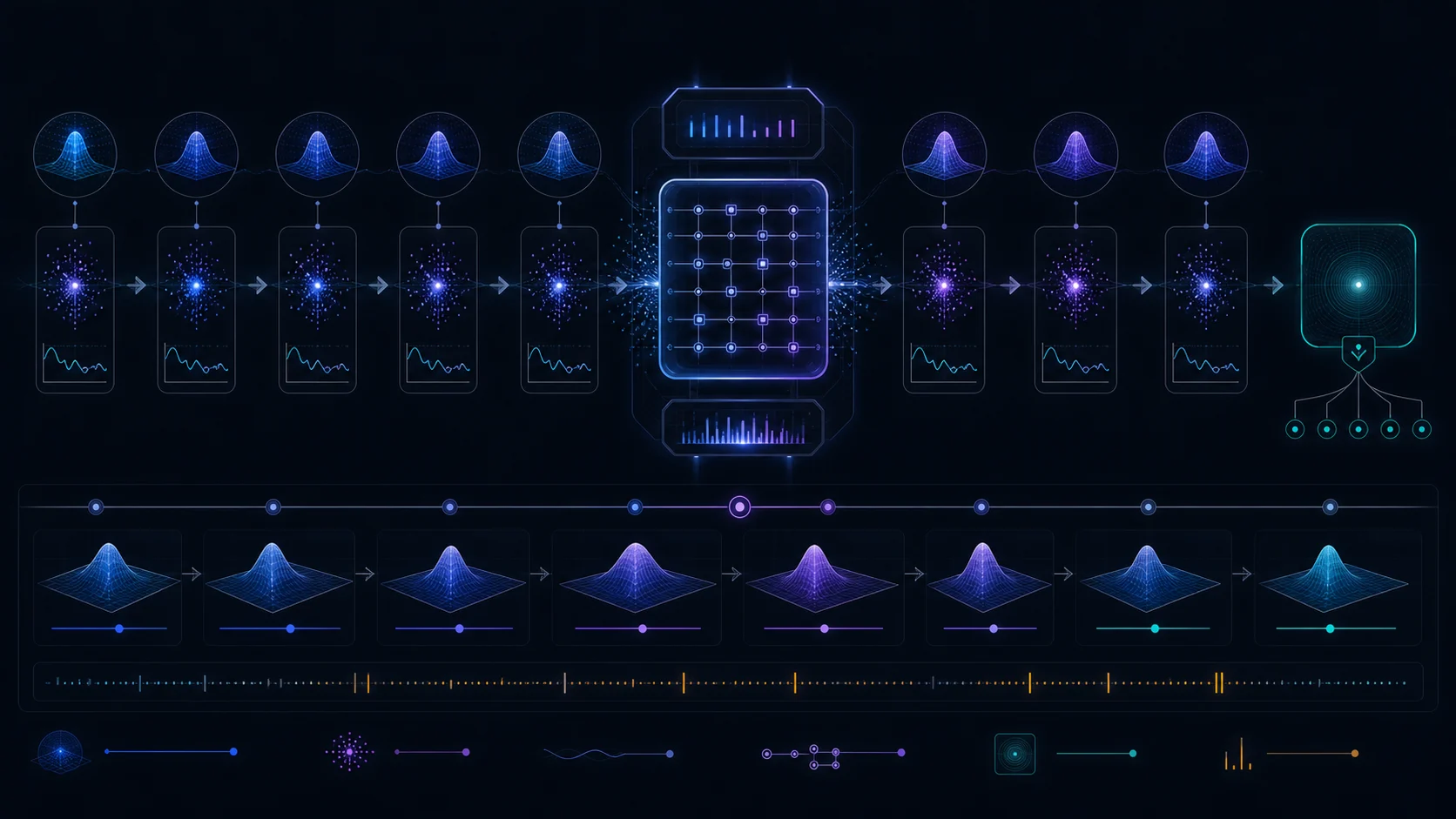
QANTIS does not replace the planner. Its hardware-tested inference core accepts a prior and observation model, estimates the difficult evidence term, and hands a conventional probability distribution back to classical software.
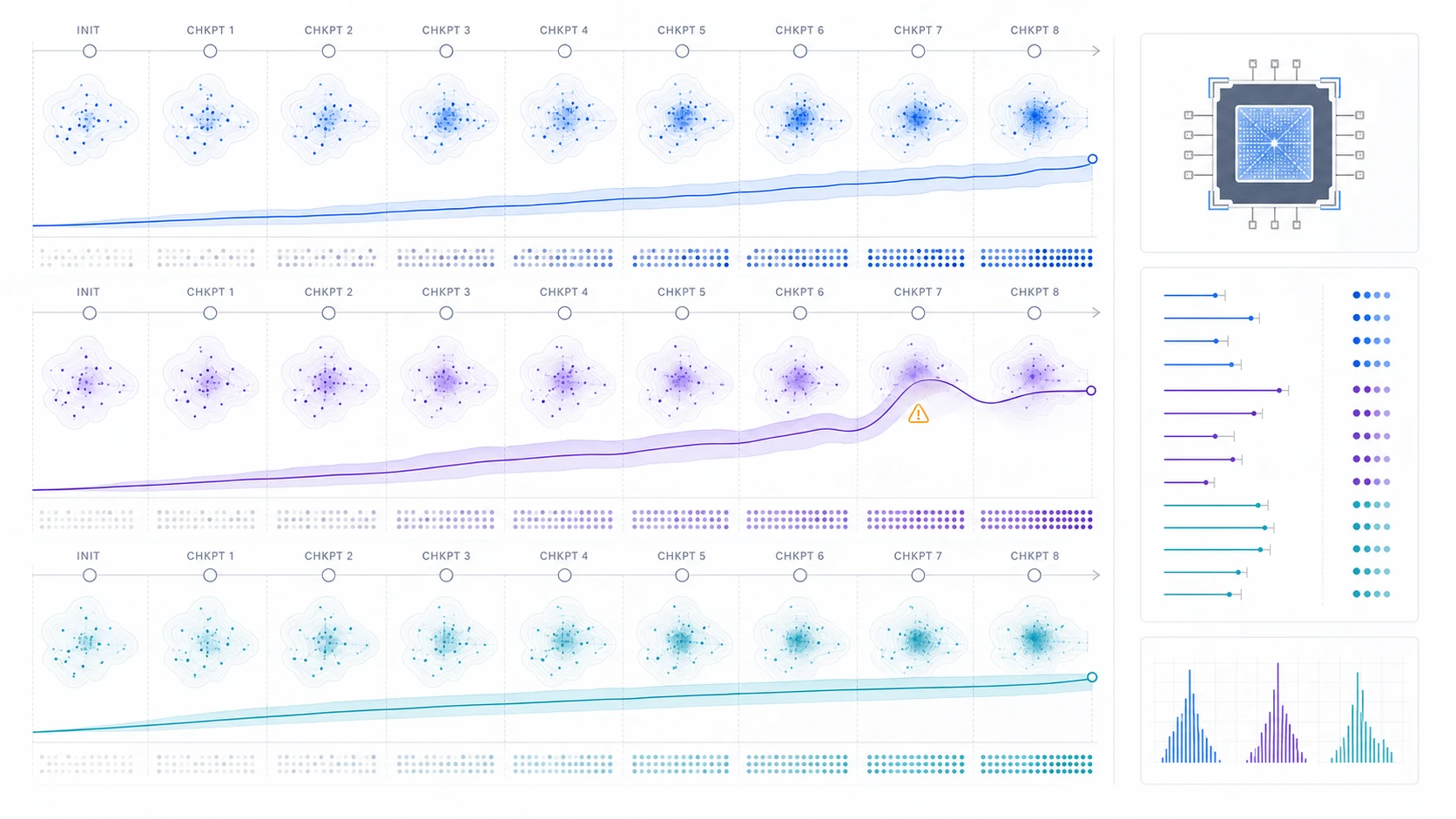
The headline FPAA run achieved a maximum Hellinger distance of 0.009 at 32,768 shots per step. At 10,000 matched shots, the maximum was about 0.033, so the evidence supports stability rather than equal-budget superiority.
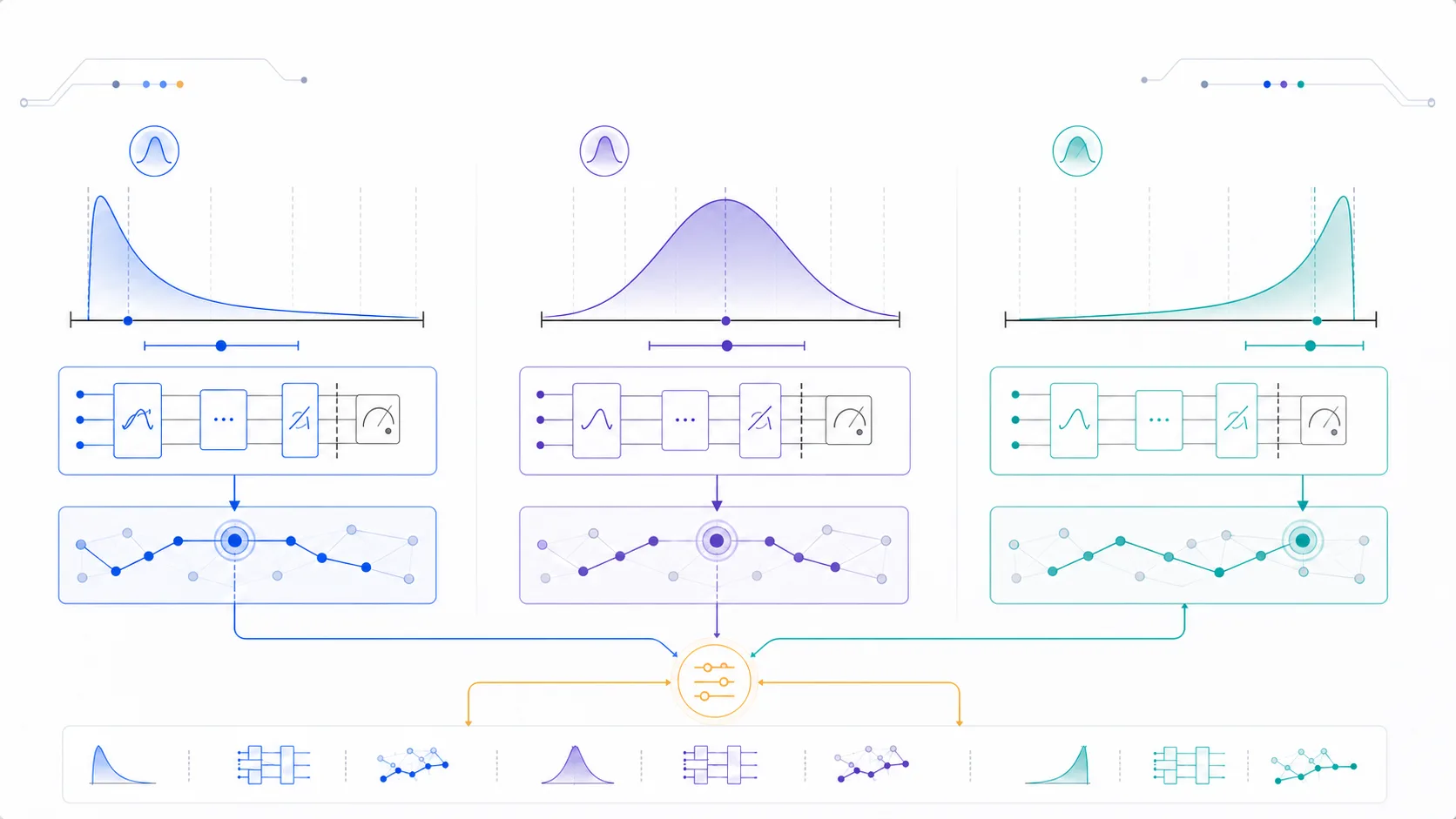
On the reported Pittsburgh backend calibration, boundary error fell from 0.6317 to 0.00224 at amplitude 0.01 and from 0.4890 to 0.00773 at amplitude 0.95.
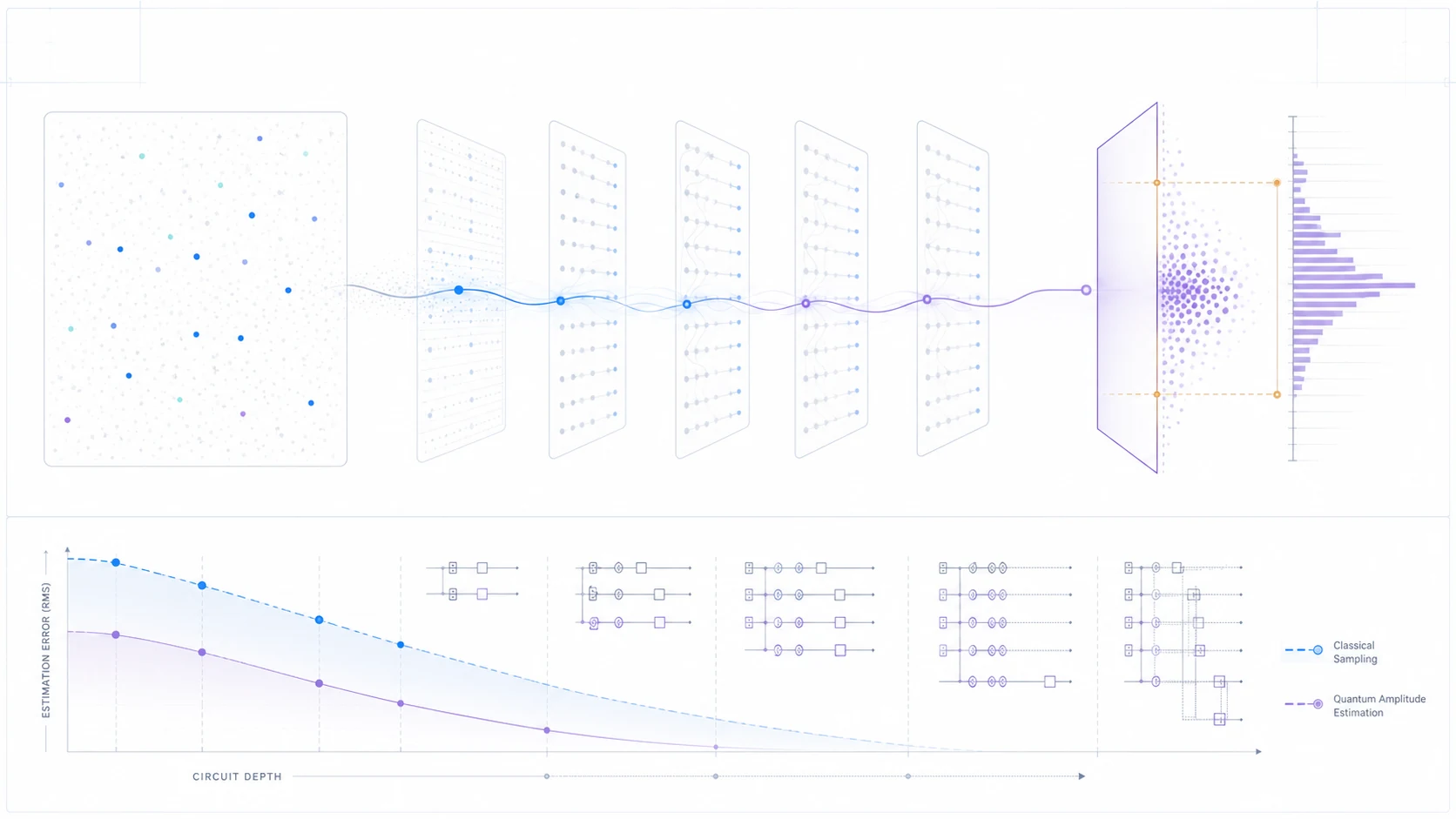
The rarest tested row closely tracks the analytic accepted-event probability, but transpilation keeps the circuit shallow. The result maps a logical sample-complexity envelope rather than validating deep circuits or wall-clock speedup.
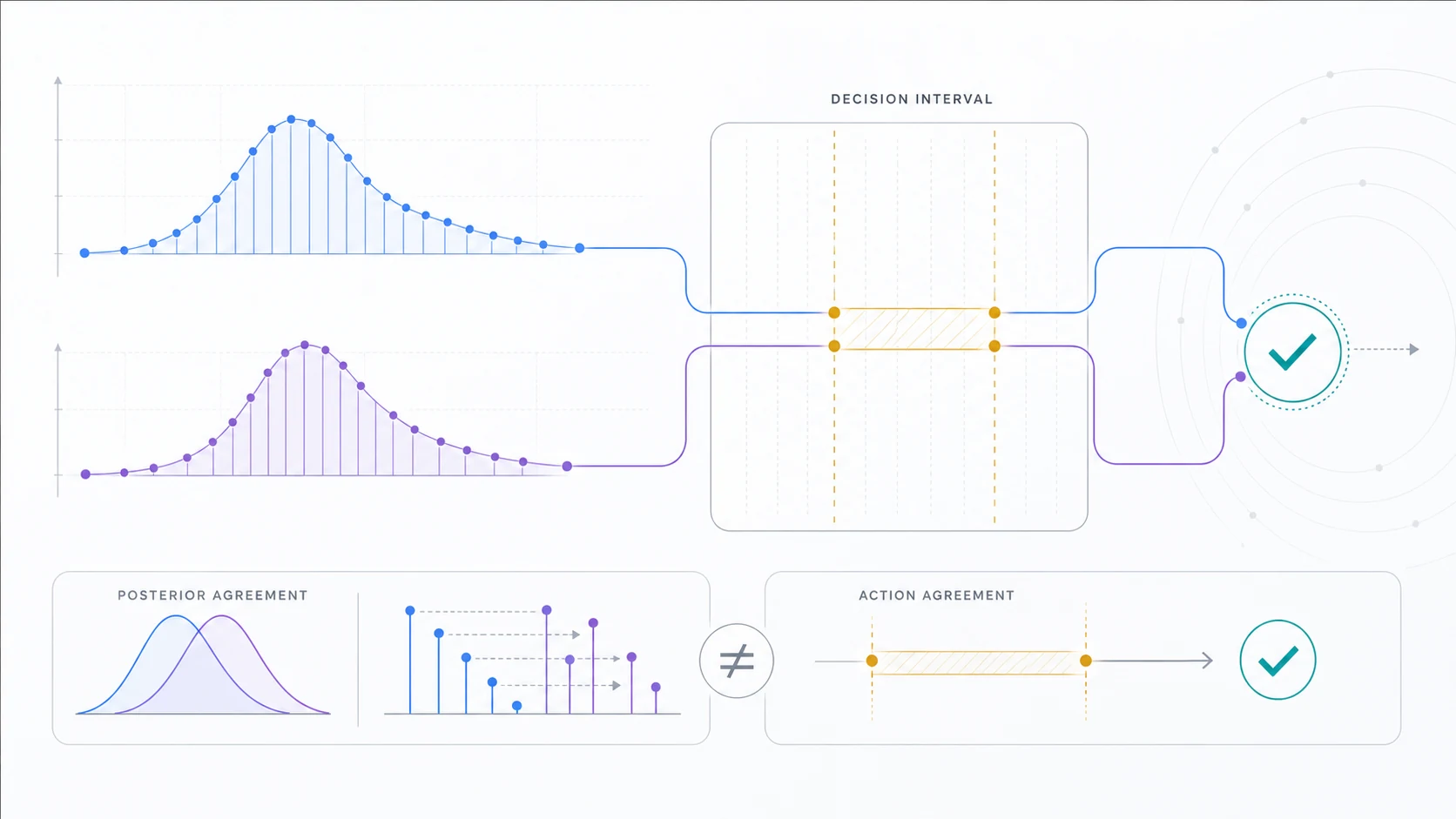
The reported 8-step matched-shot, 20-step, and 32-step checks show the same immediate action as exact Bayes with zero scored cumulative value loss under the tested Tiger rule.
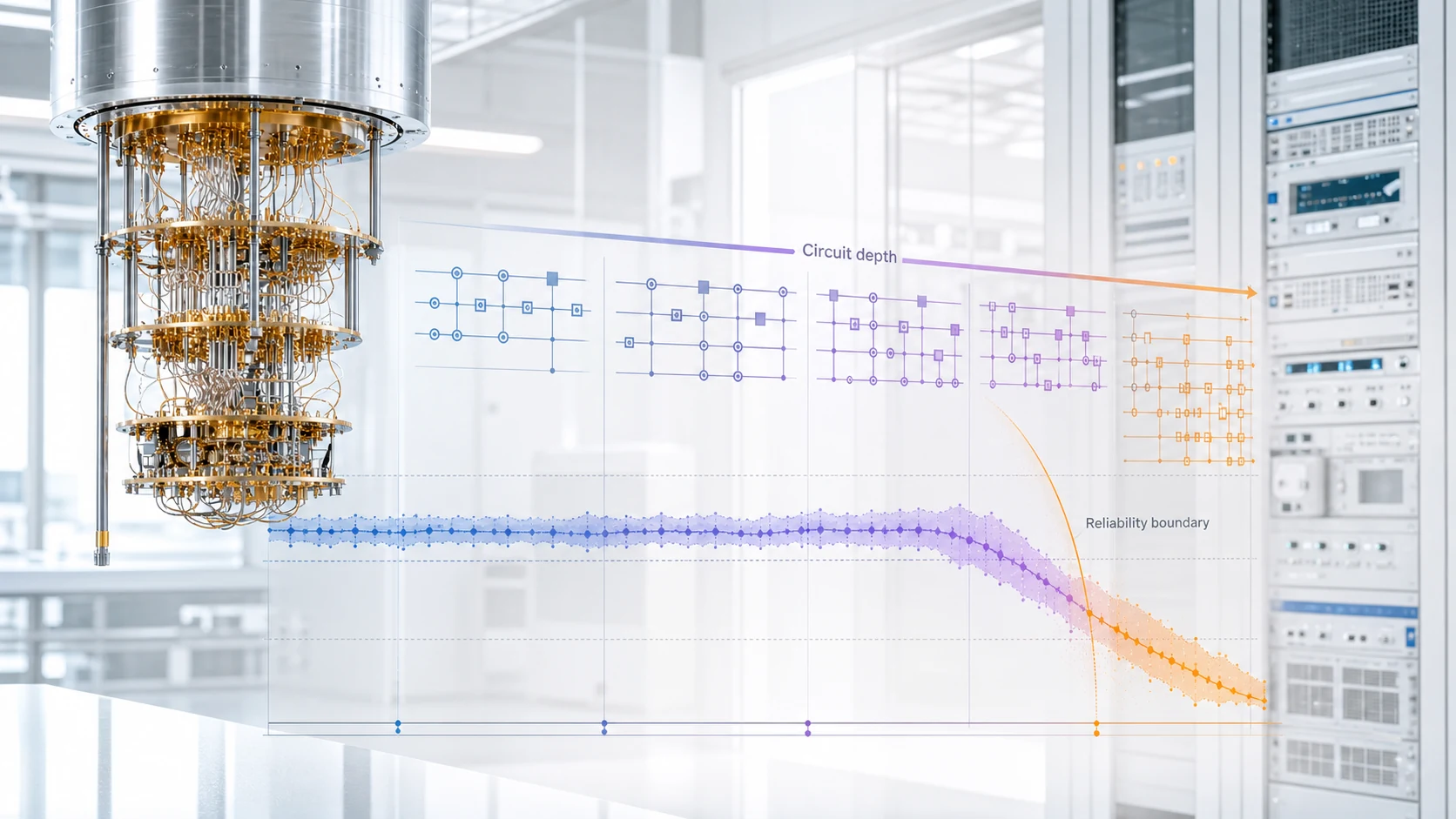
The paper's exploratory scaling probes distinguish state-space size from compiled circuit depth. Optimized four-state cases map a shallow corridor; deeper chains become noise-frontier markers.
Collaborate on one bounded research question.
Start with the classical baseline, hardware envelope, evidence plan, and a result that remains useful even when the quantum route does not earn promotion.