
Abstract
The first milestone is not a universal autonomous fleet. It is a small, useful, measurable operating loop that keeps its evidence intact when links, sensors, positioning, or participating platforms degrade.
Gap map
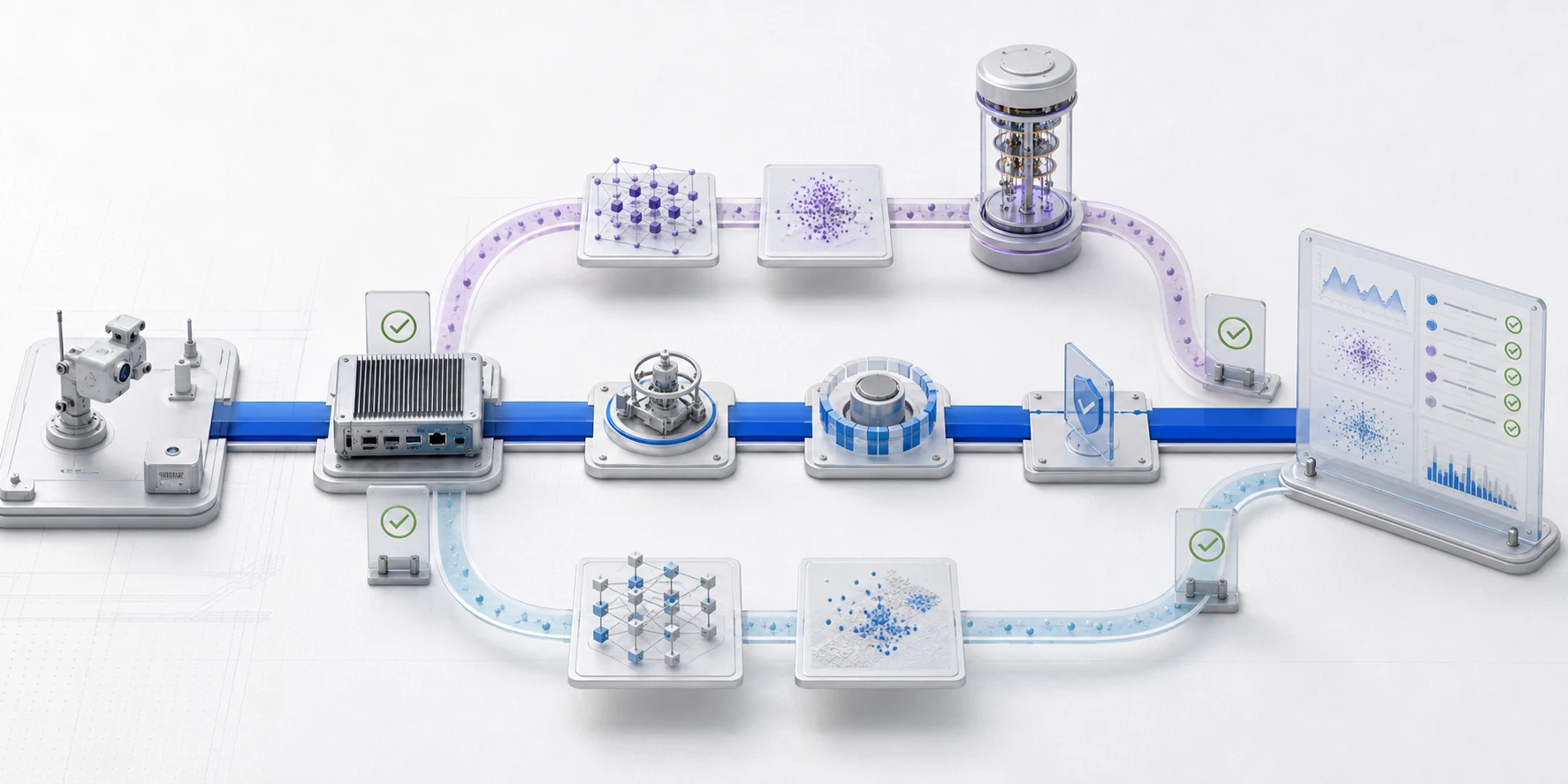
A productisation loop that can stop, learn, and continue
Each stage produces an operating artifact and a decision record. Advancement is a review outcome, not an automatic date on a roadmap.
Define and prove
- Named user problem
- Classical AI core
- Operating and authority bounds
- Nominal reference scenario
Verify
- Fault-injected simulation
- Uncertainty and recovery
- Repeatable TEVV records
- Known limitations
Integrate and pilot
- Edge runtime identity
- Operator workflow
- Bounded dual-use scenario
- Acceptance evidence
Scale or hold
- Configuration and update control
- Training and support
- Lifecycle monitoring
- Evidence-led next gate
Productisation begins with one complete operating loop.
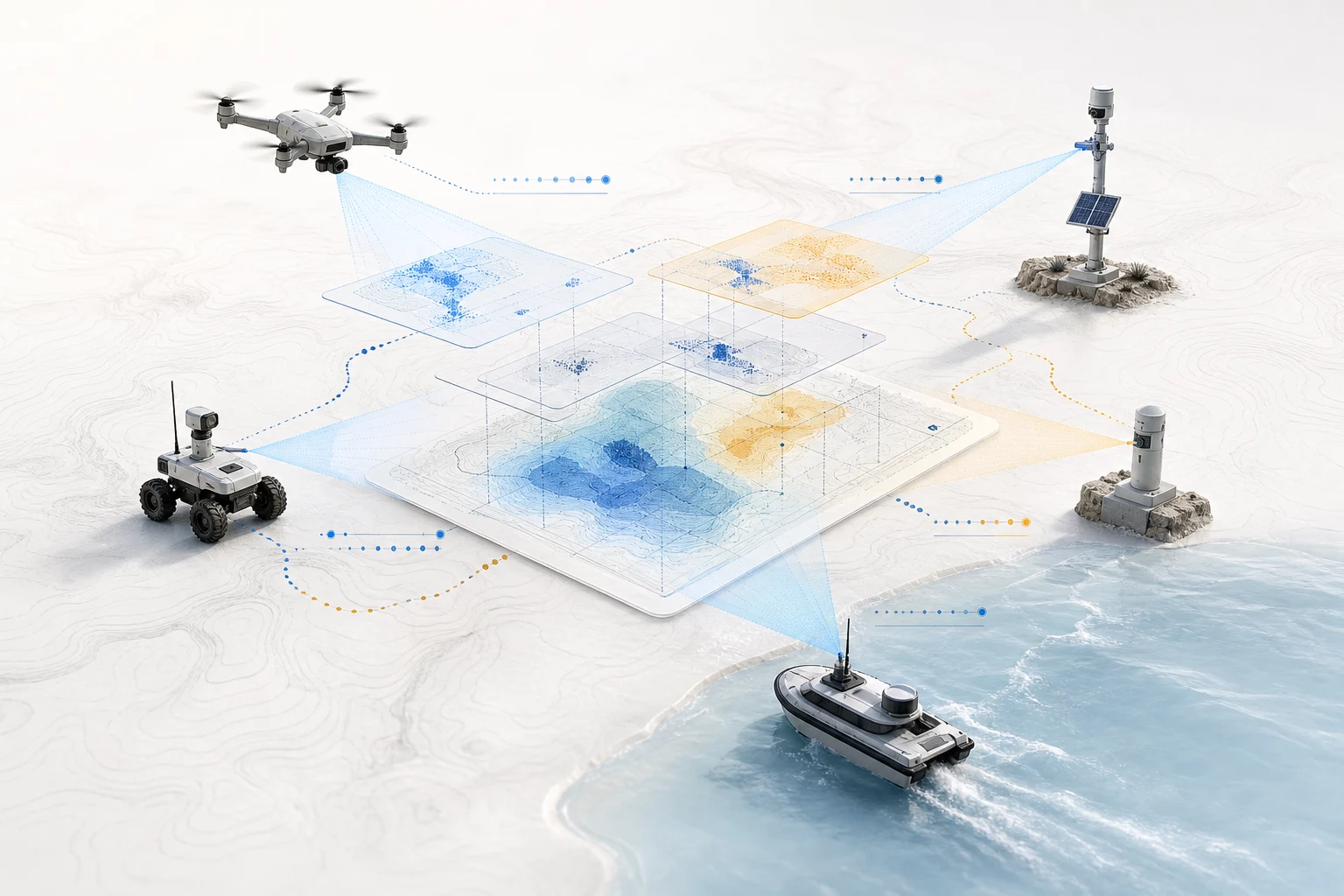
A broad distributed-autonomy vision can include sensing, world models, coordination, planning, assurance, edge runtime, human workflow, and future hybrid compute. Attempting to prove all of it at once produces a demonstration in which no failure can be isolated and no acceptance decision is defensible.
The stronger route is a narrow vertical slice: a named dual-use scenario, a small heterogeneous team, a clear shared-context question, one coordination decision, an explicit human-authority point, and a complete evidence record. The exact platform count, scenario parameters, and acceptance thresholds belong in controlled programme material rather than on a public website.

TD · Technical depth5 supporting chapters and the working checklist.Read deeper
The first stage must work without quantum or continuous cloud access.
The NODERIQ AI Core is the standalone value proposition: uncertainty-aware shared situational context, communication-aware coordination, verification, human escalation, and bounded edge operation. External compute may help analysis, but the local classical path remains intact when the connection or specialist service is unavailable.
This stage should produce more than a model checkpoint. It needs scenario definitions, input and output contracts, configuration identity, evaluation harnesses, operator views, evidence export, and a reproducible way to compare one release with the next.
Test degradation as a first-class condition, not a final demo surprise.
Nominal simulation answers whether the loop works when assumptions hold. Productisation needs to answer what happens when they do not: observations arrive late, positioning becomes unreliable, a sensor drops out, a participant disconnects, data conflicts, or an operator intervenes. These conditions should be introduced deliberately and recorded as controlled evaluation factors.
The purpose is not to publish a dramatic resilience percentage. It is to understand the boundary: which capability remains useful, how uncertainty changes, which recommendation is suppressed, when local behaviour narrows, how the authority path responds, and whether the team returns to a coherent state afterward.
- World-model quality under missing, stale, and contradictory evidence.
- Coordination quality when team membership and communication change.
- Assurance quality when uncertainty or policy state triggers escalation.
- Recovery behaviour after reconnection, replacement, or operator intervention.
Move the evidence model with the runtime.
A simulation result is not an edge product. The integrated system has resource limits, clock and network behaviour, release identity, security controls, update mechanisms, telemetry gaps, and failure states that change what the AI can reliably do. Edge integration therefore belongs inside the evaluation loop rather than after the model is declared complete.
NeuraOS supplies the broader governed-edge context for this work: approved local inference, workload identity, deterministic safety, telemetry, version state, signed updates, evidence, and rollback. NODERIQ's applied question is whether shared context and decision evidence remain coherent across those runtime events without exposing implementation-level security or topology details publicly.
A pilot should answer a procurement or research decision, not merely prove activity.
A useful pilot has a named user, a defined operating envelope, an existing workflow to improve, explicit human authority, known exclusions, and a decision waiting at the end. The decision might be to integrate another platform, improve a model, change the operator view, repeat under a harder condition, or stop the approach.
Search and rescue and critical-infrastructure inspection are strong public examples because they expose the core engineering questions—coverage, degraded links, uncertainty, task coordination, operator burden, and evidence—without implying a deployed defence capability. Actual pilot scope and partner information should be published only through an approved record.
Scaling adds lifecycle discipline before it adds fleet size.
Scale requires configuration control, release criteria, training, monitoring, support, incident review, update and rollback processes, data governance, and a way to compare behaviour across environments. Those operating capabilities are often more important to adoption than another model feature.
The hybrid compute track remains separate. Selected workloads can enter QFlow-backed classical, quantum-inspired, or quantum comparison after the AI Core is measurable. A positive result may open a bounded advisory pilot; a negative result leaves the classical product path unchanged. This separation lets the programme pursue long-term research without turning it into a dependency or an unsupported market claim.
Practical takeaways
01
Begin with one end-to-end operating loop whose user, authority, evidence, and next decision are explicit.
02
Make the classical AI Core useful without quantum or continuous cloud access.
03
Introduce degraded conditions deliberately and measure behaviour, escalation, and recovery.
04
Bring runtime identity, updates, telemetry, and rollback into evaluation before calling the work edge-ready.
05
Scale lifecycle controls before scaling the number of platforms, and keep hybrid compute on a separate evidence track.
RA · Reference annexDefinitions, recurring questions, editorial method, and primary sources.Inspect
The analysis above carries the main reading flow. This reference layer keeps terminology, recurring questions, editorial method, and primary sources available without interrupting the argument.
Editorial record
How NODERIQ evaluation from simulation to an edge pilot. was checked.
- Editorial owner
- Neura Parse Research
- Last verified
- July 17, 2026
- Method
- Synthesis of the dated primary and official records listed below, checked against the operating question in this note.
- Scope limit
- Planning analysis—not certification, customer performance evidence, procurement advice, or a claim of production readiness.
SRSources reviewed
5 records