

Product / NowFlow
See the work. Control the next step.
Read the sequence
- Conceptual operator study. Conceptual operator station facing a stationary inspection robot. A visible route for tasks, approved tools and human decisions.
- Public simulation preview. Read the control graph, review point and downstream handoff together.
- Public NowFlow site capture. The public site frames the governed control graph as a simulation preview.
- Editorial workflow map. Editorial route: Command, Build, Validate, Operate and Observe.
- Current boundary. External interfaces and production scope need environment-specific review.
Use a visible control graph to connect scoped agents, approved tools and human decisions. Define who owns the task, where release is required and what the run should record before an important action moves forward.
01 / The work
More than a conversation window.
A conversation alone cannot show which task was accepted, which system an agent may use or who can release an external action. NowFlow makes those decisions part of a visible workflow.
A configured route can include conditions, checkpoints, human approvals and failure paths. For a robotic or operator handoff, the workflow still depends on approved interfaces and the machine's independent safety controls.

Evaluation brief
Define the decision before automating the route.
- Bring
- Choose one owned process, the systems it may reach and the action whose effect matters. Name the person accountable for releasing that action.
- Inspect
- Map what an agent may prepare, where the human approval interrupts the graph and which condition sends work to a failure path.
- Decide
- Separate a request accepted by an external system from an action actually completed. If status is uncertain, reconcile it before a retry can repeat the effect.
02 / How the work moves
From an owned task to a reviewable outcome.
Trace what an agent can prepare, where a person decides and how the run records an accepted, refused or uncertain handoff. The external system keeps its own authority boundary.
Define the task
Name the outcome, accountable owner, inputs and systems that this workflow is allowed to reach.
Build the route
Connect scoped agents and tools with conditions, checkpoints, human tasks and an explicit failure path.
Review the change
Show the proposed target and effect to the person responsible before a consequential action is released.
Follow the outcome
Record what was accepted, what failed and what remains uncertain. Reconcile an external status before a retry could repeat the action.
03 / Public record
A public, labelled simulation preview.
The public NowFlow preview shows a governed control graph and simulated operating view. Read the task, approval point and downstream handoff together. This is not a fielded mission: the public simulation keeps physical dispatch and field promotion locked behind separate authority.
Review NowFlow docsEvidence views02 records
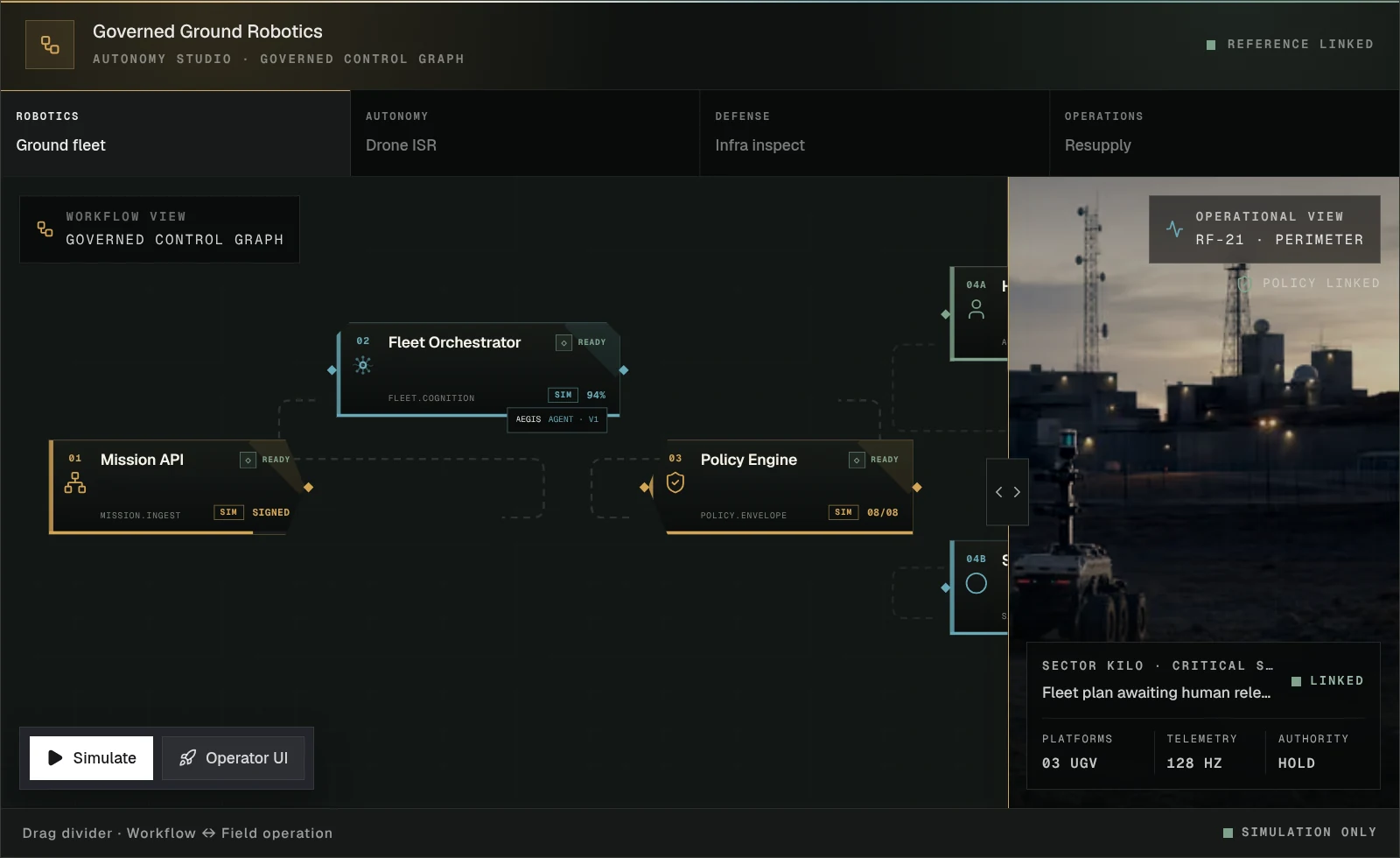
Public simulation preview
Read the task as an accountable route.
The public preview shows the control graph and a simulated operating view. It makes the scope, human decision and downstream handoff visible together.
Record 01 / 02
04 / Current boundary
Make the handoff explicit.
- Current product
- NowFlow's public surface includes mission and workflow composition, simulation, authority gates and debrief context.
- External systems
- Interfaces, credentials and deployment environment must be reviewed for each use case. A category name is not an integration guarantee.
- Physical boundary
- Workflow coordination does not replace a machine's independent control, safety functions or accountable human command.
05 / Before you begin
Questions worth answering.
Is NowFlow only a chatbot?
No. Conversation may support a process, but tasks, tools, decisions, simulation and outcomes remain visible beyond a chat thread.
Can an agent authorise every action?
No. Consequential release stays with the appropriate human authority; local operating limits remain separate.
What if an external action times out?
Acceptance, application and verification are different states. Check the external status before trying again when repetition could duplicate the action.
06 / Next step
Start with a workflow you can explain.
Choose one process with a clear outcome, approved systems and an accountable owner. Review its normal route and exception paths before expanding the scope.
Discuss NowFlow