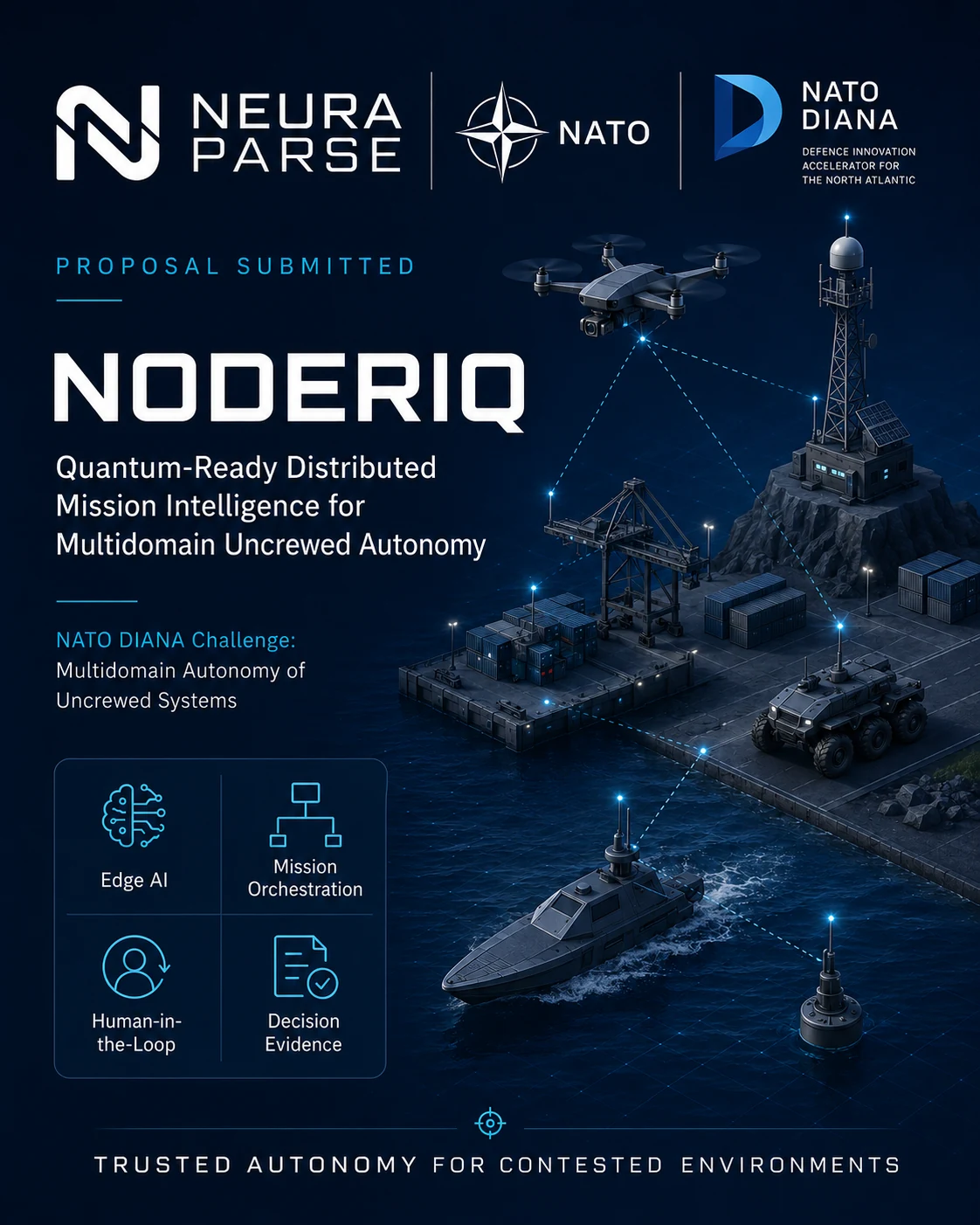
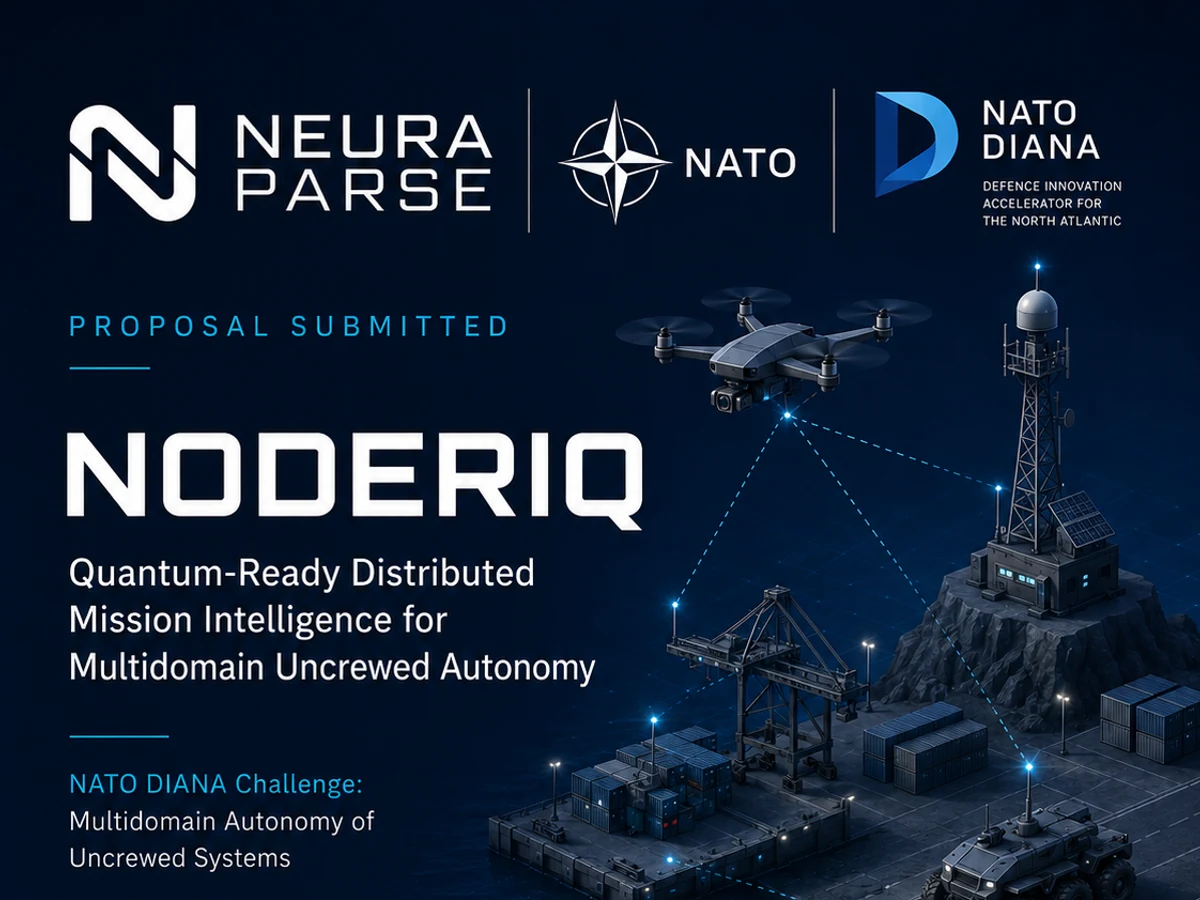
NODERIQ social card
A compact public-safe card for newsroom listing and social previews, limited to high-level challenge and capability language.
NATO DIANA public source reference
Official NATO DIANA public logo reference used for attribution only; the announcement is not an endorsement or selection notice.
Submission announced at high level only
Neura Parse has submitted NODERIQ to NATO DIANA's Multidomain Autonomy of Uncrewed Systems challenge.
NODERIQ explores quantum-ready distributed mission intelligence for trusted multidomain autonomy. The public scope combines edge AI, secure mission orchestration, human-in-the-loop assurance, and auditable decision evidence for uncrewed systems operating under contested conditions.
Autonomy needs trusted mission evidence
The public DIANA challenge brief frames multidomain uncrewed autonomy as a defense and security problem where air, land, maritime, space, and cyber-enabled systems must operate with resilience, coordination, and human trust.
For Neura Parse, the important technical direction is not simply autonomy in isolation. It is autonomy with traceable mission context: what the system sensed, what it inferred, what it recommended, what a human authorized, and what evidence can be audited afterward.
Quantum-ready distributed mission intelligence
NODERIQ is positioned around a public-safe mission intelligence layer: edge AI for tactical inference, secure orchestration for distributed operations, human-in-the-loop controls for authority, and decision evidence for trust and verification.
The quantum-ready language is intentionally high level in this announcement. Publicly, it means the architecture is designed to keep a path open for future optimization and workflow integration without exposing protected proposal mechanics or detailed technical tags.
- Edge AI for local inference near uncrewed systems and mission operators.
- Secure mission orchestration for degraded, denied, and contested operational environments.
- Human-in-the-loop assurance so authority and accountability remain explicit.
- Auditable decision evidence for transparent review, incident reconstruction, and stakeholder trust.
- Quantum-ready workflow framing for future optimization research and integration paths.
What we are deliberately not publishing
DIANA proposal material and portal content are treated as confidential and commercially sensitive. This newsroom item therefore stays at public announcement level and avoids operational or evaluation detail.
- No DIANA portal screenshots or submitted-status screens.
- No full proposal text, private documentation, or technical tag list.
- No protected architecture diagrams, roadmap details, risk mitigations, or implementation specifics.
- No internal evaluation process detail, scoring assumptions, or non-public DIANA portal fields.
AI, autonomy, quantum-ready workflows, and dual-use security
This submission reflects Neura Parse's continuing work at the intersection of AI, autonomy, quantum-ready workflows, and dual-use security technologies.
Across QFlow, NeuraOS, QANTIS, and our defense and aerospace solution work, the same principle keeps appearing: high-impact intelligent systems need evidence, controls, and workflow clarity as much as they need model performance.
Failure modes to design against
Multidomain autonomy fails in predictable ways, and most of them are not model failures. The first is authority ambiguity: a system acts, and afterward no one can state which human authorized the action or under what delegation. Human-in-the-loop assurance exists to keep authority and accountability explicit before an incident, not after.
The second is evidence loss. Uncrewed systems operating in degraded, denied, and contested environments will lose links, drop telemetry, and act on local inference. If decision evidence is not captured and preserved at the edge, incident reconstruction becomes speculation, and stakeholder trust does not survive the first contested review.
The third is orchestration collapse. Distributed operations that assume stable connectivity degrade badly when coordination channels are jammed or denied. Secure mission orchestration has to treat the contested case as the design baseline, with defined behavior for every degraded state.
A fourth failure mode is organizational rather than technical: disclosure leakage. Proposal material, portal content, and evaluation detail that enter public channels cannot be recalled. The announcement's explicit disclosure boundary is a working example of the control.
- Authority ambiguity: no explicit record of who authorized what.
- Evidence loss: local inference without preserved decision evidence.
- Orchestration collapse: coordination designed only for nominal connectivity.
- Disclosure leakage: sensitive proposal or portal material entering public channels.
What to instrument first
The mission-context chain in this announcement gives programs a concrete instrumentation order: what the system sensed, what it inferred, what it recommended, what a human authorized, and what evidence can be audited afterward. Each link in that chain is a logging requirement before it is an autonomy feature. A program that cannot answer all five questions for a single mission is not ready to scale autonomy.
Start at the edge. Tactical inference happens near the uncrewed platform and the mission operator, so evidence capture has to happen there too, under the same power, compute, and bandwidth constraints as the inference itself. Records that exist only while the link is healthy are not records.
Then instrument authority. Every human authorization should produce a durable, reviewable artifact tied to the specific recommendation it approved or rejected. That binding is what turns human-in-the-loop from a design phrase into an auditable control.
- Sensor inputs and their provenance, captured at the edge.
- Inference outputs and the context that produced them.
- Recommendations recorded as distinct, reviewable artifacts.
- Human authorizations bound to the recommendations they cover.
- Post-mission evidence packaging for audit and incident reconstruction.
Where NODERIQ sits in the Neura Parse stack
NODERIQ is a challenge submission, not a product. Its public framing, however, follows the layer structure Neura Parse already publishes. NeuralOS is an AI-native embedded Linux distribution for drones, robotics, edge AI, and quantum simulation, the natural home for tactical inference near uncrewed platforms. NowFlow, the agentic workflow platform, covers workflow execution and human-in-the-loop approval routing on the enterprise side.
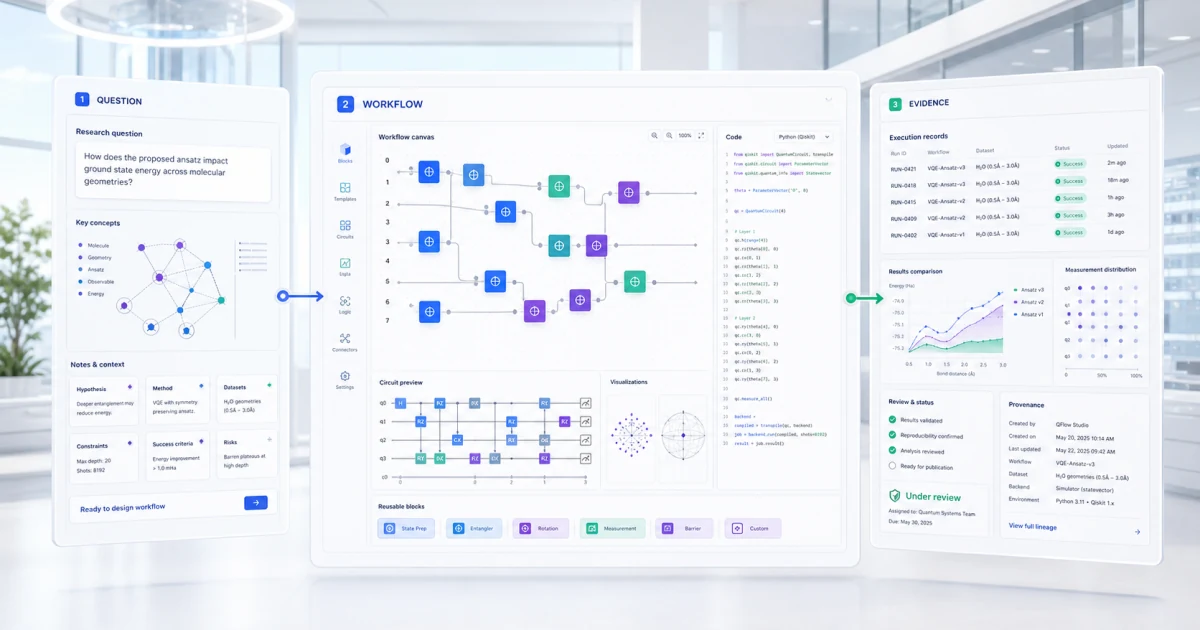
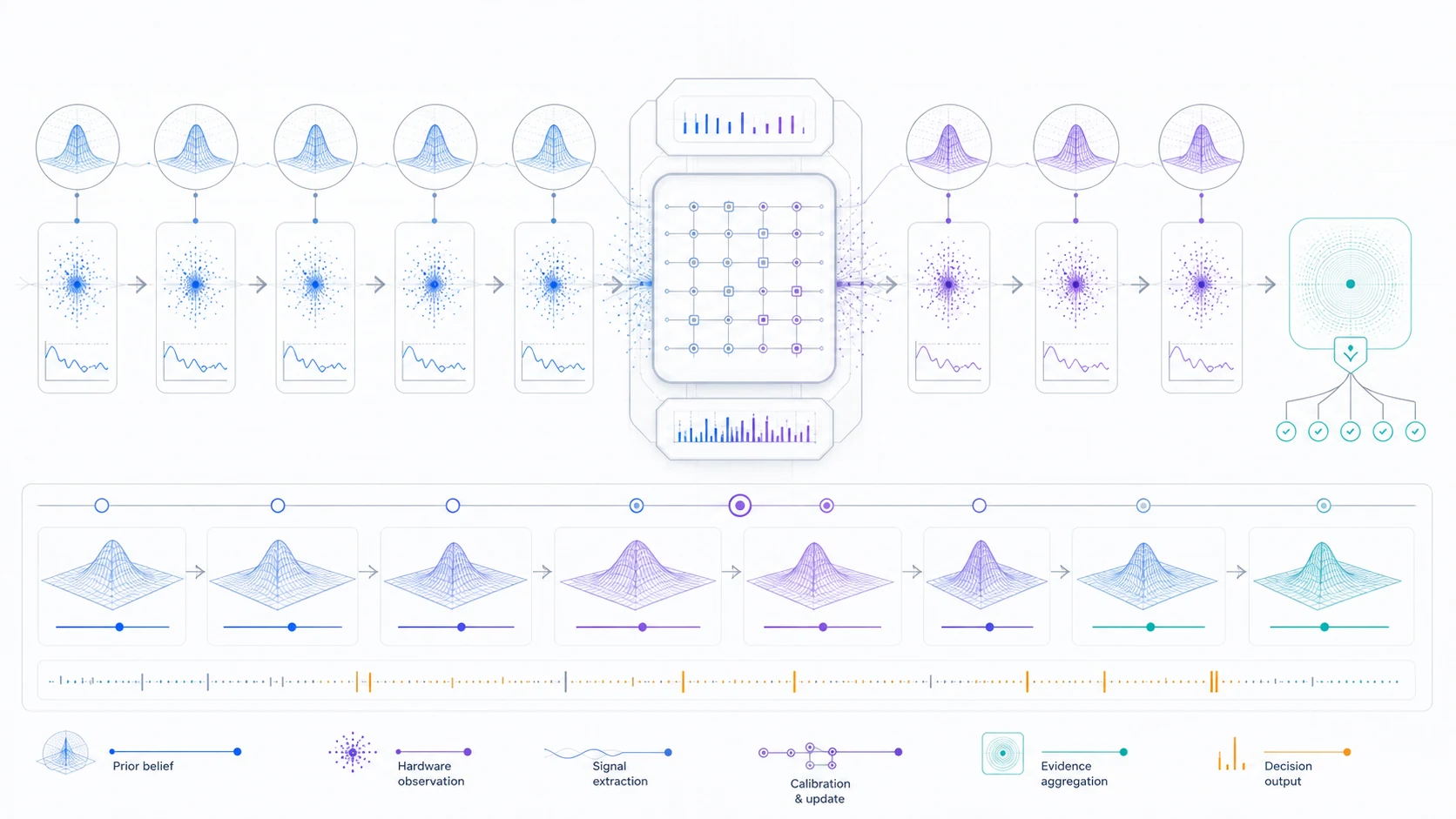
QANTIS, the quantum decision research line, studies decisions under uncertainty; its latest public paper evaluates a bounded belief-update service while planning and action remain classical. Its public repository is the Community Edition, while additional production modules and governed programme artefacts remain available through formal engagement. QFlow Studio packages reviewable evidence for quantum workflows, the same evidence discipline the announcement applies to autonomy decisions.
The quantum-ready language should be read against this stack. It is a commitment to keep optimization and workflow integration paths open, not a claim of deployed quantum capability. Public benchmark numbers and hardware campaign results are bounded by explicit research records; additional private evidence is discussed through formal engagements.
Program checklist: trusted multidomain autonomy
Actions for defense, aerospace, and enterprise program leads, derived from the NODERIQ announcement and the public DIANA challenge framing.
- 01
Verify programme claims against official sources. Treat vendor announcements as submission signals, not selection or endorsement, until the programme publishes an outcome.
- 02
Write the mission-context chain into requirements. Sensed, inferred, recommended, authorized, and audited must each map to a named, reviewable artifact.
- 03
Make human authority explicit. Define who can authorize which autonomous actions, and require a durable record of every authorization decision.
- 04
Specify degraded, denied, and contested conditions as the baseline test case for mission orchestration, not as an edge case.
- 05
Require decision evidence that supports incident reconstruction and stakeholder review, captured at the edge where inference actually happens.
- 06
Assess quantum-readiness as an integration path. Ask vendors which future optimization and workflow capabilities the architecture can absorb without redesign.
- 07
Set your own disclosure boundary before announcing anything. Keep portal content, proposal text, technical tag lists, and evaluation detail out of public channels.
- 08
Confirm attribution rules. Use programme logos and names for source reference only, never to imply endorsement or selection.
Terms used in this bulletin.
- Multidomain autonomy
- Autonomous operation coordinated across air, land, maritime, space, and cyber-enabled systems rather than within a single domain. The NATO DIANA challenge frames it as a defense and security problem requiring resilience, coordination, and human trust.
- Uncrewed systems
- Vehicles and platforms that operate without an onboard human crew, such as drones or autonomous maritime craft. They may still be supervised and authorized by remote human operators.
- Edge AI
- Machine-learning inference executed locally on or near a platform instead of in a remote data center. It lets uncrewed systems keep functioning when communication links degrade.
- Human-in-the-loop
- A control pattern in which a human must review or authorize system actions at defined points. It keeps authority and accountability explicit as autonomy increases.
- Auditable decision evidence
- Preserved records of what a system sensed, inferred, and recommended, and what a human authorized. It enables transparent review, incident reconstruction, and stakeholder trust after the fact.
- Quantum-ready
- An architecture property meaning the system keeps an integration path open for future quantum optimization and workflow capabilities without redesign. It is not a claim of current quantum hardware use.
- Dual-use technology
- Technology with both civilian and defense or security applications. Dual-use work carries disclosure constraints that shape what can be published about it.
- Contested environment
- An operating environment in which an adversary degrades or denies communications, navigation, or sensing. Often summarized as degraded, denied, and contested conditions.
Questions program teams ask.
Q01What exactly has Neura Parse announced about NODERIQ and NATO DIANA?
Neura Parse has submitted NODERIQ to NATO DIANA's Multidomain Autonomy of Uncrewed Systems challenge. The public scope describes quantum-ready distributed mission intelligence combining edge AI, secure mission orchestration, human-in-the-loop assurance, and auditable decision evidence. No proposal text, portal material, or evaluation detail has been published.
Q02Does the submission announcement mean NATO DIANA has selected or endorsed NODERIQ?
No. The article is a submission announcement only. It is not a selection notice, award notice, endorsement claim, or disclosure of any DIANA evaluation outcome, and the NATO DIANA logo appears for source attribution only. Programme status can be confirmed only through official DIANA publications.
Q03What does quantum-ready mean in the context of NODERIQ?
Publicly, it means the architecture is designed to keep a path open for future optimization and workflow integration without exposing protected proposal mechanics or detailed technical tags. It is an architecture property, not a claim of current quantum hardware capability. The announcement keeps this framing intentionally high level.
Q04Why does the announcement withhold architecture and evaluation detail?
DIANA proposal material and portal content are treated as confidential and commercially sensitive, consistent with the public bidding terms and conditions. The newsroom item therefore stays at announcement level: no portal screenshots, no full proposal text, no protected architecture diagrams, and no evaluation process detail. The disclosure boundary is stated explicitly in the article.
Q05What operational problem is NODERIQ aimed at?
The public DIANA challenge brief frames multidomain uncrewed autonomy as a defense and security problem where air, land, maritime, space, and cyber-enabled systems must operate with resilience, coordination, and human trust. NODERIQ's public lens is autonomy with traceable mission context: what the system sensed, what it inferred, what it recommended, what a human authorized, and what evidence can be audited afterward.
Q06How does NODERIQ relate to Neura Parse's existing products and research?
The submission reflects continuing work at the intersection of AI, autonomy, quantum-ready workflows, and dual-use security technologies. It sits alongside QFlow Studio, a quantum workflow and evidence studio; NeuralOS, an AI-native embedded Linux distribution for drones, robotics, edge AI, and quantum simulation; and QANTIS, a quantum decision research line whose latest paper keeps the tested belief-update service inside a classical planning loop. The shared principle is that high-impact intelligent systems need evidence, controls, and workflow clarity as much as they need model performance.