01
Global-first product surface
Localization spans dashboard widgets, issue views, sprint screens, settings, notifications, metadata, and date handling through the shared application shell.
30 localesRTL Arabic/HebrewLocale-safe dates
Open source · MIT · self-hosted
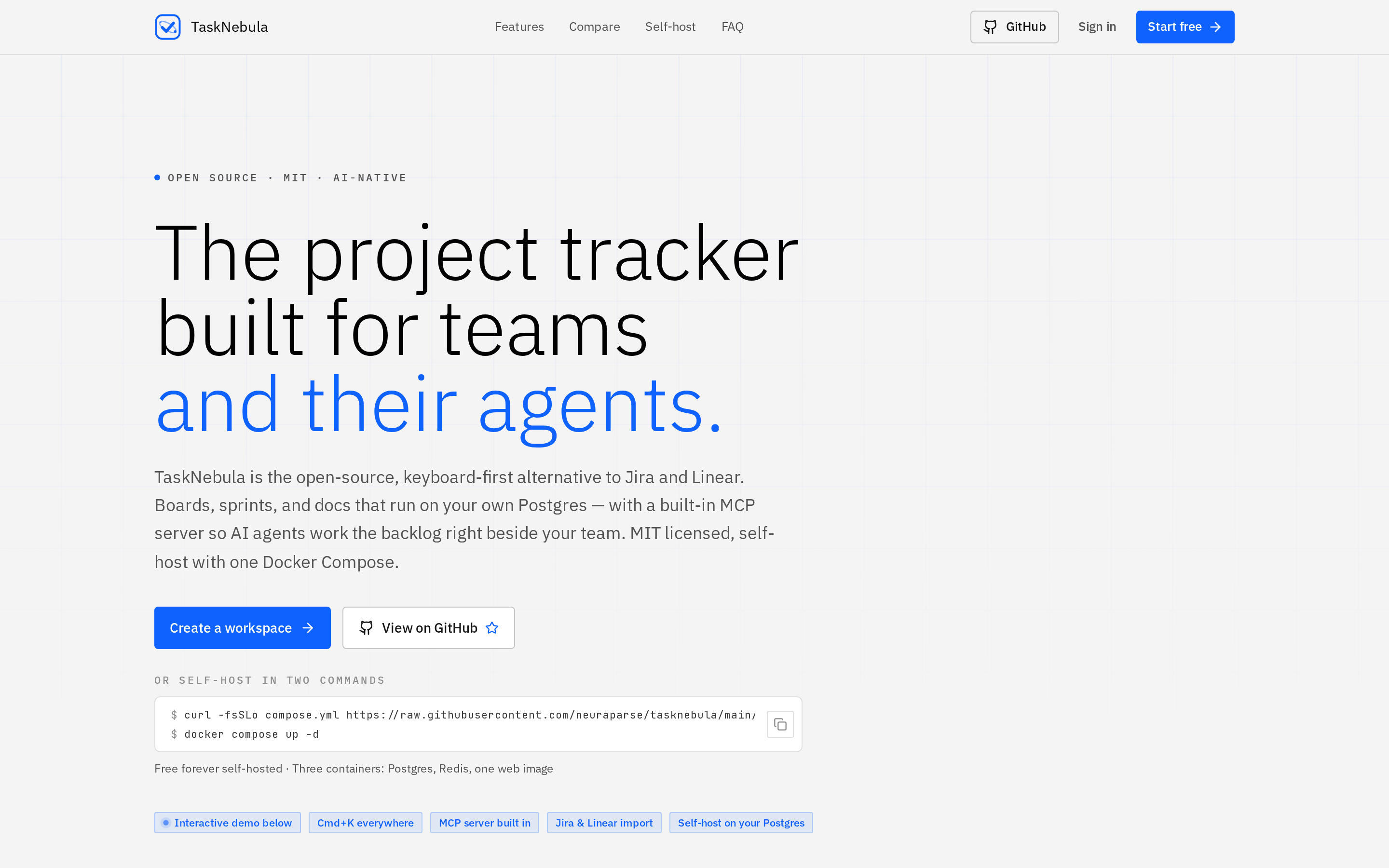
TaskNebula is the Neura Parse open-source project-management control plane: Linear-like UX, Jira-scale work graph, Docker-first operations, 30-language localization, and opt-in AI that can stay fully under your keys.
MIT licenseDocker-firstNeura Parse open source
01Product surface
Current product screenshots show issue planning, AI-assisted drafting, Kanban flow, dashboards, and the self-hosted workspace in context.
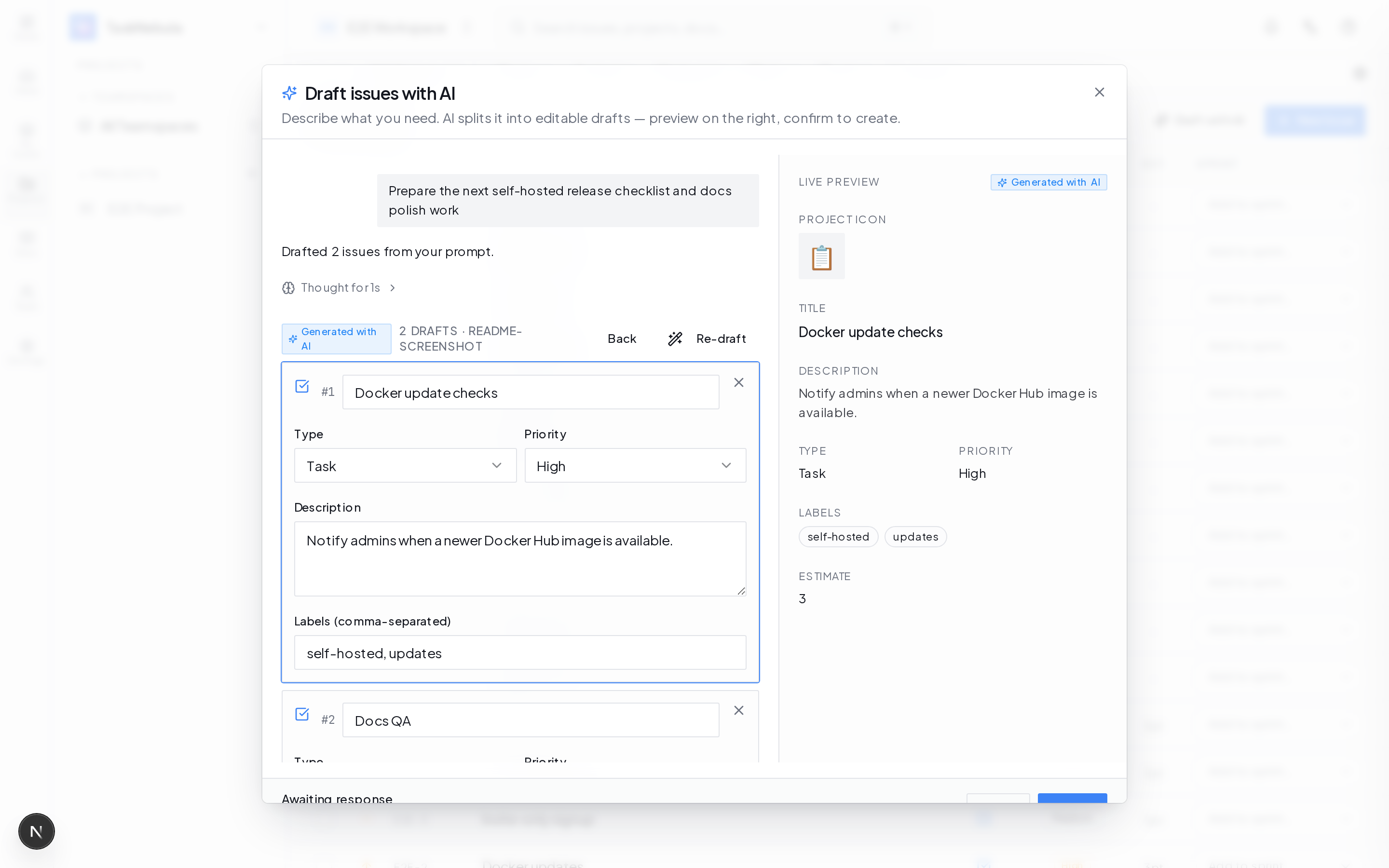
FIG 01 · Draft with AI
One prompt becomes a single issue or editable checklist before bulk creation.
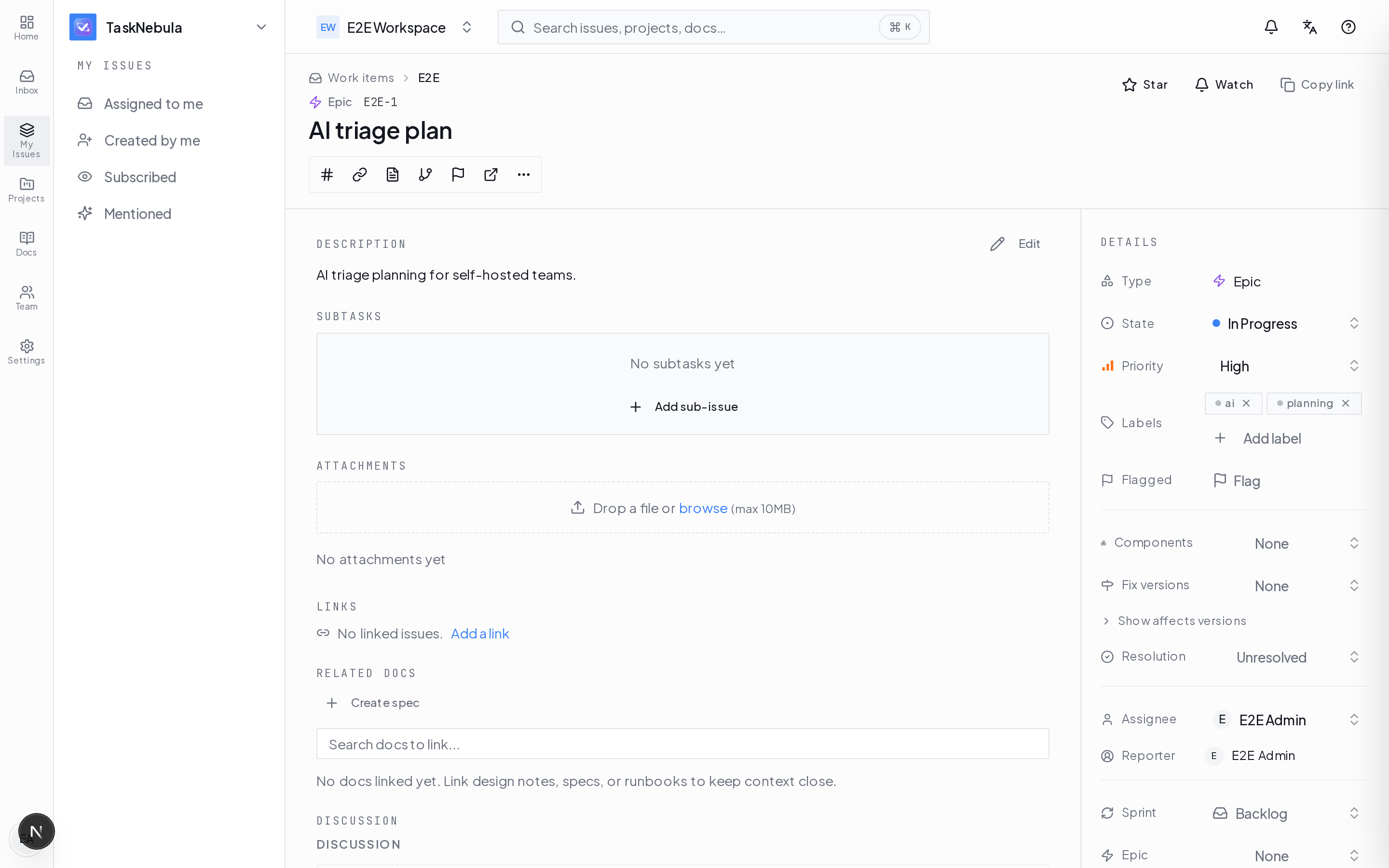
FIG 02 · Issue detail
Labels, versions, components, comments, sub-issues, and per-issue assist in one view.
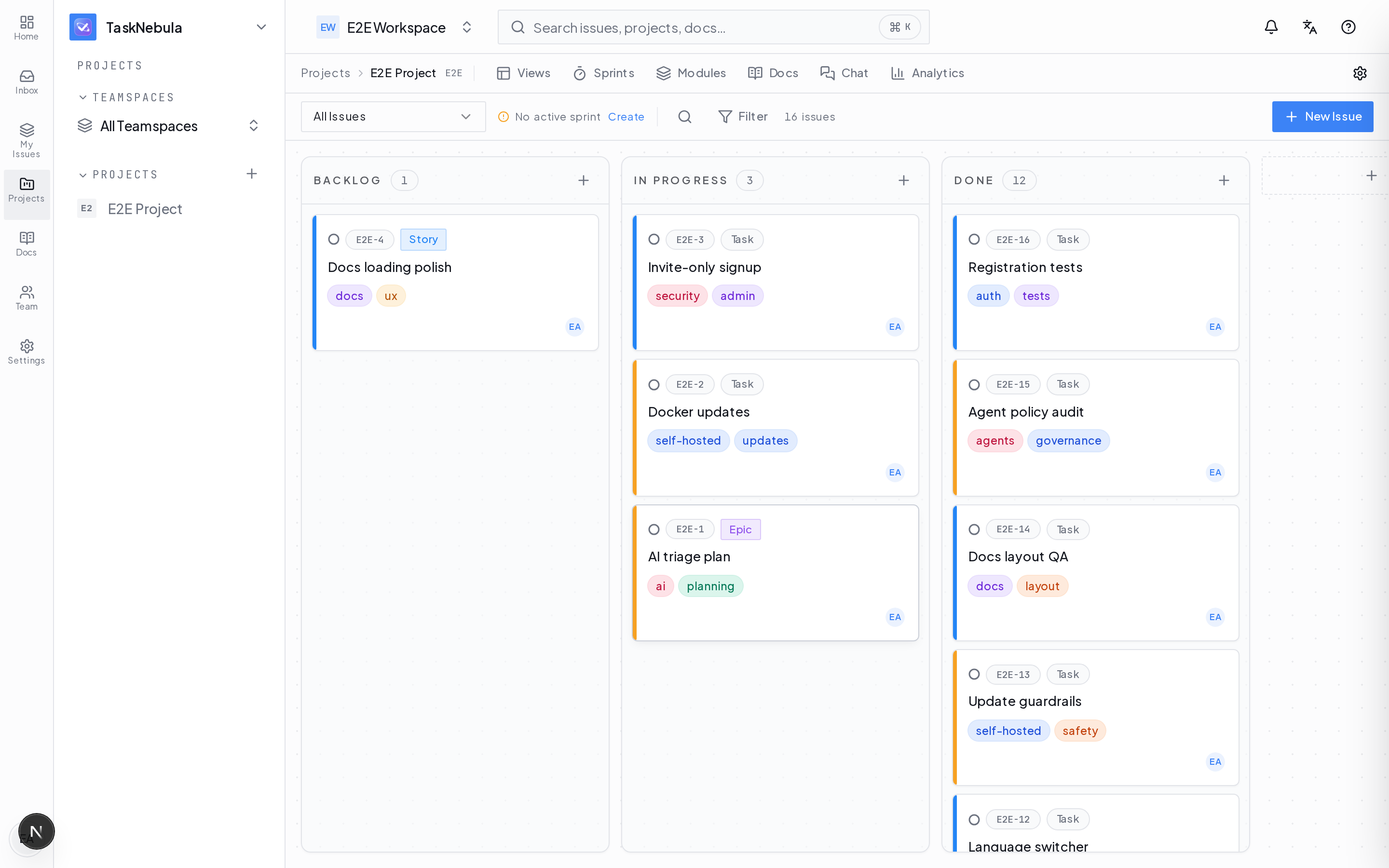
FIG 03 · Realtime board
Kanban, sprint work, drag-and-drop planning, presence, and project status loops.
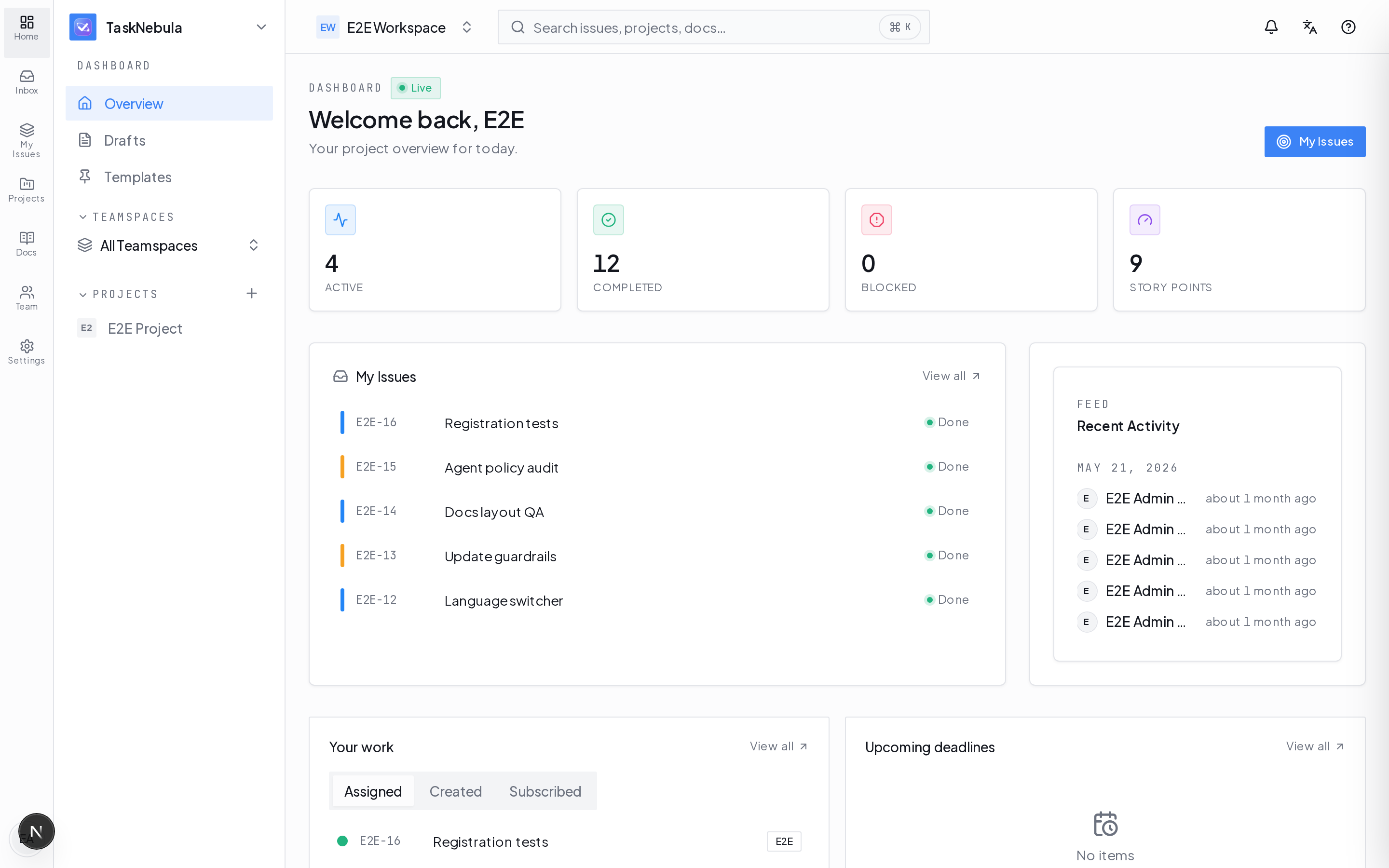
FIG 04 · Dashboard
Standup, catch-up, analytics, deadlines, pinned work, and recent activity.
02Operating model
TaskNebula brings localization, governance, update awareness, agent workflows, admin hardening, and a refreshed product interface into one self-hosted operating surface.
01
Localization spans dashboard widgets, issue views, sprint screens, settings, notifications, metadata, and date handling through the shared application shell.
02
Dashboards, project pages, settings, shell navigation, loading states, and transactional email templates share a restrained, high-contrast interface system.
03
Docker Hub webhooks, scheduled version checks, admin update notifications, digest metadata, and optional signed self-update handoff keep operators in control.
03Capabilities
TaskNebula pairs a familiar issue and project model with opt-in AI-agent governance and Docker-first operations that teams can inspect and run themselves.
01
Issues, epics, subtasks, sprints, burndown, velocity, initiatives, roadmap views, custom fields, issue links, attachments, importers, and transition rules.
02
Realtime presence, activity feed, comments, mentions, watchers, email digests, project chat, issue threads, LiveKit voice rooms, Tiptap, and Yjs.
03
30+ permission types, 63+ audit actions, role-based access, issue security levels, signed webhooks, OAuth, SAML/SCIM scaffolding, and registration controls.
04
AI is off by default. Workspace admins can enable OpenAI or Anthropic keys, keep native heuristic planning, save model profiles, and audit rotations.
05
Burndown, velocity, cycle time, throughput, lead-time distributions, project health, native charts, AI insights, retrospectives, and CSV/JSON export.
06
Cmd+K omnibar, keyboard shortcuts, route skeletons, real-time sync, Docker Compose, API keys, MCP work, AGENTOWNERS, and local coding-agent handoff.
04Install path
Choose a quick Linux install, a local Docker Desktop demo, a pinned production release, or a source build without blurring their different operating assumptions.
One-command Docker
Fresh Linux VM or homelab box
curl -fsSL https://raw.githubusercontent.com/neuraparse/taskNebula/main/scripts/quickstart.sh | bashDocker Desktop
Local Mac, Windows, Linux, or WSL demo
curl -fsSLo compose.yml https://raw.githubusercontent.com/neuraparse/taskNebula/main/docker-compose.desktop.yml && docker compose up -dPinned production
Repeatable self-hosted release
TASKNEBULA_IMAGE=neuraparse/tasknebula:<release-tag> docker compose up -dSource build
Local patching or contribution
git clone https://github.com/neuraparse/taskNebula.git && cd taskNebula && docker compose up -d --buildLocalized UI
Health endpoint
Persistent data
Realtime fan-out
Explicit profiles
05Deep dives
Operators can examine deployment, governance teams can trace AI controls, and technical evaluators can inspect the architecture without wading through one oversized overview.
01 · Self-hosting
Docker paths, services, production checklist, and update flow.
Open page02 · AI governance
BYOK AI, model profiles, AGENTOWNERS, local runners, and approvals.
Open page03 · Architecture
Stack, realtime, i18n, roadmap, and operating model.
Open page06Public record
The stack, open roadmap work, and production contract remain directly inspectable for technical evaluation.
Next.js, Postgres, Redis, Docker, reverse proxy, optional LiveKit and cron. The sophistication is in product flow and governance, not exotic infrastructure.
01Frontend
02Backend
03Data
04Realtime
05Ops
06Trust
01 · Foundation
Labels, components, release records, resolution, issue rank, workflow enforcement, boards, structured queries, notifications, tenant isolation, API keys, pagination, and scale floor.
02 · Next
Deeper code-host links, importer improvements, release notes, semantic search, Ask-AI completion, agent approval queues, MCP expansion, and coding-agent handoffs.
03 · Longer term
Custom hierarchy, field schemes, permission enforcement, portfolio plans, SLAs, configurable dashboards, proactive risk detection, and agent builder direction.
01Image
Pin TASKNEBULA_IMAGE to a tested release tag outside quick demos.
02Secrets
Generate AUTH_SECRET, REDIS_PASSWORD, and LIVEKIT_API_SECRET per install.
03Network
Keep Compose ports bound to 127.0.0.1 and expose through TLS reverse proxy.
04Persistence
Back up postgres_data, redis_data, and uploads_data.
05Updates
Pull image, restart, then verify GET /api/health.
06Automation
Enable cron only with docker compose --profile cron up -d cron.
Run it yourself
TaskNebula is a self-hostable project-management control plane for teams that want inspectable operations instead of another black-box SaaS.