
Skip to content
000APPLIED AUTONOMY PROGRAMME

NODERIQ

NODERIQ explores how heterogeneous autonomous systems can maintain shared situational context, coordinate under degraded connectivity, and keep consequential recommendations connected to evidence and accountable human authority.

AI-firstAssurance-ledEdge-operableClassical by default
A compact aerial vehicle, ground robot, and edge sensor sharing coordination and evidence cues inside a bright autonomy test hangarConcept programme visual
Public concept · heterogeneous platforms · shared context · evidence-aware review

Core operating path

Situational context

Consequential authority

Promotion standard

001The operating problem

Every platform sees a different slice of the environment at a different time. Links become intermittent, positioning degrades, sensors disagree, and one participant may disappear from the team. A shared map that hides those differences can look confident while being wrong.

NODERIQ frames the harder problem: preserve what is known, what is uncertain, where each observation came from, how recently it was seen, and how that evidence shaped a recommendation.

01Capability

Build a shared, uncertainty-aware view from observations that may be incomplete, delayed, stale, or contradictory. Source, recency, and confidence remain part of the record instead of disappearing inside a fused map.

Observe → qualify → reconcile

02Capability

Help heterogeneous platforms coordinate tasking, routes, resources, and information priorities without assuming that a central connection is always available.

Plan → coordinate → adapt

03Capability

Keep recommendations separate from authority. Consequential actions are framed by policy, review state, uncertainty, and an accountable human decision path.

Check → explain → authorize

04Capability

Keep the core useful near the operating system, sensors, and platform runtime. External services can add value, but loss of cloud or specialist compute must not remove the classical operating path.

Local → bounded → recoverable

05Capability

Evaluate selected planning or belief-estimation workloads across classical, quantum-inspired, and quantum methods only where a common problem definition and a credible baseline make comparison meaningful.

Baseline → compare → qualify

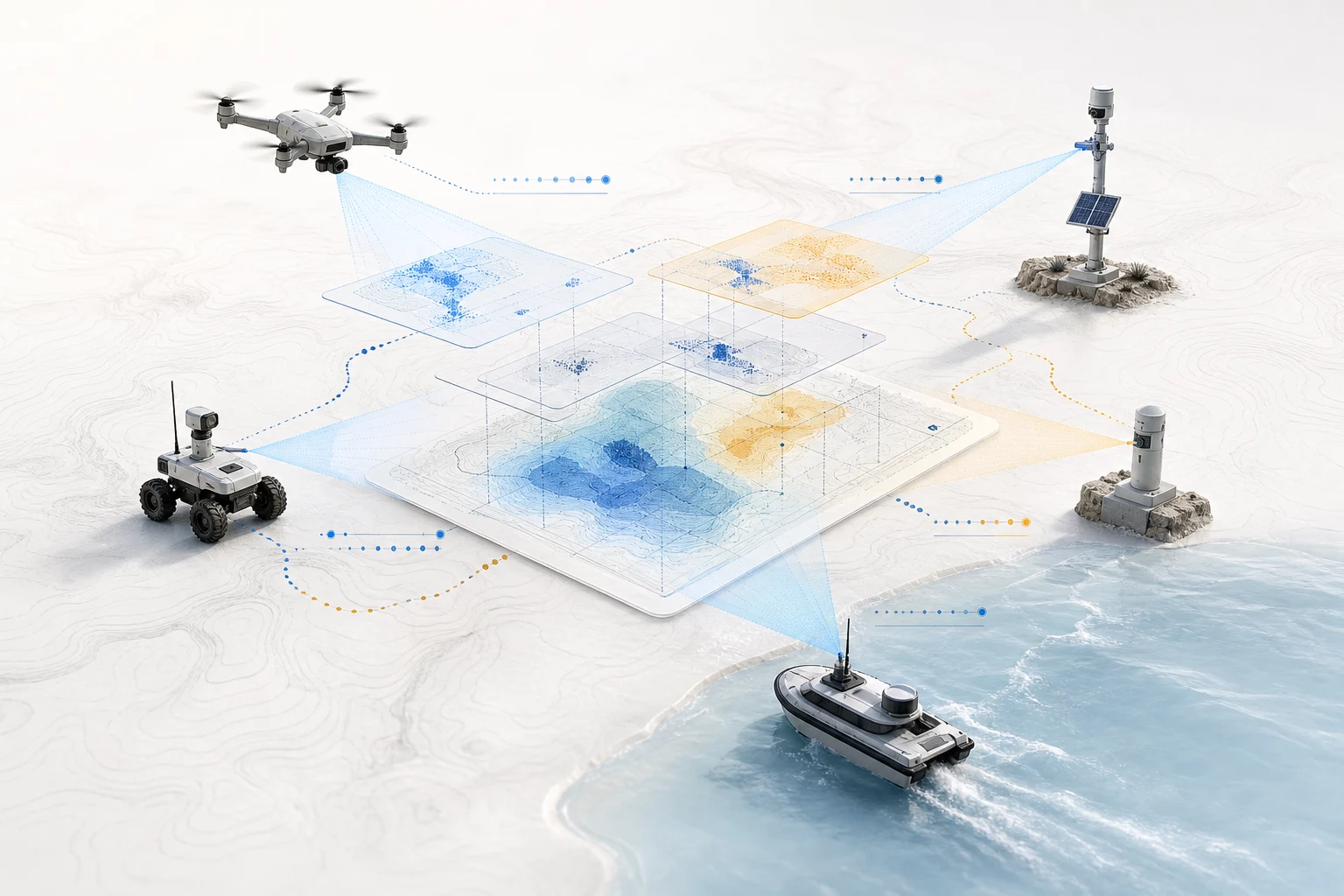
Heterogeneous autonomous platforms contributing partial observations to a layered shared operational picture with source and uncertainty cues
Concept model · observations remain connected to source, recency, and uncertainty
002From observation to authority

The public NODERIQ method is intentionally simple to explain: retain the evidence around an observation, reconcile the parts that can be reconciled, keep meaningful disagreement visible, and attach the resulting context to every planning recommendation.

OP-01

Sense

Receive platform, sensor, environmental, and operator observations with their source and time context.

OP-02

Qualify

Represent uncertainty, freshness, disagreement, and missing information instead of flattening them into false certainty.

OP-03

Share

Exchange the smallest useful evidence so participating systems can maintain a coherent operational picture under constrained links.

OP-04

Coordinate

Revisit task, route, resource, and information priorities when the environment or the available team changes.

OP-05

Verify

Check recommendations against physical constraints, mission policy, time context, and the evidence available at that moment.

OP-06

Escalate

Route ambiguity, risk, and policy exceptions to accountable human authority with the supporting record attached.

003From research to product

The programme begins with a classical AI core that must create value on its own. Assurance, edge operation, and reproducible testing are part of that core. Hybrid and quantum methods remain optional research extensions until measured results justify a wider role.

Stage 01

Primary path

Establish a useful classical and edge-operable core: shared situational context, uncertainty-aware coordination, verification, human escalation, and reproducible resilience evaluation.

  • Research and evaluation environment
  • Simulation and resilience test packs
  • Edge runtime components
  • Operator review and evidence surfaces

Stage 02

Measured extension

Describe selected non-safety-critical workloads once, run strong classical baselines first, and compare alternative solvers under the same constraints and evidence model.

  • Common workload definitions
  • Classical and quantum-inspired comparisons
  • QFlow experiment evidence
  • Policy-controlled compute routing research

Stage 03

Research gate

Advance a quantum route only when controlled measurements preserve the problem, survive hardware constraints, and show an operationally relevant reason to continue.

  • Provider-neutral evaluation records
  • Hardware-calibrated experiments
  • Classical fallback at every gate
  • Advisory pilots only where justified
Public productisation path

01

Define

Name the user problem, operating boundary, human authority, and classical baseline.

02

Prove

Build the smallest AI core that is useful without specialist external compute.

03

Verify

Run repeatable TEVV across uncertainty, degraded links, sensor loss, and recovery.

04

Integrate

Connect edge runtimes, data flows, operator tools, and existing mission systems.

05

Pilot

Evaluate a bounded dual-use scenario with named users and explicit acceptance evidence.

06

Scale

Add configuration control, training, updates, support, and lifecycle evidence.

07

Explore

Keep hybrid and quantum work on a separate comparison track until it earns promotion.

004Classical by default

Hard real-time safety, platform control, and essential local operation stay classical and on the edge. Quantum is not a dependency and never sits inside the safety-critical control loop described by this public programme.

An alternative path is eligible only for bounded, latency-tolerant planning or inference questions, and only when the same problem can be compared against a strong classical baseline. A result showing no useful advantage is still a valid outcome.

Read the compute-gate method
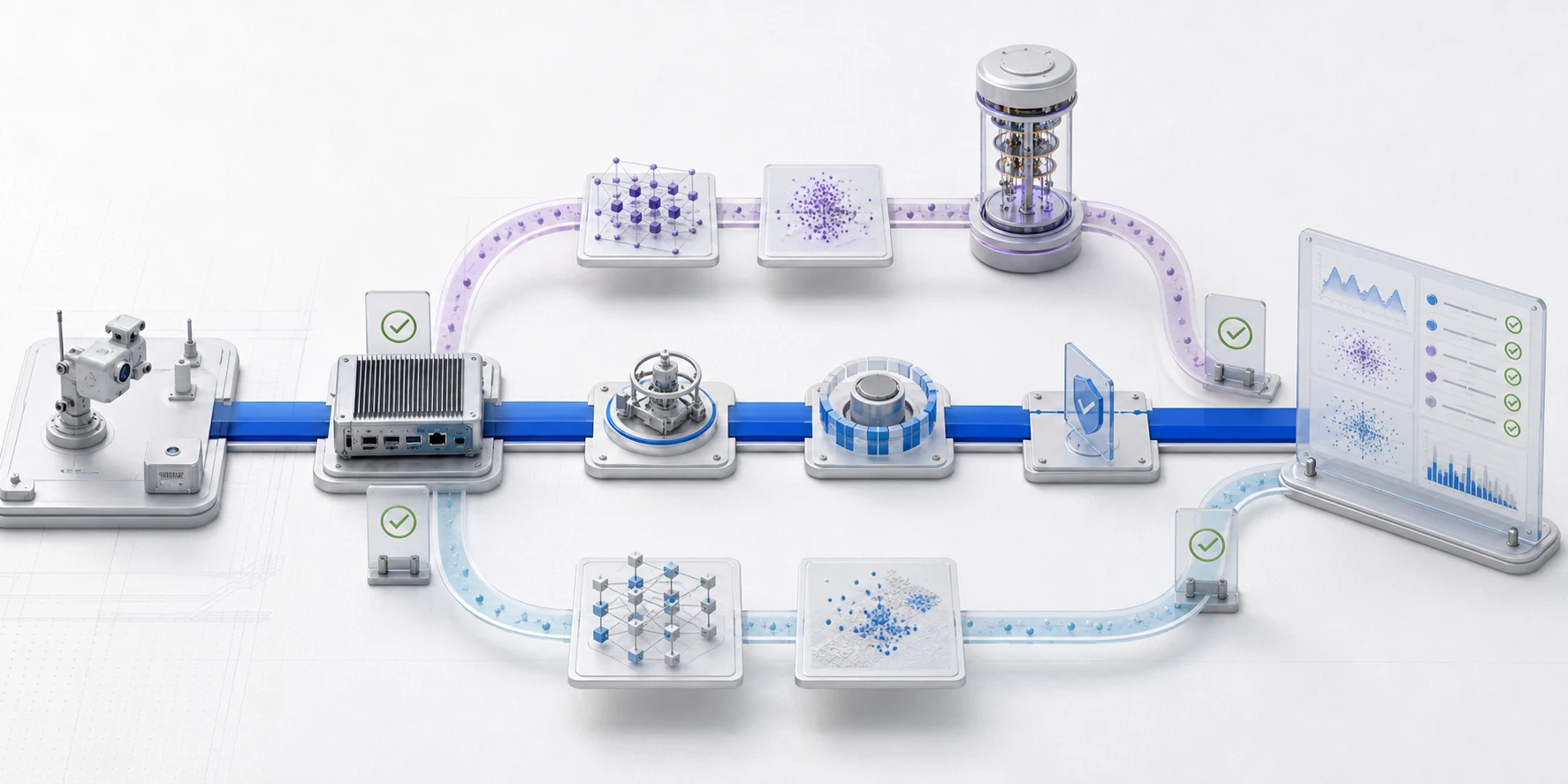
A dominant classical edge-compute path with secondary quantum-inspired and quantum evaluation lanes returning evidence to a review board
Concept evaluation path · classical core remains continuous · optional routes return evidence

G0

Is the workload explicit, measurable, latency-tolerant, and safe to evaluate outside the local control loop?

G1

Does the alternative method produce valid results in a controlled environment against a strong classical reference?

G2

Does execution on available hardware preserve the information, constraints, and uncertainty needed by the planner?

G3

Does the complete path add decision value after accuracy, latency, reliability, cost, and review burden are considered?

005What progress means

Public reporting describes measurement categories, not unpublished thresholds. The goal is to show how progress will be judged without disclosing sensitive test configurations or presenting provisional targets as achieved results.

M-01

World-model quality

How accurately the shared view represents the available evidence, uncertainty, contradictions, and change over time.

M-02

Coordination quality

Whether plans remain feasible, useful, and adaptable as links, sensors, platforms, and priorities change.

M-03

Assurance quality

Whether recommendations can be traced, reviewed, challenged, replayed, and escalated through the intended authority path.

M-04

Edge resilience

Whether essential classical capability continues within the defined local resource and connectivity envelope.

M-05

Recovery behaviour

How safely the system returns to a coherent state after stale data, platform loss, reconnection, or operator intervention.

M-06

Operational fit

Whether the result reduces burden or improves decision quality enough to justify integration, support, and lifecycle cost.

An engineer reviewing evidence, uncertainty, and policy checks before authorising a bounded ground-robot evaluation
Human authority

The intended operating record distinguishes what the system observed, what it inferred, what it recommended, which policy applied, who authorized the next step, and what happened afterward. Escalation is designed into the flow rather than added after a failure.

  • Named authority for consequential decisions
  • Visible uncertainty and disagreement
  • Reviewable policy and evidence context
  • Replay and incident-learning path
008Responsible public scope

This page explains the programme’s intent, evaluation model, productisation stages, and relationship to the Neura Parse stack. It does not disclose protected proposal material, operational configurations, detailed system topology, security implementation, decision thresholds, or unpublished performance results.

Programme status

NODERIQ is an applied research and productisation programme. It is not presented as a released product, certified capability, deployed customer system, quantum-advantage result, or NATO-selected programme.

Common questions
Q01Is NODERIQ a released product?

No. NODERIQ is presented publicly as an applied research and productisation programme. The site describes the problem, design principles, evaluation method, and intended progression without claiming production deployment or operational validation.

Q02Does NODERIQ require quantum computing?

No. Its core path is classical AI running at the edge. Selected planning or belief-estimation workloads may be compared with quantum-inspired or quantum methods, but failure to pass an evidence gate returns the workload to the classical path.

Q03What does verifiable mean here?

It means recommendations are intended to be traceable, reviewable, and connected to their evidence and authority path. It does not claim formal verification, certification, mathematical correctness, or guaranteed mission performance.

Q04What remains outside the public description?

Implementation-level model designs, data schemas, messaging protocols, security mechanisms, routing thresholds, detailed test parameters, operational configurations, proposal material, and unverified performance figures remain outside this public surface.

Bounded collaboration

We can discuss research collaboration, simulation and TEVV design, edge integration, or a bounded dual-use pilot without turning early programme intent into an unsupported readiness claim.