
P01
The problem can change between demos
Decision questionCan two reviewers confirm that classical and quantum runs address the same objective, constraints, data, and tolerance?
SVQuantum Systems Engineering
Design QFlow-backed education, repeatable research, and bounded enterprise pilots around a visible Design → Route → Code/Run → Evidence sequence.
Universities and research teams · Students and quantum developers · Innovation, security, and architecture leaders
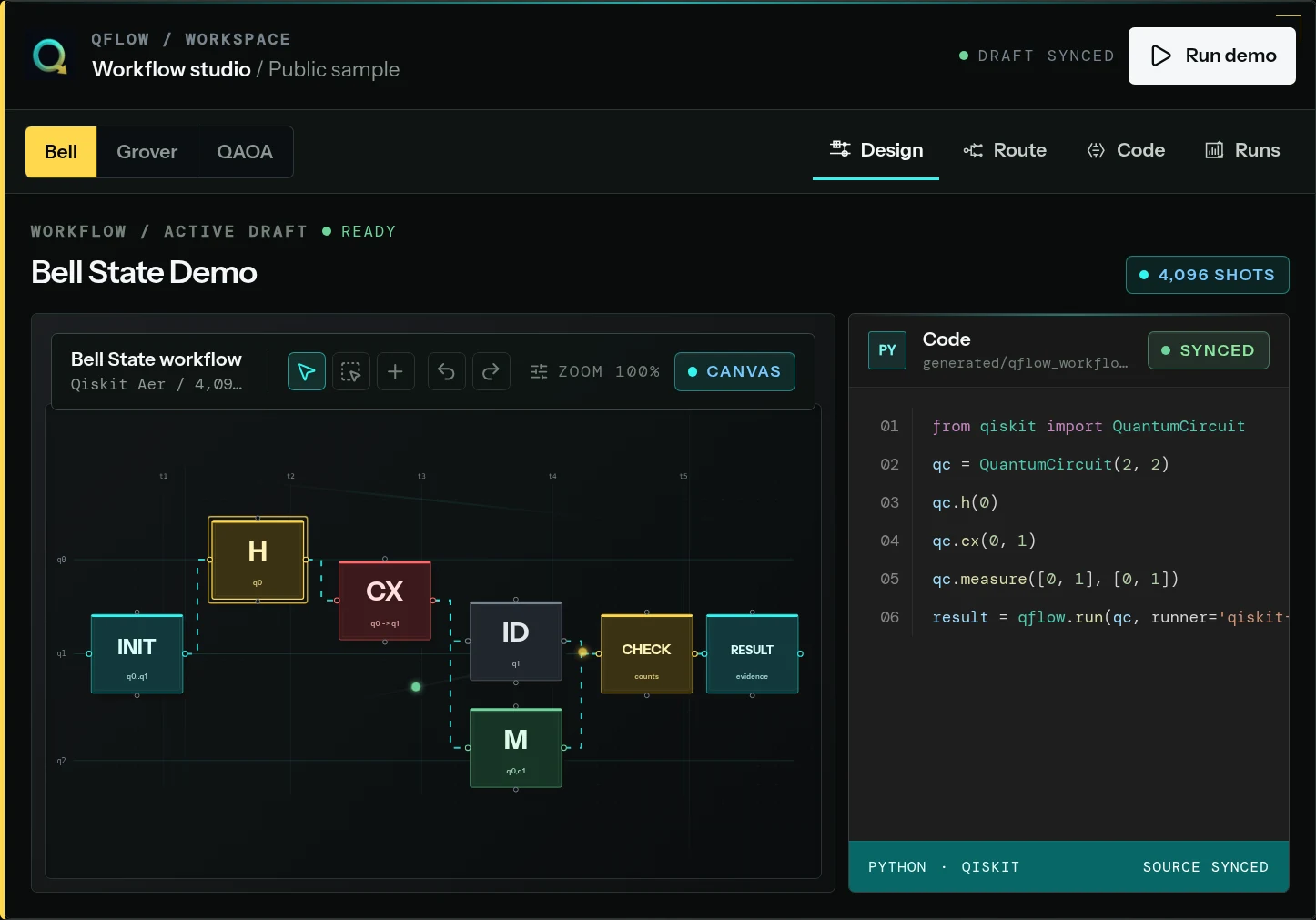
Quantum workflow evidence · Public QFlow sample · captured 24 September 2026
Public QFlow Studio Bell State sample with visual circuit and generated code. Wider route, execution and evidence requirements remain described in the evaluation method.
Layer 01
Layer 02
Layer 03
Layer 04
01 · Mission context
A course exercise, research run, or enterprise pilot is difficult to compare when the brief, classical baseline, circuit, generated Qiskit, Cirq or OpenQASM, route and provider context, run state, result, and reviewer decision live in different places. This service configures a QFlow-backed design, route, code/run, and evidence process around local simulation and agreed provider contexts; it does not imply universal access, a provider endorsement, or that a quantum method is useful or advantageous.
Programme framing
An education programme starts with learning outcomes and instructor review; a research programme starts with a reproducible question and handover path; an enterprise pilot starts with a named decision, business constraint, security boundary, classical baseline, and stop condition. QFlow keeps those differences explicit while giving each route the same connected workflow and evidence model.
P01
Decision questionCan two reviewers confirm that classical and quantum runs address the same objective, constraints, data, and tolerance?
P02
Decision questionDoes each result retain enough provider and execution context to explain or reproduce the comparison?
P03
Decision questionAre logical and physical assumptions, classical work, sample complexity, cost, and scaling limits visible before investment is proposed?
P04
Decision questionDoes the evidence record retain failed runs, limitations, reviewer disposition, and the reason for the next gate?
Execution choices follow that contract. Classical, quantum-inspired, ideal, noisy, and available-hardware targets are selected only where they add evidence, with account and instance assumptions, seeds, stopping rules, sample requirements, mitigation, expected usage, and cost stated in advance. AI-assisted code suggestions remain attributable and human-reviewed before any submission.
The problem can change between demos. Objectives, constraints, encodings, data reductions, and success thresholds are often adjusted without a single controlled problem definition.
Backend context changes the result. Simulator assumptions, topology, native gates, calibration, transpilation, shots, mitigation, queue time, and provider revisions affect what a run means.
Resource requirements are easy to hide. A small circuit demonstration may omit data loading, sampling, optimization, error correction, classical orchestration, and projected fault-tolerant resources.
Negative results must change the roadmap. If unsuccessful experiments disappear, teams repeat work and leadership receives an optimistic portfolio that cannot support a go, pause, or stop decision.
02 · Delivery system
Inputs, outputs, maturity, and the evidence boundary travel together. Capability is never separated from the condition under which it can be accepted.
Define the user, decision, mathematical problem, classical state of practice, value threshold, data boundary, error tolerance, and maturity assumption before selecting a quantum method.
Output · Problem card · baseline contract · use-case screen · experiment or monitor decision
Translate the question into a visual QFlow model and reviewable generated source, then design classical, quantum-inspired, simulator, and hardware runs where relevant with shared metrics, seeds, stopping rules, uncertainty, and preregistered comparisons.
Output · QFlow model · reviewed Qiskit/Cirq/OpenQASM · experiment protocol · baseline suite · test matrix · analysis plan
Capture source, environment, original and ISA-ready circuits, transpilation configuration, provider account and instance reference, backend, calibration context, execution ID, shots, mitigation, timestamps, QPU usage, results, and hashes in one manifest.
Output · Signed or hashed run manifest · IBM job reference · independent result bundle · provider context · usage and failure log
Compare results against the acceptance contract, record limitations and negative findings, estimate the next resource step, and route the outcome to go, refine, pause, monitor, or stop.
Output · Comparison pack · limitation register · decision record · next-experiment or monitoring brief
Define the user, decision, mathematical problem, classical state of practice, value threshold, data boundary, error tolerance, and maturity assumption before selecting a quantum method.
Translate the question into a visual QFlow model and reviewable generated source, then design classical, quantum-inspired, simulator, and hardware runs where relevant with shared metrics, seeds, stopping rules, uncertainty, and preregistered comparisons.
Capture source, environment, original and ISA-ready circuits, transpilation configuration, provider account and instance reference, backend, calibration context, execution ID, shots, mitigation, timestamps, QPU usage, results, and hashes in one manifest.
Compare results against the acceptance contract, record limitations and negative findings, estimate the next resource step, and route the outcome to go, refine, pause, monitor, or stop.
03 · System boundary
The evidence architecture keeps source code, environment, circuit, transpilation, backend context, calibration, shots, queue, failures, results, and reviewer notes attached to one run manifest. Comparisons can therefore distinguish a method limitation from a provider condition, software change, insufficient sampling, or an inconsistent baseline.
Reference layers support scoping. Interfaces, owners, and target-system constraints remain subject to validation.
The mathematical objective, data or instances, constraints, current classical approach, tolerance, and decision threshold are versioned before execution.
Typical elements · Problem card · dataset hash · solver configuration · metric · stopping rule
Quantum and classical steps, reviewed Qiskit code, dependencies, seeds, source and ISA circuit representations, resource estimates, and expected artifacts are connected independently of one result page.
Typical elements · QFlow record · Qiskit source · ISA circuit · environment lock · provenance
Ideal simulation, noisy simulation, IBM Quantum Runtime, available QPU, CPU, and GPU resources are treated as explicit targets with account, instance, backend, mode, usage, and target-specific metadata.
Typical elements · Qiskit primitives · IBM instance reference · job or batch ID · backend context
Outputs, logs, cost, uncertainty, failures, comparisons, reviewer notes, and investment gates remain connected to the exact run context.
Typical elements · Result bundle · comparison table · limitation · review status · decision receipt
Handover packages successful and unsuccessful runs with their limitations, cost, uncertainty, and decision receipt. The next action may be to refine an experiment, monitor a hardware milestone, pause the use case, or stop it. Preserving that disposition prevents later teams from repeating discarded work or turning exploratory evidence into an unsupported roadmap claim.
04 · Assurance dossier
The primary story remains calm; profiles, scope, handover evidence, and discovery questions stay available as a structured technical annex.
A cohort moves from IBM Quantum Learning concepts into guided QFlow exercises that connect a visual model, reviewed Qiskit source, simulator or authorized hardware run, results, reflection, and instructor feedback.
A research team records the problem, environment, source and ISA circuit, transpiler configuration, backend and calibration context, job reference, raw result, post-processing, baseline, and limitations as one handover package.
A selected optimisation problem is expressed under one constraint set and compared with an agreed classical solver using a bounded QUBO or QAOA study, shot and cost budget, and explicit review gate.
Included in this service pattern
Not implied by this page
Handover evidence
Problem, data, constraints, metrics, baselines, seeds, tolerances, stopping rules, and decision threshold are versioned and reviewable.
Code, dependencies, circuit or pulse artifact, target, transpilation, calibration context, shots, mitigation, seed, cost, outputs, and logs are retained or referenced.
Preprocessing, optimization, sampling, error-correction assumptions, data movement, CPU/GPU time, QPU time, and scaling limits appear in the evidence pack.
The record states go, refine, pause, monitor, or stop; names the reviewer; retains negative results; and lists the exact evidence needed to reopen the gate.
Discovery questions
Evidence register
References shape requirements and review questions. Inclusion does not imply certification, endorsement, partnership, or approval by the publisher.
05 · Engagement record
Inspectable outputs close the engagement; related services point only to the next bounded step.
Deliverables
Engagement artifacts
05 records per engagement
Quantum Systems Engineering
Plan a QFlow-backed education programme, reproducible research workflow, or bounded enterprise pilot with explicit access and acceptance gates.