
P01
Semantic integrity
Decision questionWhich contract defines meaning, authority, freshness, validation, and change for every exchanged field and event?
SVSystems Integration
Connect data, identity, APIs, sensors, enterprise platforms, and operational systems through testable interfaces.
Enterprise IT · Platform engineering · Security leadership

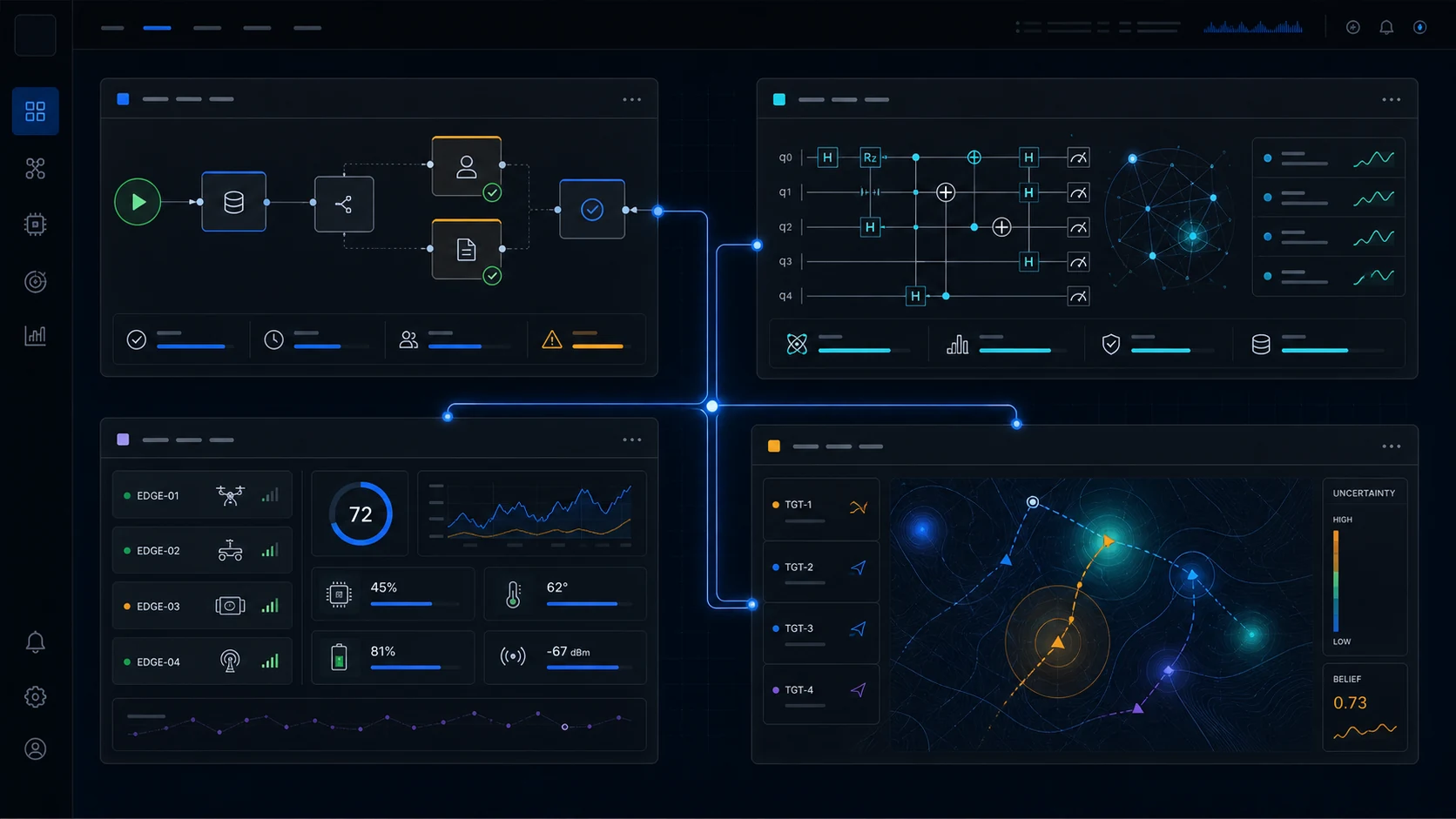
Enterprise integration · Engineering workflow study
Integration work is shown as an operational architecture across APIs, pipelines, service boundaries, identity, and observability.
01 · Mission context
Connecting a model to an API is a small part of systems integration. Production value depends on authoritative data, stable semantics, identity, policy enforcement, recoverable messaging, lineage, and acceptance evidence across every participating system.
Contract framing
Integration discovery follows the operating record across every producer and consumer, asking which system owns an identifier, timestamp, state, confidence value, or approval. Valid transport is not enough when participants interpret the same field differently, so canonical semantics and change ownership are settled before adapters make those disagreements harder to see.
P01
Decision questionWhich contract defines meaning, authority, freshness, validation, and change for every exchanged field and event?
P02
Decision questionWhich subject may access which resource for which purpose, and how is that decision enforced and audited at each boundary?
P03
Decision questionWhat are the timeout, retry, idempotency, queue, reconciliation, rollback, and dead-letter behaviours for each interface?
P04
Decision questionCan an operator reconstruct what happened without relying on logs that use unrelated identifiers or omit the decisive context?
The same pass defines the transaction boundary. Identity delegation, validation, idempotency, ordering, retries, reconciliation, and dead-letter handling are designed around the consequence of an incomplete workflow. This turns failure behavior into part of the interface contract rather than an operational surprise left to unrelated support teams.
Semantic integrity. Two systems may exchange valid JSON while disagreeing about identifiers, timestamps, units, state, confidence, or who owns the record.
Identity and trust. Service credentials, user delegation, device identity, and model tool calls create different access paths that must be evaluated continuously.
Reliability and recovery. Retries, duplicates, partial writes, late events, back pressure, unavailable dependencies, and incompatible releases can silently corrupt a workflow.
End-to-end evidence. When a decision is challenged, teams need to connect the source record, transformation, policy, model version, approval, and downstream write.
02 · Delivery system
Inputs, outputs, maturity, and the evidence boundary travel together. Capability is never separated from the condition under which it can be accepted.
Map systems of record, producers, consumers, owners, protocols, classifications, transaction boundaries, interface versions, and known failure history.
Output · Integration inventory, authority map, data-flow model, trust boundaries, dependency graph, risk register, and prioritised interface backlog.
Define canonical identifiers, schemas, event semantics, validation, lineage, ownership, versioning, and reconciliation around the required operating workflow.
Output · Versioned contracts, validation rules, mapping specifications, lineage design, test fixtures, compatibility policy, and data-quality signals.
Apply explicit identity, least privilege, resource policy, service authentication, secrets handling, network segmentation, and audit at every interface.
Output · Authentication and authorisation flows, policy decisions, credential lifecycle, service boundaries, negative tests, and access evidence.
Exercise the complete workflow under normal, delayed, duplicated, malformed, unauthorised, and unavailable conditions while preserving correlated evidence.
Output · Contract test suite, failure-injection results, trace map, dashboard specification, residual issues, cutover plan, and rollback evidence.
Map systems of record, producers, consumers, owners, protocols, classifications, transaction boundaries, interface versions, and known failure history.
Define canonical identifiers, schemas, event semantics, validation, lineage, ownership, versioning, and reconciliation around the required operating workflow.
Apply explicit identity, least privilege, resource policy, service authentication, secrets handling, network segmentation, and audit at every interface.
Exercise the complete workflow under normal, delayed, duplicated, malformed, unauthorised, and unavailable conditions while preserving correlated evidence.
03 · System boundary
The architecture carries correlated identity from the authoritative source through transformation, policy, AI or workflow processing, human approval, and the destination write. Contract tests and failure injection then show whether delayed, duplicated, malformed, unauthorised, and unavailable conditions produce the declared response without losing decisive context.
Reference layers support scoping. Interfaces, owners, and target-system constraints remain subject to validation.
Establish source authority, ownership, identity, classification, freshness, and interface state for enterprise platforms, sensors, devices, and partner systems.
Typical elements · ERP, CRM, document repository, data platform, sensor gateway, mission system, identity provider, and vendor API.
Move validated records and events through versioned interfaces with explicit delivery, ordering, idempotency, lineage, and reconciliation rules.
Typical elements · API gateway, event bus, schema registry, stream processor, data product, dead-letter queue, and canonical identifier service.
Compose workflow state, model or agent calls, deterministic rules, resource policy, and human approvals without bypassing source-system controls.
Typical elements · Workflow engine, model gateway, policy decision point, tool adapter, approval service, and transaction coordinator.
Correlate source, transformation, policy, model, approval, write, release, error, and recovery evidence across service boundaries.
Typical elements · Distributed trace, audit event, data lineage, service-level signal, contract-test result, release manifest, and incident timeline.
Handover records interface owners, supported versions, observability signals, unresolved dependencies, cutover sequence, and rollback authority. A sampled outcome should be explainable across system boundaries by the receiving team, including which evidence came from a third party and which behavior remains outside the organisation's control.
04 · Assurance dossier
The primary story remains calm; profiles, scope, handover evidence, and discovery questions stay available as a structured technical annex.
A programme must combine sensor observations, platform state, reference data, analytics, and operator approval across different timing and classification boundaries.
Business units need governed access to sensitive data and AI services without creating duplicate pipelines or broad standing credentials.
An agentic workflow needs controlled access to documents, tickets, customer records, messaging, and approval systems.
Included in this service pattern
Not implied by this page
Handover evidence
Producers and consumers pass versioned schema, semantic, validation, compatibility, and representative data-quality tests for the agreed interfaces.
Positive and negative tests show that user, service, device, and agent identities can reach only the declared resources and actions with auditable policy decisions.
Duplicate, delayed, malformed, unauthorised, unavailable, and partial-write scenarios produce the agreed retry, queue, reconciliation, rollback, or operator path.
A sampled outcome can be traced from authoritative source through transformation, policy, model or workflow, approval, and destination using correlated identifiers.
Discovery questions
Evidence register
References shape requirements and review questions. Inclusion does not imply certification, endorsement, partnership, or approval by the publisher.
05 · Engagement record
Inspectable outputs close the engagement; related services point only to the next bounded step.
Deliverables
Engagement artifacts
05 records per engagement
Systems Integration
Connect AI, data, devices, and enterprise platforms through versioned contracts, explicit authority, failure tests, and operating ownership.