
P01
Encoding can dominate the experiment
Decision questionAre all preprocessing, encoding, data-access, and classical optimization costs included in the comparison?
SVHybrid Quantum–AI Evaluation
Map quantum AI opportunities with baselines, resource estimates, hybrid execution records, and decision-ready evidence.
Innovation teams · R&D groups · AI for science teams

Quantum AI evidence · Engineering workflow study
Quantum AI advisory turns hybrid quantum-classical experiments into QFlow records with classical baselines, resource estimates, AI-assisted analysis, and QANTIS decision evidence.
Layer 01
Layer 02
Layer 03
Layer 04
01 · Mission context
Quantum kernels, variational circuits, and hybrid learning workflows are research candidates with significant data-loading, trainability, noise, sampling, and scaling questions. The engagement compares them with strong classical baselines under one evaluation contract and produces an evidence-based next decision without claiming advantage.
Crossover framing
Candidate screening fixes the dataset lineage, splits, target, loss, error costs, sample size, and current machine-learning performance before selecting an encoding or circuit family. This reveals whether feature reduction, repeated data access, or state preparation would dominate the proposed method and whether the research question survives contact with the end-to-end workflow.
P01
Decision questionAre all preprocessing, encoding, data-access, and classical optimization costs included in the comparison?
P02
Decision questionDoes the baseline suite represent credible methods, tuning effort, compute budgets, and uncertainty for this dataset and objective?
P03
Decision questionWhich measured or estimated resource becomes limiting first as the data or model grows?
P04
Decision questionAre uncertainty, repeated runs, holdout discipline, failed runs, and multiple-comparison risks visible in the conclusion?
A credible crossover test gives classical and quantum-inspired approaches a documented tuning and compute budget, repeated seeds, holdout discipline, and uncertainty analysis. Only then is a kernel, variational circuit, or hybrid feature path added under the same evaluation contract, with preprocessing and classical optimization retained in the resource comparison.
Encoding can dominate the experiment. Feature selection, dimensionality reduction, normalization, circuit encoding, and repeated data access may move substantial work outside the reported quantum model.
Weak baselines create false progress. A quantum model compared with an untuned or inappropriate classical model does not answer whether the hybrid approach adds useful evidence.
Small demonstrations may not scale. Qubit count, circuit depth, shot count, optimization iterations, noise, gradient variance, and fault-tolerant assumptions can change rapidly with problem size.
Statistical variation can be mistaken for value. Dataset splits, seeds, device drift, finite sampling, mitigation, hyperparameter search, and repeated testing can produce unstable or selectively reported outcomes.
02 · Delivery system
Inputs, outputs, maturity, and the evidence boundary travel together. Capability is never separated from the condition under which it can be accepted.
Inspect the data source, target, loss, constraints, sample size, classical performance, error cost, and plausible quantum encoding before committing to a hardware run.
Output · Candidate scorecard · encoding options · baseline contract · proceed, monitor, or stop decision
Create reproducible classical models, tuning budgets, feature pipelines, train/validation/test controls, repeated seeds, runtime, memory, and error analysis before adding a QPU path.
Output · Baseline code and environment · tuned results · error analysis · compute and cost record
Run selected kernel, variational, or hybrid feature experiments on simulators and, where justified, available hardware with controlled encodings, shot budgets, mitigation, seeds, and checkpoints.
Output · QFlow run records · learning curves · resource measurements · uncertainty · failure log
Compare quality, robustness, resource use, runtime, cost, operational complexity, and scaling sensitivity, then identify the evidence or hardware milestone required for a next step.
Output · Crossover map · limitation register · investment gate · monitoring or next-experiment plan
Inspect the data source, target, loss, constraints, sample size, classical performance, error cost, and plausible quantum encoding before committing to a hardware run.
Create reproducible classical models, tuning budgets, feature pipelines, train/validation/test controls, repeated seeds, runtime, memory, and error analysis before adding a QPU path.
Run selected kernel, variational, or hybrid feature experiments on simulators and, where justified, available hardware with controlled encodings, shot budgets, mitigation, seeds, and checkpoints.
Compare quality, robustness, resource use, runtime, cost, operational complexity, and scaling sensitivity, then identify the evidence or hardware milestone required for a next step.
03 · System boundary
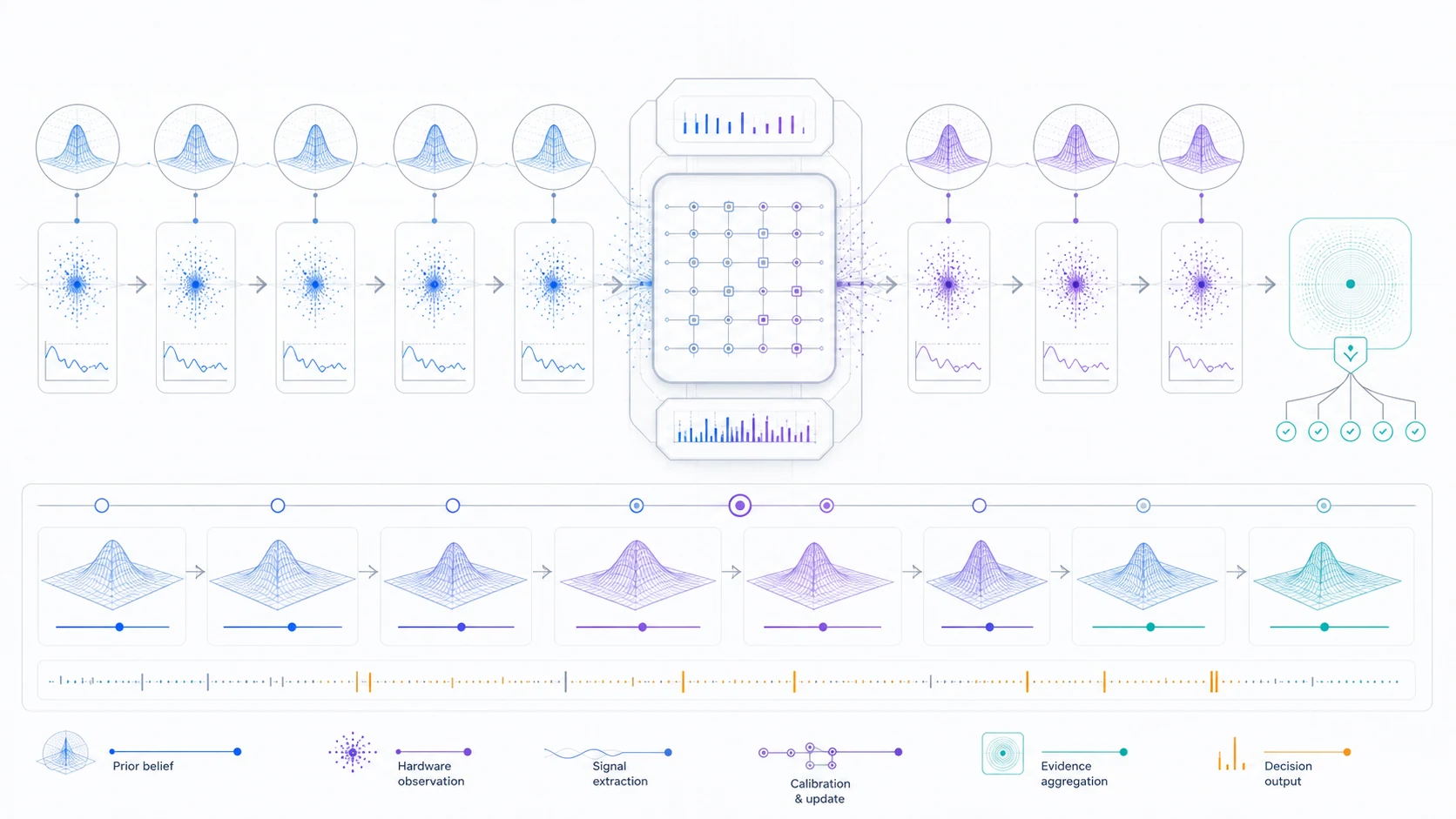
The comparison architecture connects data and leakage controls to the baseline harness, hybrid execution, and the final decision evidence. Circuit depth, shots, optimizer behavior, gradients, mitigation, backend context, CPU and GPU work, queue, cost, and unstable outcomes stay visible beside quality metrics rather than being summarized as a single best score.
Reference layers support scoping. Interfaces, owners, and target-system constraints remain subject to validation.
Dataset versions, provenance, splits, labels, preprocessing, feature selection, target, loss, subgroup checks, and prohibited leakage are fixed for comparison.
Typical elements · Dataset hash · split manifest · feature pipeline · metric · error-cost matrix
Credible classical and quantum-inspired methods share compute budgets, tuning records, repeated seeds, uncertainty analysis, and holdout evaluation.
Typical elements · Baseline registry · tuner log · learning curve · runtime and memory · error analysis
Encoding, circuit, optimizer, gradients, shots, simulator or backend, mitigation, checkpoints, and CPU/GPU/QPU work are captured as one workflow.
Typical elements · Quantum kernel · variational classifier · provider target · QFlow manifest
Quality, uncertainty, resource use, cost, failures, scaling estimates, operational constraints, and reviewer decisions remain tied to each experiment version.
Typical elements · Crossover table · limitation · negative result · gate · monitoring trigger
Handover states what was observed for the tested data, software, circuit, backend, and budget, then names the replication or hardware milestone required for another step. A proceed, monitor, or stop decision is valid without implying generalized speedup, accuracy, economic benefit, or readiness to replace an approved model.
04 · Assurance dossier
The primary story remains calm; profiles, scope, handover evidence, and discovery questions stay available as a structured technical annex.
A small, versioned dataset is evaluated with classical kernels and a defined quantum feature map using identical splits, search discipline, and uncertainty reporting.
A bounded classification task measures optimization stability, gradient behavior, shots, depth, noise sensitivity, initialization, and classical optimizer cost.
A domain team compares a hybrid feature or model component with an established surrogate under the same data, error tolerance, and end-to-end workflow budget.
Included in this service pattern
Not implied by this page
Handover evidence
Classical and hybrid methods use the same versioned data, splits, preprocessing contract, objective, metrics, error costs, and holdout rules unless a documented difference is the research variable.
Model choices, hyperparameter budgets, seeds, environments, compute, repeated results, uncertainty, and known limitations are retained for review.
Encoding, preprocessing, optimization, sampling, mitigation, CPU/GPU/QPU time, queue, cost, data movement, and scaling assumptions appear in the comparison.
The conclusion is limited to the tested configuration, reports negative and unstable results, and states the replication or milestone needed before any stronger claim.
Discovery questions
Evidence register
References shape requirements and review questions. Inclusion does not imply certification, endorsement, partnership, or approval by the publisher.
05 · Engagement record
Inspectable outputs close the engagement; related services point only to the next bounded step.
Deliverables
Engagement artifacts
05 records per engagement
Hybrid Quantum–AI Evaluation
Build a disciplined evidence layer for hybrid quantum-classical AI experiments.