PMPublic media
2 records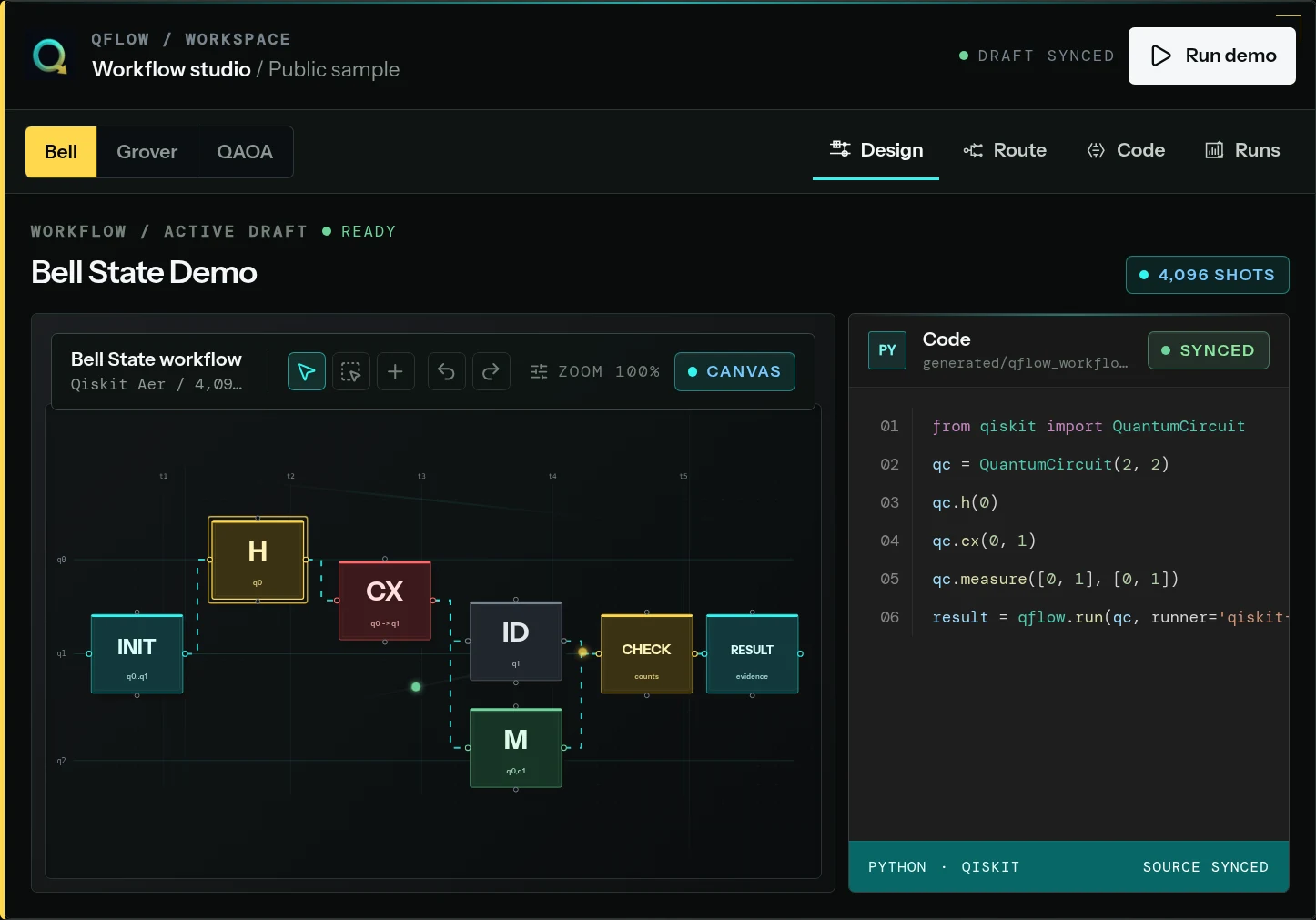
Current public Bell State sample
PUBLIC SAMPLE — QFlow Studio's Bell State circuit and generated code, captured 24 September 2026. Provider access remains separately controlled and status-labelled.

Quantum research context
Quantum research setting · QFlow Studio roadmap
Quantum for everyone, without hiding the engineering
Quantum computing becomes more useful when a student, researcher, developer, or enterprise team can begin with a real question and understand the path from that question to a runnable workflow. This July roadmap shaped the current public QFlow sequence: Design makes the brief and circuit visible, Route makes execution context deliberate, Code/Run keeps generated source and run state connected, and Evidence preserves the reviewer-safe result.
Neura Parse's IBM Partner Plus membership and direct study of public IBM Quantum Platform and Qiskit documentation inform the ecosystem context without creating an IBM product endorsement or a QFlow-specific partnership. IBM controls its infrastructure, accounts, plans, Runtime services, and hardware access. QFlow's distinct role is to help people learn, author, understand, coordinate, and review the workflow around independent provider systems.
This is a roadmap, not an IBM co-launch or product endorsement
Neura Parse is an IBM Partner Plus member. That company-level ecosystem status is distinct from the QFlow roadmap described here. This update does not announce IBM endorsement, IBM Quantum Network membership, a jointly developed product, production-certified connector, generally available integration, or bundled IBM Quantum access. Features discussed below remain roadmap priorities unless a released product surface says otherwise.
QFlow does not replace Qiskit, IBM Quantum Platform, Qiskit Runtime, or the provider's account and access controls. It is intended to sit around those layers as an accessible workflow and evidence environment. Provider availability, queue behavior, regions, plan eligibility, pricing, credits, subscriptions, and hardware access remain governed by IBM's current terms and systems.
- IBM infrastructure: accounts, instances, regions, permissions, plans, QPUs, Runtime services, and provider-side workload execution.
- Qiskit context: circuit construction, hardware-aware optimization, primitives, execution patterns, and post-processing tools.
- QFlow direction: education paths, visual authoring, synchronized code, context-aware workflow guidance, review gates, and evidence continuity.
- Status: product roadmap and active development direction; not a shipped IBM integration claim.
Practical programmes for universities and research teams
The first priority is a practical education and research programme that connects concepts to real workflow habits. A university module should be able to start on a local simulator, show how a problem maps into a circuit or operator, compare a classical reference, and move to hardware only when the learning objective and resource budget justify it.
For research teams, the programme should go beyond a course checklist. QFlow's roadmap includes reusable lab templates, instructor and reviewer views, assumption records, expected-versus-observed comparisons, reading links into official Qiskit material, and evidence packets that make a completed experiment discussable after the notebook session ends.
- Guided paths from quantum foundations to provider-aware experiments.
- Simulator-first labs with optional hardware stages and explicit cost context.
- Classical baselines and expected outcomes beside every quantum exercise.
- Research-group templates for hypotheses, methods, review notes, and follow-up work.
BD · Full bulletin5 supporting sections and the operational checklist.Read deeper
An environment where students and developers can build real workflows
Accessibility should not mean reducing quantum work to a decorative drag-and-drop demo. It should mean letting a newcomer see the structure of a real workflow while giving an experienced developer direct access to the generated code and configuration. The same project should be readable as a canvas, Qiskit or OpenQASM artifact, parameter set, backend plan, and result record.
Qiskit patterns provide a useful discipline for that interface: map the problem, optimize for target hardware, execute, and post-process. QFlow can make those stages visible as one connected project, explain why each stage exists, and let the user move between a guided surface and editable source without creating two versions of the truth.
- Begin with the research or business question instead of an unexplained circuit.
- Keep the visual workflow and generated source synchronized and reviewable.
- Show simulator, hardware, shot, precision, transpilation, and mitigation choices in plain language.
- Preserve an expert path so code, parameters, and provider-specific details remain inspectable.
Rapid pilots in quantum-safe cryptography and optimization
Enterprise adoption needs bounded pilots with a decision at the end. For quantum-safe cryptography, the useful starting point is classical security work: cryptographic inventory, exposure classification, vendor evidence, migration sequencing, interoperability tests, and an approval trail. It should not be presented as an algorithm that needs to run on a QPU.
For optimization, QFlow can structure a pilot around problem formulation, QUBO or Hamiltonian mapping where appropriate, the strongest available classical baseline, simulator checks, resource estimates, a controlled QAOA-style hardware experiment, and an evidence-based stop or continue decision. IBM's public QAOA tutorial is valuable context for the workflow shape, but a tutorial or completed hardware job does not establish quantum advantage, production readiness, or a better business outcome.
- Quantum-safe pilot: inventory, risk, owner, migration pattern, test, exception, and review evidence.
- Optimization pilot: objective, constraints, formulation, baseline, quantum candidate, resource budget, and validation metric.
- Every pilot starts with a bounded question and finishes with a documented decision gate.
- No speedup, advantage, or provider-endorsement language without evidence that directly supports it.
Make accounts, credits, plans, and subscriptions understandable
Quantum access can be confusing before the first circuit is submitted. The IBM Quantum Platform uses accounts, regions, instances, Cloud Resource Names, permissions, plan allocations, usage limits, and different execution capabilities. A student on an Open plan, a research group working with awarded compute time, and an enterprise on a paid subscription do not have the same operating context.
QFlow's roadmap priority is to make that context understandable at the point where a workflow is designed: which provider account and instance are selected, which region owns the workflow data, which execution modes appear available, what budget or allocation applies, and where the user can verify or change the official plan. QFlow is not proposing to issue IBM credits, resell subscriptions, guarantee eligibility, or override provider permissions.
- Display provider, account, region, instance, plan, allocation, and estimated-versus-actual usage as distinct fields.
- Link users to the current official plan and instance pages instead of hard-coding timeless pricing promises.
- Explain why a workflow may need job, batch, or plan-dependent session execution.
- Keep secrets such as API keys outside exported experiment and evidence records.
Keep the workflow, code, execution record, and result connected
A screenshot of a result is not a reproducible quantum experiment. The record needs to connect the question and formulation to the workflow version, generated source, package and runtime versions, transpilation context, provider instance, backend, calibration reference, shots or target precision, mitigation settings, execution identifier, usage, raw result, post-processing, and classical comparison.
IBM documents how a Runtime result can be retrieved by job ID and serialized for independent storage. QFlow's roadmap uses that pattern as a minimum, not a complete guarantee: retain provider identifiers, but also create a portable evidence package so a result remains understandable when a dashboard session ends, a calibration changes, or a team member returns later.
- One project identity across the question, workflow, source, execution, and evidence export.
- Versioned circuit and ISA artifacts with transpilation seed, options, and package context.
- Provider job, session, or batch identifiers beside backend, calibration, timestamps, and actual usage.
- Raw and processed results beside the classical baseline, interpretation, limitations, and reviewer decision.
BA · Bulletin annexDefinitions, recurring questions, source notes, and publication tags.Inspect
SNSource notes
5 recordsTags