
PMPublic media
1 records
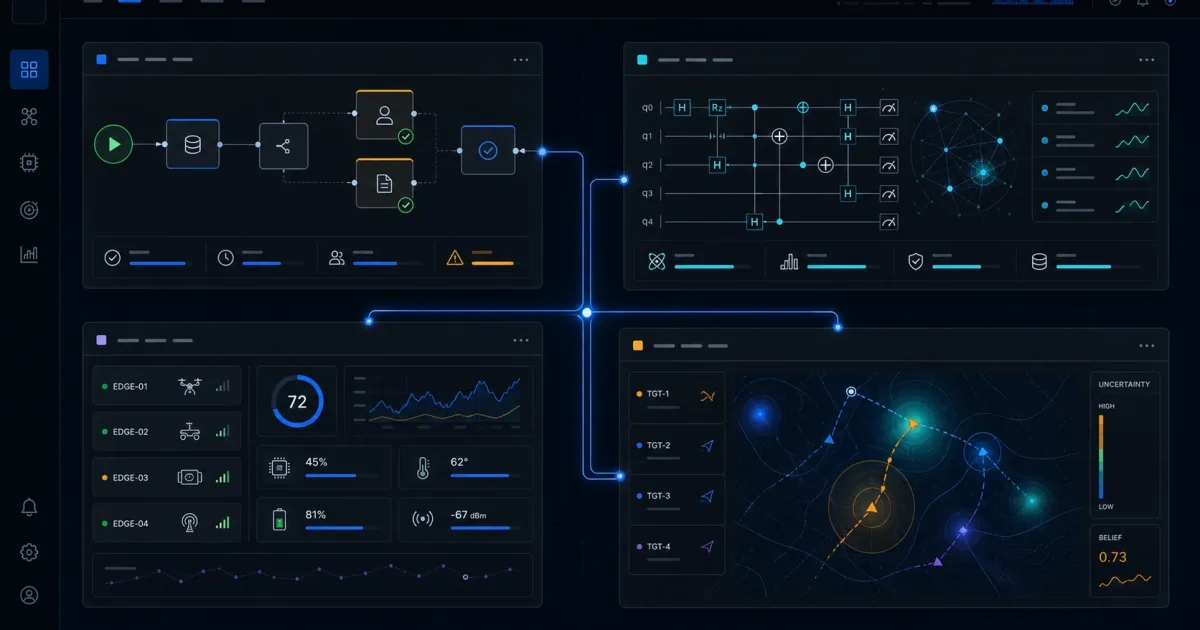
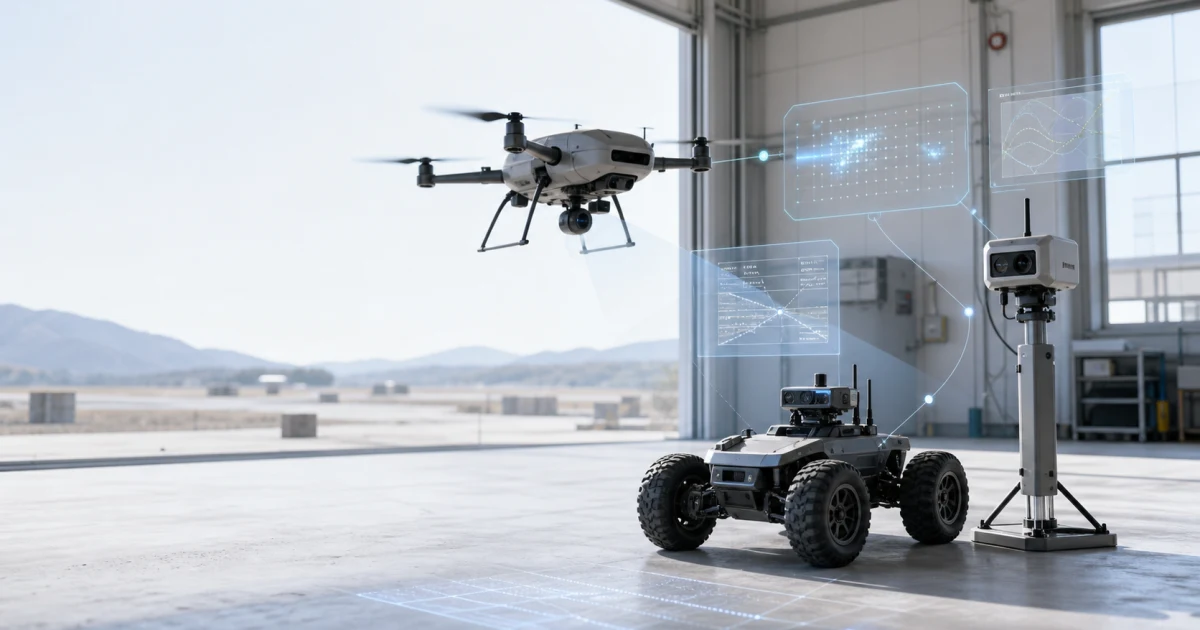
Quantum defense assurance visual
Original Neura Parse visual for public-safe quantum defense assurance, secure links, sensing, and human authority.
Quantum readiness is splitting into vertical operating tracks
Current public sources point to a practical shift: quantum readiness is no longer one generic strategy document. AI, telecom, finance, defense, and health each need their own evidence model, security boundary, and service workflow.
Neura Parse is organizing these tracks around QFlow experiment records, NowFlow approval paths, NeuraOS edge assurance where relevant, and QANTIS uncertainty framing.
The common layer is evidence
Quantum AI needs baselines and resource estimates. Telecom needs PQC migration, QKD fit assessment, and network evidence. Finance needs model-risk controls and PQC exposure tracking. Defense needs public-safe assurance records. Health needs protocol-grade evidence and clinical-claim discipline.
The shared product message is simple: quantum work becomes useful when the assumptions, limits, baselines, and decisions are reviewable.
Failure modes to design against
The most common failure is structural: one quantum strategy document that never touches a workflow. It satisfies a board request, then decays while AI, telecom, finance, defense, and health teams each face obligations the document does not address. The June 2026 sources show regulators and national programs already working per sector, so a program that stays generic falls behind its own supervisors.
The second failure is evidential. Experiments run without recorded assumptions, baselines, or resource estimates produce results nobody can review or reproduce. When a result later reaches a risk committee or a certification authority, the missing record becomes the finding. This is the gap QFlow experiment records exist to close.
The third failure is boundary confusion. Treating QKD as a substitute for PQC migration, quoting vendor performance numbers without evidence, or letting a defense claim drift past the public-safe line all create exposure that is expensive to unwind. Each track needs its security boundary stated before work starts, not after.
- One generic strategy document standing in for five vertical tracks
- Experiments with no recorded baselines, assumptions, or resource estimates
- QKD and PQC treated as interchangeable answers to the same problem
- Quantum model outputs reaching finance decisions without model-risk controls
- Defense claims published past the public-safe assurance boundary
- Health results promoted without protocol-grade evidence or clinical-claim discipline
BD · Full bulletin2 supporting sections and the operational checklist.Read deeper
What to instrument first
Start with the common layer, because the bulletin's tracks share it: evidence. Before any track-specific work, stand up the record structure that captures assumptions, limits, baselines, and decisions in reviewable form. In the Neura Parse stack this is QFlow for experiment records, with provider context, resource estimates, and negative results preserved rather than discarded.
Second, instrument the cryptographic surface. PQC exposure tracking and QKD fit assessment both depend on knowing what cryptography exists where, so the inventory precedes any migration or procurement decision. The EU coordinated roadmap gives the transition frame; the inventory tells you what it applies to.
Third, instrument decisions. Approval paths with named human authority, routed through NowFlow, turn quantum-influenced outputs into governed actions instead of informal judgment calls. Where outputs carry uncertainty into a decision, QANTIS framing makes that uncertainty explicit in the record. Edge assurance through NeuraOS follows only where readiness work reaches deployed systems.
How to evaluate quantum vendors and claims
Apply the same evidence standard to vendors that the tracks apply internally. A credible quantum claim arrives with its assumptions, its classical baseline, its resource estimate, and its limits stated. A claim that arrives as a headline number with none of these is a marketing artifact, and the June 2026 environment of large public investments and national program launches will produce many of them.
Ask where the evidence lives and who can review it. Vendor evidence requests are already standard practice in the Neura Parse quantum-safe and telecom readiness work: reviewable records, preserved provider context, and audit-ready migration documentation rather than assurances by reputation. If a vendor cannot show the record structure behind a claim, treat the claim as unverified.
Distinguish ecosystem signals from procurement evidence. IBM's June 2026 investment announcement and the G7 report are real signals about where the field is moving, but neither validates a specific vendor product for a specific program. That validation only comes from evidence a program can inspect against its own baselines.
Operational checklist
Program checklist: standing up vertical quantum readiness tracks
Actions a program lead can take now, derived from the June 2026 signals and the evidence-first structure of this bulletin.
- 01
Split quantum readiness into per-vertical tracks with named owners; retire the single generic strategy document.
- 02
Define the evidence model for each track: what gets recorded, who reviews it, and what counts as a decision.
- 03
Inventory cryptographic dependencies and start PQC exposure tracking against the EU coordinated transition roadmap.
- 04
Assess QKD fit as a separate question from PQC migration; do not treat the two as substitutes.
- 05
Record classical baselines and resource estimates before funding any quantum AI experiment.
- 06
Put model-risk controls in front of any quantum or hybrid model whose output reaches finance decisions.
- 07
Keep defense work inside a public-safe assurance boundary; separate publishable records from restricted ones.
- 08
Require protocol-grade evidence and clinical-claim discipline before any health result leaves the lab.
- 09
Route quantum-influenced decisions through recorded approval paths with explicit human authority.
- 10
Revisit the G7, EU, Google, and IBM source signals on a fixed cadence and update track assumptions when they change.
BA · Bulletin annexDefinitions, recurring questions, source notes, and publication tags.Inspect
Terminology
Terms used in this bulletin.
- PQC (post-quantum cryptography)
- Cryptographic algorithms designed to remain secure against attack by future quantum computers. PQC migration means inventorying current cryptography and replacing vulnerable algorithms across systems on a planned timeline.
- QKD (quantum key distribution)
- A physics-based method for distributing encryption keys over dedicated quantum links. It is a network technology with specific infrastructure requirements, which is why programs run a QKD fit assessment rather than treating it as a drop-in alternative to PQC.
- Baseline
- The best available classical result for the same problem, recorded before a quantum method is credited with any advantage. Without a baseline, a quantum result cannot be meaningfully reviewed.
- Resource estimate
- A stated projection of what a quantum workload requires, such as hardware scale, runtime, and cost. It separates claims that are testable now from claims that depend on future machines.
- Model-risk controls
- Governance applied to models whose outputs influence decisions: documentation, validation against baselines, and review before results reach decision makers. The finance track requires these for quantum and hybrid models.
- Evidence record
- A reviewable package capturing the assumptions, limits, baselines, and decisions behind an experiment or migration step. The bulletin's core argument is that quantum work becomes useful only when such records exist.
- Public-safe assurance
- A defense framing that documents system assurance, secure communications, and human authority in reviewable form without exposing sensitive capability detail. It defines what can be published and what stays restricted.
- Uncertainty framing
- An explicit statement of the confidence and limits around a result before it is used in a decision. In the Neura Parse stack this is the role of QANTIS where quantum or AI outputs influence decisions under uncertainty.
Field questions
Questions program teams ask.
Q01Why is quantum readiness splitting into vertical tracks instead of one enterprise-wide strategy?
Because each sector now faces different obligations and different failure costs. The June 2026 signals point in different directions: G7 central banks published a reference report on quantum opportunities, risks, and preparation for financial-sector participants, the European Commission and NIS Cooperation Group issued a coordinated roadmap for post-quantum cryptography transition, IBM announced a long-horizon quantum investment, and Google described a life-sciences research initiative. A single generic strategy document cannot satisfy an evidence model, a security boundary, and a service workflow for all five tracks at once.
Q02What does the G7 central banks quantum report mean for a finance program lead?
It is a reference report on quantum technology opportunities, risks, and preparation aimed at financial-sector participants, which makes quantum readiness a supervisable topic rather than a research curiosity. The practical response is model-risk controls for any quantum or hybrid model that touches decisions, plus PQC exposure tracking across cryptographic dependencies. Both need reviewable records, not slideware.
Q03How should a defense or aerospace program handle quantum claims when most performance data cannot be published?
Work inside a public-safe assurance boundary: record sensing, secure communications, autonomy support, and human authority decisions in reviewable evidence records while keeping sensitive detail out of public claims. Policy, investment, and research announcements are ecosystem signals rather than performance disclosures, and programs should treat vendor claims with the same discipline. Neura Parse applies this boundary to QANTIS: public benchmark numbers and hardware campaign results remain bounded by the linked arXiv records; additional private evidence is discussed through formal engagements.
Q04What is the common layer across the five quantum tracks, and how is it implemented?
The common layer is evidence: quantum work becomes useful when assumptions, limits, baselines, and decisions are reviewable. In the Neura Parse stack this maps to QFlow experiment records that preserve provider context, baselines, and resource estimates, NowFlow approval paths for human decisions, NeuraOS edge assurance where relevant, and QANTIS uncertainty framing where outputs influence decisions.
Q05Is the EU coordinated PQC roadmap only relevant to telecom operators?
No. Telecom carries the migration and QKD fit assessment work most directly, but the roadmap sets the transition expectation for every track in the bulletin. Finance needs PQC exposure tracking against it, defense needs secure communications aligned with it, and health systems inherit the same cryptographic boundary for patient and protocol data.
Q06Where do NowFlow and NeuraOS fit if the quantum experiments themselves run elsewhere?
NowFlow is the agentic workflow platform and application layer: it carries the approval paths, human-in-the-loop routing, and workflow execution that turn quantum results into governed decisions. NeuraOS is a governed edge operating platform for robotics and defence systems, and it supplies edge assurance where readiness work reaches deployed systems. Neither runs the quantum hardware; they make its outputs operational and reviewable.
SNSource notes
4 recordsTags