
Abstract
A hybrid system is credible only when every method receives the same problem, the classical baseline remains available, hardware limitations are recorded, and a negative result can stop the experiment without weakening the product.
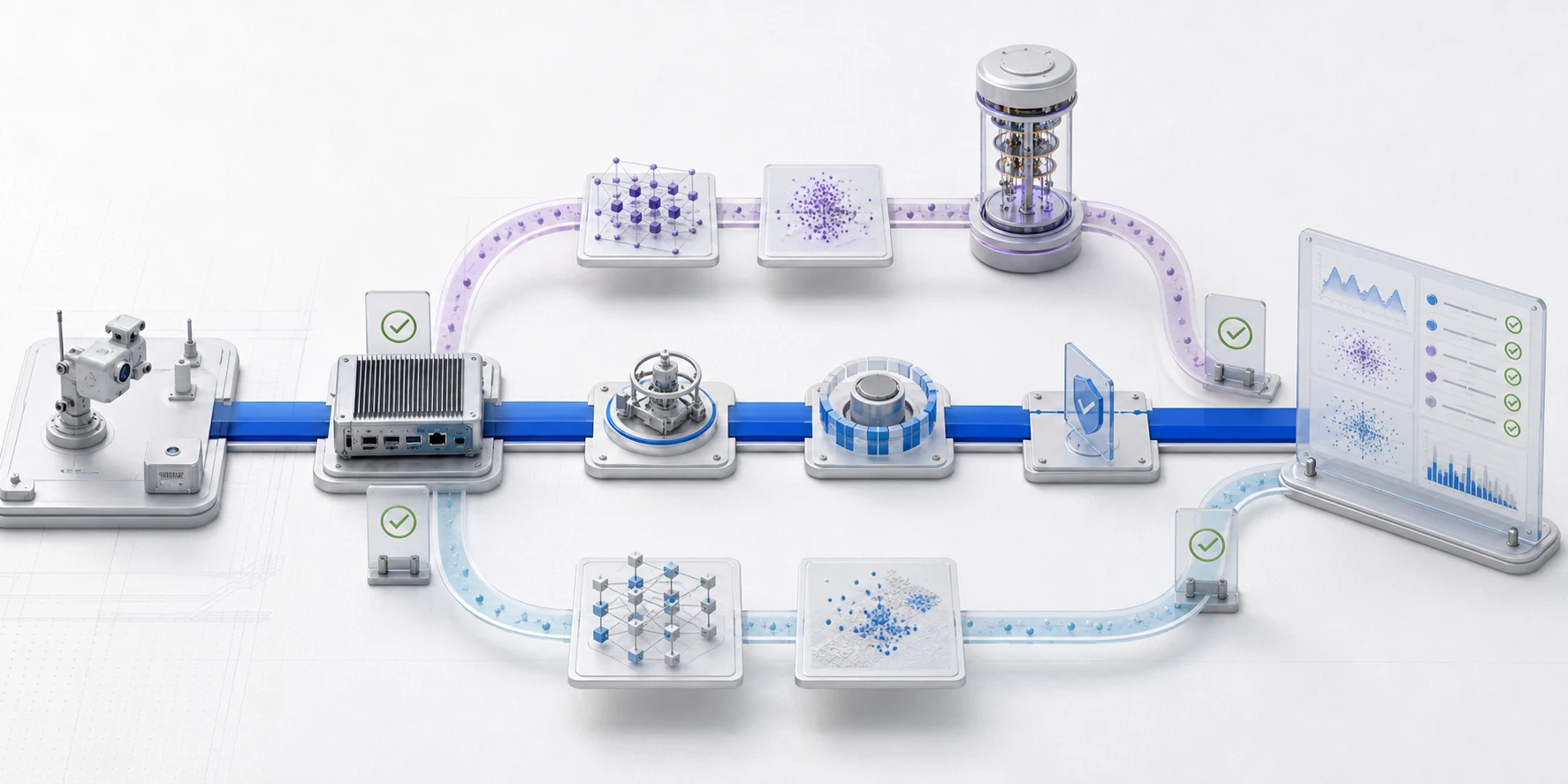
Gap map
One problem contract, several evaluation routes
Alternative compute can be compared only after the workload, constraints, baseline, output contract, and review criteria are fixed.
Classical path
- Required baseline
- Edge-operable fallback
- Safety and hard-real-time control
- Reference output
Quantum-inspired path
- Same problem representation
- Heuristic comparison
- Resource and latency record
- No promotion by label
Quantum path
- Simulator before hardware
- Backend and calibration context
- Bounded advisory output
- Classical planner remains
Evidence gate
- Quality and validity
- Reliability and latency
- Cost and integration burden
- Operational decision value
TD · Technical depth5 supporting chapters and the working checklist.Read deeper
Only bounded, latency-tolerant planning questions belong on the comparison track.
Not every computational problem becomes a quantum candidate because it is difficult. A candidate should have an explicit objective, input and output contract, measurable constraints, a credible classical solver, and enough latency tolerance to run outside the local safety loop.
For NODERIQ, public research categories include selected belief-estimation, task-allocation, route, and resource-optimization questions. These categories are deliberately broad. The public site does not disclose operational formulations, QUBO construction, routing thresholds, provider settings, circuit designs, or mission-specific objective functions.
- Hard real-time platform control stays local and classical.
- Safety enforcement stays deterministic and available without a provider connection.
- Alternative compute returns advice or evidence to a classical planner.
- A method is promoted only for a named workload and measured operating envelope.
The comparison is meaningless unless every route solves the same problem.
Applied quantum projects often fail at the boundary between formulations. A quantum route receives a simplified problem, the classical solver receives the full one, and the final comparison credits the algorithm rather than the changed assumptions. NODERIQ's proposed method fixes the problem contract before comparing methods.
That contract includes inputs, constraints, objective, output semantics, uncertainty representation, time budget, resource accounting, and the evidence packet returned to the planner. A strong classical baseline is recorded first. Quantum-inspired and quantum routes then have to preserve the same decision-relevant information.
Define, simulate, preserve, then qualify.
The first gate asks whether the workload is well defined and appropriate for an advisory path. The second asks whether the method is valid in simulation against a trusted reference. The third asks whether available hardware preserves the necessary information and constraints. The fourth asks whether the complete path adds operational value after latency, reliability, cost, integration effort, and review burden are included.
Failure at any gate is a normal outcome. The workload remains classical, the evidence is retained, and the experiment can be revisited when the method or hardware changes. The gate protects the product roadmap from becoming a sequence of quantum promises detached from user value.
- Define: explicit workload, constraints, authority, and baseline.
- Simulate: valid result under controlled, reproducible conditions.
- Preserve: hardware output retains the information the planner needs.
- Qualify: end-to-end value survives latency, reliability, cost, and integration review.
No advantage is still a valuable engineering result.
A negative result narrows the operating envelope. It can show that a formulation is classically tractable, that encoding cost dominates, that device noise changes the decision, that queue and execution latency remove practical value, or that integration effort exceeds the benefit. Each finding prevents future teams from repeating an expensive assumption.
QFlow Studio is the relevant Neura Parse surface for preserving that record: workload definition, baseline, provider and backend context, resource estimate, result, limitation, and promotion decision. The value is a reusable evidence package, not a screenshot of a circuit run.
Quantum evidence returns to a classical decision loop.
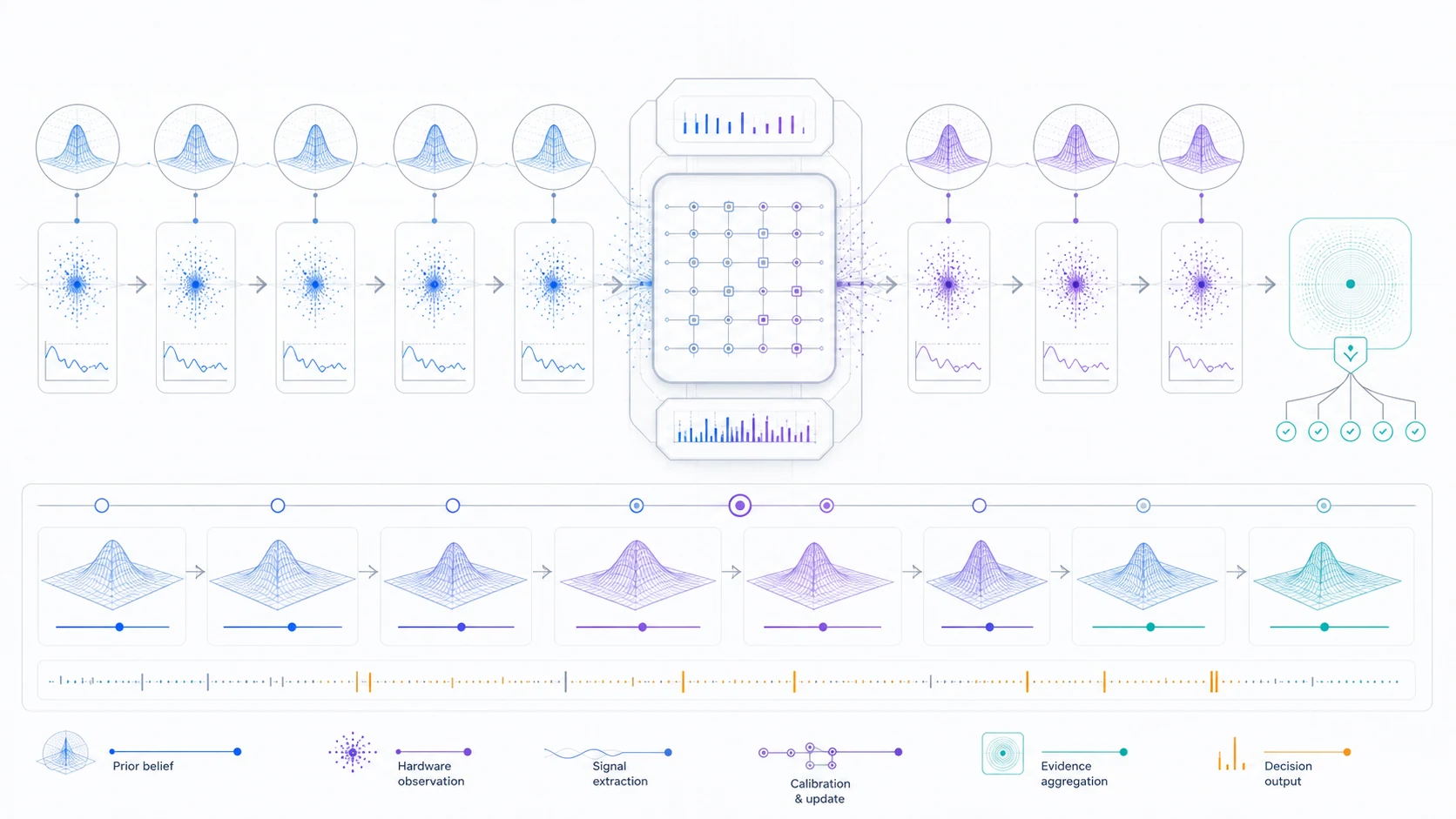
The public QANTIS paper provides a useful pattern. It treats quantum hardware as a calibrated belief-update service for a bounded rare-evidence term. A classical planner supplies the prior and observation model; the service estimates evidence; an ordinary posterior returns to classical software. The paper keeps policy selection and action execution outside the quantum claim.
NODERIQ generalizes the operating principle, not the paper's controlled result. Suitable subproblems may enter a QANTIS or other evaluation route, but the shared world model, mission logic, human authority, and safety controls remain part of the classical programme. Nothing on this page claims quantum advantage, wall-clock speedup, or production quantum integration.
Practical takeaways
01
Make the classical edge path a permanent product invariant, not a temporary fallback.
02
Keep hard-real-time safety and control outside remote or experimental compute routes.
03
Fix one problem and output contract before comparing classical, quantum-inspired, and quantum methods.
04
Use define, simulate, preserve, and qualify gates to stop unsupported promotion.
05
Record negative results as reusable evidence that improves the roadmap.
RA · Reference annexDefinitions, recurring questions, editorial method, and primary sources.Inspect
The analysis above carries the main reading flow. This reference layer keeps terminology, recurring questions, editorial method, and primary sources available without interrupting the argument.
Editorial record
How Evaluating hybrid compute for NODERIQ. was checked.
- Editorial owner
- Neura Parse Research
- Last verified
- July 17, 2026
- Method
- Synthesis of the dated primary and official records listed below, checked against the operating question in this note.
- Scope limit
- Planning analysis—not certification, customer performance evidence, procurement advice, or a claim of production readiness.
SRSources reviewed
5 records