
Learn
I want to understand quantum computing.
Best for · Beginners · students · developers
Start with one Bell-state circuit on a local simulator. Predict the result, run it, and explain what the measurements mean.
Quantum, from the beginning
You do not need a quantum computer, provider account, or physics degree for the first step. Learn the basic model, run one circuit locally, and keep the result understandable.

Choose by intent
Pick one path. You can ignore the rest of the page until that path becomes relevant.
Learn
Best for · Beginners · students · developers
Start with one Bell-state circuit on a local simulator. Predict the result, run it, and explain what the measurements mean.
Evaluate
Best for · Research · enterprise teams
Define the question and classical baseline first. Move to real hardware only when physical-device behaviour can change the decision.
Secure
Best for · Security · infrastructure leaders
Treat post-quantum migration as a separate classical engineering programme: inventory, prioritise, pilot, and build crypto agility.
Complete beginner
Understand one circuit before collecting tool names
A first circuit you can predict and explain
Student or educator
Turn foundations into a four-week learning route
An assessable lab record and portfolio artifact
Software developer
Build an inspectable Qiskit workflow
Readable source with a simulator baseline
Research team
Make the experiment repeatable before making a claim
A reproducible experiment record
Enterprise team
Frame a bounded pilot with a classical baseline
A pilot that can support an investment decision
Security leader
Treat post-quantum migration as a separate programme
A risk-prioritized migration starting point
Your first 30 minutes
IBM’s quickstart reviewed on 11 August 2026 uses Qiskit 2.5-compatible packages and a local StatevectorSampler. The first workflow needs no provider login or API key.
The circuit
q0 |0⟩ ── H ── ● ── M
q1 |0⟩ ─────── X ── M
Expect mostly 00 and 11. A successful Bell run demonstrates the workflow; it does not demonstrate useful quantum advantage.
Write down the expected result before touching the run button: a Bell circuit should produce strongly correlated 00 and 11 measurements.
Keep · one-sentence prediction
Create H plus CX, add two measurements, inspect the Qiskit source, and use a local StatevectorSampler before introducing a provider account.
Keep · circuit, source, and raw counts
Describe the distribution and sampling variation. Record the environment, settings, result, limitation, and one deliberate revision.
Keep · interpretation and evidence packet
Frame and predict
Write the question first: after a Bell-state circuit, you expect strongly correlated 00 and 11 measurements rather than every bit string.
Retain · One-sentence prediction
Build H + CX
Prepare two qubits, apply a Hadamard gate to the first, use it as the control for a CX gate on the second, then measure both.
Retain · Two-qubit circuit
Inspect the source
Find the circuit, registers, H, CX, measurement, shot count, execution route, and result object in the generated or written Qiskit source.
Retain · Reviewed source
Run locally
Use a local StatevectorSampler before creating a provider dependency. Repeat with different shot counts and keep the raw counts.
Retain · Simulator result record
Explain the distribution
Describe the expected correlation, sampling variation, and why a successful Bell run is not evidence of useful quantum advantage.
Retain · Short interpretation
Preserve and revise
Save the question, workflow, source, environment, route, settings, result, interpretation, limitations, and one deliberate change.
Retain · Reviewable evidence packet
Week 1
Bits and qubits, state, gates, circuits, measurement, probability, and the limits of common analogies.
Checkpoint · You can predict and explain a small circuit without code.
Week 2
Bell states, interference, shot-based results, local simulation, Qiskit structure, and OpenQASM inspection.
Checkpoint · You can connect a circuit diagram, source, and result record.
Week 3
Oracle-based search, variational workflows, classical optimization loops, baselines, noise, and repeated trials.
Checkpoint · You can describe an algorithm without claiming automatic speedup.
Week 4
Problem framing, simulator validation, optional QPU qualification, run metadata, interpretation, limitations, and revision.
Checkpoint · You have a portfolio artifact with method, evidence, and limits.
Real hardware comes later
A QPU is not the default run button. Promote a workflow only when topology, supported instructions, calibration, noise, queue, or another physical constraint matters to the result.
| Review question | Local simulator | QPU promotion |
|---|---|---|
| Does the local workflow pass? | The prediction, circuit, source, parameters, and result parsing work in a controlled local route. | Do not submit yet if logic, measurement, or result handling is still changing. |
| Is hardware behavior part of the question? | Use local reference primitives for ideal logic checks; use a noise-aware simulator when a modelled device comparison is useful. | A QPU is justified when topology, ISA, calibration, noise, queue, or physical-device behavior can change the decision. |
| Is the target fit understood? | Record circuit width, depth, observables, shots or precision, and the expected output contract. | Select a target, transpile to its ISA, inspect layout and depth, and confirm the primitive and execution mode. |
| Are access and stop conditions explicit? | Keep the reproducible baseline and expected result before introducing provider state. | Verify account, instance, plan, region, queue, usage budget, data boundary, job retention, and the condition that stops more runs. |
Qiskit
Open-source SDK
Build circuits and operators, use local reference primitives, transpile for a target, and work with execution results.
Boundary · Qiskit does not itself grant an IBM Quantum account, instance, plan, allocation, or QFlow product capability.
IBM Quantum
Provider platform
Controls its platform, accounts, instances, plans, Runtime services, available QPUs, access terms, and hardware documentation.
Boundary · Availability and entitlement are provider-controlled and must be checked live before a lab or paid run.
QFlow Studio
Neura Parse product
Connects visual workflow intent, generated source views, local simulator routes, run history, Academy labs, and reviewer-safe evidence.
Boundary · It does not replace Qiskit or IBM Quantum. Provider routes remain status-labelled; specialized routes and qOS remain planned or in development.
Neura Parse is an IBM Partner Plus member. This does not imply IBM endorsement, IBM Quantum Network membership, certified QFlow integration, bundled or privileged QPU access, or research validation.
Choose a next surface
Pick the surface that matches the work. A product feature, research result, and guided programme do not inherit one another’s maturity or evidence.
Product
Commercial visual quantum workflow and learning product connecting canvas, generated Qiskit, Cirq and OpenQASM views, local simulation, run history, Academy, and evidence.
Public research
Guided delivery
Education programmes, repeatable research workflows, and bounded enterprise pilots with baselines, resource estimates, evidence gates, and handover records.
Learn and build
Commercial visual quantum workflow and learning product connecting canvas, generated Qiskit, Cirq and OpenQASM views, local simulation, run history, Academy, and evidence.
Boundary · Current, beta, validation-only, preflight, credential-test, and planned routes remain explicitly separate.
Decision research
Community Edition research on quantum belief updates and data association, including two public 2026 arXiv papers reporting IBM Heron experiments.
Boundary · The latest study treats the QPU as a calibrated belief-update service inside a classical planning loop; it is not a total-runtime or quantum-advantage claim.
Research substrate
Typed quantum IR, backend abstraction, signed manifests, hybrid scheduling, and fault-tolerant promotion research.
Boundary · qmesh composes with Qiskit, Cirq, and PennyLane; it is not positioned as their replacement.
Quantum–AI research
Quantum memory-augmented neural-network research with theoretical, simulation, and hardware modes plus a cost check before hardware execution.
Boundary · Mode and cost boundaries must remain visible; a simulated or hardware run is not an automatic performance claim.
Applied delivery
Education programmes, repeatable research workflows, and bounded enterprise pilots with baselines, resource estimates, evidence gates, and handover records.
Boundary · The service structures an evaluation; it does not promise a useful quantum advantage or provider entitlement.
A separate security track
Learning circuits and migrating cryptography are different jobs. The security route starts with ownership and inventory—not with a QPU experiment.
Connect cryptography to systems, data lifetimes, protocols, certificates, libraries, hardware, suppliers, and accountable owners.
Rank long-lived data, externally exposed protocols, critical services, hard-to-update devices, and supplier dependencies.
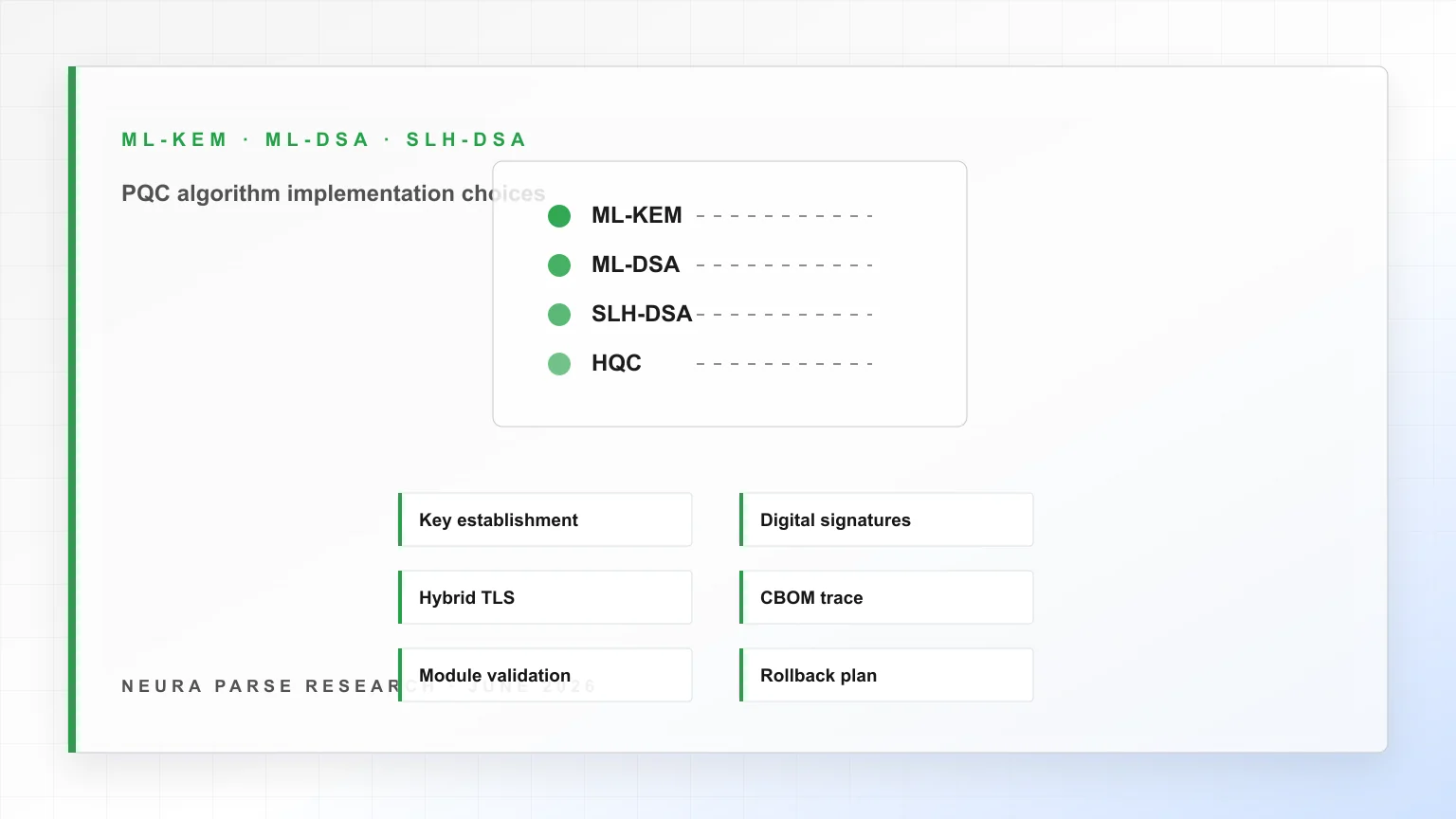
Test ML-KEM for key establishment and ML-DSA or SLH-DSA for signatures where profiles and product support are appropriate.
Make algorithms replaceable while preserving security and operations; retain interoperability, rollback, performance, and audit evidence.
Answers and evidence
The core path ends above. These questions and sources are here when you need to verify a detail, provider boundary, roadmap item, or current standard.
Quantum computing processes information with controllable quantum systems. A useful introduction follows how states are prepared, transformed by operations, and measured—not the misleading claim that a machine simply tries every answer at once.
No. Quantum algorithms address particular problem structures under specific assumptions. Evaluation still needs a problem mapping, classical baseline, realistic resource estimate, and total-workflow evidence.
No. A careful circuit model, basic algebra and probability, and a normal computer are enough for the first local labs. Deeper hardware, algorithm, and error-correction work adds more physics and mathematics as the questions demand it.
Build a Bell-state workflow: predict correlated outcomes, create H plus CX and measurements, run locally, inspect the source, vary shots, explain the distribution, and retain the evidence.
Use a QPU when physical target behavior can change the answer and the simulator workflow already passes. Record the target, ISA circuit, access, queue, usage, calibration context, job ID, evidence need, and stop condition.
No. Qiskit provides independent software tools, IBM controls its platform and hardware access, and QFlow Studio is a Neura Parse workflow, learning, and evidence layer around those kinds of tools and routes.
No. It is a company-level ecosystem programme status. It does not imply IBM endorsement, IBM Quantum Network membership, a jointly developed or certified QFlow integration, bundled hardware access, privileged access, or research validation.
No. PQC uses classical computers and quantum-resistant cryptographic standards. Learning quantum circuits and migrating enterprise cryptography are related strategic topics but different engineering programmes.
Last reviewed 11 August 2026. Check mutable software, access, roadmap, and standards details at the primary source before a course, pilot, or paid run.
Reviewed 11 August 2026: the official local Bell quickstart recommends Qiskit 2.5.0-compatible packages and uses StatevectorSampler without a provider login.
Official boundary between local reference primitives and target-specific ISA preparation for Runtime workflows.
Official account, target selection, ISA transpilation, primitive execution, job, and analysis workflow.
Official current API context for rewriting circuits to target topology and supported instructions.
Updated March 2026. IBM labels roadmap items as current intent, goals, and objectives that can change or be withdrawn.
Official programme overview. Neura Parse membership is company-level and does not establish product certification, IBM Quantum Network status, endorsement, or hardware entitlement.
Updated 5 August 2026. NIST says organizations should begin applying the principal standards now and describes the transition toward 2035.
Final NIST module-lattice-based key-encapsulation mechanism standard, published 13 August 2024; its page carries a November 2025 potential-update notice.
Final NIST module-lattice-based digital signature standard, published 13 August 2024; NIST added a minor-errata planning note on 31 July 2026.
Final NIST stateless hash-based digital signature standard, published 13 August 2024.
Final guidance updated 29 June 2026; it supersedes the withdrawn original CSWP 39 page.
NIST's 12 June 2026 preliminary PIV materials illustrate incremental, dual-stack transition work; they are not final public drafts.
Product documentation for visual workflows, Academy, provider routes, runs, evidence, security, and APIs.
Submitted 28 February 2026. The paper reports IBM Heron experiments and explicitly does not claim wall-clock advantage.
Submitted 7 July 2026. The QPU is framed as a calibrated belief-update service inside a classical planning loop.
Start locally. Keep one clear question, one result, and one limitation together.