Abstract
The practical operating layer is an assurance console for uncrewed systems: signed builds, model lineage, policy bundles, human authority, device identity, degraded-mode behavior, and post-run evidence across mixed aerial and ground assets.
Gap map
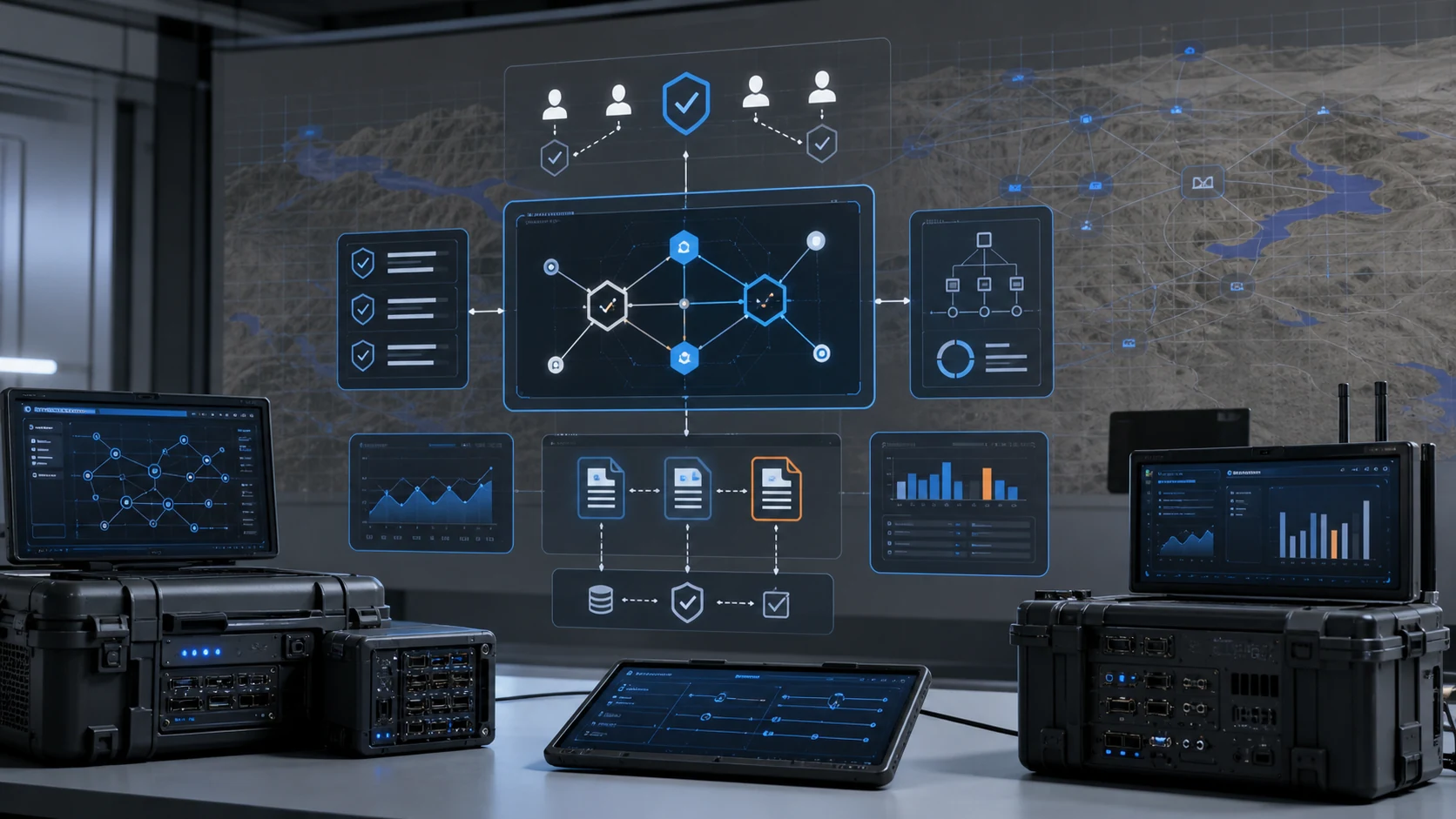
Uncrewed assurance map
Mixed autonomous assets need one evidence contract across build, deployment, runtime, and review.
Before run
- Software bill
- Model lineage
- Policy bundle
- Authority class
During run
- Device identity
- Health state
- Comms quality
- Fail-safe monitor
After run
- Telemetry package
- Exception review
- Operator notes
- Rollback decision
The autonomy question is becoming a lifecycle question.
DARPA DICE and CLARA frame the hard parts of defense AI as collective behavior, compositional reasoning, and high assurance. DARPA RACER adds a robotics angle: autonomy in complex environments is a perception, runtime, and resilience problem. DoD responsible-AI resources keep the governance bar visible.
Uncrewed systems should be treated as lifecycle-managed software systems. A drone, UGV, sensor asset, or field robot is only as trustworthy as the build, policy, operator authority, telemetry, and update path around it.
TD · Technical depth7 supporting chapters and the working checklist.Read deeper
An assurance console should sit above the fleet.
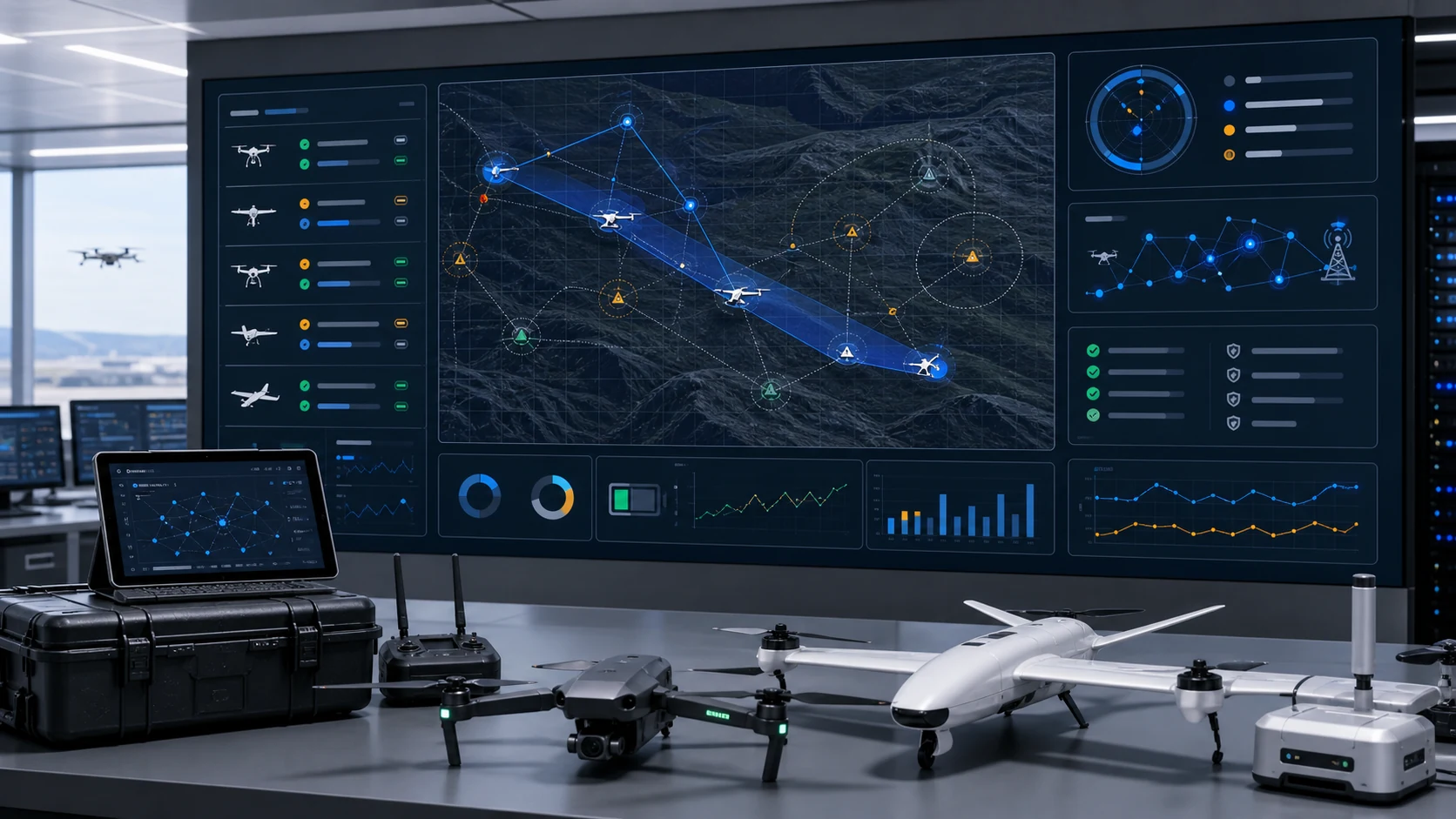
The console should show readiness across heterogeneous assets: aerial platforms, ground robots, edge gateways, sensors, and operator stations. It should not be only a map. It should show whether the system is allowed to run, why it is allowed, which version is active, and what evidence will be retained.
NeuraOS can enforce signed runtime, edge policies, health checks, model encryption, telemetry compression, and OTA rollback. NowFlow can orchestrate readiness checks, approvals, maintenance tasks, and incident review. QANTIS can score uncertainty when a decision owner needs to compare options.
- Bundle software version, model version, policy, calibration, and manifest into a release package.
- Expose per-device readiness: attestation, battery, comms, sensor health, model health, and last evidence upload.
- Route exceptions to humans with context, not only alarms.
- Retain evidence packages that can be replayed without relying on live vendor systems.
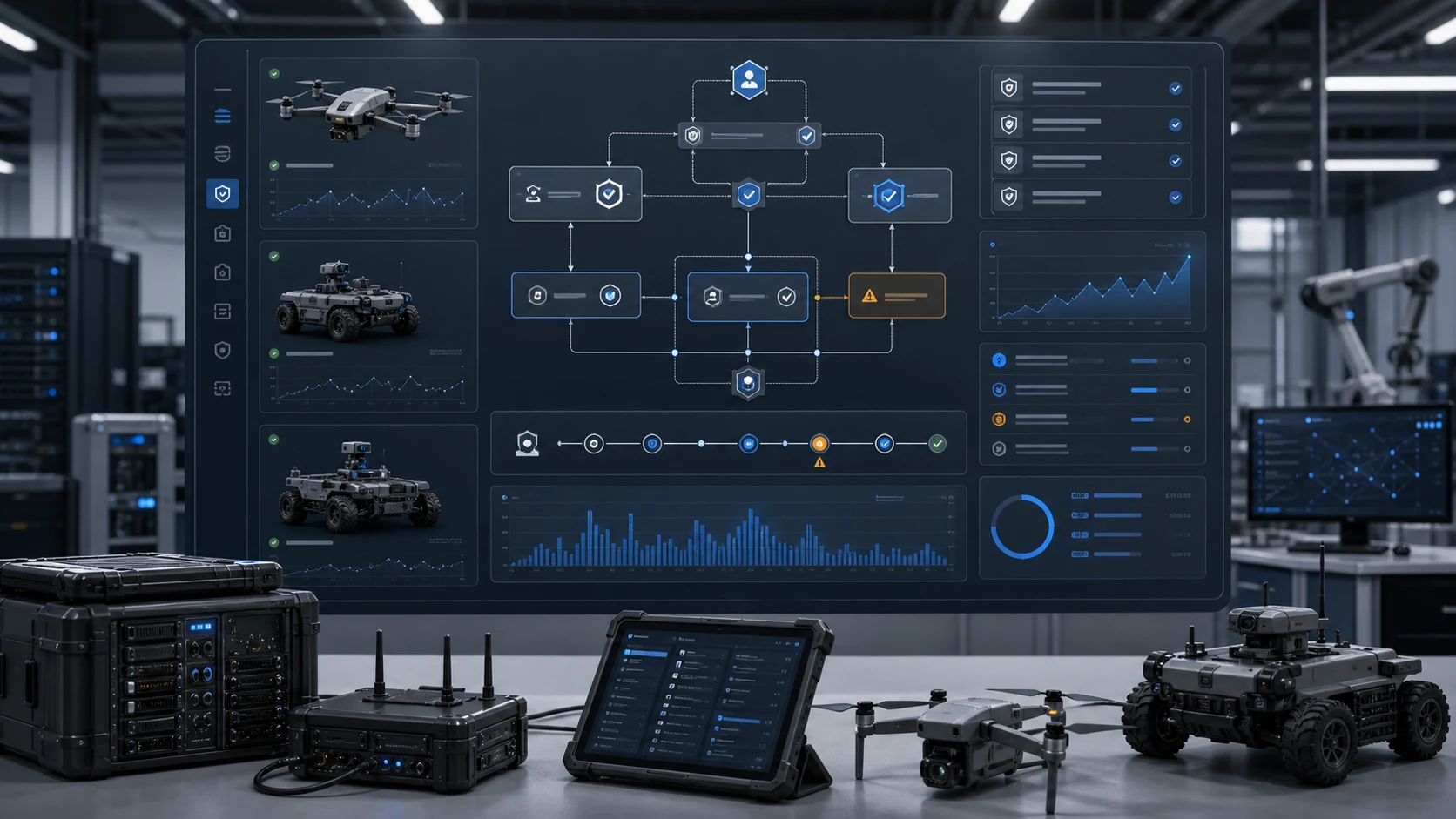
Use a system-assurance board, not a decorative fleet map.
The user interface should make authority and runtime state readable at a glance: signed release cards, device readiness, policy gates, human checkpoints, telemetry timelines, and fail-safe state. This is more useful than a decorative fleet map because it exposes the actual operating contract.
The same operating grammar applies across defense, aerospace, robotics, and critical infrastructure: asset state plus workflow evidence, with uncertainty and authority kept visible.
Mixed uncrewed fleets need assurance infrastructure.
Public discussion often jumps straight to autonomy, while a program must first manage configuration, authority, health, policy, exceptions, release identity, and evidence across mixed assets.
Assurance infrastructure gives product and engineering teams a useful operating layer without implying operational control or tactical outcomes.
Failure modes to design against before the first field trial.
Most uncrewed-systems failures that matter to a program office are not exotic. They are lifecycle failures: an asset running an unverified build, a model whose lineage nobody can state, a policy bundle that drifted from what was approved, or a degraded-mode behavior that was never exercised. Each of these is invisible on a map view and obvious on an assurance board. That is the argument for treating the console, not the vehicle, as the product surface.
The second family is authority failure. An advisory output gets treated as a command because the interface never distinguished analysis from execution. The countermeasure is structural, not procedural: authority classes on every step, separate trace objects for model output and device command, and human checkpoints that an alarm storm cannot bypass.
The third family is evidence failure. A run completes, something anomalous happens, and the telemetry needed to reconstruct it either was never retained or sits inside a vendor system the program cannot query. Designing evidence packages for offline replay before field testing is cheaper than reconstructing trust after an incident.
- Version drift: fielded software, model, or policy differs from the approved release package.
- Authority blur: advisory output reaches an actuator without an explicit approval step.
- Silent degradation: comms or sensor health decays without a visible fail-safe state change.
- Evidence gaps: post-run telemetry cannot be replayed independently of vendor systems.
- Untested fail-safes: stop, hold, return, and safe-state rules exist on paper but were never exercised.
Instrument identity and versions first, behavior second.
Programs often start instrumentation with mission behavior: routes, detections, task completion. The assurance view inverts that order. The first questions a reviewer asks are which device this is, whether its identity is attested, and which signed release it is running. Without those answers, behavioral telemetry cannot be trusted or even attributed.
The practical sequence follows the assurance map. Before the run: software bill, model lineage, policy bundle, and authority class. During the run: device identity, health state, comms quality, and fail-safe monitor. After the run: telemetry package, exception review, operator notes, and rollback decision. This ordering also matches the NIST AI Agent Standards Initiative priorities of identity, authorization, monitoring, and logging.
On the product side the sequence maps cleanly to the stack. NeuraOS carries the device-level primitives: signed runtime, health checks, telemetry compression, and OTA rollback. NowFlow carries the workflow-level primitives: readiness checks, approval routing, and incident review. The console reads both and presents one evidence contract.
- First: device identity and attestation.
- Second: signed release contents, including model lineage and policy bundle.
- Third: runtime health, comms quality, and fail-safe state.
- Fourth: post-run evidence packaging and exception review.
Evaluate vendors on evidence contracts, not autonomy demos.
An autonomy demonstration shows what a system can do in a favorable run. An evidence contract shows what a program can prove about every run. When comparing platforms, the differentiating questions are lifecycle questions: whether the release unit is signed, whether model lineage is stated, whether authority classes are explicit, and whether evidence can be replayed without the vendor's live systems.
This framing follows the direction of the cited public programs. DARPA CLARA treats high assurance as a first-class research goal, RACER treats resilience as inseparable from autonomy, and the DoD Responsible AI resources keep the governance bar visible for capability development. A vendor whose product cannot answer assurance questions is asking the program office to carry that risk.
Where a decision owner must compare options under uncertainty, the comparison itself should be evidenced. QANTIS is positioned for exactly that role: scoring uncertainty so the human decision, not only the vehicle behavior, leaves a reviewable record.
- Ask for the release unit: a signed package covering software, model, policy, calibration, and manifest.
- Ask for the authority model: advisory, supervised, approved, and blocked classes on every step.
- Ask for degraded-mode documentation: stop, hold, return, and safe-state behavior.
- Ask for evidence portability: replayable telemetry packages independent of vendor systems.
- Ask for the update path: OTA rollback and the decision record around it.
Operational checklist
Program checklist: assurance before fleet scale
Derived from the article's takeaways. Work through these before expanding an uncrewed fleet or accepting new autonomy claims.
- 01
Label every workflow step by authority class: advisory, supervised, approved, or blocked.
- 02
Bundle software version, model version, policy, calibration, and manifest into one signed release package per asset.
- 03
Record model output, policy decision, operator approval, and device command as separate trace objects.
- 04
Define degraded-mode behavior before deployment, including stop, hold, return, and safe-state rules.
- 05
Expose per-device readiness: attestation, battery, comms, sensor health, model health, and last evidence upload.
- 06
Route exceptions to a named human reviewer with context, not only alarms.
- 07
Retain post-run evidence packages that can be replayed without live vendor systems.
- 08
Require rollback plans and evidence retention for every high-risk workflow before field testing.
- 09
Verify OTA update and rollback paths on the edge runtime before adding assets to the fleet.
Practical takeaways
01
Uncrewed systems need lifecycle evidence before fleet-scale autonomy claims.
02
Advisory intelligence and authority-bearing action must remain visibly separate.
03
NeuraOS should own signed edge runtime and fail-safe policy enforcement.
04
NowFlow should own approvals, readiness workflows, and incident review.
05
QANTIS should support uncertainty and risk evidence for human decision owners.
RA · Reference annexDefinitions, recurring questions, editorial method, and primary sources.Inspect
The analysis above carries the main reading flow. This reference layer keeps terminology, recurring questions, editorial method, and primary sources available without interrupting the argument.
Terminology
Terms behind Uncrewed systems assurance: releases, authority, telemetry, and replay..
- IHA / SIHA
- Program shorthand for uncrewed aerial vehicles (IHA) and armed uncrewed aerial vehicles (SIHA). In this article they stand for aerial autonomy programs that face the same assurance requirements as ground and sensor assets.
- UGV
- Uncrewed ground vehicle: a ground robot operated without an onboard crew. One of the mixed asset classes an assurance console must cover alongside aerial platforms, sensors, edge gateways, and operator stations.
- Authority class
- A label on each workflow step that states how much power it carries: advisory, supervised, approved, or blocked. It makes visible which actions an AI system may only propose and which require explicit human approval.
- Signed release package
- A bundle of software version, model version, policy, calibration, and manifest that is cryptographically signed before deployment. Signing lets a reviewer verify exactly what is running on a device and detect drift from the approved release.
- Model lineage
- The recorded history of an AI model: where it came from, how it was produced or updated, and which version is deployed on which asset. Lineage lets a program answer which model produced a given output during post-run review.
- Degraded mode
- Predefined behavior for when a system loses comms, sensors, or health margins, typically stop, hold, return, or a safe state. The article's position is that degraded-mode behavior must be visible and reviewed before deployment, not discovered in the field.
- Attestation
- A device proving its identity and software state to the rest of the system, so the console knows it is talking to the right asset running the approved release. Attestation is part of per-device readiness alongside battery, comms, and sensor health.
- OTA rollback
- Over-the-air rollback: remotely reverting a fielded device to a previous known-good software or model version. It is the recovery half of the update path and a precondition for safe fleet-scale updates.
Field questions
Program questions behind Uncrewed systems assurance: releases, authority, telemetry, and replay..
Q01What does an assurance console for uncrewed systems actually show?
It shows readiness across heterogeneous assets: aerial platforms, ground robots, edge gateways, sensors, and operator stations. Beyond a map view, it answers whether each system is allowed to run, why it is allowed, which signed version is active, and what evidence will be retained. The board-level elements are signed release cards, device readiness, policy gates, human checkpoints, telemetry timelines, and fail-safe state.
Q02How should advisory AI be separated from authority-bearing action in an uncrewed fleet?
Advisory AI can summarize, detect anomalies, estimate risk, or propose a route without holding authority. Any action that affects safety, restricted systems, or mission risk needs explicit human authority and post-action review. In practice this means labeling every workflow step with an authority class (advisory, supervised, approved, or blocked) and keeping model output, policy decision, operator approval, and device command as separate trace objects.
Q03Which Neura Parse products cover which part of the uncrewed assurance stack?
NeuraOS, a governed edge operating platform for robotics and defence systems, enforces signed runtime, edge policies, health checks, model encryption, telemetry compression, and OTA rollback on the device. NowFlow, an agentic workflow platform with human-in-the-loop approval routing, orchestrates readiness checks, approvals, maintenance tasks, and incident review. QANTIS supplies uncertainty and risk evidence when a human decision owner needs to compare options.
Q04What belongs in a release package for an uncrewed asset?
The release unit should bundle software version, model version, policy, calibration, and manifest, signed as one package, so a reviewer can verify exactly what is running on each device. After the run, the matching evidence package should cover telemetry, exception review, operator notes, and the rollback decision. Evidence packages should be replayable without relying on live vendor systems.
Q05Why is assurance, not autonomy, the defensible lane for IHA, SIHA, and UGV programs?
Public conversation about uncrewed systems tends to jump straight to autonomy claims. Assurance infrastructure for mixed autonomous assets is commercially useful, aligned with governance expectations such as the DoD Responsible AI resources, and safer to communicate because it does not claim operational control or tactical outcomes. It also gives the product stack a clear role across defense, aerospace, robotics, and critical-infrastructure programs.
Q06How do DARPA DICE, CLARA, and RACER relate to a program office's assurance requirements?
DICE frames decentralized coordination and local inference control for resilient heterogeneous AI agent collectives, CLARA targets compositional learning and reasoning for high-assurance AI systems of systems, and RACER treats autonomy in complex environments as a perception, runtime, and resilience problem. Read together with the DoD Responsible AI Toolkit and the NIST AI Agent Standards Initiative, which prioritizes identity, authorization, monitoring, and logging, they point program offices toward lifecycle evidence rather than capability demonstrations alone.
Editorial record
How Uncrewed systems assurance: releases, authority, telemetry, and replay. was checked.
- Editorial owner
- Neura Parse Research
- Last verified
- July 12, 2026
- Method
- Synthesis of the dated primary and official records listed below, checked against the operating question in this note.
- Scope limit
- Planning analysis—not certification, customer performance evidence, procurement advice, or a claim of production readiness.
SRSources reviewed
5 records