Abstract
The strongest 2026 opportunity is not a more dramatic drone demo. It is an operating layer that turns BVLOS planning, airspace constraints, edge runtime state, telemetry, human authority, and post-flight evidence into one reviewable workflow.
Gap map
BVLOS operations map
The operating layer sits between flight-stack capability and regulator, operator, and customer trust.
Mission setup
- Airspace context
- Risk class
- Weather and constraints
- Operator authority
Runtime
- Detect-and-avoid state
- Edge model health
- Telemetry quality
- Fallback policy
Evidence
- Remote ID trace
- Flight log
- Exception review
- Safety case export
Drone autonomy is becoming an operations and assurance market.
The 2026 drone signal is regulation meeting product reality. FAA UAS guidance, BVLOS rulemaking, and EASA's civil-drone and U-space surface all point toward a future where scaling drone operations depends on demonstrable safety, identity, airspace coordination, and evidence.
This matters for commercial drones, IHA programmes, and SIHA-adjacent autonomy research, but the architecture should remain high-assurance rather than tactical. The useful layer is controlled operation: planning, authority, edge-runtime constraints, telemetry, exceptions, and review—not autonomous action for its own sake.
TD · Technical depth7 supporting chapters and the working checklist.Read deeper
BVLOS needs an evidence workflow.
Most drone software surfaces can show mission plans, vehicle position, or flight logs. Fewer connect the whole chain: why a mission was allowed, which airspace and safety assumptions were active, what the onboard runtime was allowed to do, what changed during flight, and which evidence package should be retained after the operation.
That evidence workflow becomes more valuable as fleets move beyond single-operator line-of-sight work into repeatable inspection, logistics, infrastructure, agriculture, public safety, and research programmes.
- Treat flight approval, route planning, weather limits, payload rules, and exception paths as workflow state.
- Bind each aircraft to device identity, signed software, model version, Remote ID status, and telemetry quality.
- Show detect-and-avoid and contingency behavior as reviewable evidence, not only as live UI.
- Keep human authority explicit for safety-impacting changes and post-flight exception closure.
Connect mission approval, edge runtime, and uncertainty evidence.
NowFlow handles mission requests, approvals, flight readiness, exception routing, customer notification, and evidence export. NeuraOS supplies signed runtime, local inference, telemetry, OTA rollback, and device-level policy. QANTIS is relevant when uncertainty, route choice, or sensor evidence affects a decision.
Together these layers turn drone autonomy into an operational system rather than a standalone flight-stack claim. The flight controller still matters, but the operating value comes from connecting flight capability to controlled, reviewable operations.
- Use NowFlow for mission intake, route review, approval gates, maintenance tasks, and incident closeout.
- Use NeuraOS for edge model packaging, secure boot, telemetry health, and rollback-aware OTA updates.
- Use QANTIS for uncertainty-aware route, sensor, and risk evidence where a human reviewer needs a clear confidence frame.
- Keep PX4, MAVLink, Remote ID, and UTM/U-space references as integrations, not as a closed proprietary stack claim.
A good UAV UI should expose the operating contract.
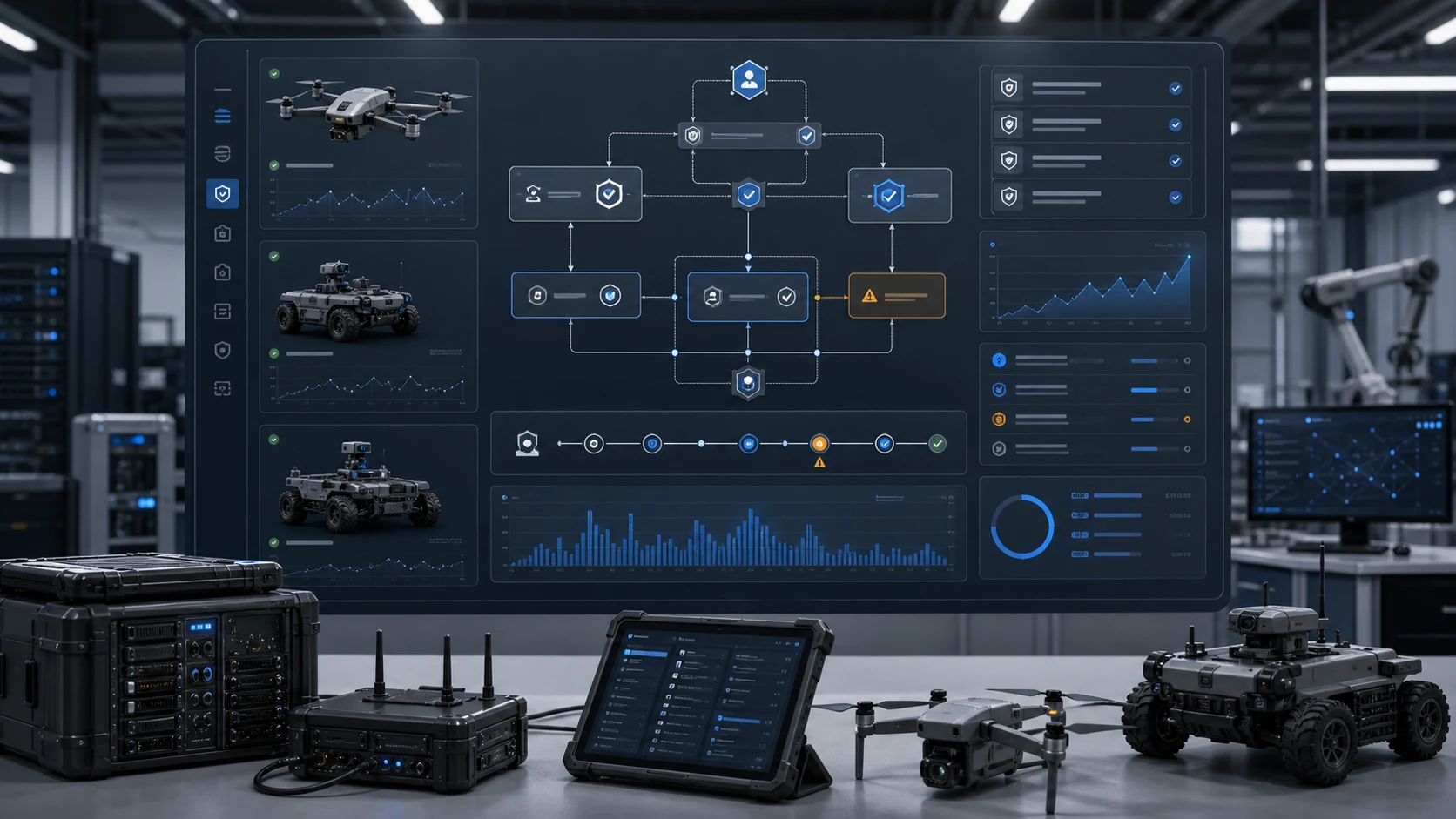
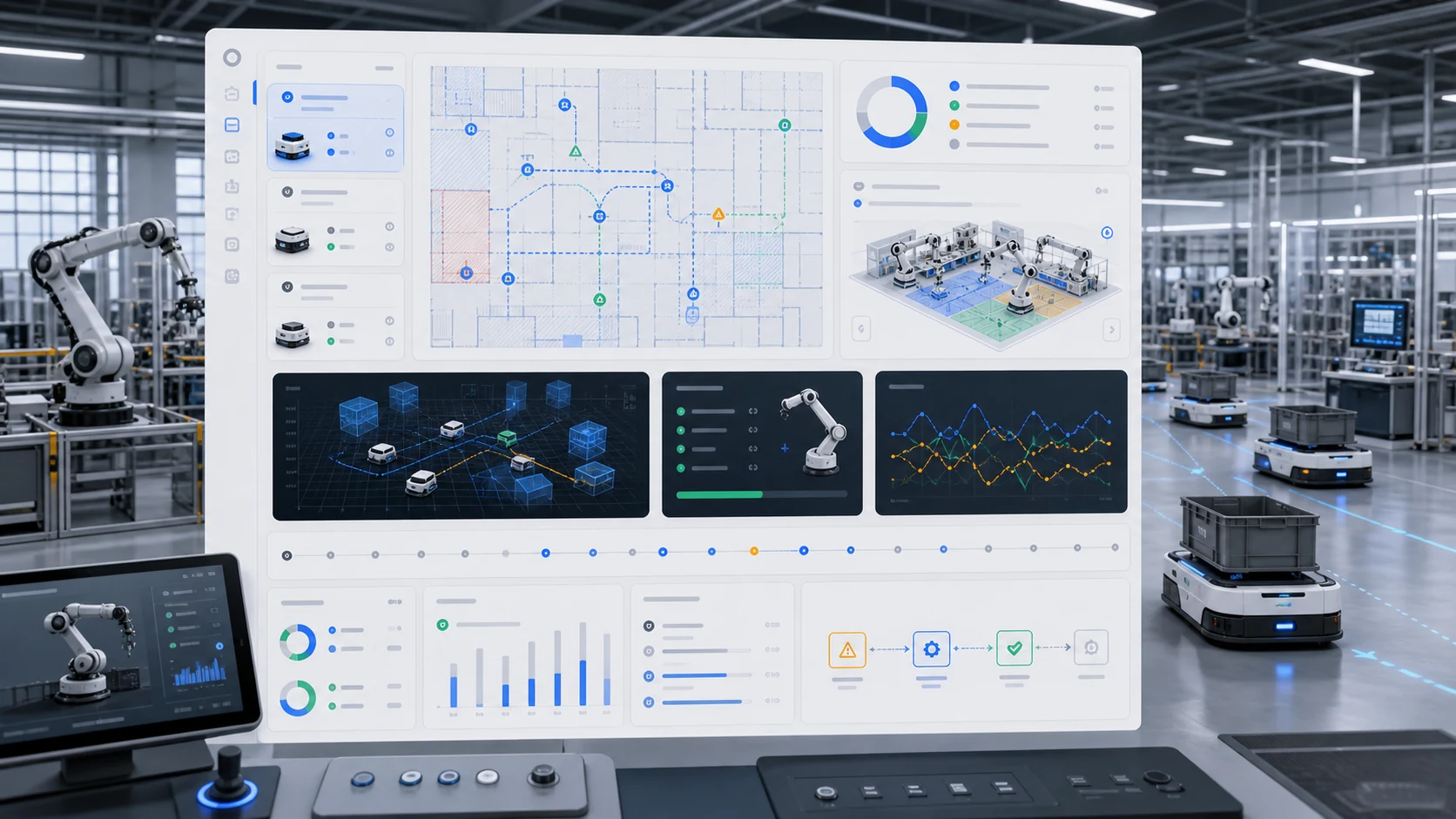
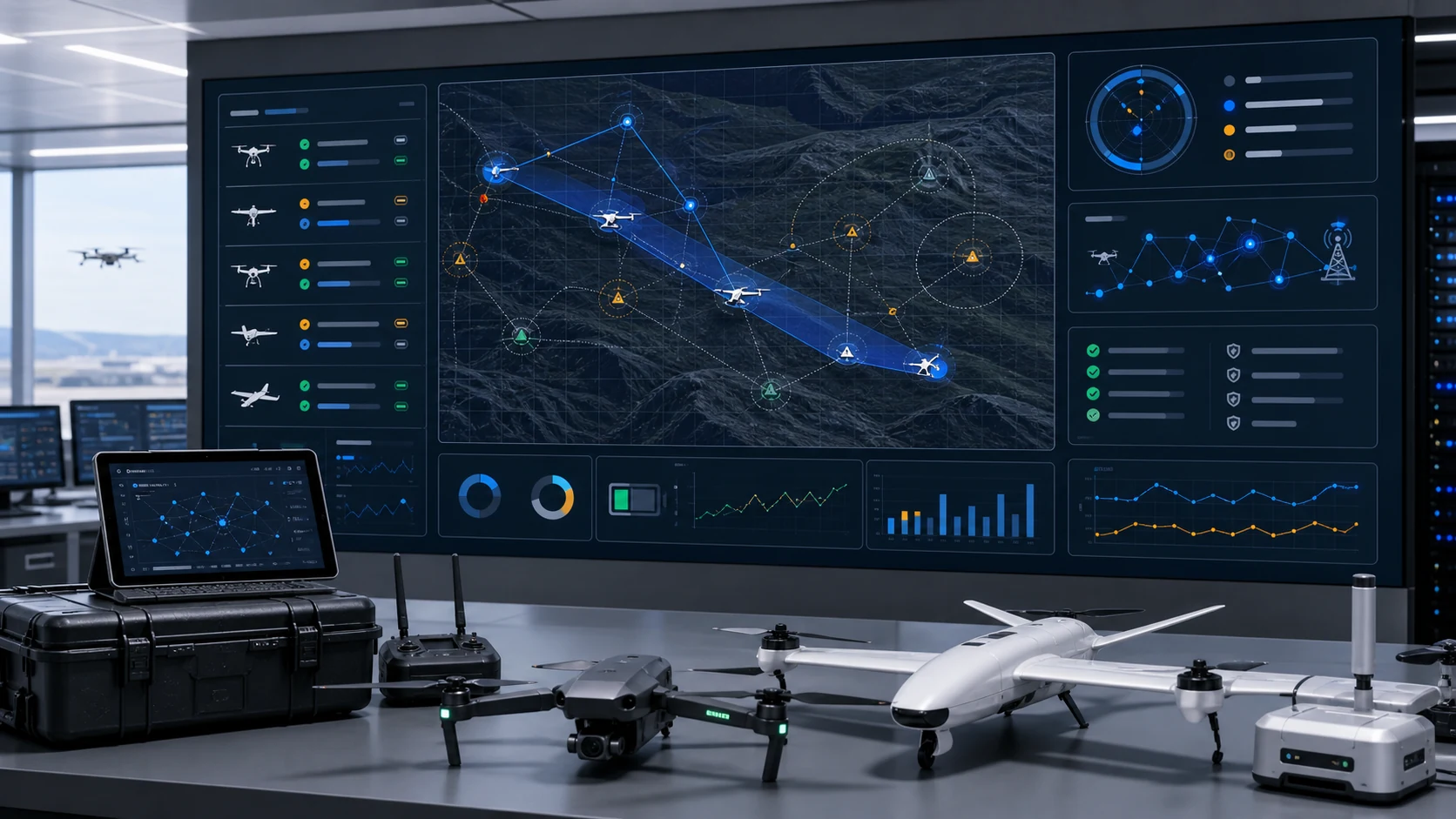
The interface should avoid cinematic drone art as the main product signal. Buyers need to see fleet readiness, route constraints, policy gates, device health, model status, comms quality, weather impacts, and evidence export in one scannable surface.
A useful operations console combines a map, fleet list, safety status, approval timeline, telemetry, exception state, and post-flight evidence. The interface should help an operator understand both what the aircraft is doing and why the operation remains authorized.
BVLOS is an operations-and-evidence category, not only a flight feature.
A BVLOS program connects workflow, edge AI, safety evidence, aircraft identity, U-space or UTM coordination, fleet telemetry, contingency handling, and post-flight review.
Framing the system around those operating records connects technology and regulation without making unsupported autonomy or readiness claims.
The evidence chain fails in predictable places.
BVLOS evidence chains rarely fail at the airframe. They fail in the seams between planning, runtime, and review. A mission gets approved against weather and airspace assumptions that nobody records. The aircraft flies, conditions change, and the fallback policy that actually executed is visible only in a live UI that nobody captured.
The second common failure is version drift. An OTA update changes the onboard model between two flights of the same route, and the flight logs look identical while the runtime behavior is not. Without signed software, recorded model versions, and rollback state, the post-flight review cannot say which system actually flew. Device identity and rollback-aware updates at the NeuraOS layer exist to close exactly this gap.
The third failure is authority ambiguity. Safety-impacting changes get made mid-operation without an explicit human decision record, and exceptions get closed without review. When a regulator or customer later asks who authorized what, the program has telemetry but no answer. Keeping operator authority as explicit workflow state is cheaper than reconstructing it afterward.
- Unrecorded planning assumptions that cannot be compared against what the flight encountered.
- Silent software or model version changes between flights of the same route.
- Telemetry gaps treated as normal noise instead of logged exceptions.
- Approvals reused across missions with different risk classes.
- Detect-and-avoid behavior visible only in live UI, never retained as evidence.
- Exceptions closed without an explicit human authority record.
Instrument the approval chain before the airframe.
Programs that start instrumentation at the sensor level tend to drown in data before they can answer basic assurance questions. The higher-leverage starting point is the approval chain: why a mission was allowed, which constraints were active, and who held authority. That state is small, structured, and maps directly to what regulators and customers ask for. It is also the state that FAA UAS guidance and EASA U-space rules implicitly require a program to be able to show.
Second, bind identity. Each aircraft should carry device identity, signed software, a recorded model version, Remote ID status, and a telemetry quality measure before any autonomy claim is made. This is the NeuraOS layer of the stack: signed runtime, local inference, telemetry health, and rollback-aware OTA updates.
Third, instrument exceptions rather than everything. A complete record of what deviated from plan, how detect-and-avoid and contingency logic responded, and how each exception was reviewed and closed is worth more than exhaustive raw logs. NowFlow-style workflow state makes exception routing and closure reviewable by default. QANTIS fits where a reviewer needs a clear confidence frame around uncertain route, sensor, or risk evidence.
- First: mission approval state, active constraints, and operator authority.
- Second: device identity, signed software, model version, Remote ID status, telemetry quality.
- Third: exception capture, detect-and-avoid behavior records, and review closure.
- Last: bulk raw telemetry retention, sized to what the evidence package actually needs.
Rulemaking sets the pace, evidence decides who scales.
The regulatory direction is set even where final text is not. FAA BVLOS rulemaking is on the public record with an active safety-framework comment history, and EASA's civil-drone and U-space surface continues to define how European operations coordinate categories, identity, and airspace. Programs should assume the compliance bar moves toward demonstrable safety and retained evidence, not away from it. Waiting for final rule text before building the evidence workflow is the expensive path.
On the capability side, edge compute keeps moving. Platforms in the Jetson Thor class push more inference onboard, which makes edge model health, signed runtime, and rollback more load-bearing, not less. Research programs like DARPA RACER show where resilient autonomy in complex environments is headed. The thesis holds either way: capability without an assurance layer does not convert into scaled operations.
For Neura Parse, the durable lane remains BVLOS drone operations software: workflow, edge AI, safety evidence, Remote ID, and U-space and UTM coordination. That framing connects product, regulation, and research without unsupported autonomy or operational claims. The programs that win the next 12 months will be the ones whose evidence packages are boring, complete, and exportable on demand.
Operational checklist
Program checklist: BVLOS evidence readiness
Derived from the article's takeaways. Work through the list before scaling any fleet beyond visual line of sight.
- 01
Model the full mission chain as workflow state: flight approval, route planning, weather limits, payload rules, and exception paths.
- 02
Bind every aircraft to device identity, signed software, a recorded model version, Remote ID status, and a telemetry quality measure.
- 03
Capture detect-and-avoid and contingency behavior as retained, reviewable evidence, not only as live UI.
- 04
Keep human authority explicit for safety-impacting changes and require a human record for post-flight exception closure.
- 05
Define the standard post-flight evidence package: Remote ID trace, flight log, exception review, and safety case export.
- 06
Verify that OTA updates are rollback-aware and that the software and model versions behind every flight are recoverable from the record.
- 07
Treat PX4, MAVLink, Remote ID, and UTM or U-space systems as integrations; do not build or claim a closed proprietary stack.
- 08
Track FAA BVLOS rulemaking and the EASA civil-drone and U-space surface, and map each requirement to a specific workflow gate.
- 09
Build the operator console around fleet readiness, route constraints, policy gates, device health, telemetry quality, and evidence export.
Practical takeaways
01
The 2026 drone-operations priority is assurance and workflow, not only flight autonomy.
02
BVLOS requires evidence around authority, airspace, runtime state, and exceptions.
03
NowFlow can own mission workflow and post-flight review.
04
NeuraOS can own signed edge runtime, telemetry health, and rollback.
05
QANTIS should support uncertainty-aware review rather than autonomous authority claims.
RA · Reference annexDefinitions, recurring questions, editorial method, and primary sources.Inspect
The analysis above carries the main reading flow. This reference layer keeps terminology, recurring questions, editorial method, and primary sources available without interrupting the argument.
Terminology
Terms behind BVLOS autonomy: the operating evidence a drone program needs..
- BVLOS
- Beyond visual line of sight: operations where the aircraft flies outside the operator's direct view. It is the trigger for scaled drone operations and the reason regulators demand identity, airspace coordination, and retained safety evidence.
- Remote ID
- A broadcast identity layer that ties an aircraft in flight to a registered identity. It functions as the identification surface regulators use to know which aircraft is operating where.
- U-space
- The European framework, under EASA rules, for coordinating drone traffic in shared airspace. It is the European counterpart to UTM.
- UTM
- UAS traffic management: systems that coordinate uncrewed aircraft in shared airspace through corridors, constraints, and deconfliction. Programs integrate with UTM rather than replacing it.
- Detect-and-avoid
- The capability that lets an uncrewed aircraft detect other traffic and hazards and respond safely. In BVLOS operations its behavior must be retained as reviewable evidence, not shown only in a live display.
- OTA rollback
- The ability to revert an over-the-air software or model update to a previous signed version if a deployment misbehaves. It keeps the fleet recoverable and keeps every flight traceable to a known runtime version.
- Safety case
- The structured evidence package that explains why an operation was allowed and how its risks were controlled. Exporting it after flight is what turns telemetry into something a regulator or customer can review.
- IHA / SIHA
- Turkish acronyms for unmanned aerial vehicle (IHA) and armed unmanned aerial vehicle (SIHA), commonly used for national UAV and combat UAV programs. The article treats SIHA-adjacent work as high-assurance autonomy research rather than tactical positioning.
Field questions
Program questions behind BVLOS autonomy: the operating evidence a drone program needs..
Q01What does BVLOS normalization actually change for a drone program in 2026?
It moves the scaling question from flight capability to demonstrable operations. FAA UAS guidance, the FAA BVLOS proposed rule record, and EASA's civil-drone and U-space rules all point the same direction: scaled operations depend on demonstrable safety, identity, airspace coordination, and retained evidence. Programs that can show why a mission was allowed and what the onboard runtime did will scale. Demos will not.
Q02What should the post-flight evidence package for a BVLOS operation contain?
At minimum: the Remote ID trace, the flight log, a record of any exceptions and how they were reviewed and closed, and an exportable safety case. The package should answer why the mission was allowed, which airspace and safety assumptions were active, what the onboard runtime was permitted to do, and what changed during flight. If detect-and-avoid or contingency logic fired, that behavior belongs in the retained record, not only in the live UI.
Q03How do NowFlow, NeuraOS, and QANTIS split responsibility in a drone operations stack?
NowFlow, an agentic workflow platform, owns mission intake, route review, approval gates, exception routing, maintenance tasks, incident closeout, and evidence export. NeuraOS, a governed edge operating platform for robotics and defence systems, owns the signed edge runtime, local inference, telemetry health, and rollback-aware OTA updates. QANTIS supports uncertainty-aware review where route choice, sensor evidence, or risk affects a decision. It does not make autonomous authority claims.
Q04Does this operating layer replace PX4, MAVLink, or existing UTM and U-space systems?
No. The flight controller still matters, and PX4, MAVLink, Remote ID, and UTM or U-space systems are treated as integrations, not as components of a closed proprietary stack. The operating layer sits between flight-stack capability and the trust of regulators, operators, and customers. Its job is to turn what the flight stack does into reviewable workflow state and retained evidence.
Q05Where does human authority belong in an increasingly autonomous BVLOS operation?
In two places, explicitly: safety-impacting changes during an operation, and exception closure after it. Autonomy can handle nominal execution, but the workflow should record who authorized deviations and who reviewed what went wrong. Keeping that authority as explicit workflow state is what makes an operation defensible to a regulator or customer later.
Q06Why is evidence the buying unit rather than autonomy?
Because the constraint on scaling is trust, not capability. Fleets moving beyond single-operator line-of-sight work into repeatable inspection, logistics, infrastructure, agriculture, public safety, and research programs must justify each operation to regulators and customers. The programs that can package that justification as exportable evidence are the ones that get to fly more missions.
Editorial record
How BVLOS autonomy: the operating evidence a drone program needs. was checked.
- Editorial owner
- Neura Parse Research
- Last verified
- July 12, 2026
- Method
- Synthesis of the dated primary and official records listed below, checked against the operating question in this note.
- Scope limit
- Planning analysis—not certification, customer performance evidence, procurement advice, or a claim of production readiness.
SRSources reviewed
5 records