
Abstract
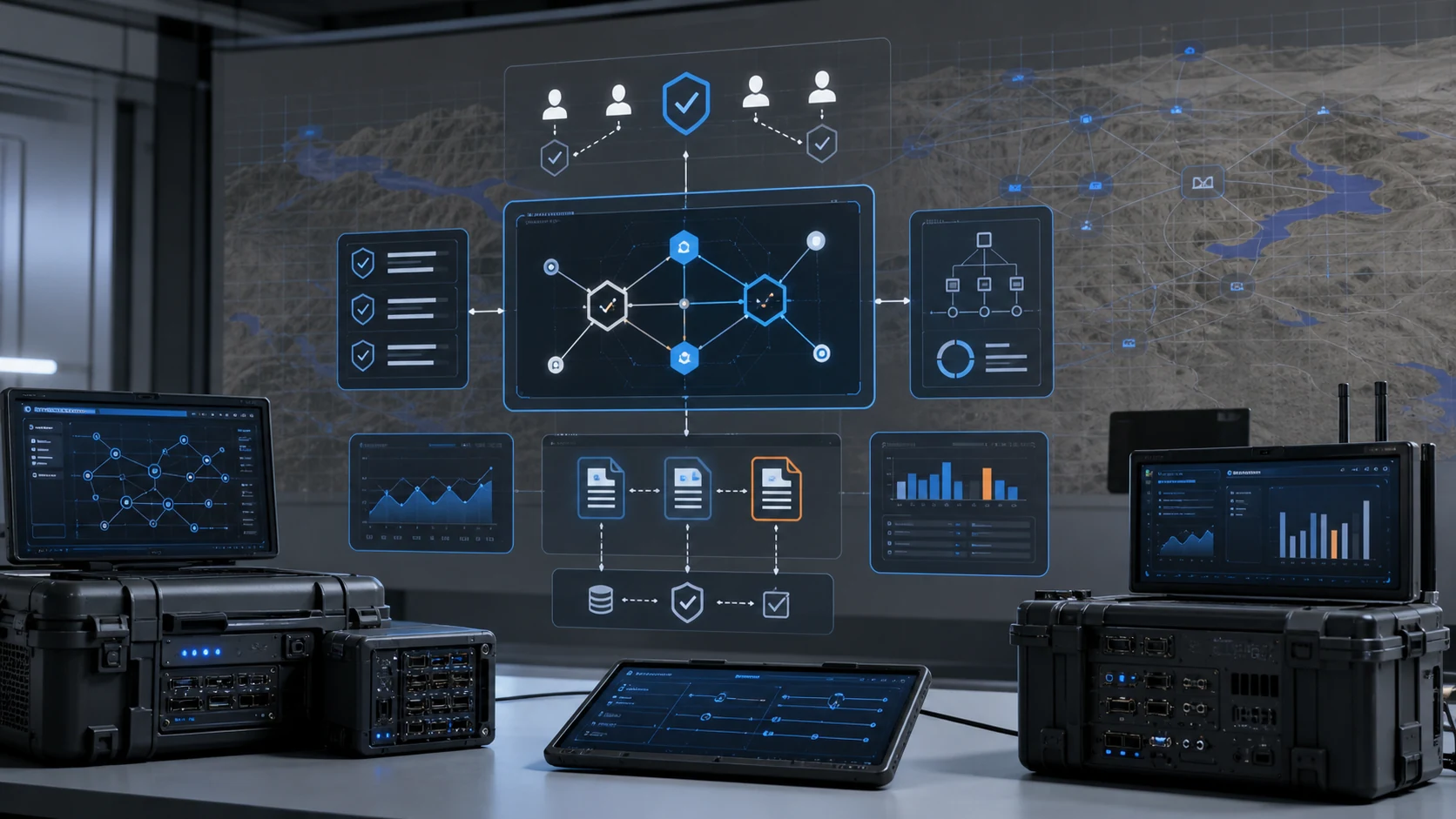
The product layer for defence AI should not be a magic autonomy button. It should be an assurance loop that shows objective, context, data provenance, policy state, operator approval, runtime telemetry, and fallback behavior.
Autonomy is becoming a systems assurance problem.
DARPA's DICE program focuses on decentralized AI agent collectives and controlled emergence. CLARA points toward compositional learning and reasoning for high-assurance AI systems. NATO's revised AI strategy and DoD Responsible AI resources emphasize responsible adoption, interoperability, accountability, and lifecycle discipline.
These sources do not imply that every defence workflow should become autonomous. They imply the opposite: as autonomy scales, the evidence layer must become stricter.
The relevant engineering question is not how to remove operators. It is how to give operators and reviewers a complete chain of evidence around AI-supported decisions.

TD · Technical depth6 supporting chapters and the working checklist.Read deeper
The assurance loop should be visible by default.
A useful defence AI workflow should preserve the objective, available context, model version, confidence signals, constraints, human approval state, deployment environment, and rollback path. That state must be inspectable before, during, and after execution.
NowFlow can provide the controlled workflow surface, and NeuraOS can host edge inference, telemetry, and fallback execution in constrained environments. QANTIS is relevant only where decision uncertainty, risk scoring, and verification are explicit parts of the research scope.
- Keep human authority explicit for actions that affect safety, mission risk, or protected systems.
- Treat each model recommendation as a proposal with provenance, constraints, and confidence context.
- Store traces that can be reviewed by engineers, operators, security teams, and programme owners.
- Design degraded-mode behavior before the first field pilot, not after a connectivity failure.
Local resilience is part of governance.
Edge systems face intermittent connectivity, sensor noise, resource limits, and changing mission context. Governance cannot depend only on a cloud dashboard if the runtime is expected to operate near the edge.
A controlled edge-AI runtime needs more than an embedded Linux base. It needs signed builds, device identity, local policy bundles, telemetry compression, secure update paths, and rollback behavior; NeuraOS is designed to supply that runtime layer.
- Bundle policy and model metadata with the deployable artifact.
- Use local health checks and watchdogs when cloud supervision is unavailable.
- Separate advisory AI from authority-bearing automation.
- Keep every edge release tied to a reproducible manifest and evidence record.
Do not oversell autonomy; make control inspectable.
Defence buyers and partners do not need vague AI transformation language. They need systems that can be tested, bounded, updated, explained, and stopped.
That makes AI assurance for defence edge systems an engineering priority: practical runtime, workflow, provenance, operator-control, and disengagement patterns aligned with public responsible-AI policy.
Most assurance failures are design omissions, not model errors.
The failure modes for contested-edge AI are largely known before deployment. Connectivity drops, sensors degrade, compute budgets shrink, and mission context shifts faster than any cloud dashboard refreshes. None of these are model failures. They are architecture failures that governance language cannot repair after the fact.
The more dangerous class is authority drift. An advisory system whose proposals are routinely accepted becomes authority-bearing in practice, even when no document assigned it that role. The separation between advisory AI and authority-bearing automation has to exist in the interface and the runtime, not only in the concept of operations.
Evidence gaps complete the list. A release without a reproducible manifest cannot be audited after an incident. A recommendation without provenance and confidence context cannot be reviewed. A runtime without a defined degraded mode fails unpredictably at exactly the moment review matters most.
- Connectivity loss that converts a supervised system into an unsupervised one with no defined degraded mode.
- Advisory outputs that accumulate de facto authority because approval is routine rather than deliberate.
- Model or policy updates shipped without signed builds or reproducible manifests.
- Confidence signals computed by the model but dropped at the operator interface.
- Governance evidence stored only in cloud systems the edge runtime cannot reach.
Instrument approval state and provenance first.
The assurance loop names eight state elements: objective, available context, model version, confidence signals, constraints, human approval state, deployment environment, and rollback path. Few programs can instrument all eight at once. The order matters.
Start with human approval state and provenance. These two anchor accountability. They answer who authorized an action and what evidence the recommendation rested on. Without them, the remaining telemetry describes behavior but cannot assign responsibility for it.
Model version and confidence signals come next, because they make review of individual decisions possible. Runtime telemetry, deployment environment, and rollback path close the loop and support degraded-mode operation at the edge. In the Neura Parse stack, NowFlow carries approval routes and workflow state, NeuraOS carries edge telemetry and fallback execution, and QANTIS applies where decision uncertainty and verification need dedicated treatment.
Evaluate vendors on inspectability, not autonomy claims.
Vendor evaluation for defense AI should invert the usual demo sequence. Do not start with what the system can do autonomously. Start with how it can be tested, bounded, updated, explained, and stopped, because those are the properties a program office must certify.
For edge runtimes, ask for the concrete mechanisms: signed builds, device identity, local policy bundles, telemetry compression, secure update paths, and rollback behavior. A vendor that cannot show these has an embedded Linux distribution, not a runtime for controlled edge AI.
For workflow layers, ask where human approval routes live and whether execution traces are reviewable by engineers, operators, security teams, and program owners. Treat performance, benchmark, and operational claims as unverified unless a released artifact or formal engagement backs them. The DARPA DICE and CLARA framing, NATO's revised AI strategy, and DoD Responsible AI resources all point to the same evaluation posture: evidence and lifecycle discipline over capability claims.
- Ask for the rollback path before asking for the roadmap.
- Require a reproducible manifest and evidence record for every release candidate.
- Verify that advisory and authority-bearing functions are separable in configuration.
- Confirm governance still functions with cloud supervision removed.
Operational checklist
Program checklist: standing up the assurance loop before autonomy scales
Nine actions derived from the article's takeaways. The first four establish accountability. The rest harden the edge runtime and the evidence trail.
- 01
Inventory every AI-supported decision and record its objective, context, model version, confidence signals, constraints, approval state, deployment environment, and rollback path.
- 02
Define which actions require explicit human approval, starting with anything that affects safety, mission risk, or protected systems.
- 03
Separate advisory AI from authority-bearing automation in the architecture and the operator interface, not only in policy documents.
- 04
Treat every model recommendation as a proposal that carries provenance, constraints, and confidence context.
- 05
Bundle policy and model metadata with each deployable edge artifact, and tie every release to a signed build, reproducible manifest, and evidence record.
- 06
Design and test degraded-mode behavior, local health checks, and watchdogs before the first field pilot.
- 07
Store execution traces in a form reviewable by engineers, operators, security teams, and program owners.
- 08
Align program documentation with NATO's revised AI strategy and DoD Responsible AI lifecycle expectations.
- 09
Remove performance, benchmark, and operational claims from program material unless a released artifact or formal engagement backs them.
Practical takeaways
01
Defence AI programs should lead with assurance, authority, and evidence rather than hype.
02
NowFlow is the right product frame for approval routes, audits, and mission workflow state.
03
NeuraOS is the right frame for edge runtime, signed updates, telemetry, and degraded-mode operation.
04
QANTIS belongs in decision assurance and research contexts where uncertainty and verification matter.
05
Responsible edge AI needs explicit authority, provenance, failure handling, and evidence.
RA · Reference annexDefinitions, recurring questions, editorial method, and primary sources.Inspect
The analysis above carries the main reading flow. This reference layer keeps terminology, recurring questions, editorial method, and primary sources available without interrupting the argument.
Terminology
Terms behind Defense AI at the contested edge: assurance loops before autonomy..
- Assurance loop
- The set of records and controls that surround an AI-supported decision, covering the objective, context, data provenance, policy state, operator approval, runtime telemetry, and fallback behavior. It makes the decision inspectable before, during, and after execution.
- Contested edge
- An operating environment near the point of action where connectivity is intermittent, sensors are noisy, compute is limited, and mission context keeps changing. Systems there cannot rely on continuous cloud supervision.
- Controlled emergence
- The research theme behind DARPA's DICE program: letting decentralized collectives of AI agents coordinate locally while keeping their collective behavior bounded and controllable.
- Provenance
- The recorded origin and history of a piece of data or a model output, including what produced it and under what constraints. It lets reviewers judge whether a recommendation should be trusted.
- Degraded mode
- A predefined way for a system to keep operating safely when part of its normal support is unavailable, such as cloud connectivity or a sensor feed. The article argues it must be designed before the first field pilot, not after a connectivity failure.
- Authority-bearing automation
- Automation permitted to act without a human approving each action, as opposed to advisory AI that only proposes. The two must be separated in system design so authority is assigned deliberately.
- Reproducible manifest
- A record attached to a software release listing exactly what went into it, so the same build can be recreated and audited later. Every edge release should be tied to one, together with an evidence record.
- Human approval state
- The recorded status of operator authorization for a given action within a workflow. It is kept explicit for actions that affect safety, mission risk, or protected systems.
Field questions
Program questions behind Defense AI at the contested edge: assurance loops before autonomy..
Q01What is an AI assurance loop, and how is it different from ordinary model monitoring?
An assurance loop preserves the full decision context around an AI-supported action: the objective, available context, model version, confidence signals, constraints, human approval state, deployment environment, and rollback path. Ordinary monitoring watches model outputs. The assurance loop makes the whole decision inspectable before, during, and after execution, by engineers, operators, security teams, and program owners.
Q02Do DARPA DICE and CLARA mean defense workflows are about to become fully autonomous?
No. DICE studies decentralized AI agent collectives and controlled emergence, and CLARA targets compositional learning and reasoning for high-assurance AI systems. Read together with NATO's revised AI strategy and DoD Responsible AI resources, the signal is the opposite of unchecked autonomy: as autonomy scales, the evidence layer must become stricter.
Q03How can governance hold when an edge system loses cloud connectivity?
Governance cannot depend only on a cloud dashboard if the runtime is expected to operate near the edge. Policy and model metadata should be bundled with the deployable artifact, local health checks and watchdogs should run when cloud supervision is unavailable, and degraded-mode behavior should be designed before the first field pilot. Each edge release should stay tied to a reproducible manifest and evidence record so behavior remains auditable after reconnection.
Q04Where does human authority belong in an AI-supported mission workflow?
Human authority should be explicit for any action that affects safety, mission risk, or protected systems. Every model recommendation should be treated as a proposal carrying provenance, constraints, and confidence context. Advisory AI should be separated from authority-bearing automation in the architecture, not only in policy documents.
Q05Which Neura Parse products map to which part of the assurance loop?
NowFlow, the agentic workflow platform, provides the controlled workflow surface for approval routes, audits, and mission workflow state. NeuraOS, a governed edge operating platform, hosts edge inference, telemetry, and fallback execution in constrained environments. QANTIS applies in decision-assurance and research contexts where uncertainty, risk scoring, and verification matter. Its public repository is the Community Edition, and production modules are reserved for the private Collaborator Edition.
Q06What claims should a program office refuse to accept without evidence?
Performance claims, benchmark claims, and operational claims that are not backed by a released artifact or a formal engagement. Defense buyers need systems that can be tested, bounded, updated, explained, and stopped. Vendor language that leads with autonomy or transformation rather than inspectable control is a signal to probe harder.
Editorial record
How Defense AI at the contested edge: assurance loops before autonomy. was checked.
- Editorial owner
- Neura Parse Research
- Last verified
- July 12, 2026
- Method
- Synthesis of the dated primary and official records listed below, checked against the operating question in this note.
- Scope limit
- Planning analysis—not certification, customer performance evidence, procurement advice, or a claim of production readiness.
SRSources reviewed
5 records