Abstract
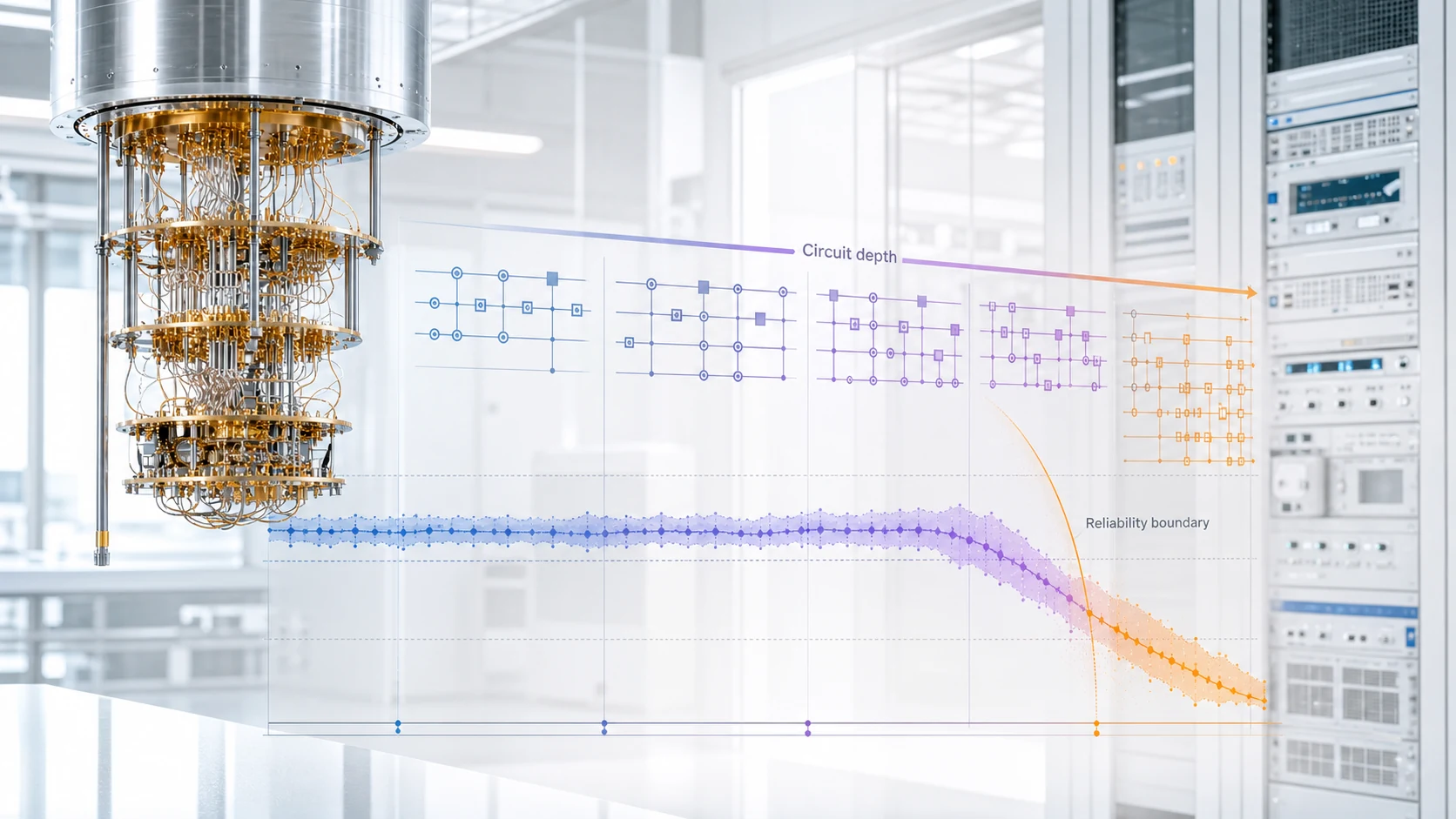
The paper's exploratory scaling probes distinguish state-space size from compiled circuit depth. Optimized four-state cases map a shallow corridor; deeper chains become noise-frontier markers.
Gap map
The QANTIS scale-up boundary on current Heron hardware
The paper separates shallow validated controls from deeper exploratory circuits so state-space growth is not confused with physical circuit viability.
Primary corridor
- 8-step primary Tiger run on Kingston
- 12-step primary Tiger run on Fez
- Planner-facing posterior and action checks
Supporting transfer
- Same-backend Heron R3 repeats
- Boston-to-Pittsburgh continuation
- Cross-backend operating checks
Exploratory frontier
- Optimized three-qubit four-state sweep
- Deeper four-state stress envelope
- UCGate and QSD synthesis pilots
Engineering conclusion
- State-space size alone is not the first bottleneck
- Compiled depth per update is binding
- Shallower encodings or future hardware are required
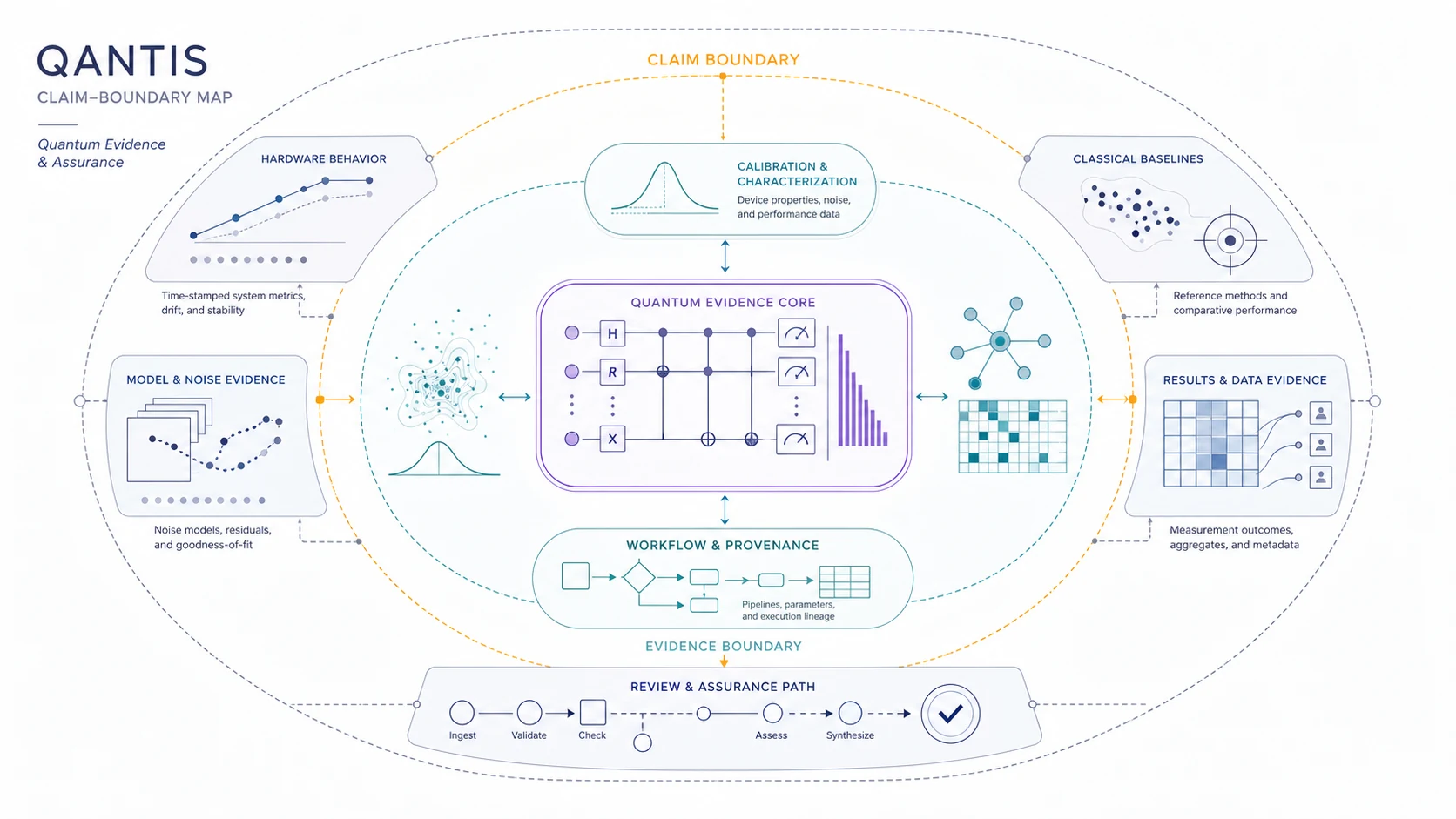
The main campaign and transfer checks should not be blended.
The primary sequential evidence is split across an 8-step run on IBM Kingston and a 12-step run on IBM Fez. Heron R3 processors Pittsburgh and Boston are used for supporting transfer checks, including same-backend trajectories and a Boston-to-Pittsburgh continuation.
This division matters. A transfer check asks whether the unit cell survives a new hardware context. The four-state and synthesis rows ask a different, exploratory scaling question; neither replaces the primary campaign or creates a cross-device guarantee.
TD · Technical depth7 supporting chapters and the working checklist.Read deeper
The optimized four-state pilot shows that width alone is not the first failure mode.
The optimized four-state circuit reports six of six cases below the paper's strict Hellinger corridor. This extends the exploratory operating map from the two-qubit Tiger unit cell to a shallow three-qubit encoding.
The result is useful because it separates a modest increase in state-space size from a major increase in compiled depth. It remains an exploratory pilot, not evidence of a realistic large-state autonomous system.
Deeper encodings turn the run into a noise marker.
In the deeper four-state stress envelope, three of six cases pass the strict band while five of six preserve the maximum-a-posteriori state. UCGate and QSD pilots continue the same probe with richer compiled chains.
The paper's conclusion is direct: current Heron processors are constrained first by circuit depth per belief update. When the oracle remains shallow, the posterior can remain stable; when compilation produces a deep chain, the result marks the coherence frontier instead of a validated operating corridor.
Noise mitigation helps selectively and can hurt when depth already dominates.
The paper treats layerwise Richardson extrapolation, bounded zero-noise extrapolation, gate twirling, and adaptive barrier FPAA as diagnostics. Gate twirling can help in the shallow Tiger and four-state corridor, while its overhead becomes counterproductive on deeper UCGate chains.
This is why a single mitigation recipe would be misleading. The correct choice depends on the compiled circuit, backend, depth, and calibration state. Mitigation cannot be assumed to rescue a circuit that is already outside the coherence envelope.
Depth pilots map future work; they do not establish scale readiness.
Primary evidence remains the 8-step Kingston and 12-step Fez sequential Tiger posteriors. Heron R3 transfer rows are supporting controls. The optimized and deeper four-state rows, plus UCGate and QSD runs, remain exploratory evidence that localizes the bottleneck.
The paper excludes wall-clock speedup, hardware advantage, full policy optimization, end-to-end autonomy, and downstream MTDA advantage. The classical tractability of the small Tiger cell is also explicit, so the scale-up pilots cannot be read as a performance win over classical planning.
- Primary: small-state sequential posterior preservation.
- Supporting: Heron R3 hardware-transfer checks.
- Exploratory: optimized and deeper four-state encodings plus synthesis pilots.
- Out of scope: realistic autonomous-system scale and advantage claims.
The next experiment should optimize the encoding before increasing the claim.
The practical roadmap is to reduce problem-specific oracle depth, preserve transpile manifests, test the same posterior and action gates, and collect reliable queue-inclusive and queue-exclusive timing fields on future live-hardware reruns. Only then can runtime cost be discussed responsibly.
A QANTIS evidence packet should therefore include backend, circuit source, compiled depth, two-qubit gate count, shots, calibration window, mitigation choice, raw counts, posterior metrics, and fallback state. Scale is credible only when all of those remain inspectable.
usable hardware envelope = shallow encoding + calibrated estimator + posterior gate + classical fallbackScaling fails first through depth, not through a state-count headline.
A larger state space does not translate into one fixed hardware cost. The encoding determines how many operations the processor must preserve before measurement, so two problems with the same number of states can occupy very different physical regimes after transpilation.
The QANTIS controls use a shallow 4-state corridor and deeper UCGate pilots to separate these effects. Shallow two- and three-qubit belief oracles can be stabilized in the reported corridor; deeper compiled chains become coherence-limited. The evidence therefore identifies circuit depth per update as the current binding constraint.
That is a useful negative boundary. It tells an engineering team to invest in shallower, problem-specific belief encodings and to preserve the classical decision path while waiting for better hardware. It does not justify turning exploratory pilots into a production-readiness or quantum-advantage claim.
Exploratory evidence belongs in a separate claim tier.
arXiv:2607.06760, submitted 7 July 2026, explicitly separates its primary Tiger result, supporting controls, and exploratory 4-state and UCGate scaling evidence. The paper describes the deeper runs as an operating-boundary probe for present IBM Heron hardware.
This article preserves that hierarchy. Heron is the tested processor family, not proof of a hardware advantage; the larger encodings map where current depth becomes limiting, not where general autonomous-system readiness begins.
Operational checklist
Scale-up checklist: test depth before claiming state-space readiness
Use exploratory encodings to locate the hardware frontier, not to label a prototype production-ready.
- 01
Record source depth, transpiled ISA depth, two-qubit structure, and shot budget for every belief oracle.
- 02
Hold the decision problem fixed while comparing shallow and deeper encodings.
- 03
Track posterior distance and MAP-state stability separately.
- 04
Label 4-state and UCGate results as exploratory unless they meet a predeclared validation corridor.
- 05
Run mitigation A/B tests and count the depth overhead introduced by mitigation itself.
- 06
Treat coherence-limited runs as boundary markers rather than failed headline demonstrations.
- 07
Prefer shallower problem-specific encodings before increasing state complexity.
- 08
Keep classical inference and fallback paths active while the quantum circuit remains outside its validated corridor.
Practical takeaways
01
Keep the Kingston 8-step and Fez 12-step primary runs separate from Heron R3 transfer controls.
02
Read every four-state sweep as exploratory evidence, not realistic autonomy validation.
03
Treat deeper UCGate and QSD runs as exploratory markers of the coherence frontier.
04
Do not assume mitigation can compensate for a depth-dominated circuit.
05
Prioritize shallower problem-specific encodings and complete runtime evidence in the next campaign.
RA · Reference annexDefinitions, recurring questions, editorial method, and primary sources.Inspect
The analysis above carries the main reading flow. This reference layer keeps terminology, recurring questions, editorial method, and primary sources available without interrupting the argument.
Terminology
Terms behind QANTIS on IBM Heron: circuit depth defines the current boundary..
- IBM Heron
- The IBM quantum processor family used for the hardware case study and its transfer, calibration, horizon, and scaling controls.
- Compiled circuit depth
- The number of sequential hardware-level operation layers after a circuit is translated for a specific backend; deeper circuits expose the state to noise for longer.
- UCGate
- A uniformly controlled gate construction used in the exploratory scaling pilots to encode richer belief transformations; its deeper compiled chains expose the current hardware boundary.
- Coherence-limited
- A regime in which circuit depth and accumulated hardware noise prevent the quantum state from preserving the intended computation reliably enough.
- Exploratory scaling evidence
- Measurements used to locate a future scale-up path or failure boundary, without treating the tested configuration as a validated operational system.
Field questions
Program questions behind QANTIS on IBM Heron: circuit depth defines the current boundary..
Q01What is the binding hardware constraint identified by the QANTIS experiments?
The scaling controls point to compiled circuit depth per belief update as the binding constraint on the tested IBM Heron devices. Shallow belief oracles can remain within a useful posterior corridor, while deeper encodings become noise-frontier probes. State-space size by itself was not the first limit observed in these pilots.
Q02Do the 4-state and UCGate runs validate larger autonomous systems?
No. The 4-state corridor and UCGate pilots are exploratory scaling evidence. They help distinguish a shallow encoding that can still be checked from a deeper circuit that becomes coherence-limited, but they do not establish realistic large-state POMDP readiness or an end-to-end autonomy stack.
Q03Can error mitigation remove the depth boundary?
Not in the reported evidence. Mitigation is useful diagnostically in shallow regimes, but its overhead can become counterproductive on deeper UCGate chains. The practical path is to design shallower problem-specific encodings, keep a classical fallback, and re-test the boundary on later hardware rather than assuming mitigation makes depth irrelevant.
Editorial record
How QANTIS on IBM Heron: circuit depth defines the current boundary. was checked.
- Editorial owner
- Neura Parse Research
- Last verified
- July 20, 2026
- Method
- Synthesis of the dated primary and official records listed below, checked against the operating question in this note.
- Scope limit
- Planning analysis—not certification, customer performance evidence, procurement advice, or a claim of production readiness.
SRSources reviewed
3 records