Abstract
QANTIS does not replace the planner. Its hardware-tested inference core accepts a prior and observation model, estimates the difficult evidence term, and hands a conventional probability distribution back to classical software.
Gap map
The planner-facing QANTIS service contract
The validated object is the belief-update module, with a classical interface on both sides and a visible evidence hierarchy around every result.
Input
- Prior belief from the classical decision loop
- Observation model for the current sensor event
- A rare-evidence estimation problem
Calibrated quantum step
- Build the belief oracle
- Amplify the accepted-evidence event
- Estimate the amplitude with boundary-aware BIQAE
Safety check
- Convert the estimate into an ordinary Bayes update
- Compare with the exact Bayes posterior
- Check whether both posteriors select the same action
Output
- Planner-facing posterior distribution
- Classical planning remains responsible for the action
- No end-to-end autonomy claim
The useful quantum boundary is deliberately narrow.
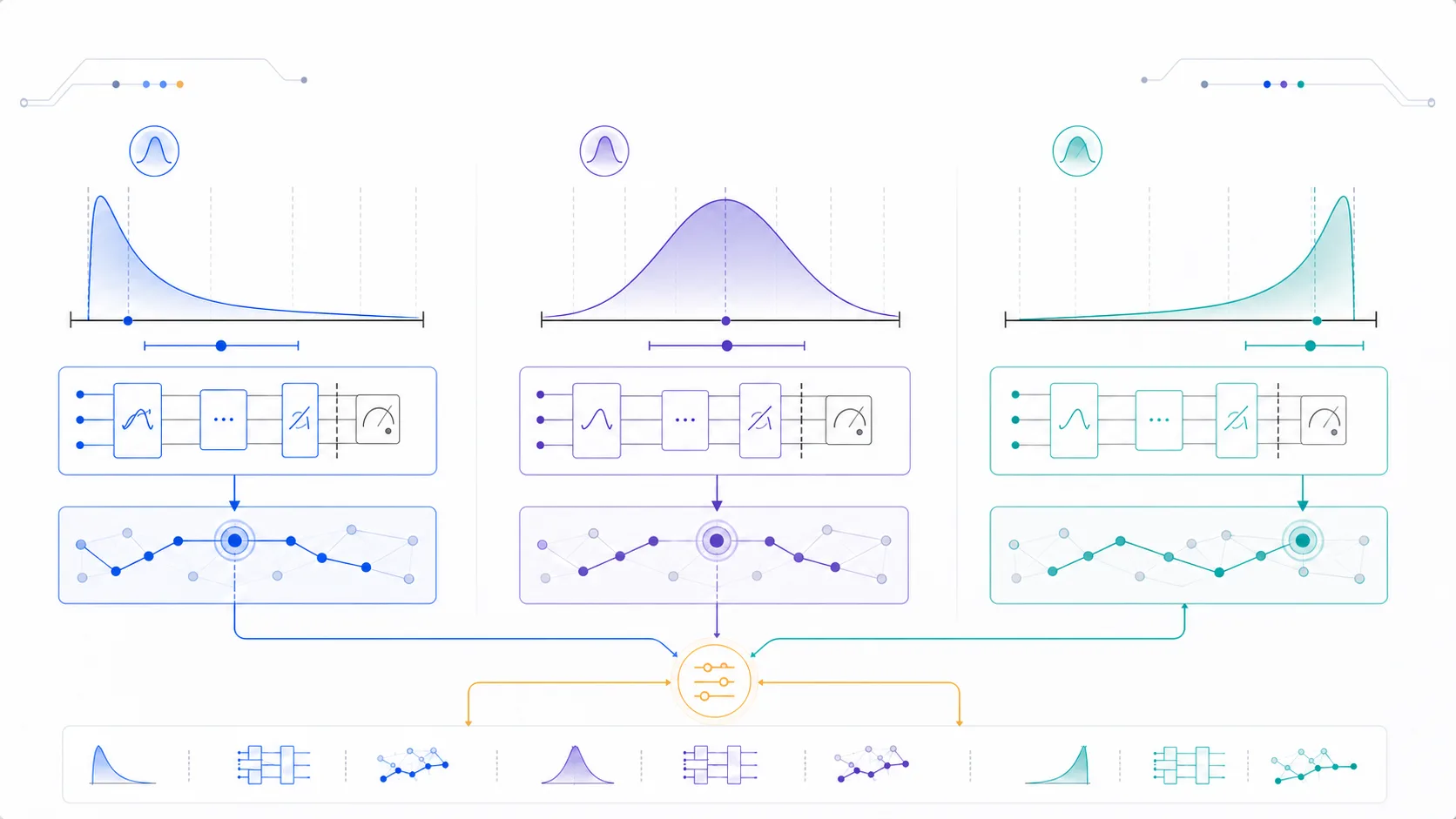
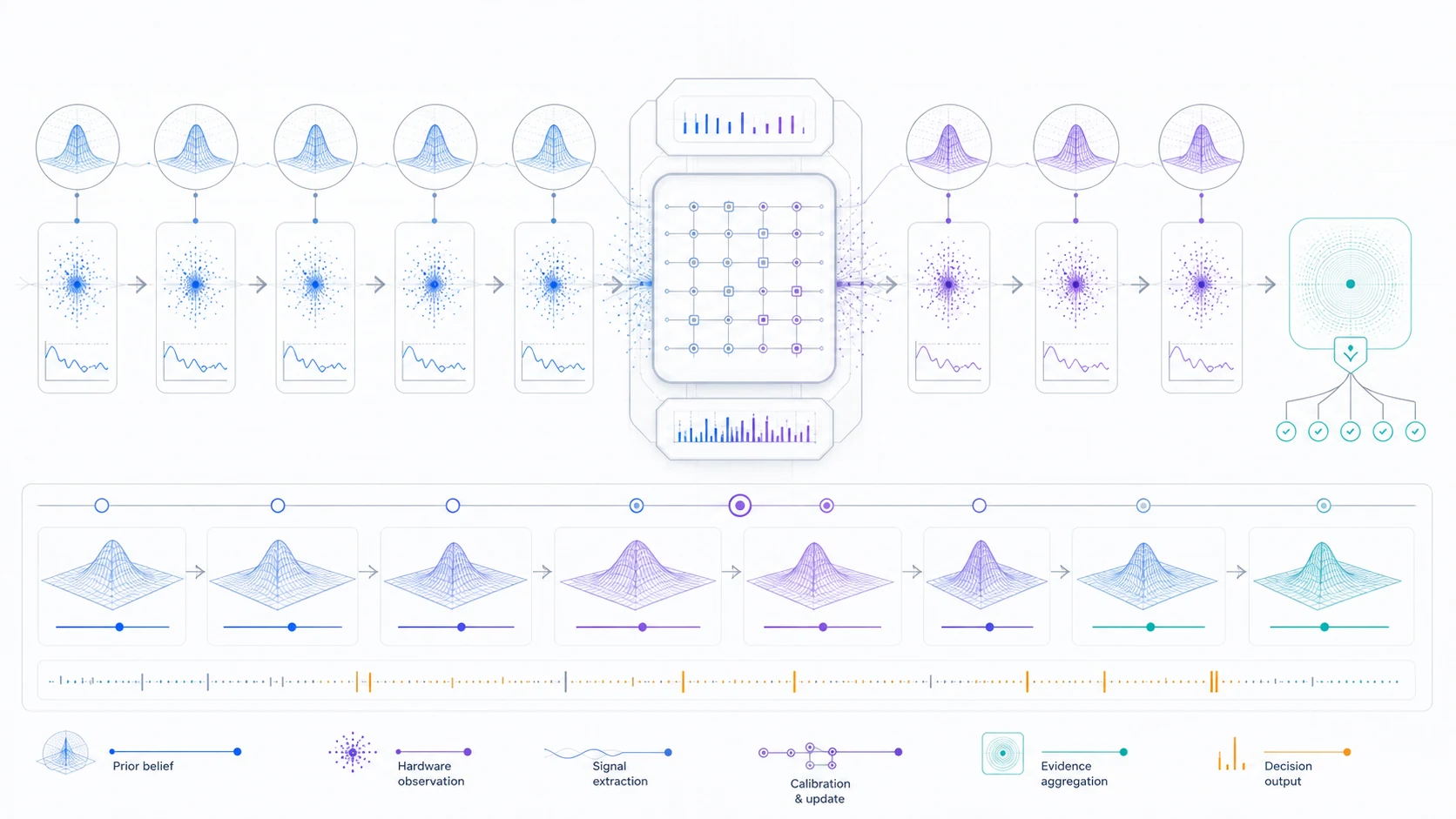
A partially observable system cannot act safely on a sensor event alone. It maintains a belief over hidden states, predicts how that belief changes, weights the possibilities by the new observation, and normalizes the result. The new QANTIS paper isolates the difficult normalization evidence term and treats the quantum processor as a calibrated service for that one step.
The interface stays conventional. A classical planner supplies the prior and observation model. QANTIS builds the belief oracle, applies calibrated amplification and BIQAE, and converts the resulting evidence estimate into an ordinary posterior. The planner receives probabilities, not quantum state, and remains responsible for downstream policy and action selection.
prior belief + observation model -> calibrated evidence estimate -> ordinary posterior -> classical planner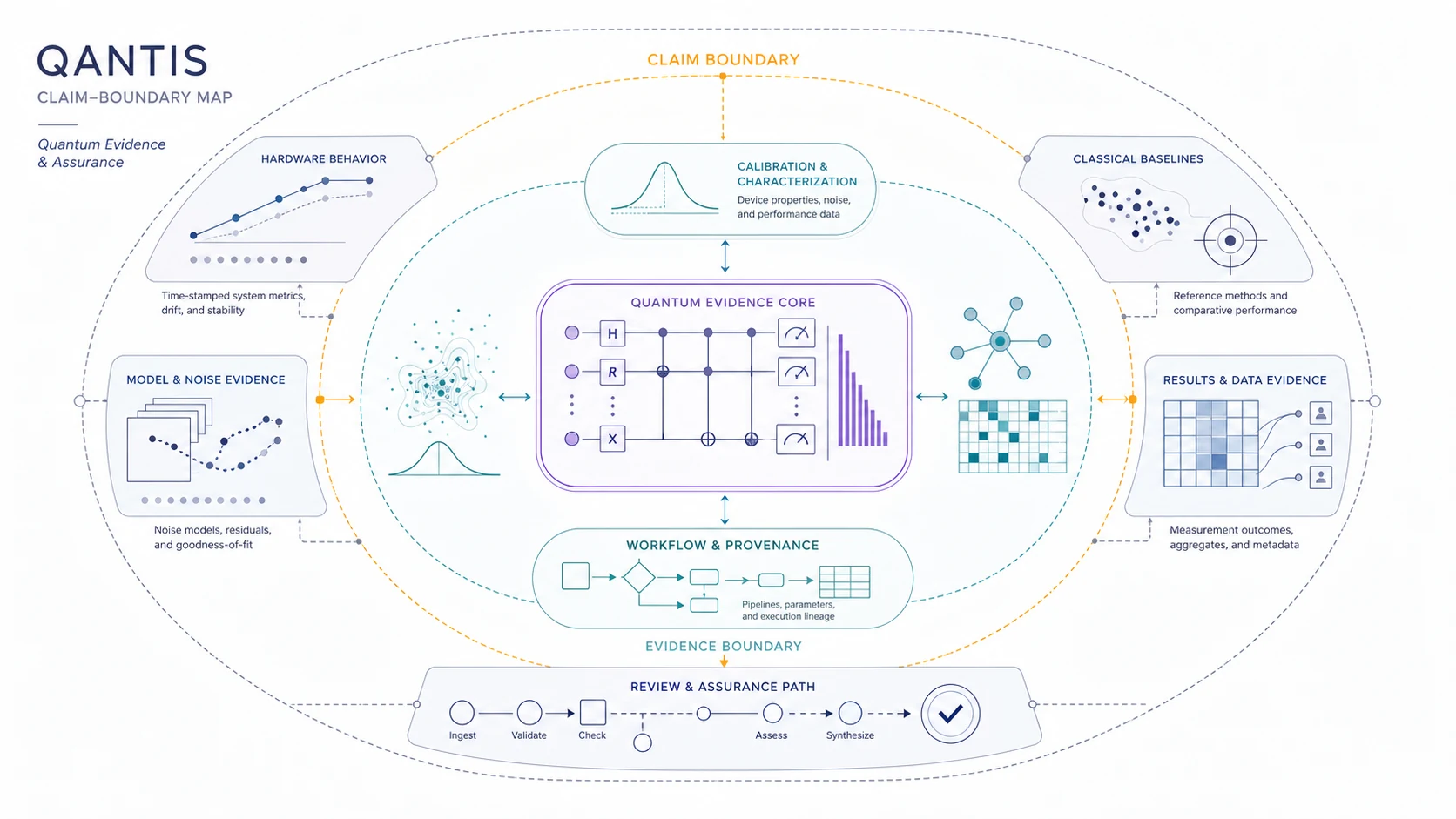
TD · Technical depth7 supporting chapters and the working checklist.Read deeper
The main result is sequential Tiger belief updating on Heron.
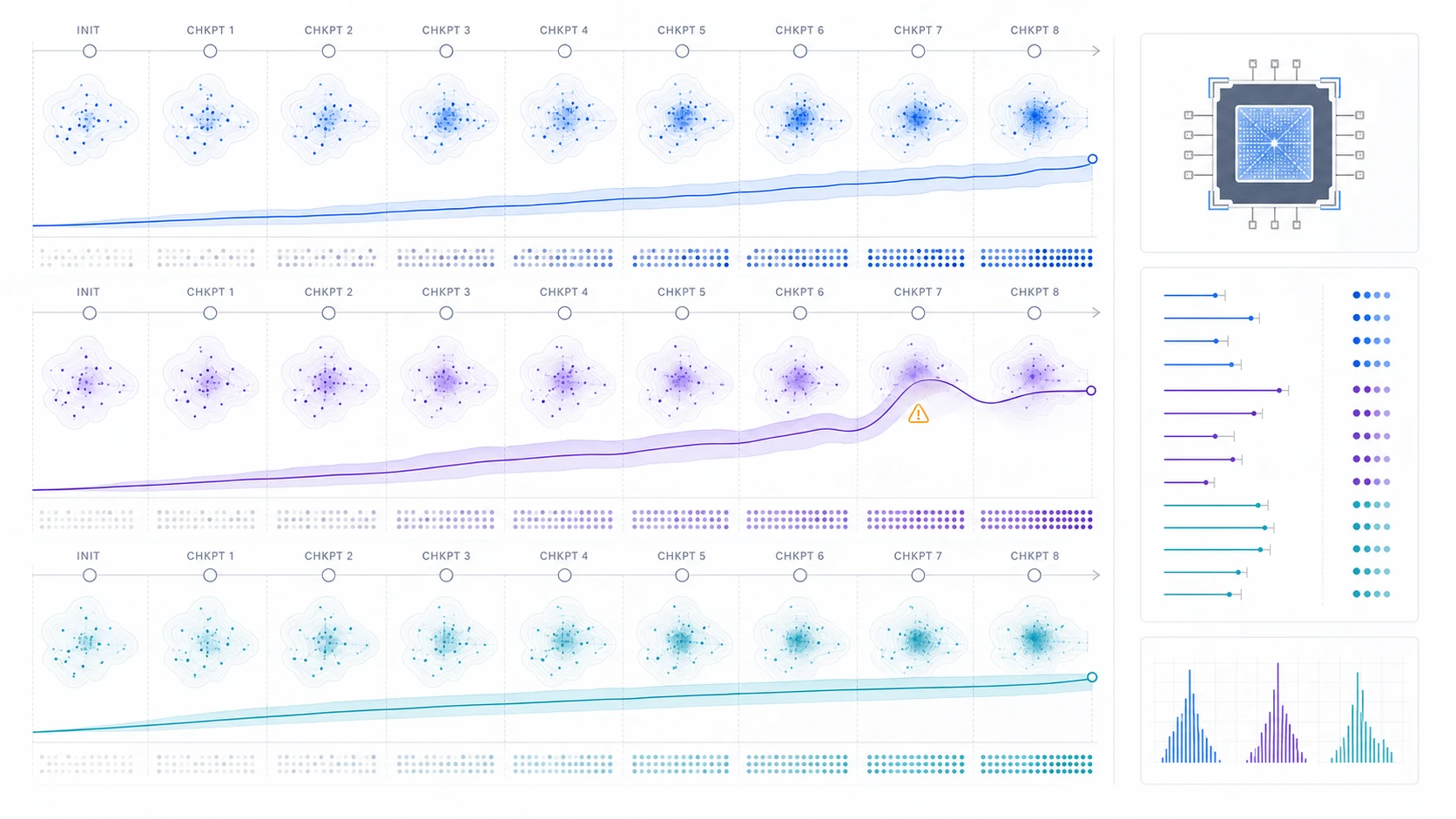
The primary evidence is the repeated two-state Tiger POMDP loop on present IBM Heron hardware. The paper reports 8-step and 12-step primary runs because sequential reuse is the systems question: every posterior becomes the next prior, so estimation error can travel forward through the decision horizon.
All-step fixed-point amplitude amplification keeps the reported posteriors in the same operating band as exact Bayes across those runs. This is stronger than showing one isolated amplitude estimate, but it remains a controlled small-state case study. It does not establish a large-state planner or a general autonomy result.
Longer horizons test reuse without expanding the primary claim.
The 20-step and 32-step trajectories are supporting controls. They ask whether repeated feedback causes the service to collapse outside the band seen in the primary runs. The reported controls remain stable, which supports the interpretation that the result is not tied to one short trajectory.
Those rows are not promoted into a broader claim. Heron R3 transfer, mitigation comparisons, boundary calibration, and the rare-event sweep serve the same purpose: they probe robustness and operating limits around the primary sequential Tiger result.
- Primary: 8-step and 12-step sequential Tiger POMDP belief updates.
- Supporting: 20-step and 32-step trajectories, Heron R3 transfer, mitigation checks, BIQAE calibration, and the rare-event envelope.
- Exploratory: four-state corridor and UCGate/QSD pilots that map a scaling path.
- Out of scope: wall-clock speedup, full policy optimization on hardware, end-to-end autonomy, and downstream MTDA advantage.
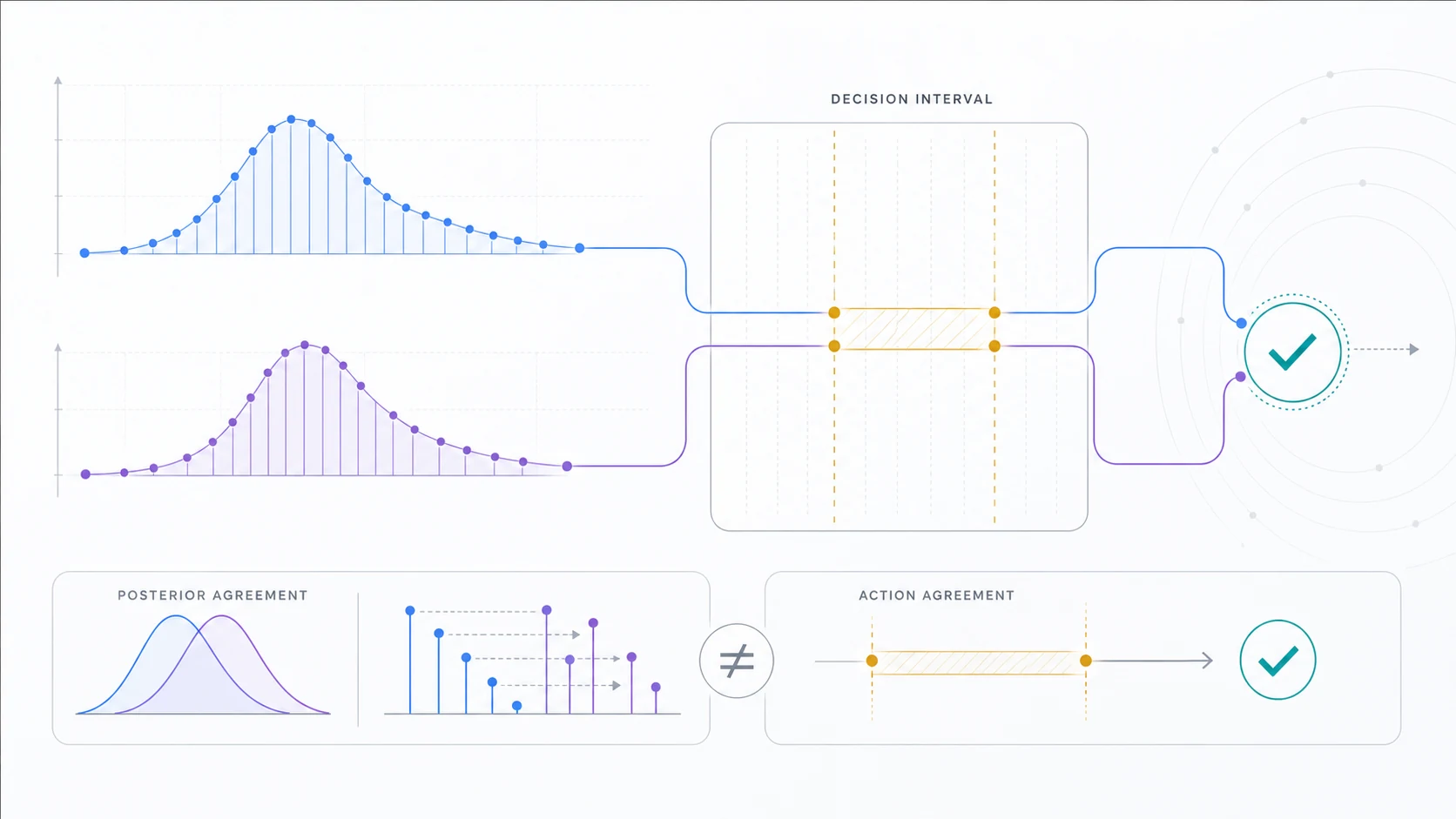
Posterior error is interpreted through the action it could change.
Posterior distance matters to an operator only when it changes a decision. The paper therefore sends both the hardware-derived posterior and the exact Bayes posterior through the same standard Tiger immediate-reward rule. In every reported check, the two posteriors select the same immediate action.
That agreement is specific to the reported trajectories and thresholds. It shows that the remaining posterior differences did not cross an action boundary in these checks; it does not prove action agreement for other POMDPs, reward functions, sensors, or operating regimes.
Calibration and fallback are part of the product, not a footnote.
A reusable service needs more than a circuit. It needs backend context, shot budgets, calibration state, posterior-distance gates, an exact or trusted reference path, and a deterministic way to return control to classical software. The QANTIS paper makes that evidence chain visible instead of treating hardware execution as the result by itself.
For a production research program, the same contract suggests a safe integration pattern: invoke the quantum step only inside its measured envelope, record the estimate and its context, compare against an accepted reference where available, and retain a classical fallback whenever the evidence gate fails.
What this paper supports, and what it explicitly does not.
The supported statement is precise: a hardware-calibrated rare-evidence belief-update primitive was reused in reported sequential Tiger POMDP checks on IBM Heron and returned planner-facing posteriors that preserved the immediate action under the tested rule.
The paper does not claim peer review, quantum advantage, wall-clock speedup, an end-to-end autonomous system, full policy optimization on hardware, or hardware advantage for downstream tracking and assignment. Those exclusions are essential to reading the result correctly.
The useful abstraction is a posterior service, not a quantum robot.
Partial observability creates a clean seam between inference and action. A planner begins with a belief over hidden states, receives a noisy observation, and needs a normalized posterior before it can choose what to do. QANTIS places the hardware experiment inside that seam: the quantum operation supports estimation of the evidence term, then an ordinary Bayes update produces the planner-facing result.
That boundary makes the work legible to a systems team. The hardware output is judged by the posterior it returns and by whether that posterior changes the immediate action, not by an isolated amplitude or circuit screenshot. It also prevents a successful small inference primitive from being misreported as a validated autonomy stack.
The 8-step and 12-step runs are the primary sequential evidence. The 20-step and 32-step trajectories are controls: useful because error is repeatedly fed back as the next prior, but still controls on the same small problem family. A production review should preserve that evidence hierarchy.
Operational checklist
Integration checklist: treat quantum inference as a bounded service
Use this before inserting a hardware belief update into any partially observable decision loop.
- 01
Write the service contract as prior plus observation model in, posterior distribution out.
- 02
Keep downstream policy selection and action execution in the classical planner.
- 03
Define an exact or trusted classical Bayes reference for every test trajectory.
- 04
Feed each returned posterior into the next step so sequential error is tested rather than hidden.
- 05
Record posterior distance and downstream action agreement at every decision check.
- 06
Separate primary horizons from longer stress controls in dashboards and claims.
- 07
Set an operating-envelope gate that routes uncertain or out-of-range updates to the classical path.
- 08
Archive backend, circuit, shot, calibration, and posterior records together for review.
Practical takeaways
01
Treat QANTIS as a calibrated evidence-estimation service inside a classical decision loop.
02
Keep the service output ordinary: the planner consumes a posterior distribution and remains classical.
03
Read the 8-step and 12-step runs as primary evidence and the 20-step and 32-step runs as supporting controls.
04
Evaluate posterior fidelity together with action agreement; neither measure should stand alone.
05
Do not convert a controlled Heron case study into a speedup, advantage, or end-to-end autonomy claim.
RA · Reference annexDefinitions, recurring questions, editorial method, and primary sources.Inspect
The analysis above carries the main reading flow. This reference layer keeps terminology, recurring questions, editorial method, and primary sources available without interrupting the argument.
Terminology
Terms behind QANTIS as a calibrated belief-update service..
- POMDP
- Partially Observable Markov Decision Process: a classical framework in which an agent maintains a belief over hidden states because observations do not reveal the state directly.
- Belief update
- The step that combines a prior belief with a new observation model to produce a posterior belief for the planner.
- Evidence term
- The probability of receiving the observation under the current belief model. It normalizes the Bayes update and becomes difficult to estimate when the event is rare.
- Planner-facing posterior
- The ordinary probability distribution returned by the QANTIS inference service to the classical planner after the hardware-assisted evidence estimate is converted through Bayes' rule.
- Operating envelope
- The measured range of horizons, amplitudes, circuit depths, and error levels within which the service has supporting evidence; it is a boundary for use, not a general advantage claim.
Field questions
Program questions behind QANTIS as a calibrated belief-update service..
Q01What does QANTIS mean by a hardware-calibrated belief-update service?
It is a deliberately narrow service contract inside a classical decision loop. The service receives a prior belief and an observation model, uses the quantum processor to estimate the rare-event evidence term, and returns an ordinary posterior distribution. The classical planner still owns the policy and the next action; the 7 July 2026 arXiv preprint does not claim an end-to-end autonomous quantum system.
Q02Which sequential results are primary, and which are controls?
The primary hardware story is the 8-step and 12-step Tiger POMDP campaign. The 20-step and 32-step trajectories are longer-horizon controls that test whether repeated posterior feedback stays in the same operating band. They extend confidence in the service loop, but they do not broaden the claim into realistic large-state autonomy.
Q03Why return a classical posterior instead of a quantum state to the planner?
A classical posterior keeps the interface inspectable and lets the same planner compare the hardware result with exact Bayes under one decision rule. It also creates a clear safety boundary: teams can measure posterior distance and action agreement at every update, while retaining the classical path when the quantum service is unavailable or outside its calibrated envelope.
Editorial record
How QANTIS as a calibrated belief-update service. was checked.
- Editorial owner
- Neura Parse Research
- Last verified
- July 20, 2026
- Method
- Synthesis of the dated primary and official records listed below, checked against the operating question in this note.
- Scope limit
- Planning analysis—not certification, customer performance evidence, procurement advice, or a claim of production readiness.
SRSources reviewed
3 records