Abstract
The reported 8-step matched-shot, 20-step, and 32-step checks show the same immediate action as exact Bayes with zero scored cumulative value loss under the tested Tiger rule.
Gap map
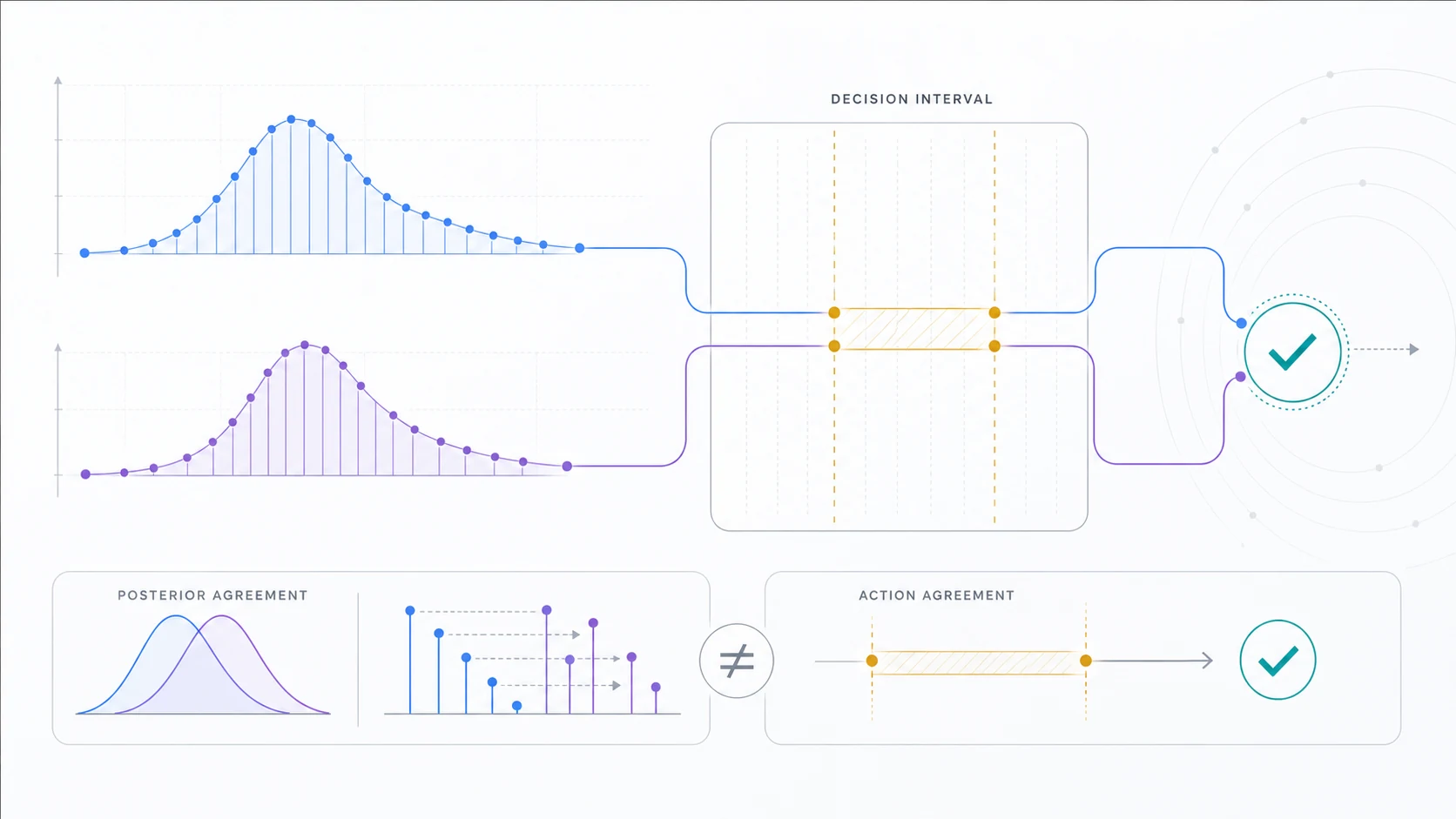
Posterior fidelity and decision impact are separate gates
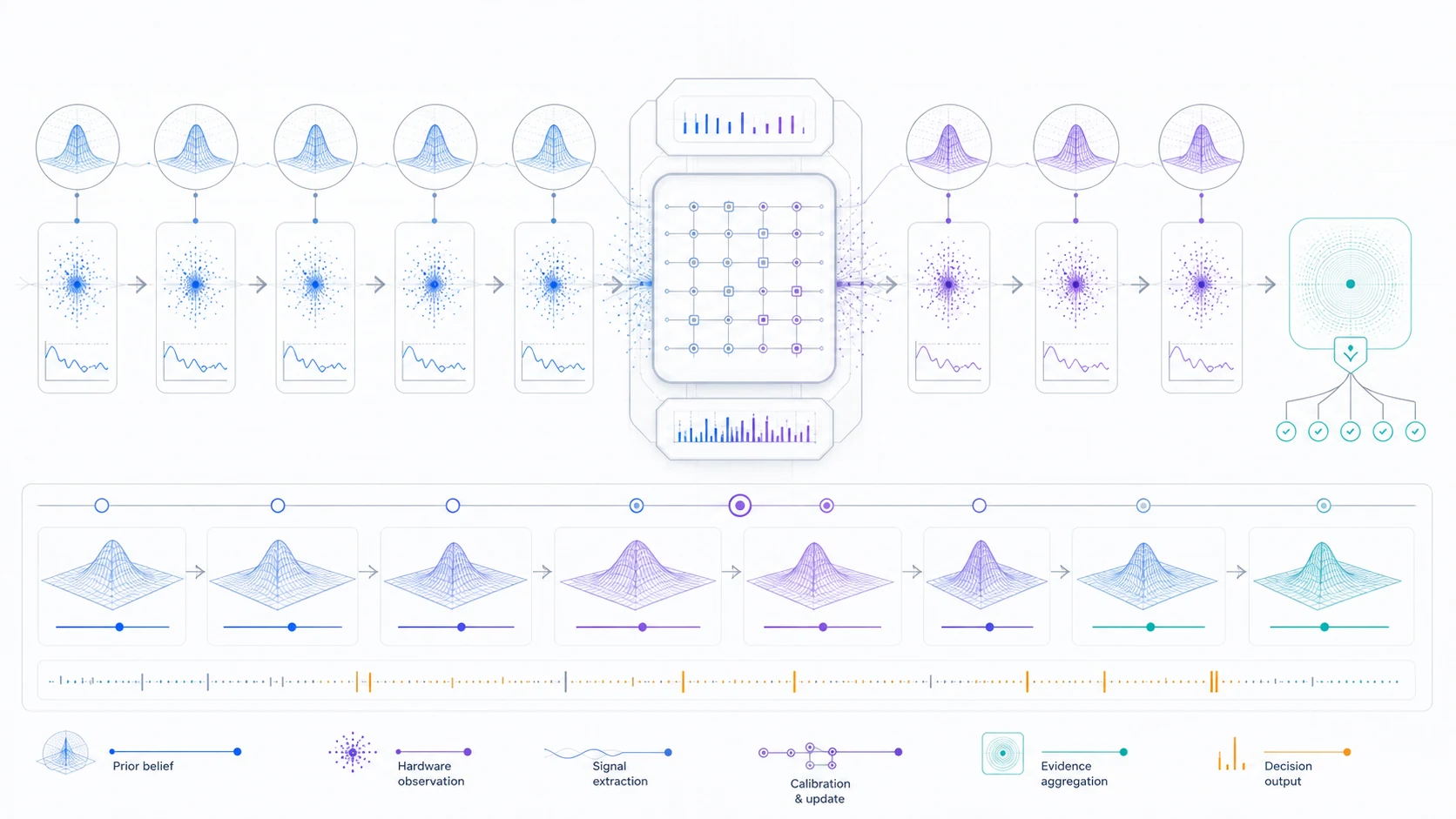
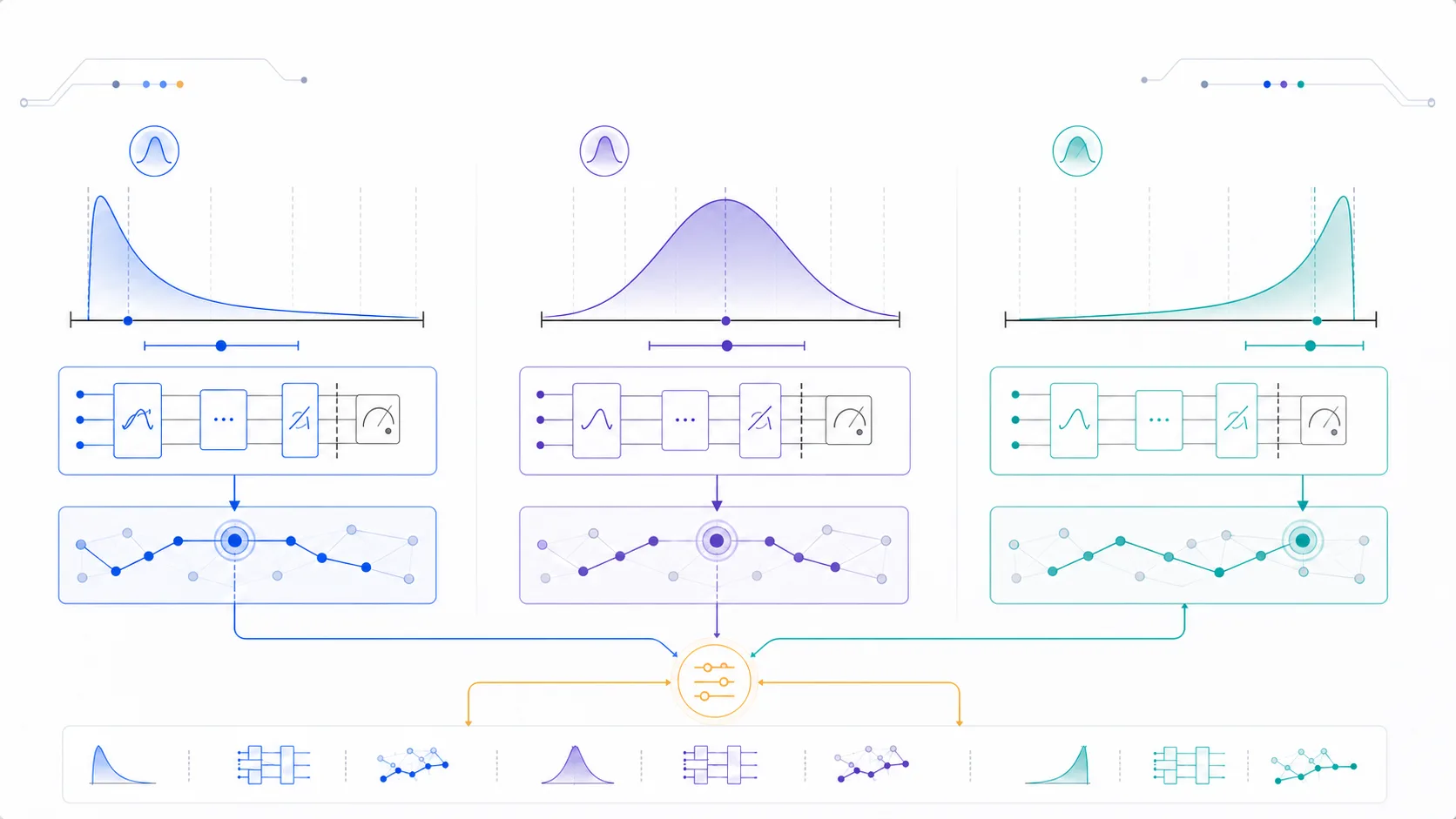
Both the exact and hardware-derived posteriors pass through the same immediate-reward rule so the experiment can distinguish probability error from an action flip.
Reference path
- Exact Bayes posterior
- Standard Tiger immediate-reward thresholds
- Reference action and expected value
Hardware path
- Calibrated QANTIS evidence estimate
- Ordinary planner-facing posterior
- The same action thresholds
Two checks
- Hellinger distance between posteriors
- Immediate-action agreement
- Value loss only when actions differ
Interpretation
- Same action in every reported check
- No general policy-equivalence claim
- Classical planner retains authority
A posterior metric becomes operational only through a decision rule.
Hellinger distance measures how far the hardware-derived posterior is from exact Bayes, but it does not say whether that difference changes the next action. A small error near an action threshold can matter more than a larger error far from one.
The QANTIS paper therefore performs a planner-facing check. Both posteriors enter the same standard Tiger immediate-reward rule: open right above 90 percent belief that the tiger is left, open left below 10 percent, and listen between those thresholds.
TD · Technical depth7 supporting chapters and the working checklist.Read deeper
Every tested posterior selects the same immediate action as exact Bayes.
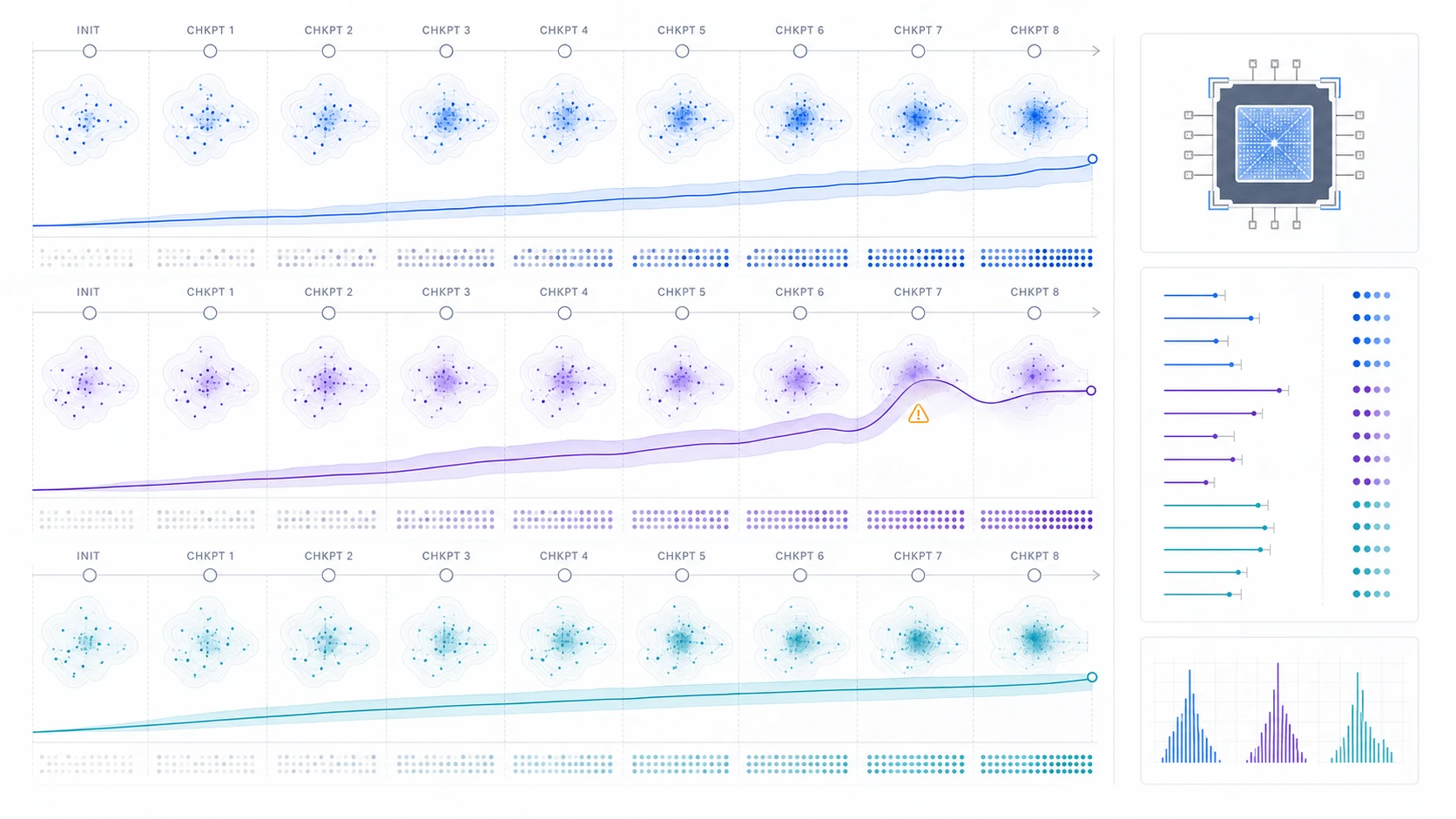
The 8-step matched-shot FPAA trajectory reports 8 of 8 action agreements. The 20-step and 32-step supporting controls report 20 of 20 and 32 of 32. Under the paper's scoring rule, cumulative value loss is 0.000 for each trajectory because there is no action disagreement.
The posterior distances do not disappear: the reported maximums for these decision checks are 0.0326, 0.0343, and 0.0228. The evidence says those deviations stayed inside the same action regions for the tested rule and trajectories.
The 8-step result and longer controls carry different evidentiary weight.
The matched-shot 8-step decision check is tied to the primary sequential Tiger case study. The 20-step and 32-step trajectories extend the operating envelope as supporting controls. Their role is to test whether action consistency survives repeated posterior feedback, not to broaden the system claim.
The paper also includes 12-step primary fidelity evidence, Heron R3 transfer, calibration, and rare-event controls. Larger-state pilots remain exploratory and are not folded into the action-agreement claim.
Action agreement is local to the tested reward model and thresholds.
The result does not prove that any planner would make the same choice. A different loss model, risk tolerance, observation sequence, hidden-state space, or threshold could convert the same posterior deviation into a different action.
Nor does immediate-action agreement validate full policy optimization. The downstream planner is classical and outside the hardware-tested module. The paper checks the immediate decision impact of the returned posterior, not a long-horizon quantum policy or end-to-end autonomous behavior.
Decision evidence should preserve the threshold that produced the action.
An auditable decision record needs the hardware posterior, exact or trusted reference, distance metric, reward parameters, action thresholds, selected action, and value-loss calculation together. Without the threshold context, an action-agreement percentage cannot be reproduced or challenged.
This pattern generalizes as an assurance method, not as a general performance claim. For any new domain, the operator must define the decision rule and acceptable error region before hardware results are interpreted.
decision evidence = posterior fidelity + threshold context + action agreement + value impactMeasure the distance, then ask whether it crosses a decision boundary.
A belief-update service can return a posterior that is numerically imperfect yet operationally equivalent for the next decision. Conversely, a small error near a threshold can flip an action. That is why a single distribution metric cannot carry the whole systems claim.
The QANTIS evaluation sends the hardware posterior and the exact Bayes posterior through the same Tiger immediate-reward rule. Across all reported decision checks, the selected immediate action agrees. This converts posterior fidelity into decision evidence while keeping the planner classical and inspectable.
The correct conclusion remains narrow. Agreement under one immediate-action rule shows that the observed errors did not cross those tested thresholds. It does not prove that the distributions are identical, that a multi-step policy is optimal, or that a different cost model would make the same choices.
Action agreement is a safety check inside the stated case study.
arXiv:2607.06760, submitted 7 July 2026, reports action agreement alongside posterior Hellinger distance for matched-shot and extended-horizon checks. The authors frame the result as validation of the planner-facing posterior returned by the service, not validation of the full autonomy stack around it.
This article follows that boundary. It uses 'same immediate action' rather than broader phrases such as autonomous performance, policy advantage, or mission success.
Operational checklist
Decision-evidence checklist: connect inference error to operator impact
A posterior benchmark becomes useful when it is evaluated at the decision boundary.
- 01
Define the decision rule and its thresholds before running hardware tests.
- 02
Evaluate the exact Bayes and hardware-derived posteriors with the same rule.
- 03
Record posterior distance and immediate action for every step.
- 04
Flag how close each posterior lies to an action threshold, even when the actions agree.
- 05
Calculate value loss under the exact posterior whenever an action differs.
- 06
Keep the reward model version attached to the run record.
- 07
Test matched-shot and longer-horizon controls through the same decision pipeline.
- 08
Avoid extending immediate-action agreement into claims about full policies or real-world autonomy.
Practical takeaways
01
Measure posterior distance and action agreement as separate decision-assurance gates.
02
Keep the exact reward model and thresholds inside the evidence record.
03
Read 8/8 as part of the primary case study and 20/20 plus 32/32 as supporting controls.
04
Do not generalize same-action results beyond the tested Tiger rule and trajectories.
05
Keep planning and authority classical even when the evidence estimate uses quantum hardware.
RA · Reference annexDefinitions, recurring questions, editorial method, and primary sources.Inspect
The analysis above carries the main reading flow. This reference layer keeps terminology, recurring questions, editorial method, and primary sources available without interrupting the argument.
Terminology
Terms behind QANTIS posterior fidelity when the action stays the same..
- Action agreement
- A check that two posteriors passed through the same decision rule select the same immediate action.
- Decision threshold
- A posterior-probability boundary at which the planner changes from one action to another.
- Posterior fidelity
- How closely the hardware-derived posterior matches the exact or trusted reference distribution, measured separately from action choice.
- Value loss
- The reduction in expected immediate reward when the hardware posterior selects a different action from the exact posterior.
- Immediate-reward rule
- A planner rule that selects the next action from current belief and current rewards, without claiming optimization of a complete long-horizon policy.
Field questions
Program questions behind QANTIS posterior fidelity when the action stays the same..
Q01Why is action agreement more informative than posterior distance alone?
Posterior distance measures numerical fidelity, but a planner ultimately uses the posterior to choose an action. Passing the hardware-derived and exact Bayes posteriors through the same decision rule reveals whether the measured inference error crosses an operational threshold. In every reported decision check in the preprint, both posteriors selected the same immediate action.
Q02Does same-action agreement mean the posteriors were identical?
No. Two posterior distributions can differ while remaining on the same side of the action thresholds. The paper reports posterior Hellinger distance alongside action agreement precisely because the metrics answer different questions: one describes distribution fidelity, the other describes immediate decision impact under the tested rule.
Q03Does the result validate a complete autonomous policy?
No. The check uses the standard immediate-reward rule for the small Tiger POMDP. It shows that the tested posterior errors did not flip the immediate action in the reported 8-step, 20-step, and 32-step checks. It does not establish long-horizon policy optimality, end-to-end autonomy, or generalization to a different reward model.
Editorial record
How QANTIS posterior fidelity when the action stays the same. was checked.
- Editorial owner
- Neura Parse Research
- Last verified
- July 20, 2026
- Method
- Synthesis of the dated primary and official records listed below, checked against the operating question in this note.
- Scope limit
- Planning analysis—not certification, customer performance evidence, procurement advice, or a claim of production readiness.
SRSources reviewed
3 records