Abstract
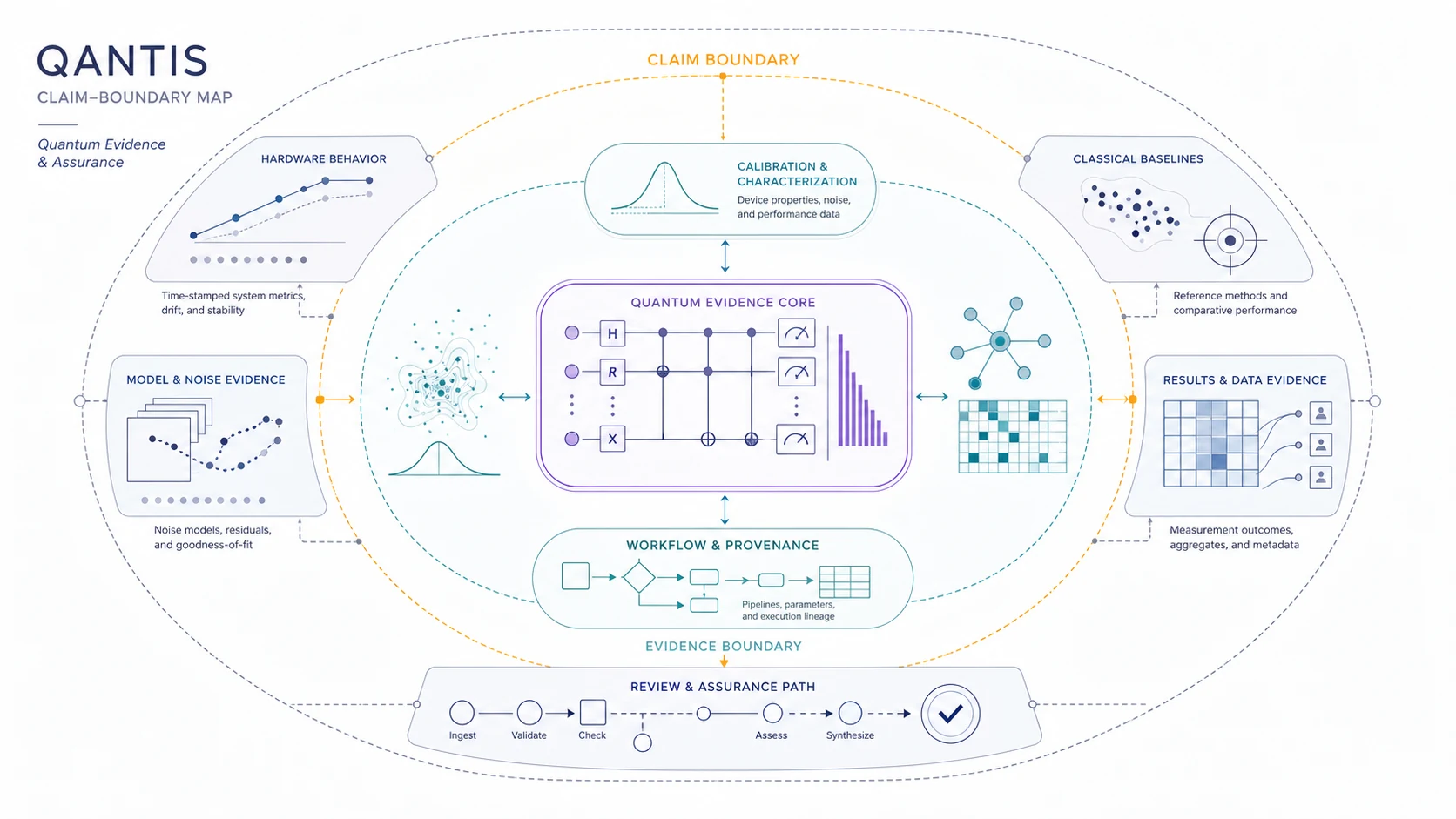
The QANTIS result is credible when read narrowly: calibrated shallow belief updates can remain close to exact Bayes in controlled hardware runs. The evidence does not establish wall-clock advantage, general scale, or end-to-end autonomy.
Gap map
A reviewer’s evidence ladder for QANTIS
Each result should be read at the level its experiment supports, without allowing an amplification number to inherit a system-level claim.
Measured strongly
- Two-state sequential posterior distance on selected Heron runs
- Same-backend estimator calibration near zero and one
- Immediate Tiger action agreement under one reward rule
Supported conditionally
- Longer 20-step and 32-step trajectories
- Rare-event sample-complexity operating envelope
- Shallow four-state optimized encodings
Exploratory
- Deeper UCGate and QSD synthesis paths
- Transfer across backends and calibration windows
- Mitigation choices under growing depth
Not established
- Wall-clock speedup or quantum advantage
- General autonomous-system safety
- Production scale or independent reproduction
A fair critique begins by stating what the experiment actually measures.
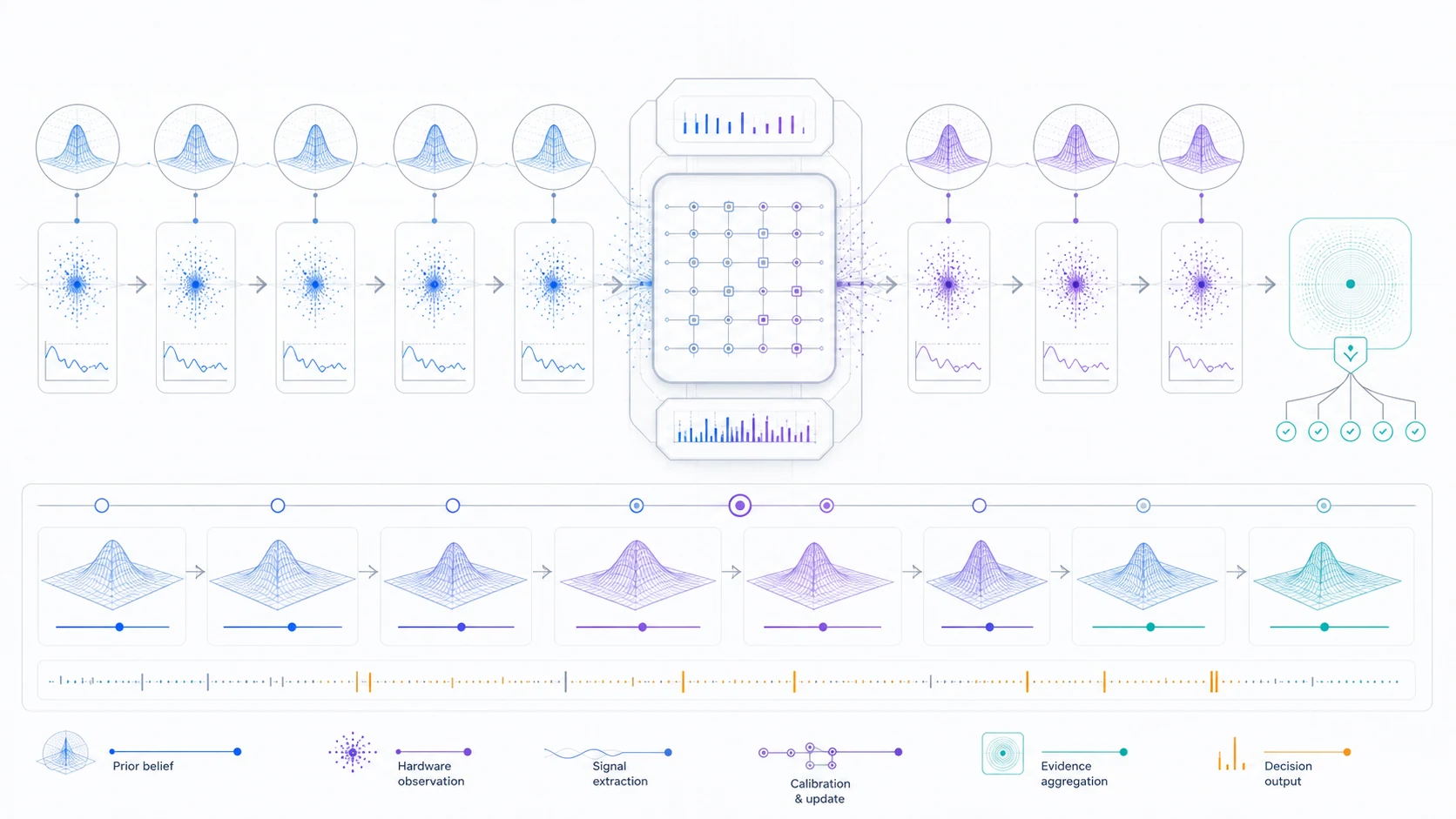
The latest QANTIS paper is a controlled hardware case study of a belief-update component. A classical system supplies a prior distribution and observation model. IBM Heron circuits estimate the accepted-evidence term, calibration and normalization produce an ordinary posterior, and a classical planner consumes that posterior. The quantum processor neither chooses the policy nor executes the action.
Within that contract, the work answers a legitimate question: can shallow amplitude-amplification and estimation routines be stabilized well enough to survive sequential feedback? This is more meaningful than an isolated circuit fidelity chart because each posterior becomes the next prior. It is also much narrower than a claim about autonomous decision-making.
The appropriate critical standard is therefore modular. Posterior fidelity, calibration behavior, resource accounting, decision threshold sensitivity, timing, scale, and reproducibility must be reviewed separately. Success in one layer should not be silently promoted into evidence for the next.
TD · Technical depth7 supporting chapters and the working checklist.Read deeper
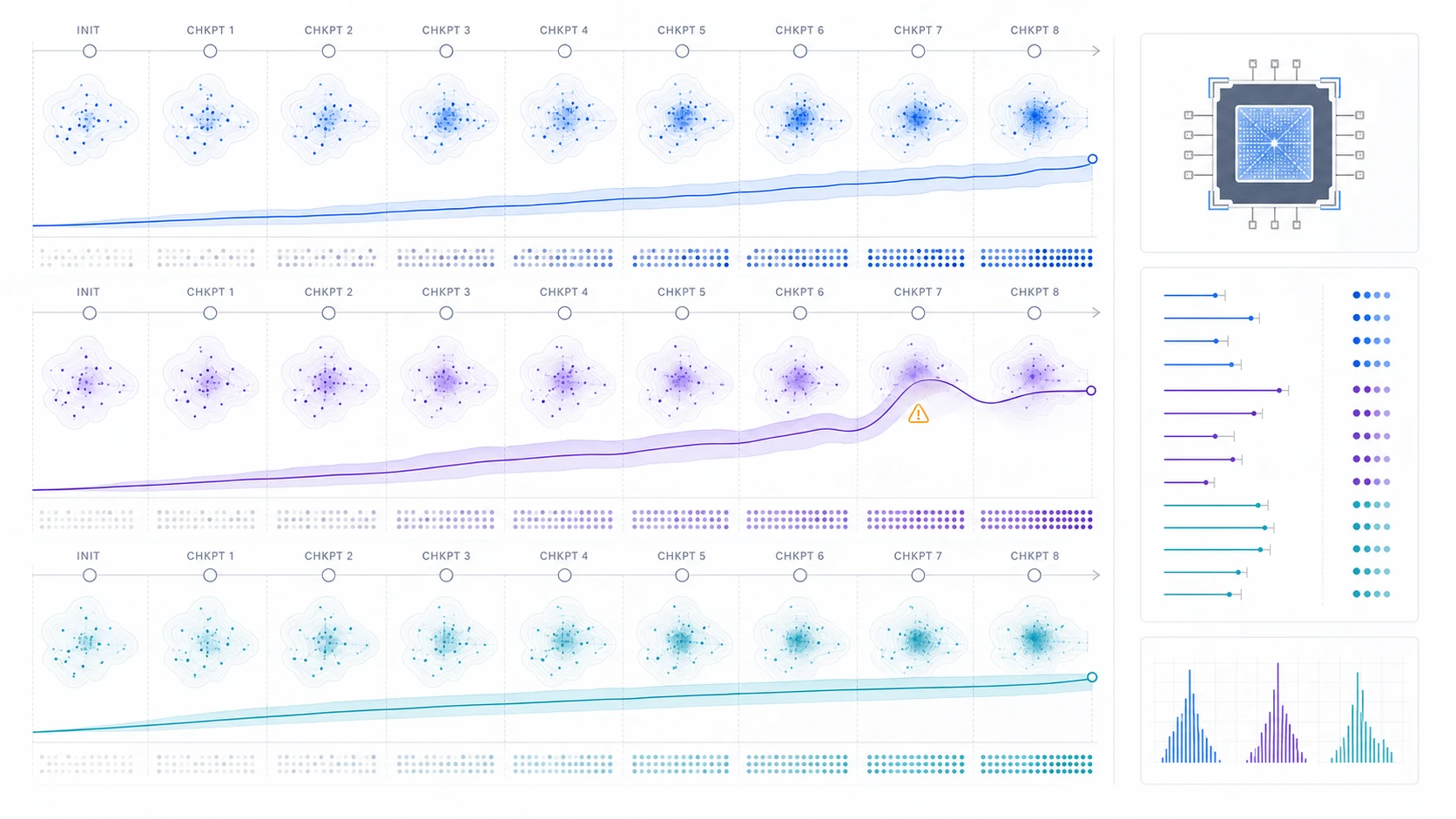
Sequential posterior fidelity is the paper’s best-supported result.
The 8-step all-step FPAA run reports a maximum Hellinger distance of 0.009 at 32,768 shots per step, and the 12-step primary run reports 0.021. Longer 20-step and 32-step trajectories remain in a similar operating band as supporting controls. The strength is not merely low error at one point; it is the absence of obvious error runaway in the selected repeated-update paths.
Boundary-aware BIQAE provides a plausible mechanism for part of that stability. On paired Pittsburgh tests, reported absolute error at amplitude 0.01 falls from 0.6317 to 0.00224, and at 0.95 from 0.4890 to 0.00773. The protocol acknowledges that an estimator tuned for the interior can fail precisely where rare evidence or concentrated beliefs place it.
These measurements are still context-bound. They use small belief spaces, selected observation sequences, shallow circuits, named devices, and particular calibration windows. They support a hardware operating envelope, not a device-independent guarantee.
The shot budgets prevent a simple FPAA-versus-Grover victory claim.
The headline 0.009 FPAA number uses 32,768 shots per step. When FPAA is run at 10,000 shots per step, the reported maximum Hellinger distance is about 0.033. The guarded Grover comparison uses an adaptive budget from 8,000 to 16,000 shots, averaging about 10,000, rather than one fixed count at every step.
This design supports two conclusions: high-shot FPAA produced the best reported posterior fidelity, and lower-budget FPAA remained usable in the tested decision checks. It does not isolate the algorithm from the measurement budget well enough to establish equal-budget superiority. The paper itself leaves a strictly constant-shot Grover rerun as future work.
A stronger comparison would preregister identical per-step and total trajectory budgets, repeat observation schedules across multiple calibration windows, report confidence intervals over independent jobs, and include a classical estimator tuned to the same target error. Until then, stability is the defensible word; superiority is not.
The one-in-a-million result is logical amplification, not elapsed-time acceleration.
In the rare-event control, an analytic evidence probability of one in a million is mapped to a measured accepted probability of 0.9718, close to the analytic amplified value 0.9714. The paper reports 971,832x logical amplification. That is a striking statement about probability mass inside the constructed circuit family.
It is not a 971,832x hardware speedup. The one-qubit instance compiles to no more than six single-qubit basis gates, and the paper does not compare the complete quantum workflow against the time required for classical normalization. Queueing, compilation, execution, calibration, mitigation, and post-processing are absent from a matched total-runtime study.
The correct interpretation is still useful: shallow amplitude amplification can make extremely sparse accepted events measurable within a fixed shot envelope. In this deliberately shallow one-qubit case, the measured accepted probability closely matches the predicted amplified value; the result does not demonstrate deep-circuit resilience or commercial advantage.
Action agreement is encouraging but narrower than policy validation.
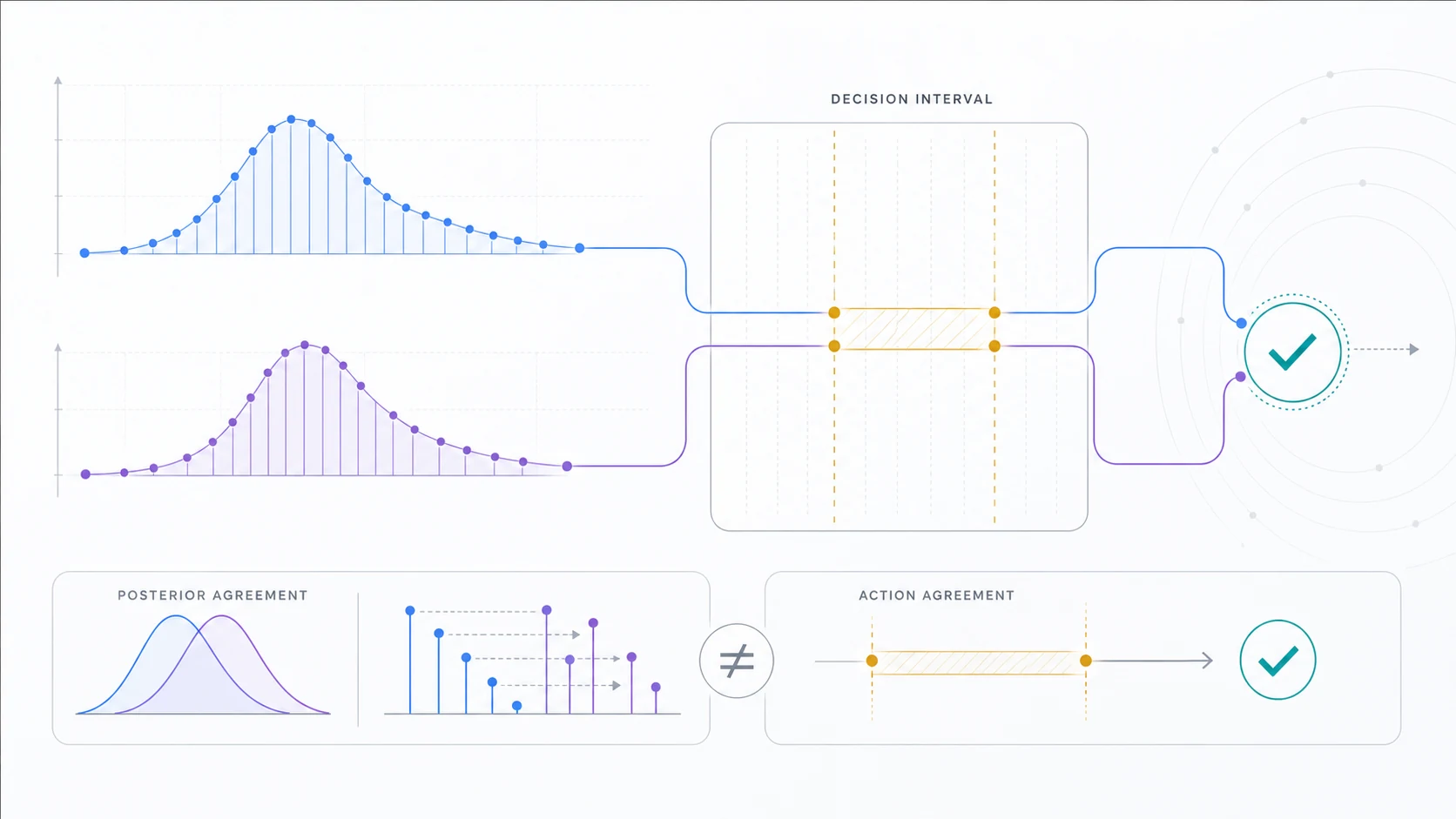
QANTIS compares the hardware-derived and exact Bayes posteriors under the tested Tiger immediate-reward rule. Reported matched-shot checks agree in 8 of 8 steps, and the longer controls agree in 20 of 20 and 32 of 32 steps, with zero measured cumulative immediate value loss under that rule. This connects distribution error to an observable decision boundary.
Agreement can occur even when posterior error is nonzero because both distributions remain on the same side of the action threshold. Move the reward values, add a planning horizon, place the posterior closer to indifference, or introduce asymmetric safety costs, and the same estimation error could matter. The study validates immediate action consistency for the tested trajectory and reward structure, not an optimal policy over arbitrary POMDPs.
A stronger decision study would sweep reward matrices and threshold margins, report regret as a function of posterior distance, and include deliberately difficult near-boundary cases. It should also distinguish immediate action from full policy selection, which remains classical and outside the quantum service.
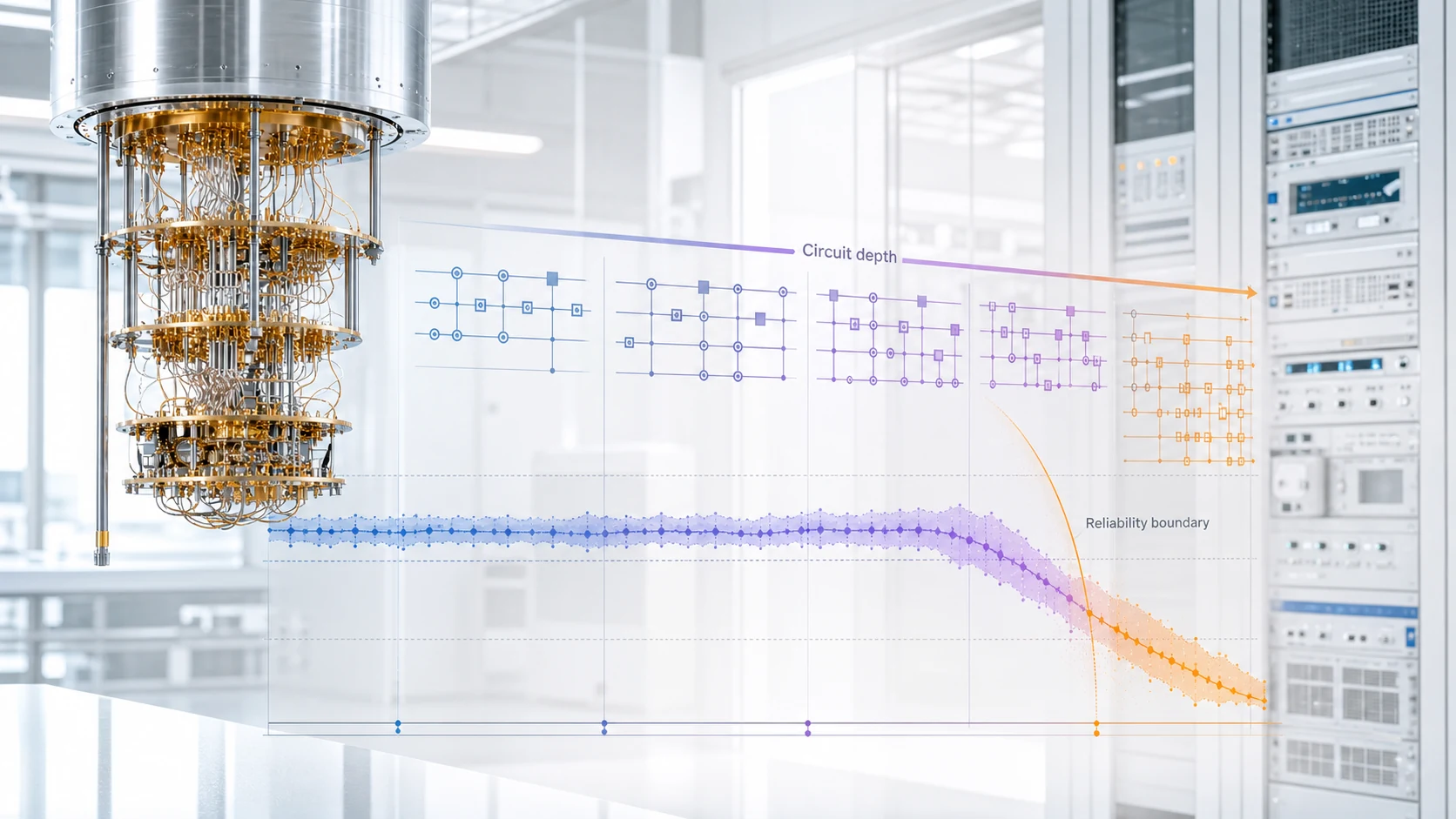
In the tested encodings, compiled depth is a primary practical constraint.
The optimized four-state sweep reports six of six cases below Hellinger distance 0.05. A deeper synthesis stress path reaches that strict band in three of six cases and preserves the maximum-a-posteriori state in five of six. These results are informative because they show that two encodings with the same logical state count can occupy very different hardware regimes.
Mitigation is not monotonically beneficial. The reported controls show it helping selected shallow circuits and hurting deeper UCGate chains. Extra noise scaling and extrapolation can add variance or distort a circuit whose error structure no longer matches the mitigation model. A blanket “mitigation on” policy would therefore weaken, not strengthen, the evidence.
The responsible scale claim is architectural: compact belief oracles with controlled compiled depth can be stabilized on current Heron devices. State-space growth that produces deep preparation, routing, or controlled-unitary chains remains exploratory. A qubit count without transpiled depth, two-qubit gates, and acceptance statistics is not a readiness metric.
The public record needs a campaign-level evidence bundle and reliable timing.
The papers provide algorithms, tables, device names, reported shots, and an explicit claim hierarchy, while the public GitHub repository provides the MIT-licensed Community Edition. That is a meaningful disclosure surface. The raw campaign archive is not publicly bundled with that Community Edition in a form from which an independent reviewer can reconstruct every table row using job-level counts, exact transpiler artefacts, calibration snapshots, software locks, random seeds, and derivation scripts.
Runtime evidence is the second major gap. The latest paper does not provide a reliable field set for submission time, queue duration, execution duration, calibration overhead, mitigation overhead, and classical post-processing across matched alternatives. Without those fields, neither queue-inclusive nor queue-exclusive total-runtime conclusions are available.
Both papers are arXiv v1 preprints as of July 20, 2026, not peer-reviewed publications. That does not invalidate the hardware observations, but it changes the confidence language. Replication across independent teams, backends, calibration windows, and reference implementations is necessary before treating the service envelope as broadly established.
QANTIS is strongest as a disciplined experiment, not an advantage announcement.
The work deserves credit for making the quantum boundary replaceable, reporting matched-shot context beside its best number, connecting posterior error to a decision check, and publishing negative scaling signals. Those choices produce a more credible research object than a broad “quantum autonomy” narrative would.
Its limits are equally clear. The validated belief spaces are small; the best fidelity uses a larger shot budget; the extreme amplification example is shallow; mitigation becomes unreliable with depth; timing is incomplete; raw campaign artefacts are not publicly bundled with the Community Edition; and peer review and independent reproduction remain open.
The next decisive result would be a preregistered, independently reproducible benchmark with fixed budgets, full timing, multiple reward thresholds, automatic classical fallback, and a depth-gated larger-state workload. If QANTIS remains accurate under those harder conditions, the evidence would advance from a controlled service case study toward a reusable quantum inference component.
Practical takeaways
01
The strongest QANTIS evidence is sequential posterior fidelity on shallow, controlled IBM Heron workloads.
02
FPAA stability is supported; equal-budget superiority over guarded Grover is not yet established.
03
971,832x is a logical probability amplification factor, not a wall-clock speedup.
04
Immediate Tiger action agreement does not validate general policy selection or autonomous-system safety.
05
Depth and mitigation behavior limit scaling more directly than logical state count alone.
06
Publicly reconstructable campaign artefacts, full timing, peer review, and independent replication remain priority gaps.
RA · Reference annexDefinitions, recurring questions, editorial method, and primary sources.Inspect
The analysis above carries the main reading flow. This reference layer keeps terminology, recurring questions, editorial method, and primary sources available without interrupting the argument.
Editorial record
How A critical review of QANTIS hardware evidence and its limits. was checked.
- Editorial owner
- Neura Parse Research
- Last verified
- July 20, 2026
- Method
- Synthesis of the dated primary and official records listed below, checked against the operating question in this note.
- Scope limit
- Planning analysis—not certification, customer performance evidence, procurement advice, or a claim of production readiness.
SRSources reviewed
5 records