Abstract
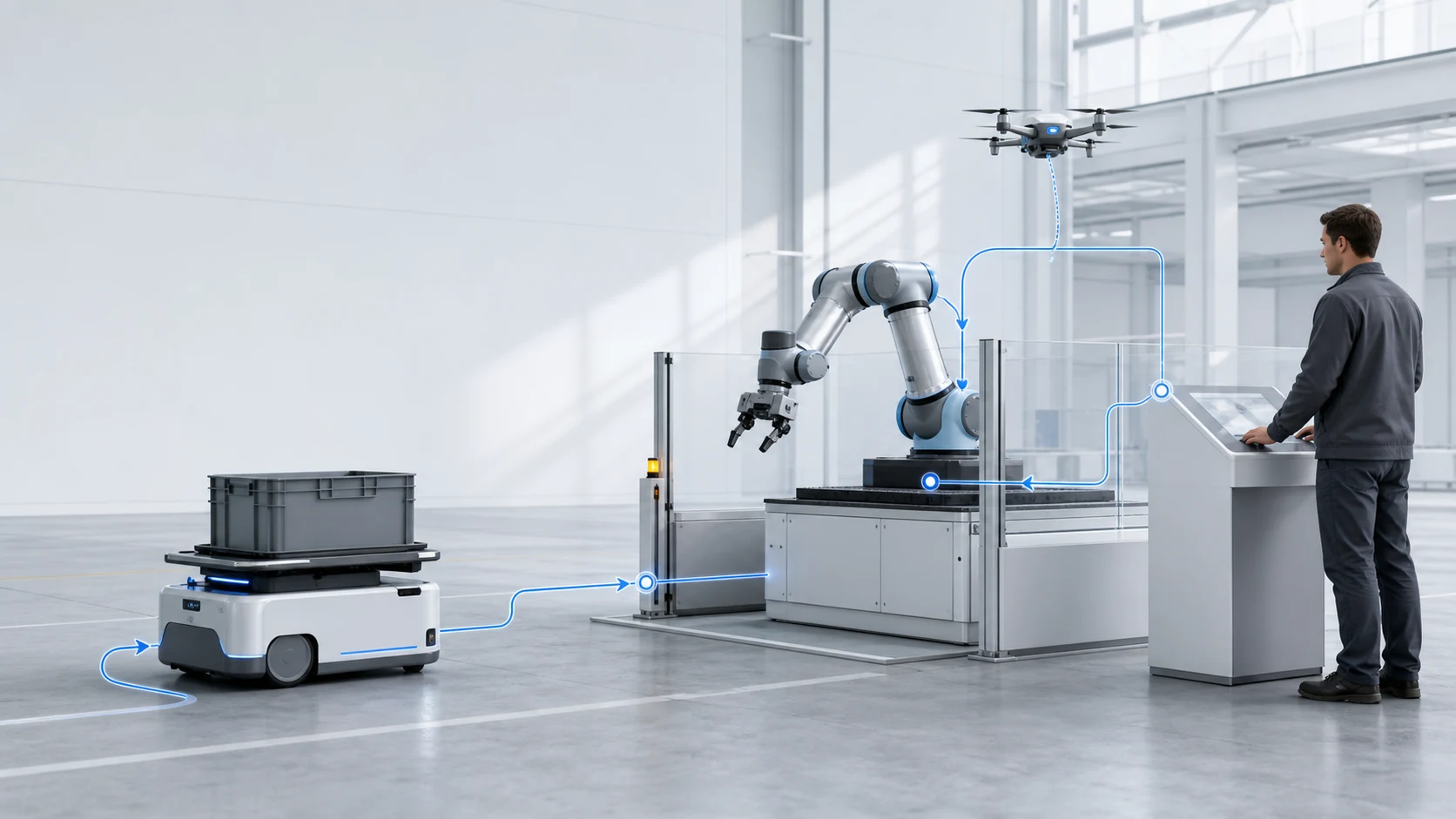
Interoperability is not one protocol and it is not a wall of vendor logos. It is the ability to assign, hand off, pause, recover, and prove a mission across machines that retain different controllers, maps, clocks, safety cases, and fleet managers.
Gap map
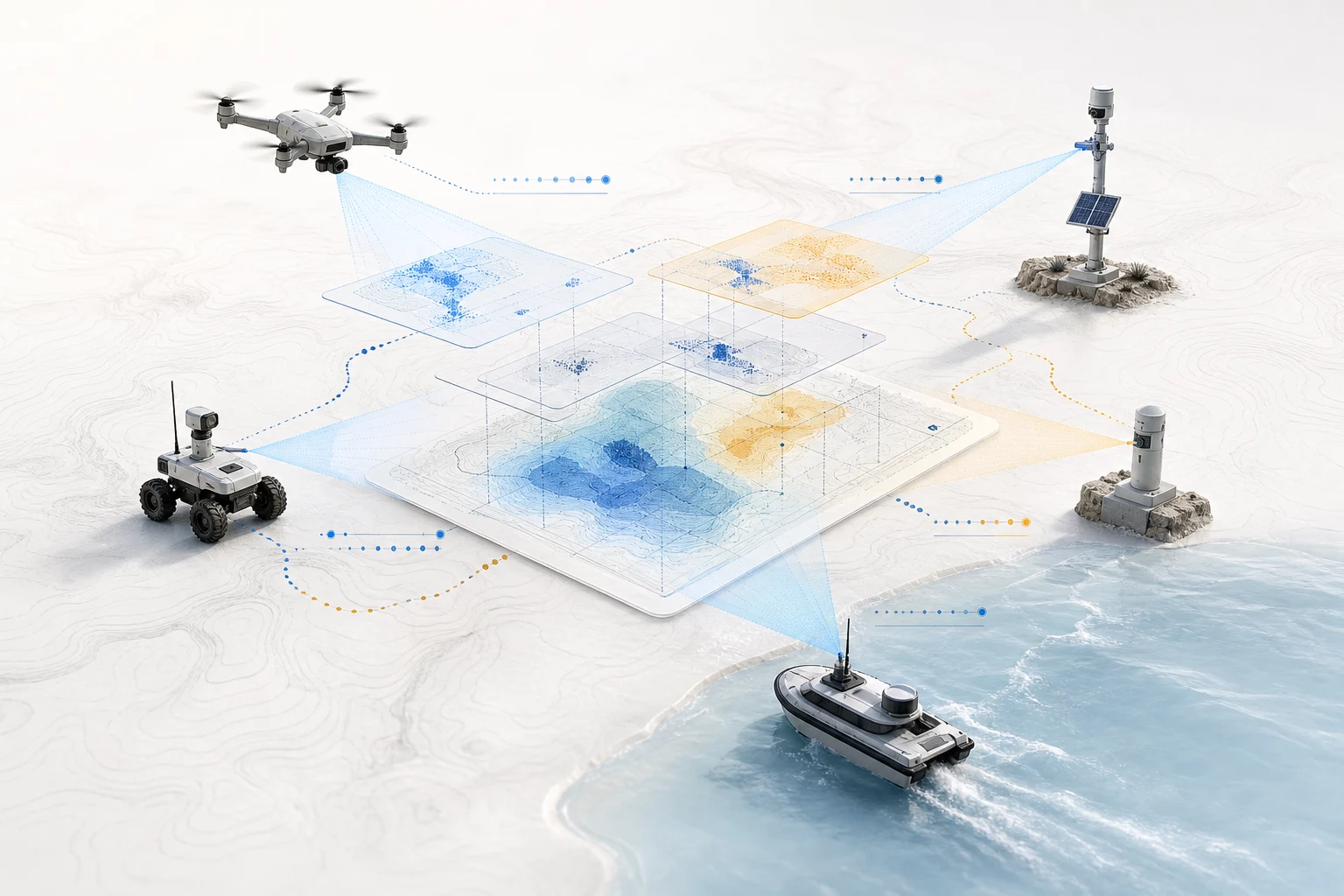
A federation, not one giant robot controller
The mission plane coordinates outcomes and evidence. Fleet managers, workcells, vehicle controllers, and safety systems retain the local knowledge and authority they need.
Mission plane
- Work-order semantics
- Priority and dependencies
- Human authority
- Evidence and replay
Integration plane
- Capability adapters
- Identity and time
- Map and frame transforms
- Order and status translation
Resource plane
- Doors and lifts
- Routes and work zones
- Chargers and tools
- Workcell readiness
Device plane
- Local planner
- Platform controller
- Safety functions
- Offline and recovery state
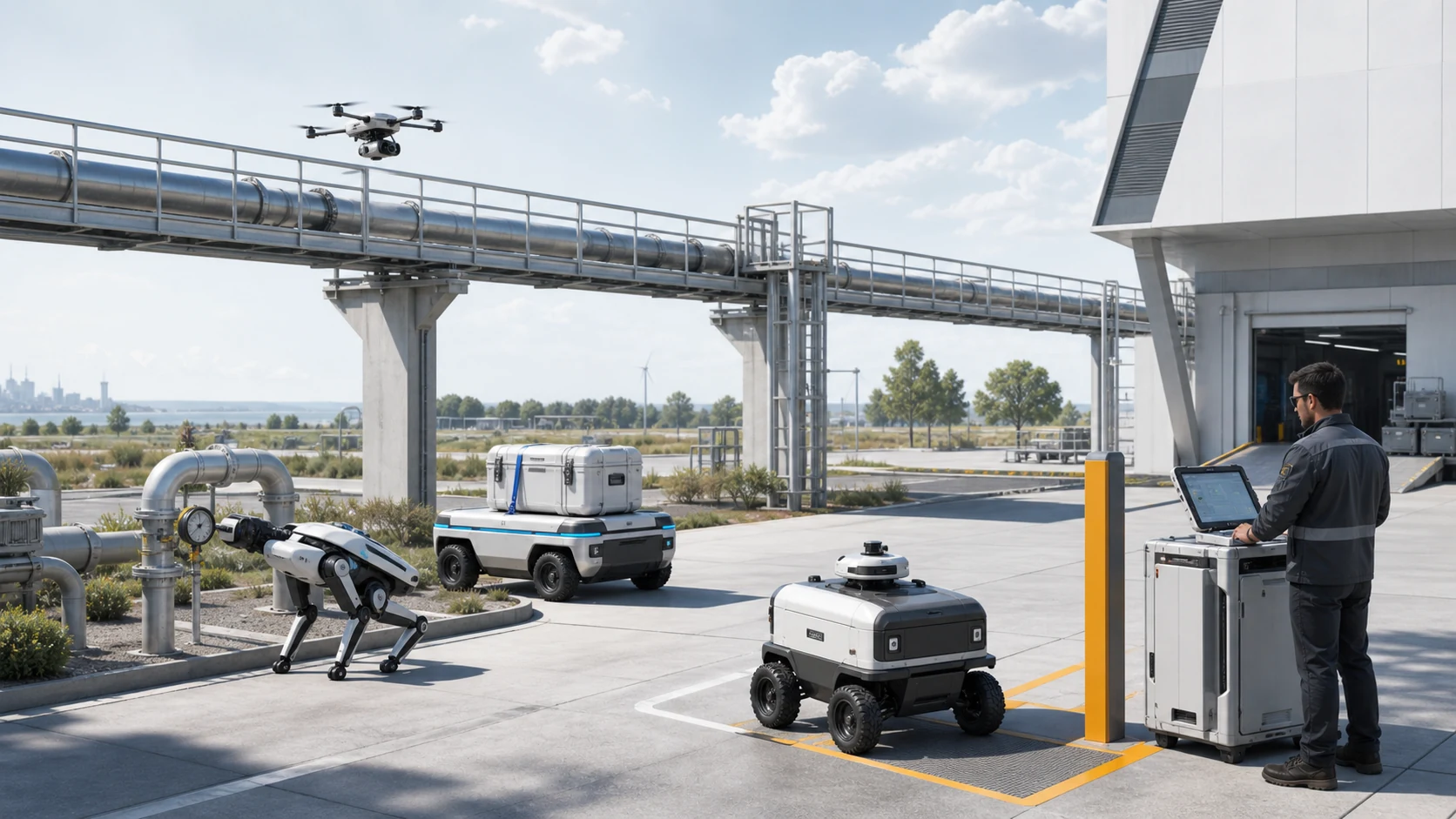
The field is moving from one capable robot toward teams of unlike machines.
Google's July 2026 Gemini Robotics 2 announcement makes multi-robot collaboration an explicit foundation-model capability, including coordination between different embodiments. Open-RMF has long demonstrated a complementary systems problem: heterogeneous fleets need task allocation, traffic deconfliction, lifts, doors, chargers, and workcells to behave as shared resources. VDA 5050 now publishes Version 3.0.0 as the current mobile-robot order and status interface. OPC UA for Robotics 1.02 provides a released information model for robot assets, operating state, and condition data.
Together, these signals point to an ecosystem, but they do not collapse into one universal stack. A reasoning model can understand a mission. VDA 5050 can structure orders and status for mobile robots. Open-RMF can coordinate participating fleets and facility resources. OPC UA can expose industrial equipment information. ROS 2 can provide a component and communications foundation. None of these alone owns the business objective, human authority, cross-system evidence, or every robot's safety case.
NodeRiQ's useful position is between those layers: preserve one mission meaning and shared evidence record while respecting the fact that each platform arrives with different capabilities, controllers, maps, clocks, fleet software, and operating limits.
TD · Technical depth8 supporting chapters and the working checklist.Read deeper
Use each standard for the problem it actually defines.
VDA 5050 Version 3.0.0 is a current, important interface for communication between central master control and mobile robots in intralogistics. It creates a valuable common boundary for orders and status. It does not make an AMR, aerial drone, industrial arm, inspection sensor, and autonomous road vehicle interchangeable, nor does it define the enterprise approval or evidence workflow around them.
Open-RMF provides a broader coordination pattern for heterogeneous fleets and infrastructure. Its public demonstrations cover task dispatch, traffic conflict handling, lifts, doors, campus routes, workcells, and fleets with limited pause/resume APIs. The architectural lesson is federation through adapters: independent systems expose the control and state needed for shared scheduling while retaining their vendor-specific internals.
OPC UA for Robotics 1.02 adds an industrial information-model perspective. It covers motion-device systems, robot and controller identity, operating modes, component structure, asset configuration, and runtime or condition data. Those records can help a mission layer decide whether a device is eligible, healthy, configured correctly, or due for intervention—without pretending OPC UA is the mission planner.
Every participant needs a current, evidence-backed capability passport.
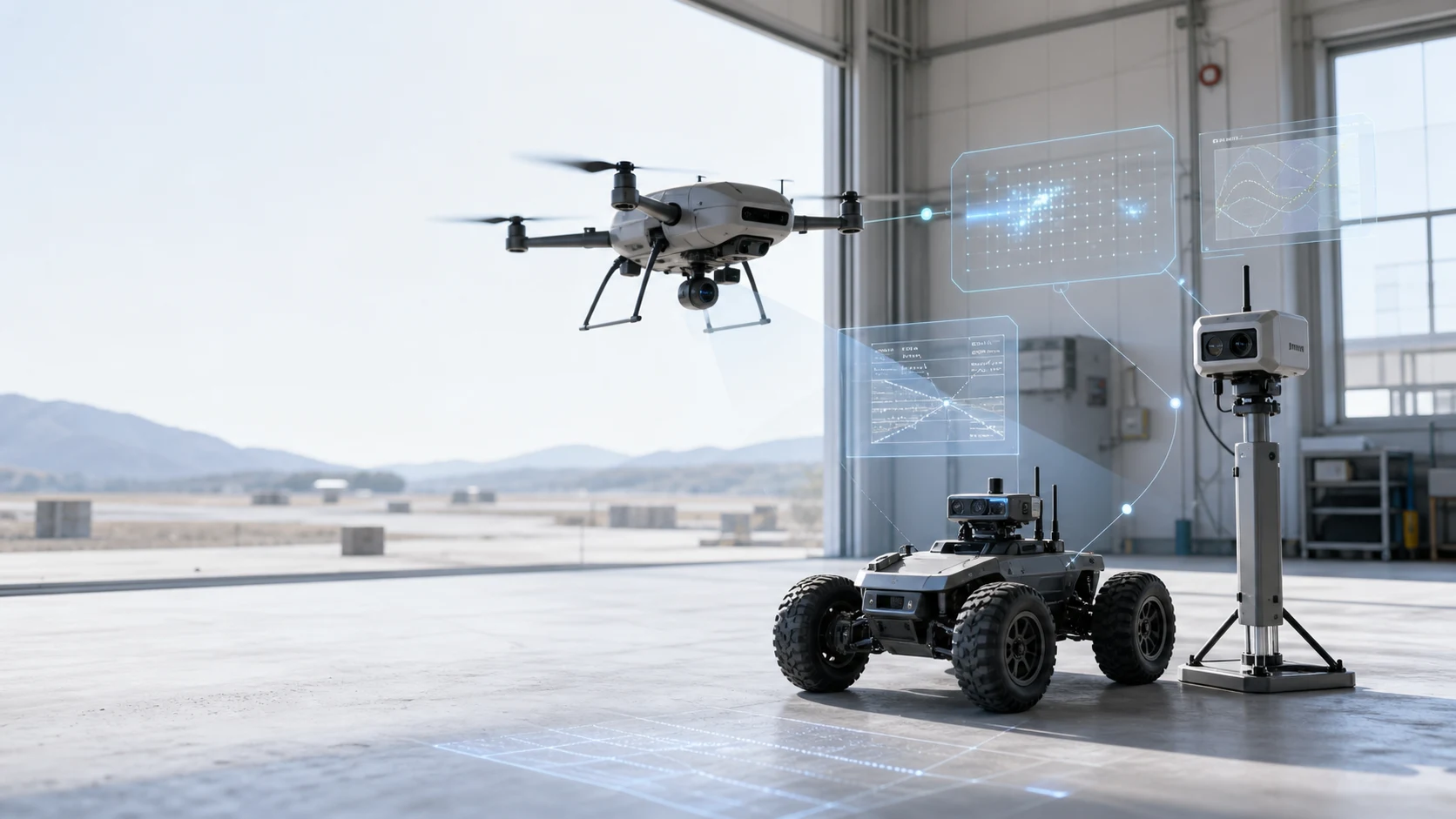
A static registry says a robot has a gripper. A useful capability passport says which end effector is currently installed, the supported payload envelope, the available sensing modes, the operating-zone restrictions, the software and configuration identity, battery or energy state, communication modes, maintenance state, and which evidence the platform can return for task completion.
The passport should also expose uncertainty and temporary degradation. A robot may remain eligible for transport but lose precise placement because a camera is unavailable. A drone may retain visual inspection but lose an accurate global position. A manipulator may be healthy while the receiving fixture is not. Capability is a time-varying claim that needs provenance, not a permanent checkbox.
- Embodiment and tool state: base, arm, gripper, sensor, payload carrier, or specialist attachment.
- Mobility and workspace: route class, slope, clearance, reach, weather, lighting, and public-access constraints.
- Compute and link state: local inference, storage, latency tolerance, intermittent-network behaviour, and update identity.
- Evidence contract: images, measurements, state receipts, confidence, event logs, and replay support.
- Assurance boundary: applicable safety functions, integration scope, unresolved hazards, and named operating owner.
The hardest coordination problems often belong to the building, not the robot.
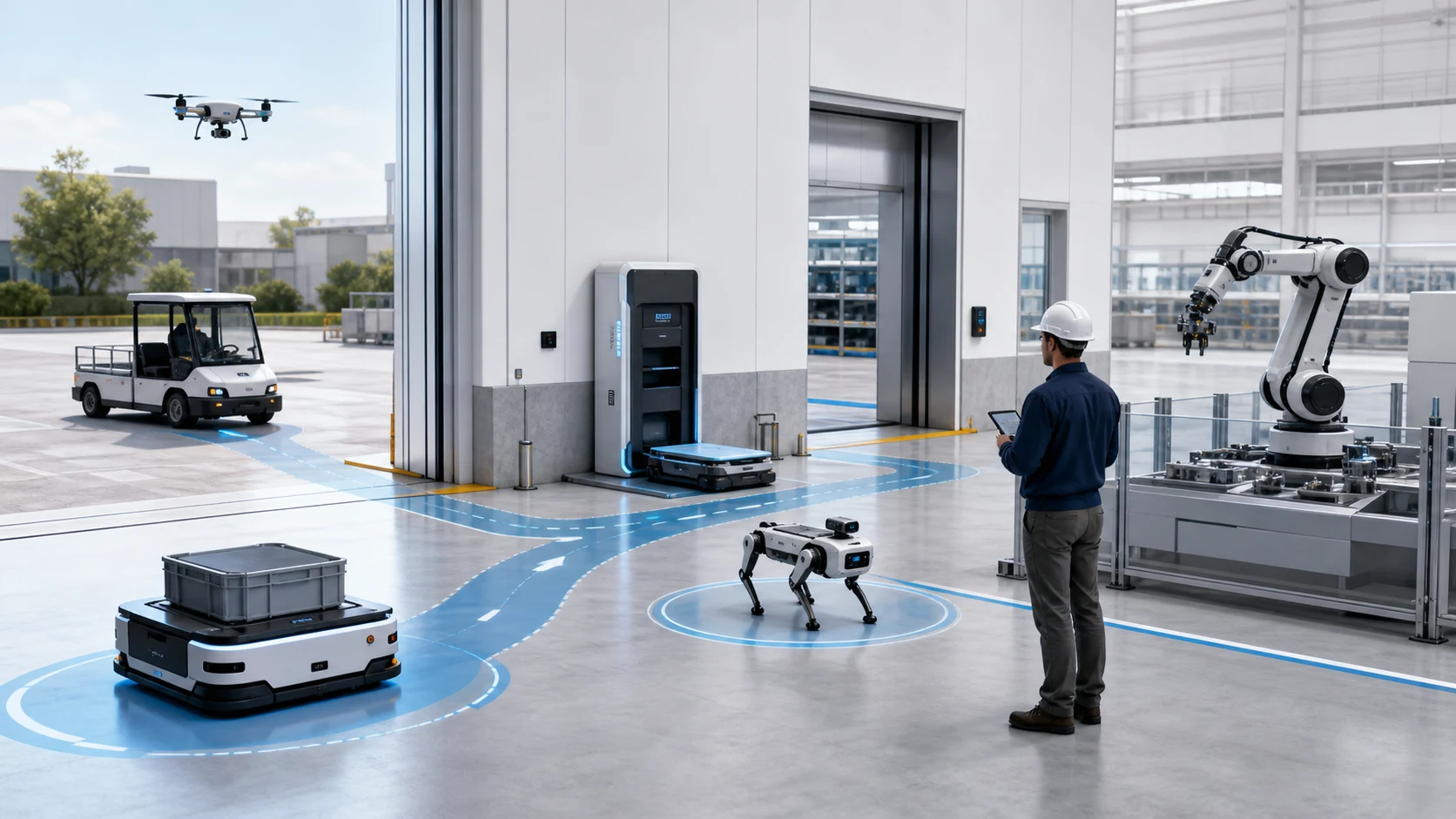
Robots compete for narrow corridors, doors, lifts, chargers, loading docks, workcell windows, tools, and human attention. A local planner can produce a collision-free route for one platform and still create a system-level deadlock. A drone and a mobile robot may not collide physically yet can invalidate each other's sensing or operating zone. A workcell can be ready mechanically while its upstream quality release is still pending.
The ecosystem needs explicit reservations, dependencies, leases, and release evidence for these resources. Open-RMF demonstrates the importance of traffic and infrastructure negotiation for mobile fleets. NodeRiQ's wider research question is how the same resource record can inform unlike platforms and how uncertainty or priority changes should trigger replanning without erasing human intent.
The mission must degrade into local islands without losing its history.
ROS 2 Kilted made rmw_zenoh a Tier 1 middleware implementation and documents security support, reflecting continued work on flexible distributed communications. Technology choice alone, however, does not define degraded operation. The programme must decide which task states are safe to continue locally, which evidence is stored, how identities and clocks are maintained, and what happens when two disconnected participants make incompatible progress.
NodeRiQ's classical-first position is that local safety and platform control remain available without cloud or quantum access. A device can continue a pre-authorized bounded action, pause at a safe point, or return according to its local policy. When the link returns, the mission layer should reconcile event histories rather than overwrite one participant with the latest snapshot. Conflicts remain visible until a rule or accountable person resolves them.
One ecosystem expands the attack surface and the assurance surface together.
A cross-device mission plane can become a powerful path for lateral movement if identity, authorization, software provenance, and least privilege are weak. A camera should not gain motion authority because it shares a message bus. A fleet adapter should not be allowed to close a work order it cannot verify. A model-generated plan should not gain direct access to an unrestricted device API.
Current 2026 robotics safety work is explicitly layered. NVIDIA's Halos for Robotics announcement spans compute, sensing, system software, safety applications, inspection, and preparation for third-party certification. ISO 10218 separates the industrial robot from the integrated application, while ISO 3691-4 treats the operating zone as material to driverless industrial-truck safety. The lesson for NodeRiQ is that ecosystem assurance cannot be delegated to one model, protocol, or robot vendor.
- Mutual identity for devices, adapters, operators, and software configuration.
- Capability-scoped authorization instead of network-level trust.
- Signed or integrity-protected work orders, state receipts, and configuration records where required.
- Independent safety channels and local stop behaviour that do not depend on the mission planner.
- A test matrix that covers the integrated application and operating zone, not only each component in isolation.
NodeRiQ is not presented as a universal robot operating system or deployed fleet platform.
This ecosystem model is a public architecture and engagement direction for the NodeRiQ applied programme. It draws on current standards and public robotics platforms to define where a shared mission and evidence layer may add value. It does not claim released adapters, compatibility with every vendor, control of certified systems, production deployment, or performance at fleet scale.
The commercial conversation should therefore begin with the customer's existing devices and constraints. Which fleet managers must remain? Which standards are already supported? Which shared resource causes the most operational friction? Which handoff lacks evidence? Which failure is expensive or unsafe to diagnose? A high-quality PoC answers one of those questions with a reviewable record before the ecosystem expands.
Practical takeaways
01
Treat the autonomy ecosystem as a federation of local systems, not one giant robot controller.
02
Separate transport, syntax, semantics, context, and authority when evaluating interoperability.
03
Use VDA 5050, Open-RMF, OPC UA Robotics, and ROS 2 for their actual scopes rather than calling any one of them universal.
04
Represent capability as a current evidence-backed passport that can degrade over time.
05
Test one heterogeneous handoff, one shared resource, one link failure, and one safe refusal before scaling the fleet.
RA · Reference annexDefinitions, recurring questions, editorial method, and primary sources.Inspect
The analysis above carries the main reading flow. This reference layer keeps terminology, recurring questions, editorial method, and primary sources available without interrupting the argument.
Field questions
Program questions behind One mission, many machines: the autonomy ecosystem after the single-robot era..
Q01Is there one standard that connects every autonomous device?
No. VDA 5050, Open-RMF, OPC UA Robotics, ROS 2, vendor APIs, and other interfaces solve different parts of the problem. A real integration must preserve task meaning, spatial and temporal context, authority, safety, and evidence across those boundaries.
Q02Would NodeRiQ replace an existing fleet manager?
The public PoC direction does not require replacement. Existing fleet managers and device-local controllers can remain responsible for their robots while NodeRiQ evaluates a shared mission, context, authority, and evidence layer across adapters.
Q03Which devices can a NodeRiQ ecosystem include?
The public evaluation profile may include mobile robots, vehicles, workcells, manipulators, drones, inspection platforms, vision systems, building infrastructure, and fleet managers. Actual eligibility depends on available interfaces, operating limits, safety scope, and the evidence a specific PoC requires.
Editorial record
How One mission, many machines: the autonomy ecosystem after the single-robot era. was checked.
- Editorial owner
- Neura Parse Research
- Last verified
- August 25, 2026
- Method
- Synthesis of the dated primary and official records listed below, checked against the operating question in this note.
- Scope limit
- Planning analysis—not certification, customer performance evidence, procurement advice, or a claim of production readiness.
SRSources reviewed
10 records