Abstract
NodeRiQ should enter through an operational seam: a gauge reading that must become a service task, a payload that crosses fleet and workcell boundaries, or a remote inspection that must survive disconnection and return with reviewable evidence.
Gap map
Five entry profiles, one evaluation discipline
Each profile changes the devices and environment, but the PoC always fixes the mission, injects a failure, preserves human authority, and closes with evidence.
Inspect
- Gauge and asset state
- Drone or quadruped capture
- Anomaly evidence
- Service recommendation
Move
- AMR or vehicle task
- Payload identity
- Shared route or door
- Workcell handoff
Respond
- Priority change
- Remote or degraded link
- Human release
- Local safe pause
Learn
- Outcome receipt
- Conflict retention
- Recovery replay
- Next-envelope decision
Choose the broken handoff, not the most photogenic robot.
A robot demo optimizes for visible motion. A valuable use case optimizes an operational decision. The key question is not whether a quadruped can walk, a drone can fly, or a manipulator can grasp. It is whether an observation becomes a trusted task; whether the correct device receives it; whether the task survives an exception; whether a person can intervene; and whether the final record is strong enough to release the next action.
This is why NodeRiQ's early programme value sits at the seams between systems. Existing robots and models may already perform the physical skill. The gap is often shared context, capability-aware assignment, infrastructure coordination, degraded-connectivity behaviour, and a coherent evidence chain across the workflow.
The profiles below are proposed evaluation structures based on current public robotics capabilities and standards. They are not claims that Neura Parse has completed these deployments for customers.
TD · Technical depth9 supporting chapters and the working checklist.Read deeper
Turn a remote observation into a bounded maintenance decision.
Google DeepMind's April 2026 Gemini Robotics-ER 1.6 release highlights industrial instrument reading, multi-view reasoning, and success detection. Those capabilities make the perception layer more useful, but an operating workflow still needs to identify the asset, preserve the original imagery and measurement context, compare the reading with an approved range, distinguish a model estimate from a calibrated sensor, and decide who can release a maintenance action.
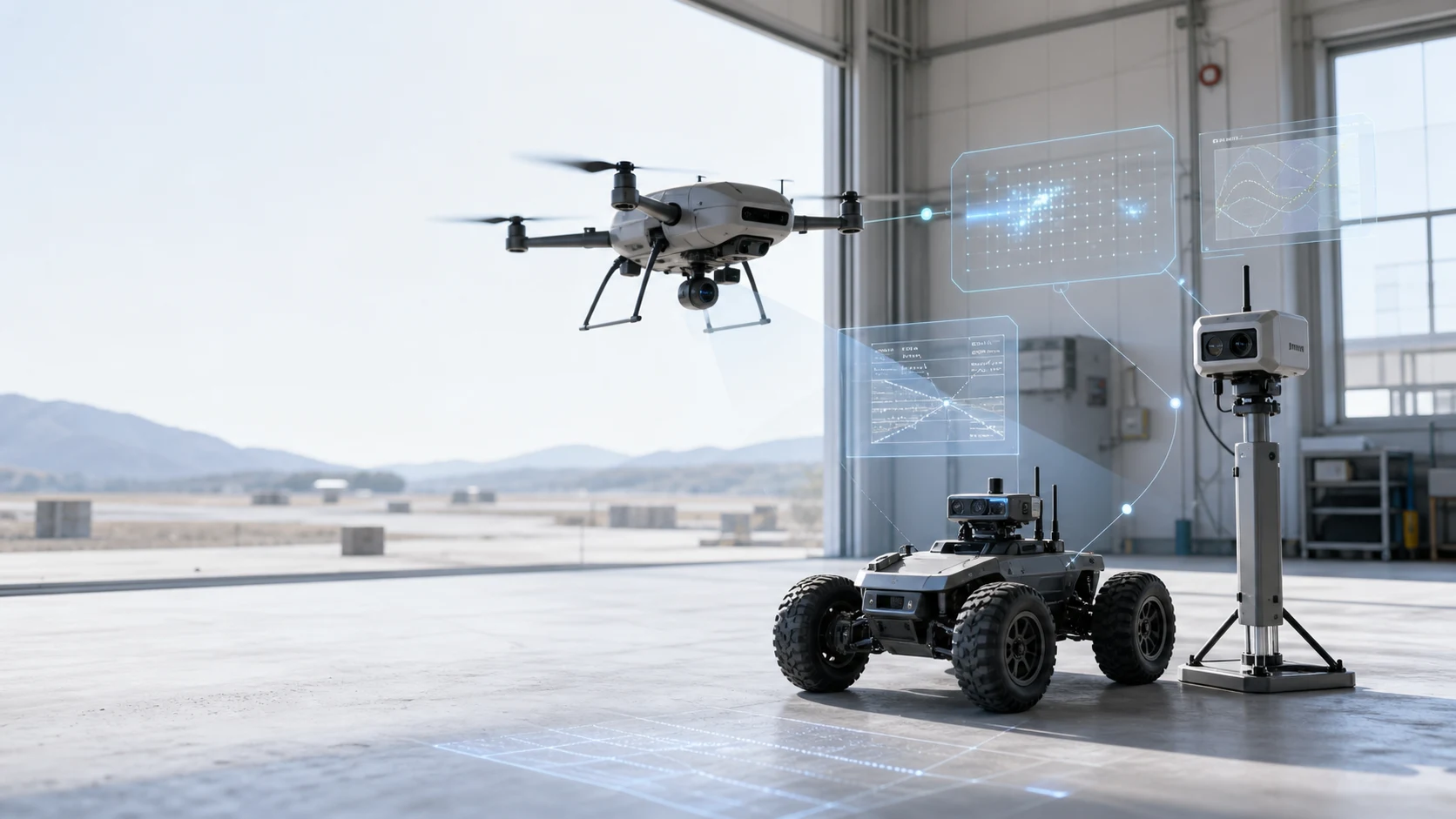
A NodeRiQ inspection PoC can connect a drone, quadruped, fixed camera, or mobile robot to one asset class and one service workflow. The platform captures an instrument or condition record; the shared context retains location, time, viewpoint, device and model identity, confidence, and conflicting evidence; a human reviews the recommendation; and the system dispatches or withholds the next bounded task.
- Use cases: utility corridor inspection, gauge reading, thermal or visual anomaly review, remote site rounds, and infrastructure condition triage.
- Injected failure: obscured gauge, stale asset identity, disagreement between views, or lost link before upload completes.
- Acceptance evidence: source media, asset match, uncertainty, reviewer decision, resulting work order, and final inspection or maintenance receipt.
- Boundary: no claim of certified measurement, autonomous maintenance release, or general anomaly detection without task-specific evaluation.
Coordinate a payload across AMR, door, lift, and workcell boundaries.
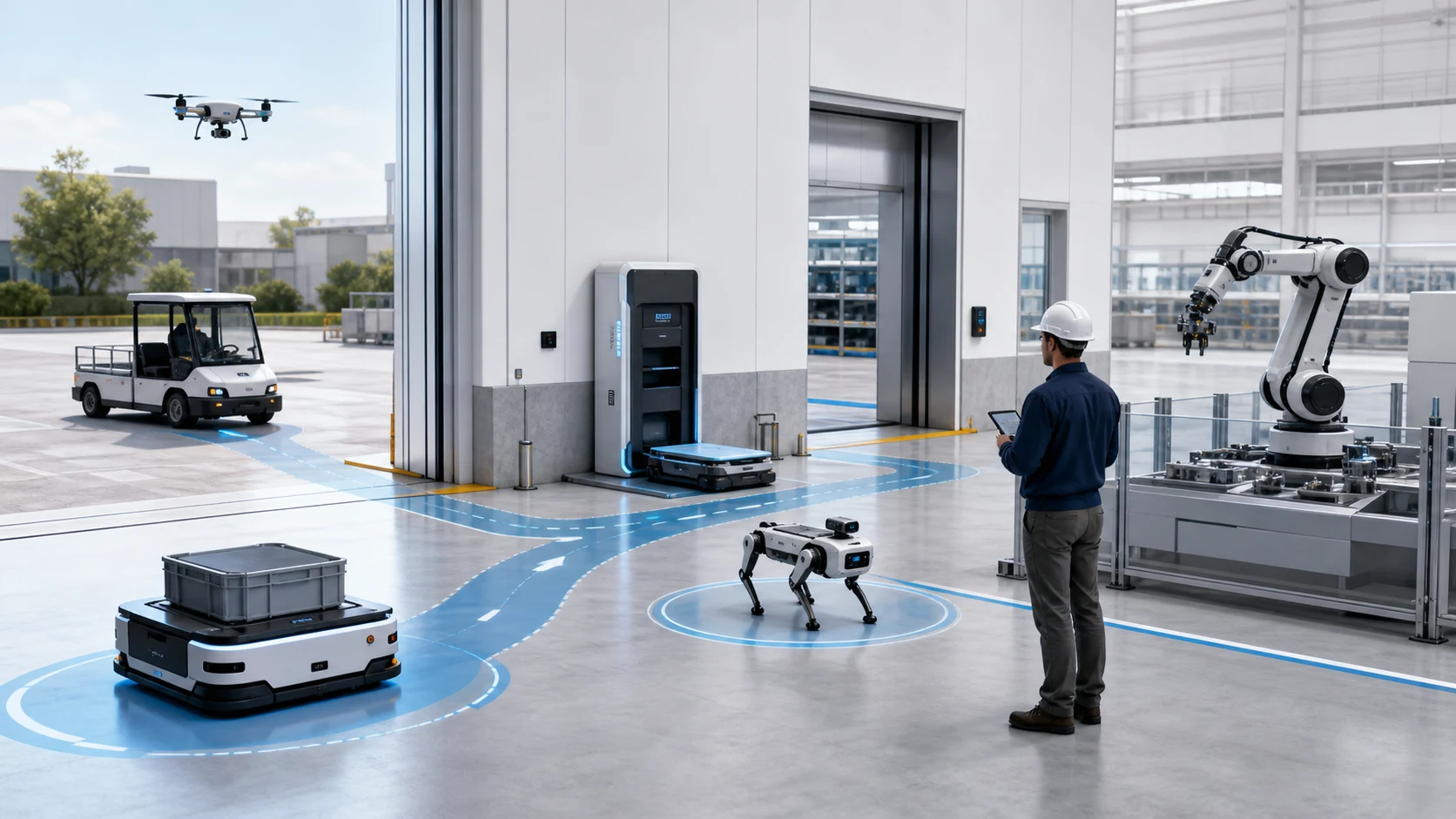
Intralogistics is a strong first profile because the ecosystem problem is concrete. VDA 5050 Version 3.0.0 provides a current order-and-status interface for mobile robots. Open-RMF demonstrates heterogeneous fleets, task dispatch, traffic negotiation, lifts, doors, and workcells. NVIDIA's Isaac Mission Control reference connects VDA 5050, MQTT, mission dispatch, route services, and edge robots while publishing current scope and limitations.
NodeRiQ does not need to replace these systems. The PoC can preserve one payload and work-order identity across them: request pickup, reserve shared resources, assign a capable fleet, confirm loading, move through the facility, verify the receiving workcell state, record handoff, and recover if the destination or route becomes unavailable.
- Use cases: line-side replenishment, inspection-sample movement, kitting, tool delivery, and warehouse-to-workcell handoff.
- Injected failure: closed route, lift unavailable, payload mismatch, low battery, or workcell not ready.
- Acceptance evidence: assignment rationale, reservations, payload identity, route and state receipts, handoff proof, and recovery decision.
- Boundary: no claim of universal VDA 5050 compatibility, optimized fleet throughput, or production-safe integration before site evaluation.
Keep evidence coherent when the network and the team split apart.
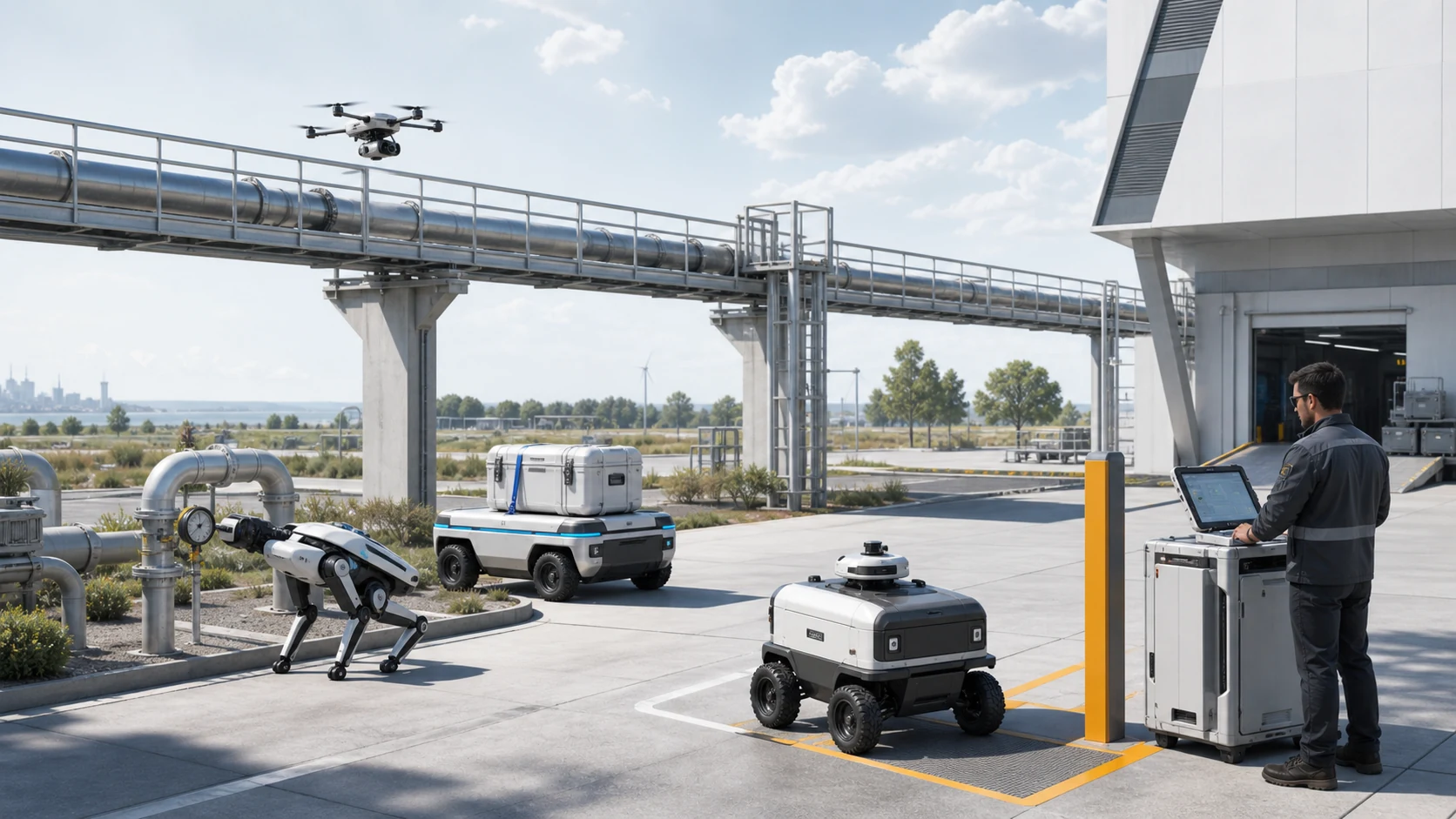
Remote field work exposes the difference between a connected demo and a resilient system. An aerial platform may survey a corridor while a ground vehicle carries equipment, a technician works from a temporary base, and central specialists review only intermittent updates. The local team needs a useful state even when the connection disappears; the central record must later understand what occurred while it was absent.
The NodeRiQ Field Evidence Continuity PoC should use store-and-forward evidence with source identity, clock context, uncertainty, configuration, and local authority. A lost connection triggers a pre-agreed safe state rather than an improvised one. When the link returns, event histories reconcile, conflicts remain visible, and a human decides whether the remote task can close or requires another observation.
- Use cases: energy and water infrastructure, environmental survey, remote construction, maritime or Arctic observation, and dispersed field service.
- Injected failure: connectivity partition, clock drift, duplicate task, missing media segment, or incompatible local and central updates.
- Acceptance evidence: offline event chain, local decision scope, reconnection diff, conflict resolution, operator receipt, and replay.
- Boundary: no claim of validated telecom integration, extreme-environment certification, or unattended autonomous operation.
Replan urgent movement without allowing priority to erase safety or accountability.
Emergency and high-priority logistics can include medical or technical supplies, site recovery equipment, spare sensors, batteries, or inspection kits. The difficult part is not only shortest-path planning. Priorities change; routes close; people enter operating zones; one vehicle may carry the correct payload but lack the required access; a receiving team may move before the delivery arrives.
A public-safe NodeRiQ evaluation should model priority as an input to assignment, never as permission to bypass the safety envelope. The workflow records who declared the priority, which resource reservations changed, which lower-priority tasks were displaced, how affected operators were notified, and what evidence closed the delivery. A human retains authority for consequential changes.
- Use cases: emergency logistics exercises, incident-site equipment movement, critical-spares delivery, and constrained campus response.
- Injected failure: destination change, blocked access, loss of the preferred vehicle, or human entry into the route.
- Acceptance evidence: priority source, revised plan, affected-task receipts, human release, safe pause, delivery proof, and after-action replay.
- Boundary: public evaluation only; no claim of emergency-service adoption, operational readiness, or autonomous response authority.
Let unlike robots complete one job without sharing one controller.
Gemini Robotics ER 2 makes multi-robot collaboration and longer task orchestration visible at the model layer. NVIDIA Isaac Sim provides public multi-robot examples and 2026 documentation for composing controllers and simulation workflows. The practical production question is how a mobile base, manipulator, vision system, and human station agree on task state when each retains different control and safety software.
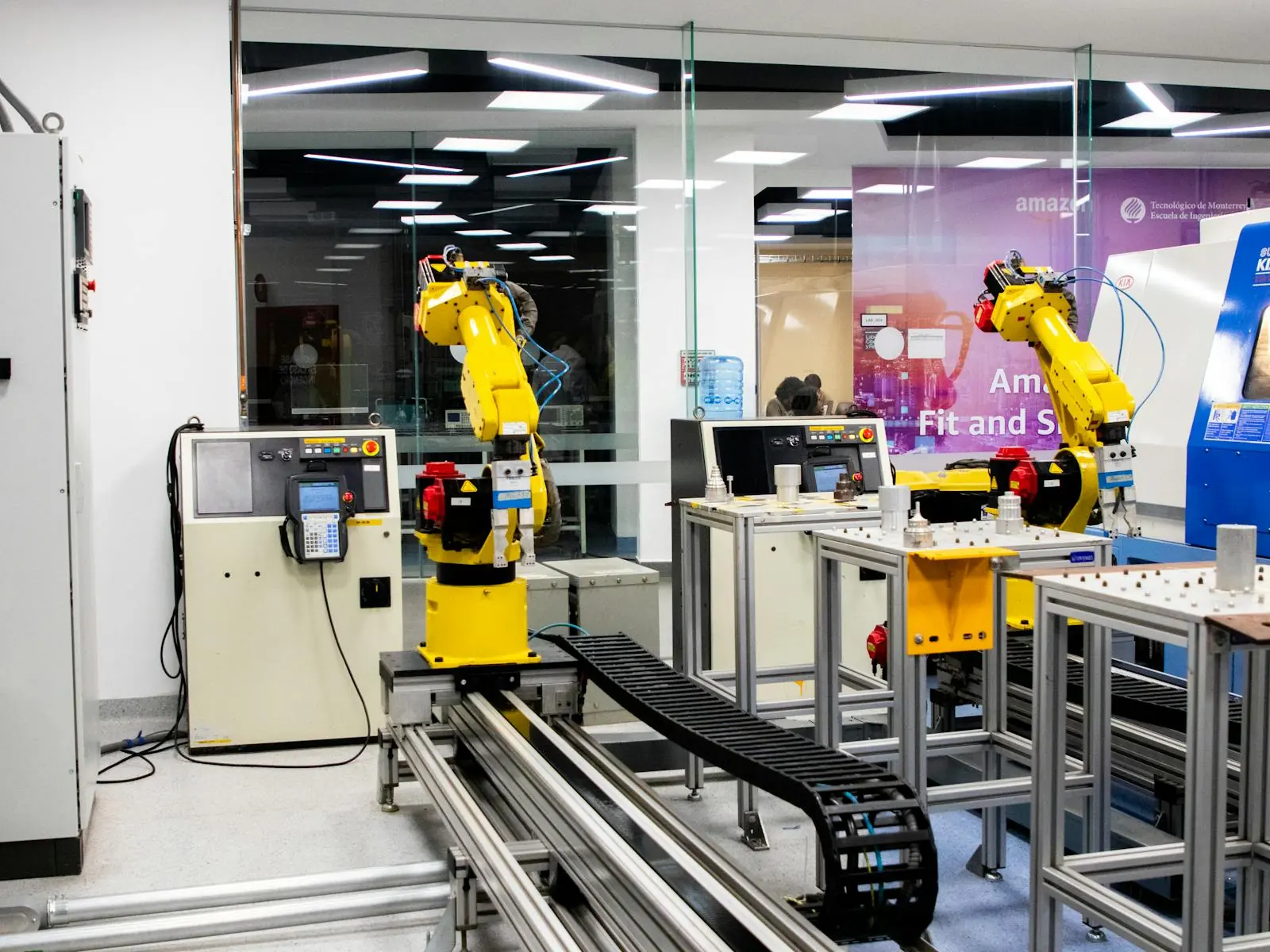
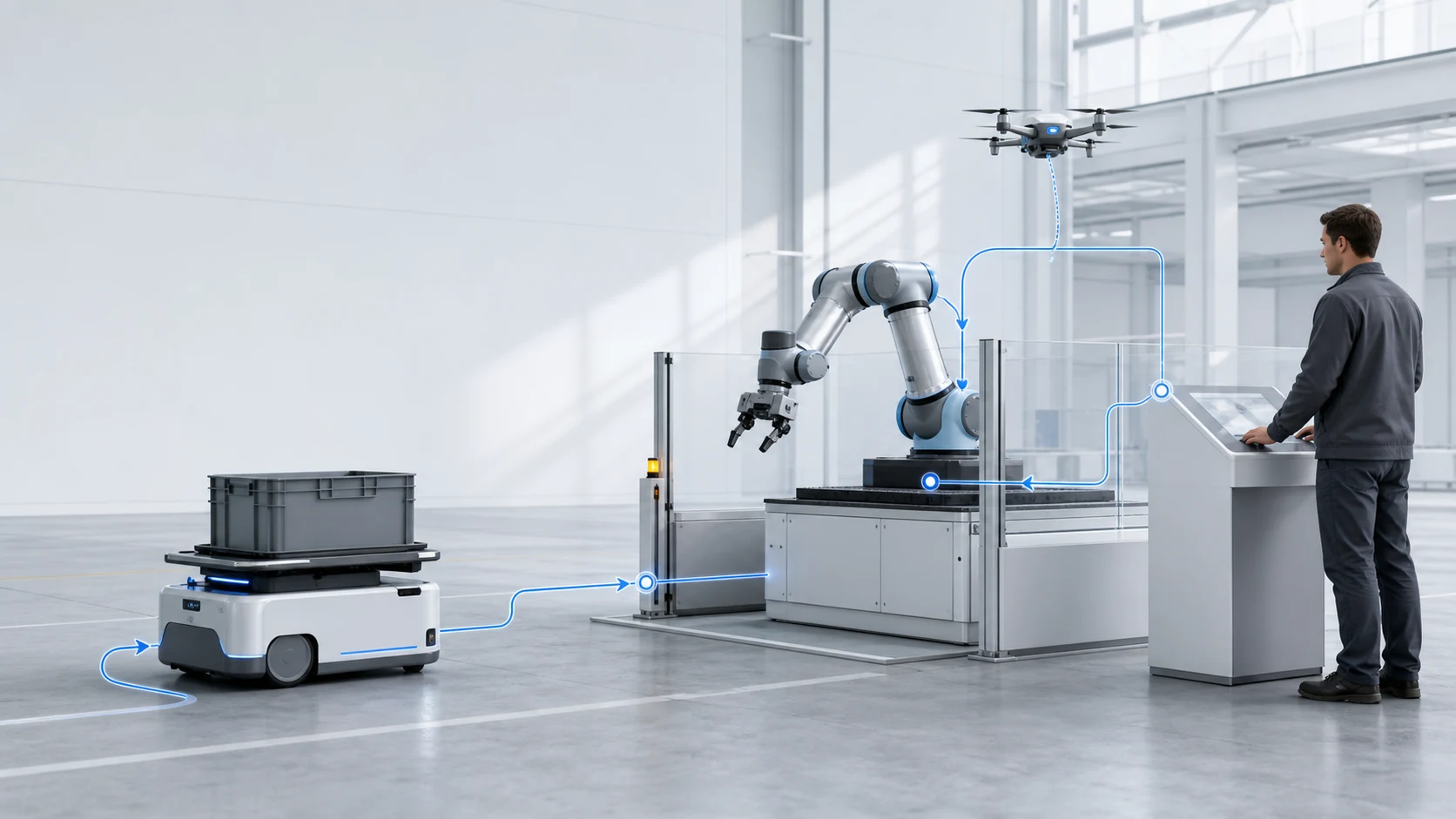
A NodeRiQ workcell PoC can coordinate one material or inspection flow: the mobile platform arrives, the workcell verifies readiness, the manipulator performs a bounded action, external sensing checks the physical result, and the mobile platform departs only after the evidence packet closes. The shared mission layer coordinates dependencies; local controllers remain responsible for motion and safety.
- Use cases: machine tending evaluation, mobile manipulation, quality-inspection handoff, flexible kitting, and tool exchange.
- Injected failure: grasp failure, object identity conflict, workcell state change, occluded verification view, or unavailable human reviewer.
- Acceptance evidence: readiness state, task and tool identity, execution events, independent completion check, exception path, and closeout.
- Boundary: no claim of certified collaborative operation, cycle-time improvement, or general manipulation performance.
Break the mission cheaply before a physical system can break it expensively.
NVIDIA's 2026 Cosmos 3 and Isaac work illustrates the expanding physical-AI development loop: scenario generation, action data, simulation, policy evaluation, and movement toward edge deployment. Simulation is valuable for NodeRiQ because the programme can vary connectivity, clock drift, resource conflicts, sensor disagreement, human delay, and device loss faster than a physical test campaign can safely reproduce them.
Simulation does not prove the field outcome. Its role is to falsify assumptions, exercise recovery, and define the physical test matrix. Every promoted scenario should preserve the simulation configuration, initial state, expected invariant, observed failure, and reason it deserves a hardware run. The hardware campaign then records the differences that simulation missed.
Move from evidence map to non-production mission thread to bounded field decision.
In the first 30 days, map one workflow and its evidence: systems, owners, device capabilities, operating zones, current handoffs, failure history, and completion definition. Build an adapter and authority inventory before choosing a model. The deliverable is a shared task contract and acceptance plan, not a slide deck claiming autonomy.
By 60 days, run the thread in simulation or a controlled test environment. Exercise the nominal path and at least three failures, including one lost link and one human intervention. Produce a replay that connects observations, recommendations, authority, device events, and recovery.
By 90 days, run a bounded non-production physical evaluation if the evidence gates allow it. Compare the physical result with the simulation assumptions, document unresolved hazards and adapter gaps, and make an explicit stop, iterate, or expand decision. Timeline depends on site, device access, safety review, and integration scope; these phases are an engagement shape, not a delivery guarantee.
The first win is a better operating decision, not autonomous scale.
Useful PoC measures include task-state completeness, evidence freshness, assignment validity, exception-detection delay, human intervention quality, recovery success, reconciliation conflicts, unexplained state transitions, replay completeness, and time to determine what happened. Throughput, utilization, and cycle time matter only after the team can trust the record.
A negative result can still be valuable. The adapter may lose essential semantics; the shared resource may not expose enough state; a model may fail under the real camera geometry; the local platform may not support the required safe pause; or operator workload may exceed the benefit. The programme should retain that evidence and narrow the use case rather than hide the result behind a futuristic demo.
These are proposed solution profiles, not solved-customer claims.
The use cases in this atlas describe where NodeRiQ programme principles may be evaluated with current robotics technologies. They do not state that Neura Parse has delivered these systems, that the robotics models cited are integrated into NodeRiQ, or that any scenario has achieved production, certification, customer acceptance, or a performance result.
The customer-facing value is specificity. A prospective programme can select one profile, provide the actual devices and interfaces, identify one costly exception, and agree on the authority and evidence needed for a non-production test. That is a credible path from futuristic capability to operational proof.
Practical takeaways
01
Select use cases around broken handoffs and evidence gaps rather than robot novelty.
02
Begin with inspection-to-action, intralogistics handoff, remote field continuity, priority logistics, or a mixed workcell.
03
Inject connectivity, sensing, resource, and human-authority failures before expanding autonomy.
04
Use simulation to falsify assumptions and define the hardware test matrix—not as field proof.
05
Judge the first PoC by its next-envelope decision and replay quality, not fleet scale or marketing impact.
RA · Reference annexDefinitions, recurring questions, editorial method, and primary sources.Inspect
The analysis above carries the main reading flow. This reference layer keeps terminology, recurring questions, editorial method, and primary sources available without interrupting the argument.
Field questions
Program questions behind The 2026 robotics use-case atlas: where NodeRiQ should prove value first..
Q01Which NodeRiQ robotics use case should a company start with?
Start where one bounded physical workflow already has an evidence or handoff failure: inspection-to-maintenance, AMR-to-workcell delivery, remote field reconciliation, priority logistics, or multi-robot task completion. The best first case has a named owner and a costly exception that can be safely reproduced.
Q02Are these completed NodeRiQ customer deployments?
No. They are source-backed public evaluation profiles and PoC structures. NodeRiQ remains an applied research and productisation programme, not a released or fielded robotics product.
Q03Does a NodeRiQ PoC require new robots?
Not necessarily. The preferred starting point is the customer's existing devices, fleet managers, sensors, and work systems. The programme then tests whether a bounded shared mission, authority, and evidence layer can cross those interfaces without replacing local safety or control.
Editorial record
How The 2026 robotics use-case atlas: where NodeRiQ should prove value first. was checked.
- Editorial owner
- Neura Parse Research
- Last verified
- August 25, 2026
- Method
- Synthesis of the dated primary and official records listed below, checked against the operating question in this note.
- Scope limit
- Planning analysis—not certification, customer performance evidence, procurement advice, or a claim of production readiness.
SRSources reviewed
11 records