Abstract
The useful unit of robotic autonomy is not a natural-language command. It is a bounded work order that can be decomposed, assigned, executed, challenged, recovered, and closed with evidence.
Gap map
The robotic workflow around the model
Reasoning is one lane. A dependable mission also needs a task contract, a capability-aware assignment, local safety, progress evidence, and a recoverable closeout state.
Frame
- Objective and completion test
- Operating zone
- Allowed actions
- Human authority
Plan
- World and resource state
- Capability matching
- Task graph
- Alternative and abort path
Execute
- Device-local controller
- Safety envelope
- Progress events
- Bounded tool calls
Prove
- Success detection
- Exception receipt
- Recovery replay
- Signed closeout decision
High-level robot reasoning is becoming an orchestrator, not only a perception model.
Google's July 2026 Gemini Robotics ER 2 release is a useful marker for the field. The model is described as a high-level brain that consumes continuous multimodal context, plans multi-step work, calls lower-level robot interfaces as tools, tracks progress, self-corrects, and coordinates different robots. The release also separates embodied reasoning from the vision-language-action or navigation layer that performs motor execution.
That separation is important for NODERIQ. A model can help interpret intent and decide what comes next without becoming the safety controller, fleet master, identity system, or legal authority. The public model card reinforces the boundary: developers are asked to use discretion in production and not use the robotics model for safety-critical work where failure can foreseeably cause injury or damage.
The future-facing position is therefore not 'let the model run the robots.' It is 'make reasoning one governed participant inside a workflow whose other participants can constrain, observe, stop, and audit it.'
TD · Technical depth7 supporting chapters and the working checklist.Read deeper
Start with a work order that a person, planner, and machine can all interpret.
A prompt such as 'inspect the west utility corridor and bring back anything unusual' leaves too much unresolved. Which corridor boundary is authoritative? Which sensors are required? May the robot open a door, enter an occupied zone, or ask another platform for help? What counts as complete? What evidence must return before the task can close? A demonstration can improvise these details. A production workflow cannot.
The NodeRiQ task contract is a proposed programme pattern, not a published implementation schema. Publicly, it can be described as a bounded record containing the objective, operating zone, required capabilities, prohibited actions, dependencies, completion evidence, time and energy constraints, escalation owner, and safe end states. The record should survive every translation from business request to robot-specific command.
- Objective: the physical outcome, not merely the motion to perform.
- Evidence: the observation, measurement, image, state change, or handoff receipt that proves progress.
- Bounds: where, when, and under which environmental or human-presence conditions the task remains valid.
- Authority: who may approve, cancel, extend, or change the task when evidence changes.
- Recovery: which local state is safe when connectivity, sensing, payload, or downstream infrastructure fails.
Assign the work to a capability envelope, then choose a device.
Hard-coding a mission to one robot creates a brittle system. The more durable request is capability-based: move a payload of a defined class, read a gauge within a specified view envelope, traverse a route class, manipulate an object with a required tool, or maintain a sensor watch for a defined period. Device identity matters later for calibration, certification scope, maintenance, and accountability; it should not be the first abstraction in task design.
Open-RMF demonstrates one practical mechanism for mobile fleets: capable fleet adapters respond to a task notice with proposals, and a dispatcher awards the work according to configured criteria such as finish time or cost. NodeRiQ's public programme can learn from that pattern without claiming to replace Open-RMF or expose a universal fleet API. The research question is how capability, uncertainty, shared context, and human priority should shape assignment across a wider set of autonomous devices.
Long work should be represented as checkpoints, dependencies, and observable state changes.
A useful task graph makes hidden assumptions visible. A drone cannot begin an inspection until the airspace and weather gate is valid. A mobile robot cannot deliver a part until the receiving workcell is ready. A manipulator cannot close the handoff until payload identity and placement are verified. A downstream task should not advance because the previous command returned success; it should advance because the required physical evidence arrived.
Continuous progress understanding is one of the notable 2026 research signals. Gemini Robotics ER 2 reports progress classification and moment-finding work that helps identify when a step completes or fails. For an operating system, those model outputs should be treated as evidence with confidence and provenance, not as unquestionable state. Device events, external sensors, workcell state, and human confirmation can corroborate or challenge the model's interpretation.
- Ready means dependencies, permissions, environment, and resource reservations are valid.
- Running means the device has accepted the bounded task and is reporting current execution state.
- Blocked means a named dependency or observation prevents safe progress.
- Needs review means the evidence is insufficient or the requested change exceeds delegated authority.
- Complete means the required outcome evidence—not only a command acknowledgement—has been accepted.
The workflow earns trust when the happy path breaks.
A robotic workflow should be designed around expected exceptions: the route is occupied, a lift is unavailable, the object moved, the gauge is unreadable, the battery forecast changed, the payload identity conflicts, the receiving cell is not ready, the link degraded, or a person entered the operating zone. The system needs more than retry. It needs to decide whether to gather new evidence, reassign, wait, return to a safe point, request teleoperation, or escalate to a human.
Every exception should preserve the causal record: what was expected, what was observed, which policy or physical constraint blocked progress, which alternatives remained, who changed the plan, and whether the recovery returned the system to a known state. That record is the foundation for evaluation and for improving the task contract instead of simply tuning the model after every incident.
Prove one complete work thread before adding autonomy breadth.
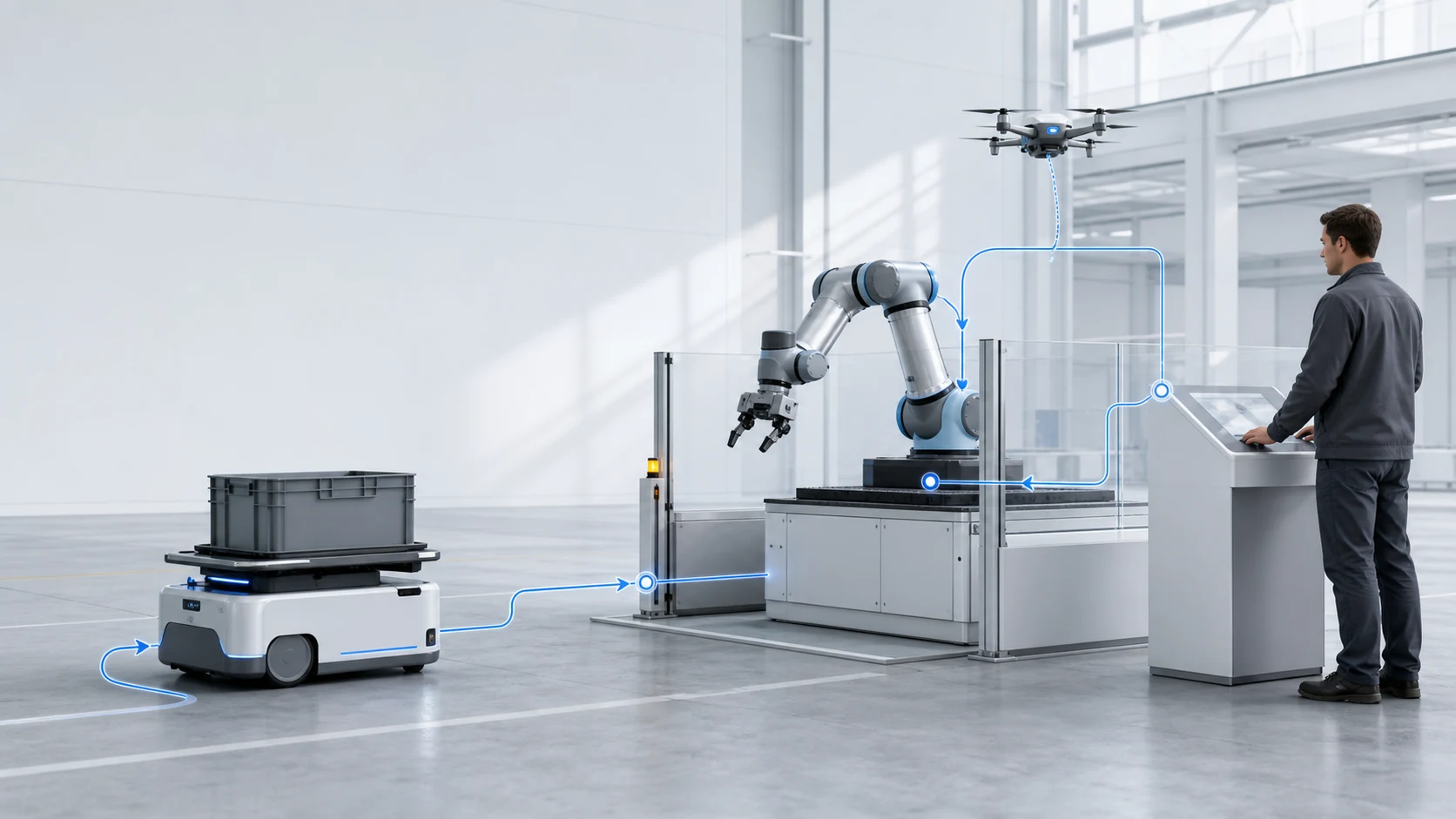
A NodeRiQ robotic-workflow PoC should begin with one non-production task that crosses at least two device or system boundaries. For example: an inspection robot captures a reading, a planner classifies the exception, a mobile robot carries a service kit, a human approves access to the final zone, and the work closes only when the instrument and payload states are reconciled.
The decisive tests are operational: can the same task be replayed; can a device be swapped through an adapter without changing the work-order meaning; does stale evidence block assignment; does human rejection propagate to every participant; does the task recover after a dropped link; and can the team explain why the final state is complete? Throughput matters later. First, the workflow must remain understandable under pressure.
- Nominal run with complete evidence and a clear closeout receipt.
- One injected stale-sensor or contradictory-observation event.
- One device or shared-resource unavailability event and reassignment decision.
- One human rejection, correction, or pause with authority propagation.
- One degraded-link recovery with local state reconciliation and replay.
This is a product direction and PoC contract, not a deployment claim.
NodeRiQ is publicly presented as an AI-first applied research and productisation programme. The workflow described here is a design and evaluation structure derived from current robotics systems, standards, and Neura Parse's published programme principles. It does not claim a released robot-control product, a completed customer deployment, a universal adapter catalogue, certified safety, or validated performance.
That boundary makes the proposal more useful. A prospective pilot can ask for a bounded workflow, name the devices and infrastructure already present, choose one exception that matters operationally, and agree on the evidence needed to expand. The outcome of the first engagement is a measured decision about the next operating envelope—not a promise of general autonomy.
Practical takeaways
01
Treat a robot request as a bounded work contract, not a natural-language command.
02
Assign by capability before binding work to a specific device or vendor.
03
Advance task state using physical evidence and corroboration, not command acknowledgements alone.
04
Separate high-level reasoning, human workflow authority, and hard-real-time safety control.
05
Make exceptions, recovery, and replay part of the first PoC rather than a later reliability phase.
RA · Reference annexDefinitions, recurring questions, editorial method, and primary sources.Inspect
The analysis above carries the main reading flow. This reference layer keeps terminology, recurring questions, editorial method, and primary sources available without interrupting the argument.
Field questions
Program questions behind A robot task is not a prompt. It is a verifiable workflow..
Q01Does NodeRiQ directly control robot motors or safety functions?
No such public claim is made. The proposed NodeRiQ role is high-level shared context, coordination, evidence, and recommendation. Hard-real-time control and safety enforcement remain local, classical, and specific to the robot and integrated application.
Q02What makes a robotic workflow verifiable?
Verifiable is used here to mean traceable and reviewable: the work order, supporting observations, assigned capability, authority decision, progress events, exception handling, and completion evidence remain connected. It does not mean formal verification or certification.
Q03What is the smallest useful NodeRiQ robotics PoC?
One non-production task crossing two device or system boundaries, with a named completion test, one human authority gate, one injected failure, local safe behaviour, reconciliation, and a replayable closeout record.
Editorial record
How A robot task is not a prompt. It is a verifiable workflow. was checked.
- Editorial owner
- Neura Parse Research
- Last verified
- August 25, 2026
- Method
- Synthesis of the dated primary and official records listed below, checked against the operating question in this note.
- Scope limit
- Planning analysis—not certification, customer performance evidence, procurement advice, or a claim of production readiness.
SRSources reviewed
7 records