
Robotics / Network intelligence
When the link changes, the mission changes.
A late frame, a missing reply and a busy edge computer create different problems. Connect those conditions to the task, the permission to act and the evidence needed to continue.
Inspect the decision path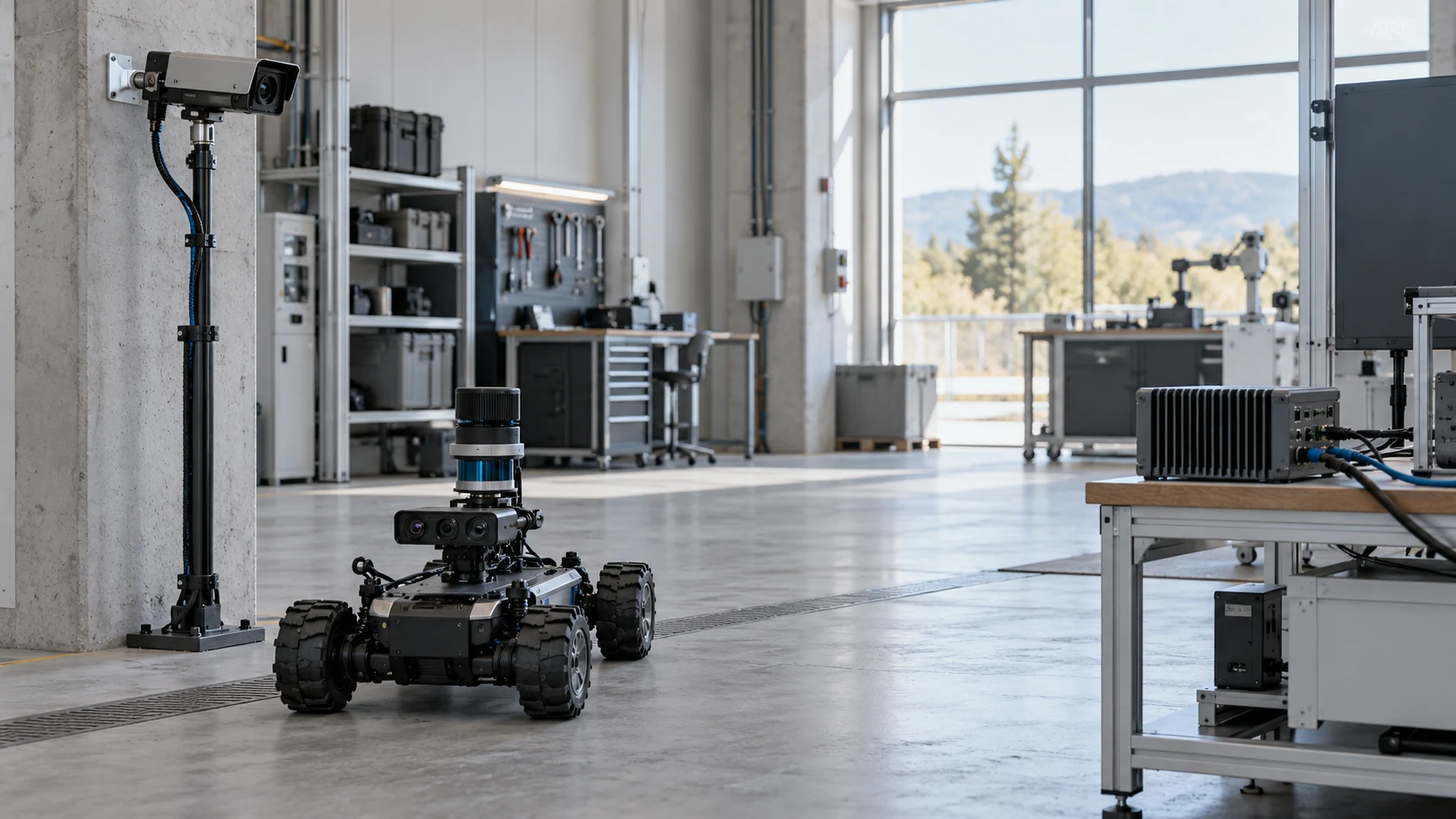
The timing question
Measure beyond inference.
Follow one observation from capture to a permitted action and its outcome. Use a consistent clock model; compare local and remote processing with the same workload, quality criteria and resource limits.
- Sensing
- Capture time, sensor identity and calibration context
- Could the observation already be too old?
- Network transfer
- Delivery delay, jitter, loss and last confirmed contact
- Which part of the mission picture is missing?
- Queue and inference
- Waiting time, model version, compute load and output quality
- Does local processing improve the complete path?
- Approved handoff
- Review, command admission, validity and device receipt
- Is this action still authorised?
- Outcome
- Progress, completion evidence and unresolved state
- What actually finished?
A smaller model or a nearer server may help one stage while changing quality, contention or power use elsewhere. Latency reduction is an evaluation objective; no speed-up or real-time deadline is claimed here.
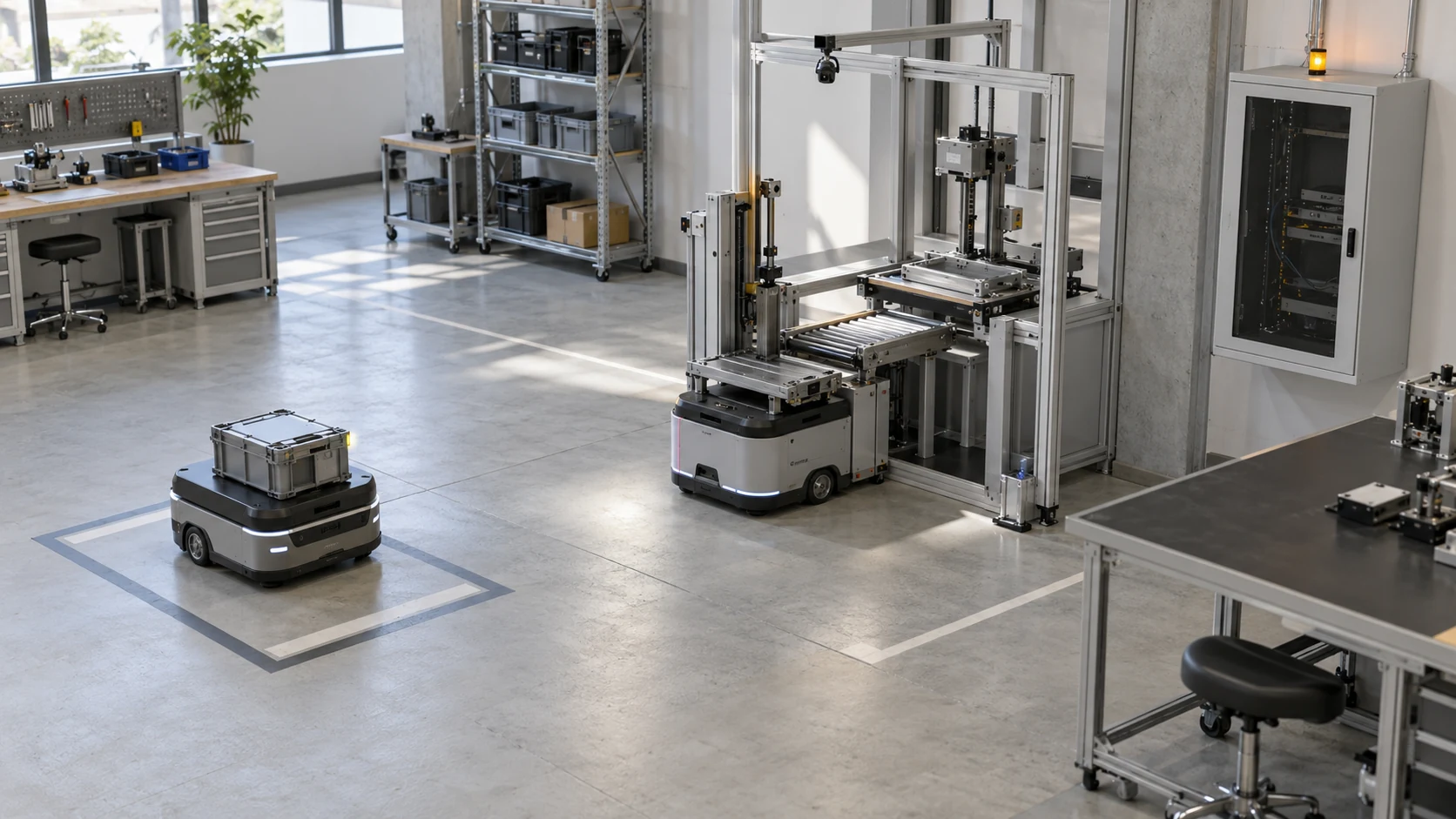
Network conditions and task decisions
A healthy link does not prove a completed task.
- A delayed observation
- Retain its capture time and uncertainty. Check the task's freshness policy before using it to recommend another action.
- A missing acknowledgement
- Keep receipt and completion unresolved. Recover the command identity and device record before deciding whether another request is appropriate.
- A partitioned workcell
- Show the last confirmed resource owner. An expired reservation alone does not prove the physical station is clear.
- A restored connection
- Reconcile task state, evidence and authority. Link recovery is an input to the next decision, not permission to resume automatically.
NODERIQ and engineering services
Turn link conditions into reviewable choices.
NODERIQ brings mission context, capabilities and constraints into task recommendations. Its NowFlow layer connects review and human release; the NeuraOS foundation links approved intent to command admission and typed outcomes. Device-local motion and safety remain authoritative.
Our scoped engineering work starts with a sensor and network dependency map, an end-to-end timing baseline and a recovery test plan. Outputs can include freshness rules, a local or remote processing comparison, a failure-response matrix and a trace that connects operator decisions to outcomes.
Work in progress
NODERIQ-RCN separately investigates degraded communications, multi-robot coordination and reproducible validation. Candidate host/QEMU experiments cover lost replies, delayed messages, duplicate commands and restart during recovery. These are proposed studies, not reported results.
NODERIQ-RCN researchAcceptance boundary
Host and QEMU evidence can inspect software state and recovery. Each physical target still needs its own transport, controller, sensor, timing and safety acceptance. NeuraOS physical operation remains NO-GO and production_authorized is false. The website preview has no live fleet or dispatch.
Engineering notes
Follow the technical questions.
Measure the whole sensor-to-action path
Capture, transfer, queuing, inference and the authorised handoff each need their own timing record.
Keep sensor freshness separate from authority
A new frame can update the evidence without extending the permission to act.
Recover the mission after a lost reply
Reconcile command identity, resource ownership and outcome evidence before another assignment.
Technical context and sources
Our evaluation approach applies distributed-systems principles to a bounded mission. The sources below provide external technical context; they do not establish a NODERIQ integration or certification.