PMPublic media
1 records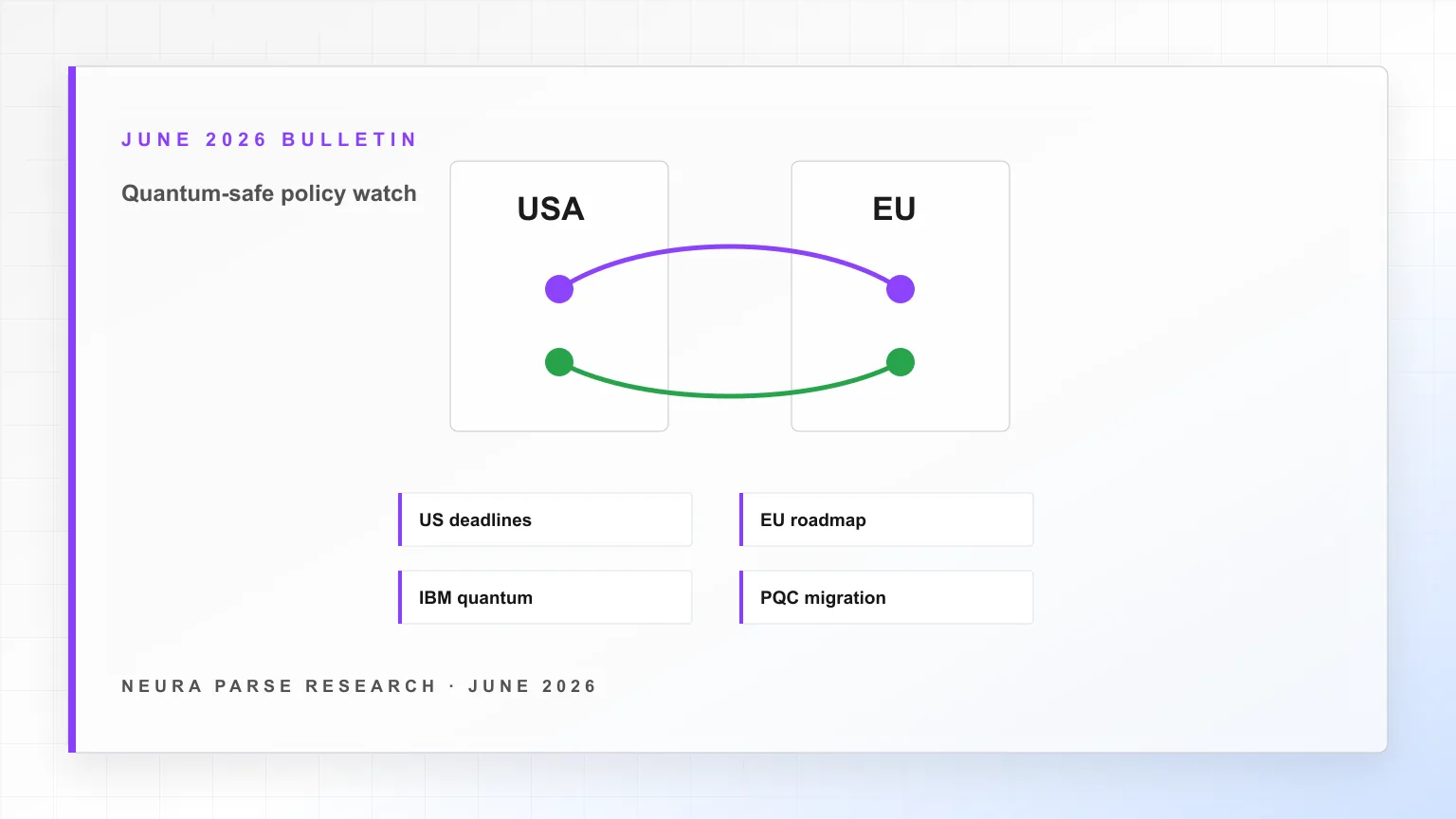
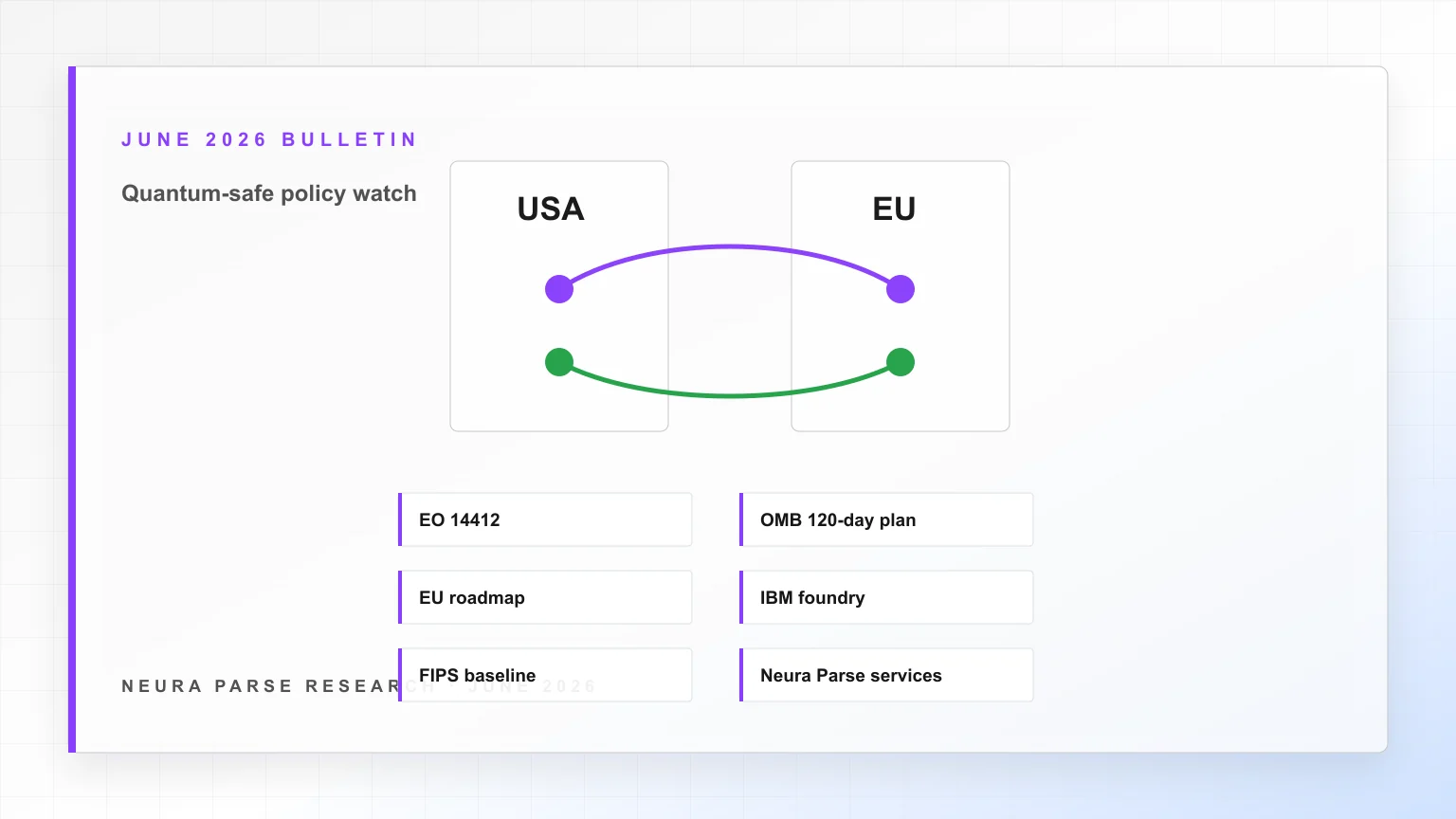
Quantum-safe policy watch card
Compact preview card for the newsroom feed, highlighting U.S. deadlines, EU roadmap, IBM quantum, and PQC migration.
Quantum-safe readiness is now operational work
June 2026 brought a concentrated set of public signals for quantum-safe readiness: U.S. executive action on advanced cryptographic attacks, OMB execution guidance, Europe's coordinated PQC roadmap, and IBM's public quantum investment signal.
For Neura Parse, the operational message is direct. Quantum-safe planning needs a control surface: inventory, ownership, algorithm decisions, vendor evidence, test status, and executive reporting.
Policy signals are aligning around inventory and proof
The United States is pushing migration planning into agency execution, while the EU roadmap supports a synchronized Member State transition. These are not identical legal instruments, but they converge on the same practical need: know where cryptography is used, prioritize high-risk systems, and prove the migration path.
- Crypto inventory and cryptographic bill of materials become first-class security artifacts.
- Vendor and product readiness need to be tracked, not assumed.
- High-risk, long-lived, and regulated systems should move before low-impact internal tooling.
- QKD and EuroQCI belong in infrastructure assessment, while PQC remains the broad software migration path.
Quantum roadmaps need operational records
IBM's June 2026 quantum investment strengthens the long-term fault-tolerant quantum signal. That does not remove the near-term security requirement. It makes the separation clearer: prepare for quantum computing with disciplined workflows, and prepare for quantum attacks with crypto-agile migration controls.
QFlow is the natural Neura Parse product surface for experiment records, provider context, resource estimates, and decision evidence. NowFlow is the operating layer for migration tasks, approvals, and vendor follow-up.
BD · Full bulletin4 supporting sections and the operational checklist.Read deeper
Keep the two service tracks connected
We are shaping two related service tracks: Quantum-Safe Security for PQC inventory and migration execution, and Quantum Systems Engineering for QFlow-based experiment governance, resource-estimation evidence, and provider-aware workflow operations.
The common theme is evidence. Whether the work is cryptographic migration or quantum workflow adoption, teams need a record that can survive review by security, leadership, procurement, and technical operators.
Failure modes to design against
The most common failure mode is waiting on hardware news. IBM's investment and the fault-tolerant roadmap can read as a reason to defer, but the policy instruments run on their own clock. EO 14412 and M-26-15 push agencies into execution now, and the EU roadmap does the same for Member States. A program that indexes its migration to quantum hardware milestones will be late on compliance evidence.
The second failure mode is conflating the two quantum tracks. Preparing for quantum computing is a workflow and experiment governance problem. Preparing for quantum attacks is a cryptographic migration problem. Mixing them produces plans that satisfy neither security review nor research review.
The third failure mode is inventory without follow-through. A crypto inventory with no named owner, no vendor evidence behind it, and no test status attached is a snapshot, not a control surface. The policy signals converge on proof, and proof requires artifacts that stay current.
- Deferring migration because fault-tolerant hardware has not arrived.
- Running quantum computing readiness and quantum-attack readiness as one program.
- Publishing an inventory once and letting it drift.
- Accepting vendor PQC claims without written evidence.
- Migrating easy internal tooling first while high-risk systems wait.
What to instrument first
Instrument the inventory before anything else. The U.S. and EU signals both make the cryptographic inventory and the cryptographic bill of materials first-class artifacts, so the earliest gains come from knowing where cryptography is used and who owns each instance. Coverage matters more than polish at this stage. An incomplete inventory with named owners beats a complete one nobody maintains.
Then instrument the vendor channel. Vendor and product readiness need to be tracked, not assumed, which means a standing register of requests sent, evidence received, and gaps outstanding. NowFlow is the operating layer for migration tasks, approvals, and vendor follow-up.
Finally instrument decisions. Algorithm choices, test status, prioritization calls, and executive signoffs should land in a record that security, leadership, procurement, and technical operators can all review. On the quantum computing side, QFlow Studio holds the parallel record: experiments, provider context, resource estimates, and decision evidence.
How to evaluate vendors on quantum-safe claims
The bulletin's rule is short: vendor and product readiness need to be tracked, not assumed. In practice that means asking each vendor where its products use cryptography, what its PQC migration path is, and what evidence backs the claim. A roadmap slide is a claim. A documented migration path with test status is evidence.
Prioritize the vendors behind high-risk, long-lived, and regulated systems, since those systems should move first. For infrastructure and network vendors, ask separately about QKD and EuroQCI positioning, because those belong in infrastructure assessment rather than the broad PQC software migration path.
Keep the responses in the same control surface as the rest of the program: inventory, ownership, algorithm decisions, test status, and executive reporting. Evidence scattered across inboxes does not survive procurement or security review.
- Ask for the vendor's cryptographic bill of materials or an equivalent disclosure.
- Ask for a dated PQC migration path, not a general commitment.
- Ask what test status exists for already migrated components.
- Record every response and every open gap in the program register.
Operational checklist
Program checklist: quantum-safe execution after June 2026
Actions derived from the U.S., EU, and IBM signals in this bulletin. Each item produces an artifact that survives review.
- 01
Assign a named owner for cryptographic migration and set an executive reporting cadence.
- 02
Build a cryptographic inventory and a cryptographic bill of materials, and treat both as maintained security artifacts rather than one-time reports.
- 03
Rank systems by risk and move high-risk, long-lived, and regulated systems before low-impact internal tooling.
- 04
Map program obligations against EO 14412, OMB M-26-15, and the EU coordinated PQC roadmap for each jurisdiction in scope.
- 05
Request written PQC readiness evidence from every vendor and product in the inventory; track responses, do not assume them.
- 06
Record algorithm decisions, test status, and migration approvals in a workflow with an audit trail.
- 07
Assess QKD and EuroQCI as infrastructure questions, separate from the PQC software migration path.
- 08
Keep quantum computing experiment records separate from quantum-attack mitigation work, and preserve provider context and resource estimates for each experiment.
BA · Bulletin annexDefinitions, recurring questions, source notes, and publication tags.Inspect
Terminology
Terms used in this bulletin.
- Post-quantum cryptography (PQC)
- Cryptographic algorithms designed to resist attacks from future quantum computers. PQC is the broad software migration path referenced by both the U.S. and EU guidance.
- Quantum key distribution (QKD)
- A hardware technique that uses quantum physics to exchange encryption keys over dedicated links. In this bulletin it is treated as an infrastructure assessment question, not a replacement for PQC migration.
- EuroQCI
- The European quantum communication infrastructure initiative referenced alongside the EU PQC roadmap. It sits on the infrastructure side of quantum-safe planning.
- Cryptographic bill of materials (CBOM)
- A structured record of where and how cryptography is used across systems, products, and vendors. Current policy signals treat it as a first-class security artifact.
- Crypto agility
- The ability to change cryptographic algorithms and configurations without redesigning systems. It is the property that makes staged PQC migration and later algorithm changes practical.
- Fault-tolerant quantum computing
- Quantum computing that corrects its own errors reliably enough to run long computations. IBM's June 2026 investment funds a roadmap toward the first fault-tolerant quantum computers.
- Resource estimate
- A projection of the qubits, runtime, and cost a quantum workload would need. QFlow Studio stores resource estimates alongside experiment records as decision evidence.
Field questions
Questions program teams ask.
Q01Does IBM's June 2026 quantum investment change when we need to start post-quantum migration?
No. The investment strengthens the long-term fault-tolerant quantum computing signal, but it does not remove the near-term security requirement. The two tracks stay separate: prepare for quantum computing with disciplined workflows, and prepare for quantum attacks with crypto-agile migration controls. Migration planning should run on the policy timeline, not the hardware timeline.
Q02How do the U.S. and EU quantum-safe signals differ, and what do they have in common?
The United States is pushing migration planning into agency execution through Executive Order 14412 and OMB memo M-26-15, while the EU coordinated roadmap supports a synchronized Member State transition. They are not identical legal instruments. They converge on the same practical need: know where cryptography is used, prioritize high-risk systems, and prove the migration path.
Q03Where does quantum key distribution fit relative to post-quantum cryptography in a migration plan?
QKD and EuroQCI belong in infrastructure assessment, while PQC remains the broad software migration path. Evaluate QKD where dedicated communication infrastructure is under consideration, and run PQC as the default migration mechanism across the software estate. Keeping the two on separate tracks avoids infrastructure questions stalling the software migration.
Q04What artifacts should a program produce first to demonstrate quantum-safe readiness?
Start with a cryptographic inventory and a cryptographic bill of materials; the current policy signals treat these as first-class security artifacts. Add named ownership, algorithm decisions, vendor readiness evidence, test status, and executive reporting. Prioritize high-risk, long-lived, and regulated systems before low-impact internal tooling.
Q05How does Neura Parse support quantum-safe programs operationally?
Through two connected service tracks. Quantum-Safe Security covers PQC inventory and migration execution, and Quantum Systems Engineering covers QFlow-based experiment governance, resource-estimation evidence, and provider-aware workflow operations. NowFlow can coordinate migration tasks, approvals, and vendor follow-up, while QFlow Studio connects experiment records, provider context, resource estimates, and decision evidence.
Q06Why does the bulletin insist on evidence rather than plans?
Because the record has to survive review by security, leadership, procurement, and technical operators. Plans state intent; evidence shows inventory coverage, vendor responses, test status, and the decisions actually taken. Both the U.S. execution guidance and the EU roadmap converge on proving the migration path, not declaring it.
SNSource notes
5 recordsTags