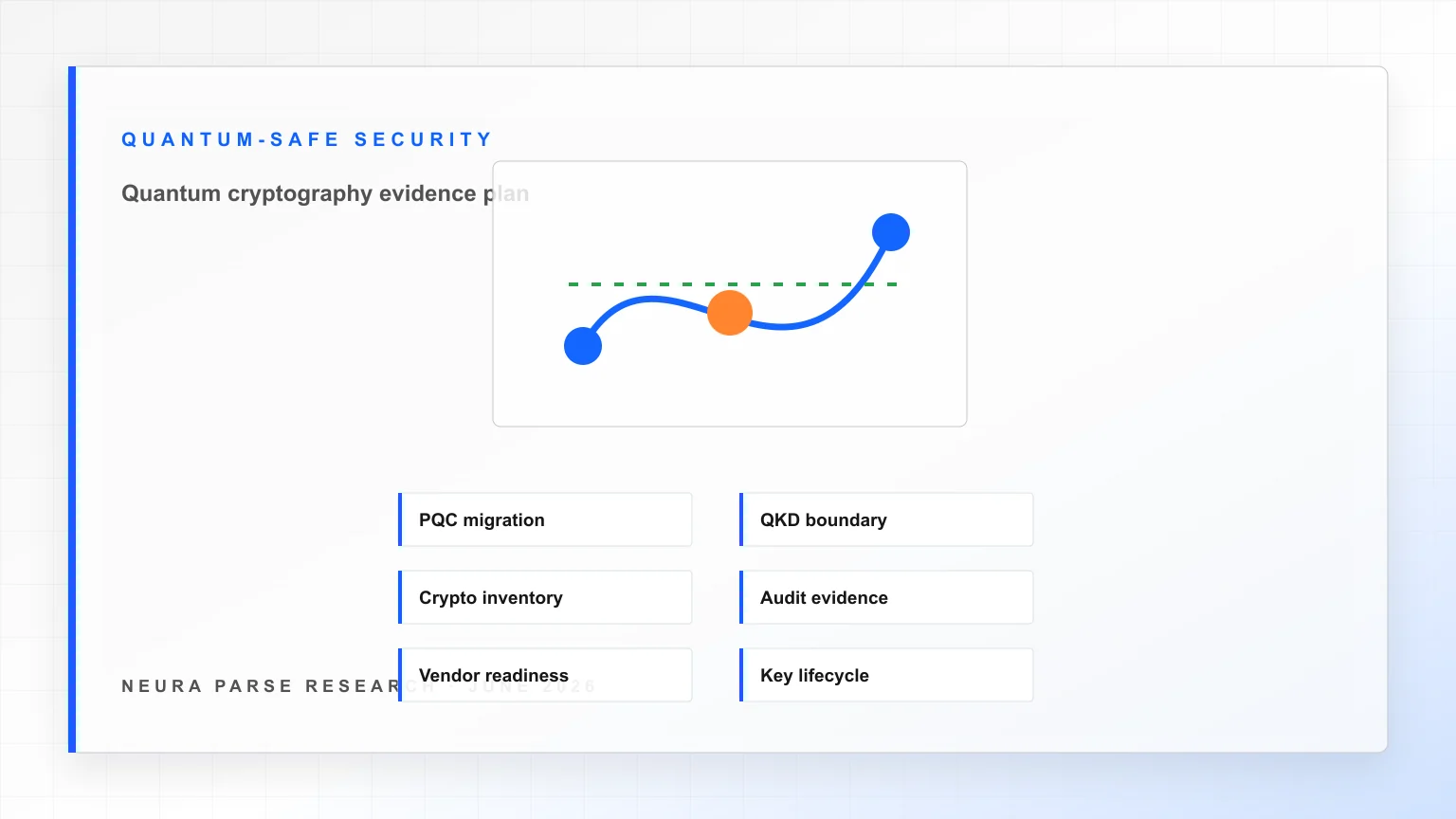

Telecom teams should not treat QKD, PQC, RAN automation, and edge runtime as separate slide decks. The practical work is a network evidence model covering assets, protocols, vendors, rollout windows, and operator authority.
Gap map
Quantum telecom evidence map
The plan connects cryptographic migration, quantum communication assessment, AI-native operations, and edge rollout.
Security
- Crypto inventory
- PQC pilots
- Certificate paths
- Vendor evidence
Network
- Core and transport
- RAN/O-RAN
- Edge sites
- Telemetry and rollback
Quantum links
- QKD fit
- EuroQCI context
- Physical control
- Cost and geography
June 2026 signal
Telecom quantum readiness is not one technology.
The EU PQC roadmap and EuroQCI keep two related but distinct tracks visible: software cryptography migration and quantum communication infrastructure. GSMA guidance makes the telecom migration concrete across products, devices, protocols, and long-lived systems.
At the same time, 3GPP Release 20 and O-RAN Release 5 show the network becoming more AI-native and workflow-heavy. That matters because quantum-safe changes will land inside operational networks that already need approval, rollout, observability, and rollback discipline.
Operating model
Put PQC and QKD into the same review surface, not the same bucket.
PQC is the general migration path for telecom software, firmware, protocols, certificates, and partner interfaces. QKD is a specialized infrastructure option where link control, geography, hardware, and compliance value can justify the cost.
A responsible telecom service should evaluate both without overclaiming either. The work is to map assets, rank risk, assess vendor readiness, run pilots, and preserve enough evidence for security, network, procurement, and regulatory reviewers.
- Use NowFlow for owner assignment, vendor requests, approvals, pilot state, and exception handling.
- Use NeuralOS messaging where edge sites or devices need signed updates, local policy, and telemetry health.
- Use QFlow only when quantum communication or quantum workflow evidence is part of the customer problem.
- Keep QKD language constrained to infrastructure assessment, not internet-scale replacement claims.
Service wedge
Start with high-risk links and hard-to-update systems.
Telecom estates include core systems, RAN infrastructure, transport equipment, SIM/eSIM paths, customer-premise devices, OSS/BSS platforms, cloud services, and partner APIs. A good first engagement picks the systems where data lifetime, vendor dependency, and replacement cost create future liability.
The first artifact should be a network quantum-readiness register: asset, protocol, crypto use, owner, vendor status, QKD relevance, pilot path, rollback, and evidence state.
Practical takeaways
Quantum telecom requires both PQC migration and constrained QKD assessment.
PQC is broad software migration; QKD is specialized infrastructure analysis.
Network teams need evidence surfaces that include vendors, rollout, and rollback.
NowFlow and NeuralOS make the topic operational rather than purely advisory.
Sources reviewed
Source 01
EU coordinated roadmap for transition to post-quantum cryptography
June 2026 NIS Cooperation Group roadmap for synchronized PQC transition across EU Member States.
Source 02
European Quantum Communication Infrastructure (EuroQCI)
European Commission programme for terrestrial and space-based quantum communication infrastructure.
Source 03
GSMA post-quantum cryptography document library
Telecom-focused PQC publications, including implementation and prototype guidance updated in 2026.
Source 04
3GPP Release 20, 5G-Advanced and 6G studies
Release 20 keeps 5G-Advanced moving while starting formal 6G study work, with June 2026 architecture milestones.
Source 05
O-RAN Alliance Release 5, June 2026
AI/ML workflow services, RIC coordination, O-Cloud lifecycle management, TLS 1.3, Zero Trust, and AI/ML security controls.