
Abstract
The hard work is not adopting a quantum-safe label. Teams need to know which systems use vulnerable public-key cryptography, where NIST post-quantum standards apply, where QKD is defensible, and how each decision will survive review.
Gap map
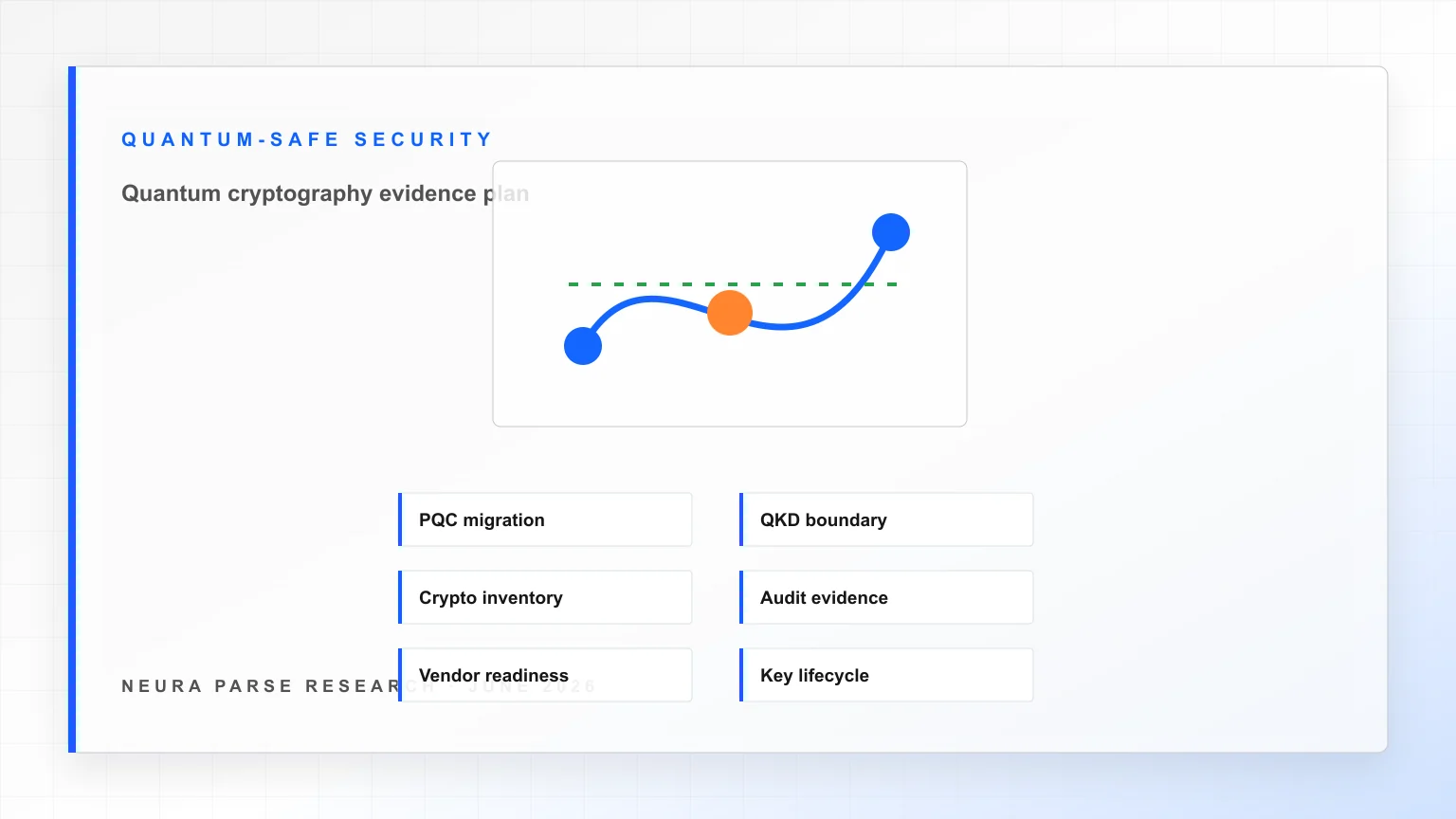
Quantum-safe migration map
PQC rollout, QKD boundary decisions, risk prioritization, key lifecycle, and review evidence belong in the same migration plan.
Policy pressure
- U.S. EO 14412
- OMB M-26-15
- EU PQC roadmap
- CISA product categories
Technical migration
- Dependency discovery
- ML-KEM and signatures
- Protocol transition pilots
- QKD only where link economics justify it
Delivery operations
- NowFlow migration workspace
- QFlow evidence records
- Vendor readiness scoring
- Audit-ready decision trail
The June 2026 signal is execution, not awareness.
The June 2026 policy surface is unusually clear. The White House executive order on advanced cryptographic attacks and OMB M-26-15 move U.S. federal agencies toward execution planning for post-quantum cryptography. CISA's product-category guidance gives buyers a practical lens for finding software and hardware that depend on public-key cryptography.
Europe is also moving from principle to roadmap. The NIS Cooperation Group roadmap, supported by the European Commission, creates a synchronized transition path for Member States, while EuroQCI keeps a separate quantum-communication track for infrastructure where physics-based secure links may be justified.
That combination matters. The enterprise question is no longer whether quantum-safe cryptography should be considered. It is how to inventory dependencies, prioritize high-risk systems, test standards, coordinate vendors, and preserve evidence that the transition was controlled.
TD · Technical depth6 supporting chapters and the working checklist.Read deeper
Do not collapse PQC and QKD into the same promise.
Quantum cryptography is often used loosely. For enterprise planning, the useful split is sharper. Post-quantum cryptography is a standards and software migration path: algorithms designed to resist quantum attacks while running on classical computers. Quantum key distribution is a physical-layer communication approach that can be valuable in narrow high-assurance links but is not a general replacement for internet-scale cryptographic migration.
A serious migration plan should avoid treating QKD as a universal answer. The practical control model is crypto-agility: inventory, algorithm selection, hybrid rollout, vendor validation, policy gates, and evidence retention. QKD belongs only where link budget, geography, physical control, and compliance value justify specialized infrastructure.
- PQC belongs in software, firmware, TLS, VPN, signing, PKI, device identity, and supply-chain validation plans.
- QKD belongs in constrained link assessments where physical infrastructure, trust model, and operational cost can be defended.
- Crypto-agility is the architectural ability to rotate algorithms, certificates, libraries, and policies without rewriting the whole system.
- Evidence is the missing control layer: every migration decision needs an owner, source, risk, test state, fallback, and approval status.
Policy, technical scope, and evidence form the operating layer.
Most organizations will not fail because they cannot name ML-KEM. They will fail because cryptographic usage is scattered across applications, devices, SaaS contracts, embedded firmware, certificate authorities, VPN gateways, message queues, databases, and partner APIs.
A practical operating layer scopes affected services, classifies risk, assigns owners, requests vendor attestations, runs staged tests, approves cutovers, and exports a review pack for security, legal, and procurement teams. The companion inventory guide provides the field-level discovery and CBOM model; this page stays focused on program strategy and the PQC-versus-QKD boundary.
quantum_safe_readiness = scoped_systems x control_fit x vendor_status x test_evidence x rollback_confidenceStart with the systems that create future liability.
The first phase should not be a generic PQC workshop. It should be a scoped assessment of long-lived data, identity systems, signing infrastructure, device fleets, regulated customer data, and third-party dependencies that are expensive to update later.
A credible first phase can produce an asset map, a PQC impact score, vendor outreach pack, algorithm decision register, pilot migration candidates, and a board-level timeline aligned to U.S. and EU policy pressure.
- Map harvest-now-decrypt-later exposure and long confidentiality lifetimes.
- Separate key establishment, digital signatures, code signing, device identity, and archival verification.
- Track libraries and vendor products against CISA categories and NIST standards.
- Run protocol-transition pilots before changing production trust anchors.
Inventory blind spots, QKD overreach, and rollback gaps.
The first failure mode is inventory illusion. A spreadsheet of TLS endpoints is not a cryptographic inventory, because usage hides in embedded firmware, SaaS contracts, certificate authorities, message queues, and partner APIs. Programs that declare coverage early tend to discover the expensive dependencies during cutover, when options are worst. Discovery has to run as a continuous control, not a one-time scan.
The second failure mode is promise collapse. Teams that buy or sell QKD as a general quantum-safe answer inherit an architecture that cannot cover software, signing, PKI, or device identity. PQC and QKD answer different questions, and a migration plan that blurs them will not survive review. The boundary between them is itself a decision that needs an owner and a written justification.
The third failure mode is cutover without rollback. Changing production trust anchors before hybrid pilots complete removes the fallback path that the readiness formula depends on. Rollback confidence is a multiplier, not an afterthought; if it is zero, readiness is zero. Every cutover approval should reference a tested fallback state.
- Inventory illusion: declared coverage without firmware, SaaS, and partner-API depth.
- Promise collapse: QKD treated as a substitute for PQC migration.
- Silent vendor drift: attestations that age without re-verification.
- Anchor-first cutover: production trust changes before hybrid pilots complete.
- Evidence gaps: decisions with no owner, test state, or approval record.
What to instrument before the first cutover.
The readiness formula in this article multiplies inventory coverage, algorithm fit, vendor status, test evidence, and rollback confidence. Each factor should be an observable quantity, not an opinion. That means instrumenting the migration itself: which assets are discovered, which have owners, which have vendor attestations, which have passed staged tests, and which have approved fallbacks.
Instrument inventory coverage first, because it gates everything downstream. An algorithm decision register means little if a third of the estate is undiscovered. Track coverage by system class, separating key establishment, digital signatures, code signing, device identity, and archival verification, since each class migrates on a different path and timeline.
Then instrument the decision trail. Every migration decision should carry owner, source, risk, test state, fallback, and approval status, and the whole record should export as a review pack for security, legal, and procurement. In the Neura Parse stack, NowFlow coordinates that work as approval-gated workflows, and QFlow Studio preserves the standards context, assumptions, and test evidence behind each decision.
Evaluate vendors on evidence, not on labels.
Quantum-safe is becoming a label before it becomes a property. The credible evaluation lens is the one buyers already have: CISA's product categories identify the hardware and software classes that use or transition to PQC standards, and the finalized NIST standards define what an implementation should conform to. A vendor claim that names neither is a marketing statement, not evidence.
Attestations should be specific and dated. Ask which algorithms ship today, which sit on the roadmap, whether hybrid modes are supported for staged rollout, and how certificates, libraries, and policies can be rotated without a rewrite. That last question is the crypto-agility test, and it separates vendors that can survive an algorithm change from vendors that cannot.
Score vendor status as a readiness input, not a procurement checkbox. The readiness formula treats vendor status as a multiplier, so an estate full of unresponsive vendors caps the whole program. Feed attestations, gaps, and outreach state into the same decision register that holds internal migration decisions, and revisit the scores as products move against the CISA categories.
Operational checklist
Program checklist: PQC migration with a defensible evidence trail
Derived from the article's takeaways and sections. Work the list in order; inventory and exposure mapping gate everything downstream.
- 01
Build a cryptographic inventory across applications, devices, SaaS contracts, embedded firmware, certificate authorities, VPN gateways, message queues, databases, and partner APIs.
- 02
Map harvest-now-decrypt-later exposure and flag systems with long confidentiality lifetimes as first migration priority.
- 03
Separate key establishment, digital signatures, code signing, device identity, and archival verification into distinct migration tracks.
- 04
Track libraries and vendor products against CISA product categories and the finalized NIST post-quantum standards.
- 05
Request vendor attestations, score readiness, and record gaps in an algorithm decision register.
- 06
Run hybrid-mode pilots before changing any production trust anchor.
- 07
Assess QKD only for constrained links where physical infrastructure, trust model, and operational cost can be defended.
- 08
Record every migration decision with owner, source, risk, test state, fallback, and approval status.
- 09
Align a board-level timeline to U.S. EO 14412, OMB M-26-15, and the EU coordinated roadmap, and revisit it as reporting obligations land.
Practical takeaways
01
The 2026 quantum cryptography work is migration evidence, not awareness.
02
PQC is the general enterprise path; QKD is a specialized infrastructure assessment.
03
Crypto-agility requires workflow, ownership, vendor evidence, and rollback paths.
04
NowFlow can coordinate migration work while QFlow stores evidence and source context.
05
An effective first phase scopes high-risk systems, chooses the right control path, and produces board-ready execution planning.
RA · Reference annexDefinitions, recurring questions, editorial method, and primary sources.Inspect
The analysis above carries the main reading flow. This reference layer keeps terminology, recurring questions, editorial method, and primary sources available without interrupting the argument.
Terminology
Terms behind Quantum-safe migration in 2026: where PQC, QKD, and evidence fit..
- Post-quantum cryptography (PQC)
- Cryptographic algorithms designed to resist attacks from quantum computers while running on today's classical computers. It is a standards and software migration path, not new hardware.
- Quantum key distribution (QKD)
- A physical-layer technique that uses quantum communication links to establish encryption keys. It applies to narrow, high-assurance point-to-point links, not to internet-scale cryptographic migration.
- Crypto-agility
- The architectural ability to rotate algorithms, certificates, libraries, and policies without rewriting the whole system. It is the property that lets an organization change cryptography again when standards evolve.
- Harvest-now-decrypt-later
- An attack pattern in which an adversary records encrypted data today and decrypts it later, once quantum attacks against current public-key cryptography become practical. It makes data with long confidentiality lifetimes an immediate migration priority.
- ML-KEM
- The NIST-standardized post-quantum key-encapsulation mechanism used to establish shared encryption keys. It is a primary replacement for the public-key key-exchange methods that quantum attacks threaten in protocols such as TLS.
- Hybrid mode
- A transitional configuration that runs a classical algorithm and a post-quantum algorithm together, so the connection holds if either one fails. Hybrid TLS pilots let teams test PQC on production paths before changing trust anchors.
- Trust anchor
- A root cryptographic key or certificate that other keys and certificates chain back to, such as a certificate authority root. Changing a production trust anchor is high-risk and should follow successful hybrid pilots.
- Vendor attestation
- A vendor's documented statement of which cryptographic algorithms its product uses today and how it will transition to post-quantum standards. Attestations feed readiness scoring and the migration decision register.
Field questions
Program questions behind Quantum-safe migration in 2026: where PQC, QKD, and evidence fit..
Q01Should our program prioritize post-quantum cryptography or quantum key distribution?
Post-quantum cryptography is the general enterprise path. It is a standards and software migration that runs on classical computers and applies to TLS, VPN, signing, PKI, device identity, and supply-chain validation. Quantum key distribution is a physical-layer approach for narrow high-assurance links, and it should only be assessed where link budget, geography, physical control, and compliance value justify the cost. Treating QKD as a universal answer is a planning error.
Q02What changed in June 2026 that makes quantum-safe migration urgent for program planning?
The White House executive order on advanced cryptographic attacks, EO 14412, and OMB M-26-15 move U.S. federal agencies from awareness to execution planning and reporting for post-quantum migration. In parallel, the NIS Cooperation Group roadmap, supported by the European Commission, creates a synchronized PQC transition path across EU Member States, while EuroQCI runs a separate quantum-communication infrastructure track. Programs that sell into or depend on these markets now face documented migration expectations, not advisories.
Q03Where should a program with no cryptographic inventory start?
Start with discovery, not algorithm selection. Cryptographic usage is typically scattered across applications, devices, SaaS contracts, embedded firmware, certificate authorities, VPN gateways, message queues, databases, and partner APIs. CISA's product-category guidance gives buyers a practical lens for finding hardware and software that depend on public-key cryptography. Classify risk, assign owners, and prioritize systems with long confidentiality lifetimes before running any pilot.
Q04What is harvest-now-decrypt-later exposure and how should it drive priority?
It is the risk that an adversary records encrypted data today and decrypts it later, once quantum attacks against current public-key cryptography become practical. The exposure is highest where confidentiality lifetimes extend past the migration window, such as long-lived records, identity systems, signing infrastructure, and regulated customer data. Map that exposure first and let it set migration order.
Q05What evidence should a quantum-safe migration produce for auditors and review boards?
Every migration decision needs an owner, a source, a risk classification, a test state, a fallback, and an approval status. A credible first phase produces an asset map, a PQC impact score, a vendor outreach pack, an algorithm decision register, pilot migration candidates, and a board-level timeline aligned to U.S. and EU policy pressure. The full record should export as a review pack for security, legal, and procurement teams.
Q06How does Neura Parse support a quantum-safe migration program?
NowFlow, the agentic workflow platform, coordinates the migration work: discovery tasks, vendor outreach, staged tests, and approval routing. QFlow Studio stores standards context, assumptions, baselines, and experiment records as reviewable evidence. The quantum-safe security service covers cryptographic inventory, post-quantum migration planning, QKD fit assessment, a cryptographic bill of materials, vendor evidence requests, and audit-ready migration records.
Editorial record
How Quantum-safe migration in 2026: where PQC, QKD, and evidence fit. was checked.
- Editorial owner
- Neura Parse Research
- Last verified
- July 20, 2026
- Method
- Synthesis of the dated primary and official records listed below, checked against the operating question in this note.
- Scope limit
- Planning analysis—not certification, customer performance evidence, procurement advice, or a claim of production readiness.
SRSources reviewed
6 records