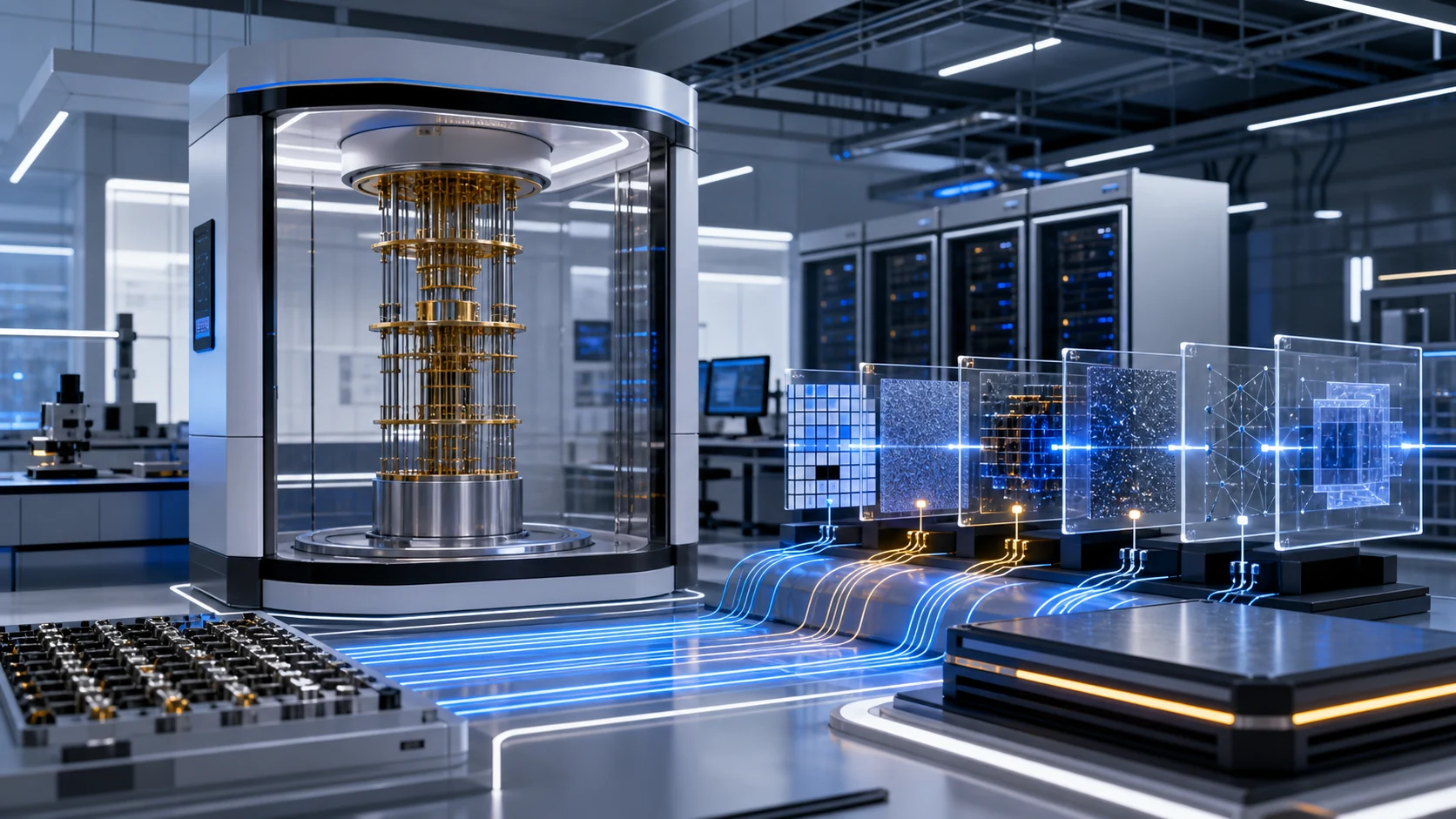
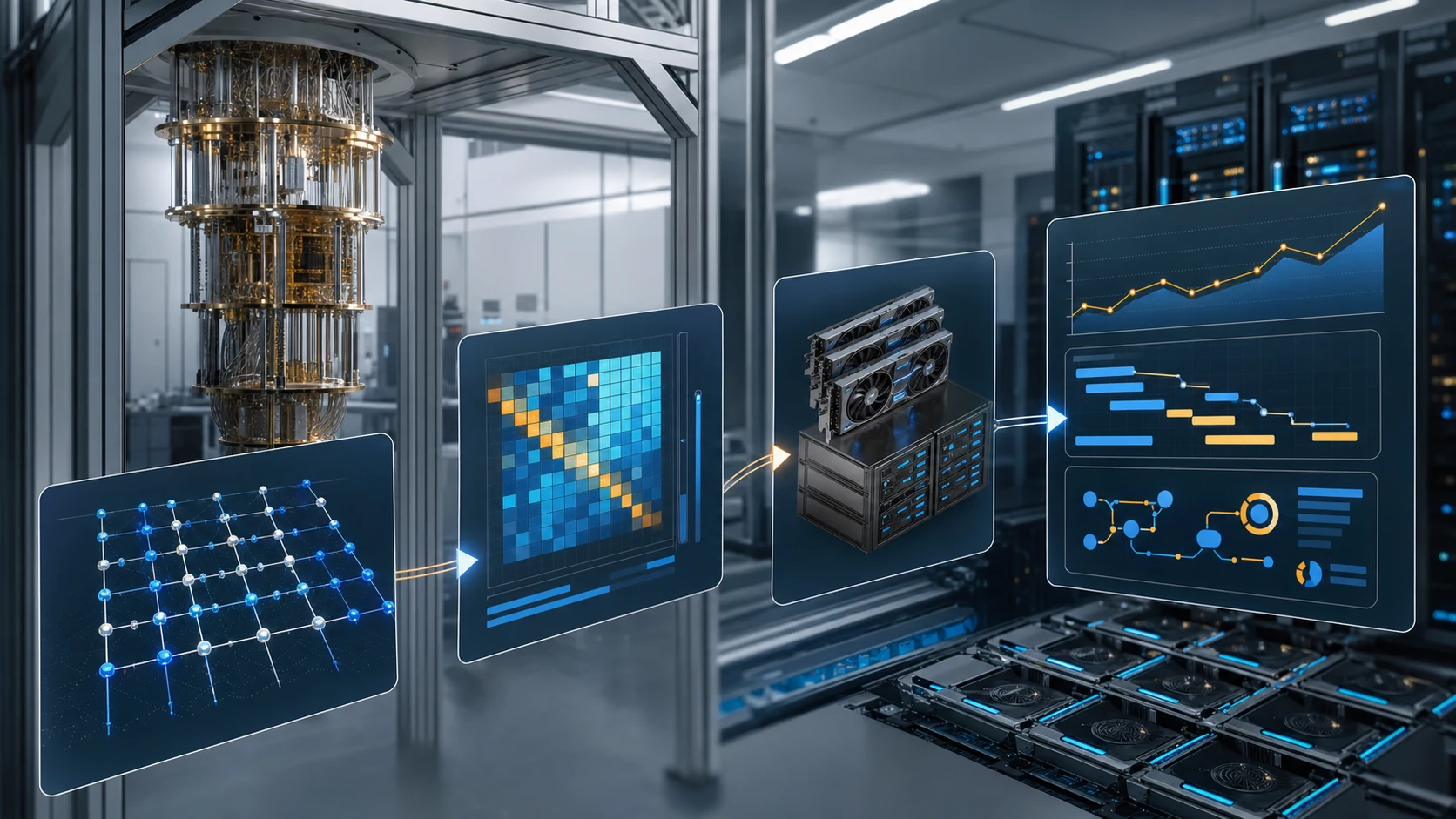
The credible enterprise question is not whether quantum and AI sound powerful together. It is whether a quantum subroutine changes a measurable workflow after classical baselines, cost, error budget, and decision impact are recorded.
Gap map
Quantum AI operating record
Useful quantum AI needs one record across problem framing, baselines, execution, interpretation, and decision impact.
Frame
- Business or science objective
- Classical baseline
- Error tolerance
- Value threshold
Execute
- Quantum circuit or Hamiltonian
- Backend metadata
- Resource estimate
- AI-assisted analysis
Decide
- Uncertainty
- Crossover state
- Reviewer notes
- Investment gate
June 2026 signal
Quantum AI is becoming a workflow accounting problem.
IBM's June 2026 investment and roadmap messaging keeps attention on fault-tolerant systems, verification, debugging, and developer tooling. Google Quantum AI's roadmap frames the path from error suppression to useful error-corrected computation. CUDA-Q reinforces the operational reality that serious experiments already span CPUs, GPUs, simulators, and QPUs.
That is enough to justify enterprise tracking, but not enough to justify vague advantage claims. A credible quantum AI programme should show exactly what was compared, what resources were assumed, and which downstream decision changed.
Service pattern
Start with a crossover map, then decide what to fund.
Most teams should begin with a decision-level crossover map: classical method, quantum-inspired method, simulator result, noisy hardware result, and fault-tolerant estimate compared against the same objective.
The map should include data loading, compilation, logical resources, runtime, error budget, cost, repeatability, and the business or scientific consequence of the result.
- Record negative results as useful evidence.
- Keep resource estimates visible even when the first run is only a simulator.
- Separate AI-assisted interpretation from quantum execution evidence.
- Treat every claim as provisional until the baseline is stronger than the demo.
Neura Parse fit
QFlow, qmesh, and QANTIS divide the work cleanly.
QFlow is the user-facing workspace for experiments, assumptions, providers, backends, costs, and review notes. qmesh is the substrate for manifests, intermediate representation, adapter context, and reproducibility. QANTIS is where uncertainty becomes a decision signal instead of a decorative score.
That service message is stronger than a generic quantum AI claim: Neura Parse helps make quantum AI experiments reviewable before customers make roadmap or procurement decisions.
Practical takeaways
Quantum AI needs baselines, resource estimates, and decision impact in one record.
The near-term service value is readiness and evidence, not broad acceleration claims.
QFlow can own the experiment workspace; qmesh can preserve provenance.
QANTIS becomes useful when uncertainty affects an action or investment gate.
Sources reviewed
Source 01
IBM quantum computing investment, June 2026
Five-year investment across R&D, manufacturing, M&A, and ecosystem expansion for fault-tolerant quantum systems.
Source 02
IBM Quantum Roadmap 2026
Profiling, verification, debugging, and quantum-classical workload tooling for 2026 and beyond.
Source 03
Google Quantum AI roadmap
Milestones from error suppression and logical qubits toward useful, error-corrected quantum computation.
Source 04
Grand challenges in the applications of quantum computers
Application-driven framing for useful quantum computation across chemistry, materials, optimization, and science.
Source 05
NVIDIA CUDA-Q quantum development platform
Hybrid quantum-classical programming across QPU, GPU, and CPU resources.