Abstract
As quantum roadmaps move toward fault tolerance, the software layer must preserve problem definitions, compiler choices, backend metadata, simulation baselines, error behavior, manifests, and decision impact.
The roadmaps are getting larger; the evidence burden is getting heavier.
IBM's June 2026 quantum investment announcement reinforces the industry's shift from noisy demonstrations toward large-scale, fault-tolerant systems. IBM's roadmap material also emphasizes the surrounding developer and verification tooling needed to make those systems useful.
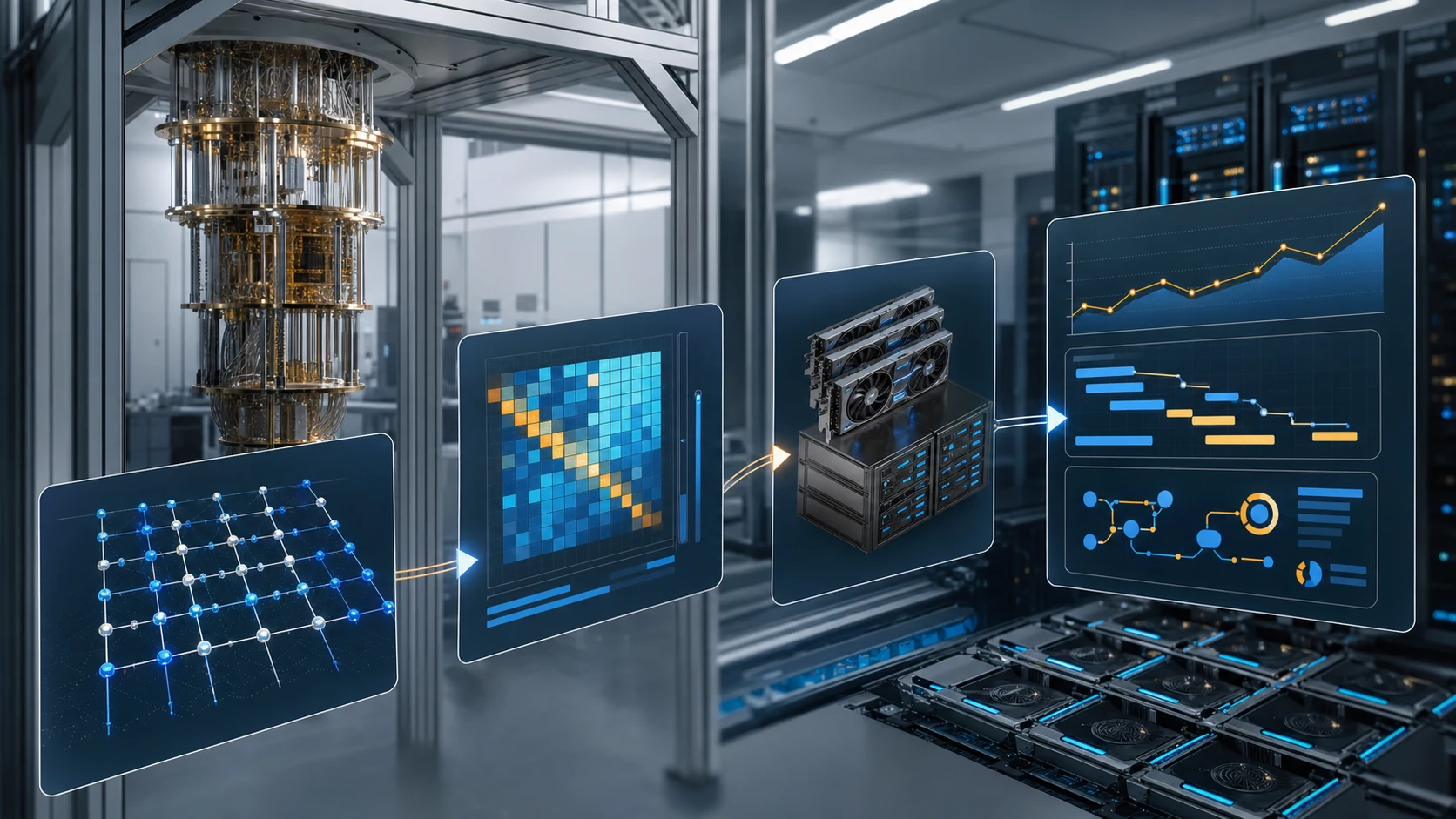
NVIDIA CUDA-Q points in the same architectural direction from the hybrid programming side: quantum work is increasingly planned as a workload that spans QPUs, GPUs, CPUs, simulators, and classical optimizers.
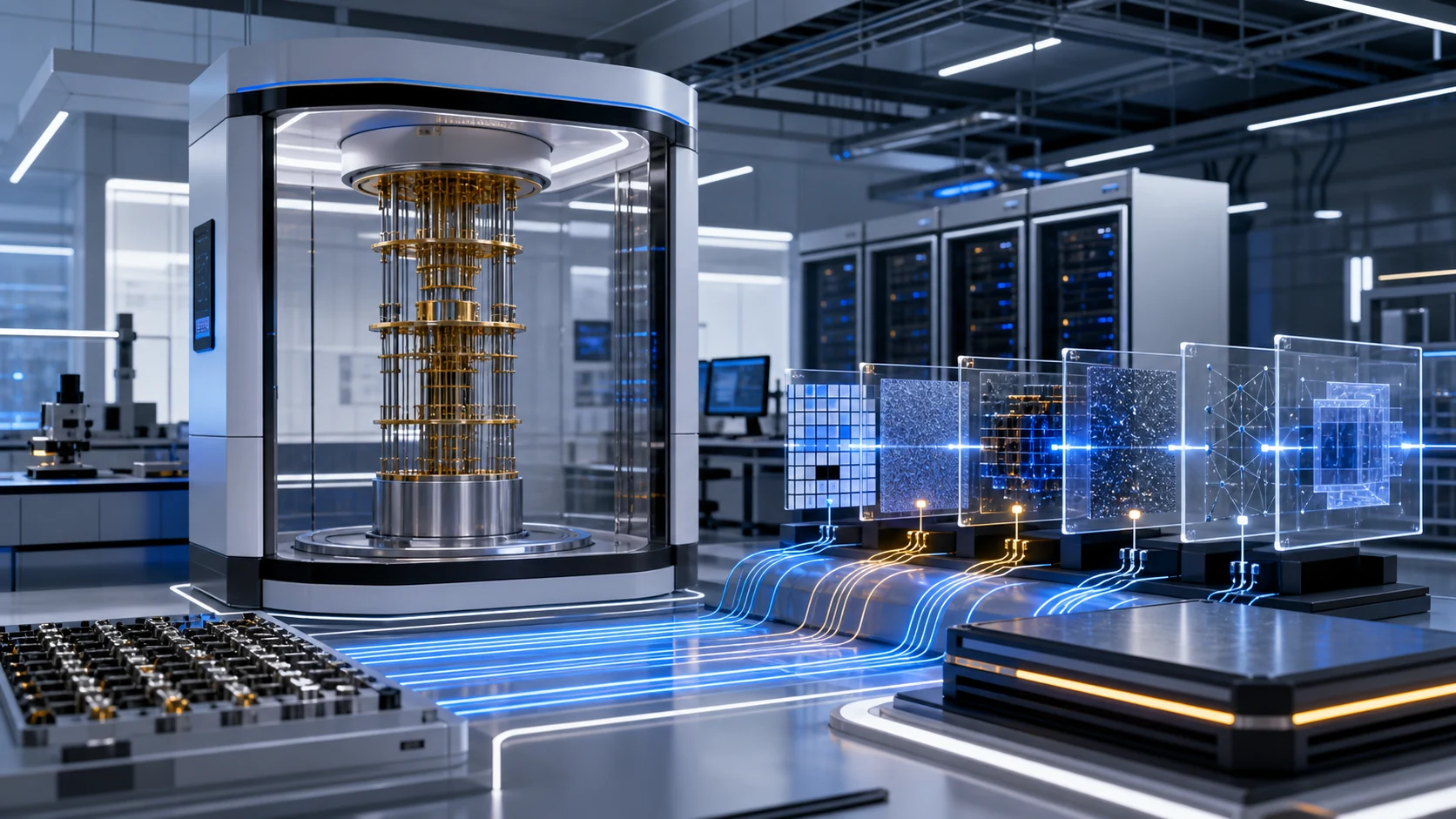
The engineering lesson is that a quantum application is not only a circuit. It is a reproducible record of assumptions, execution, results, and review.
TD · Technical depth7 supporting chapters and the working checklist.Read deeper
Make every experiment portable and reviewable.
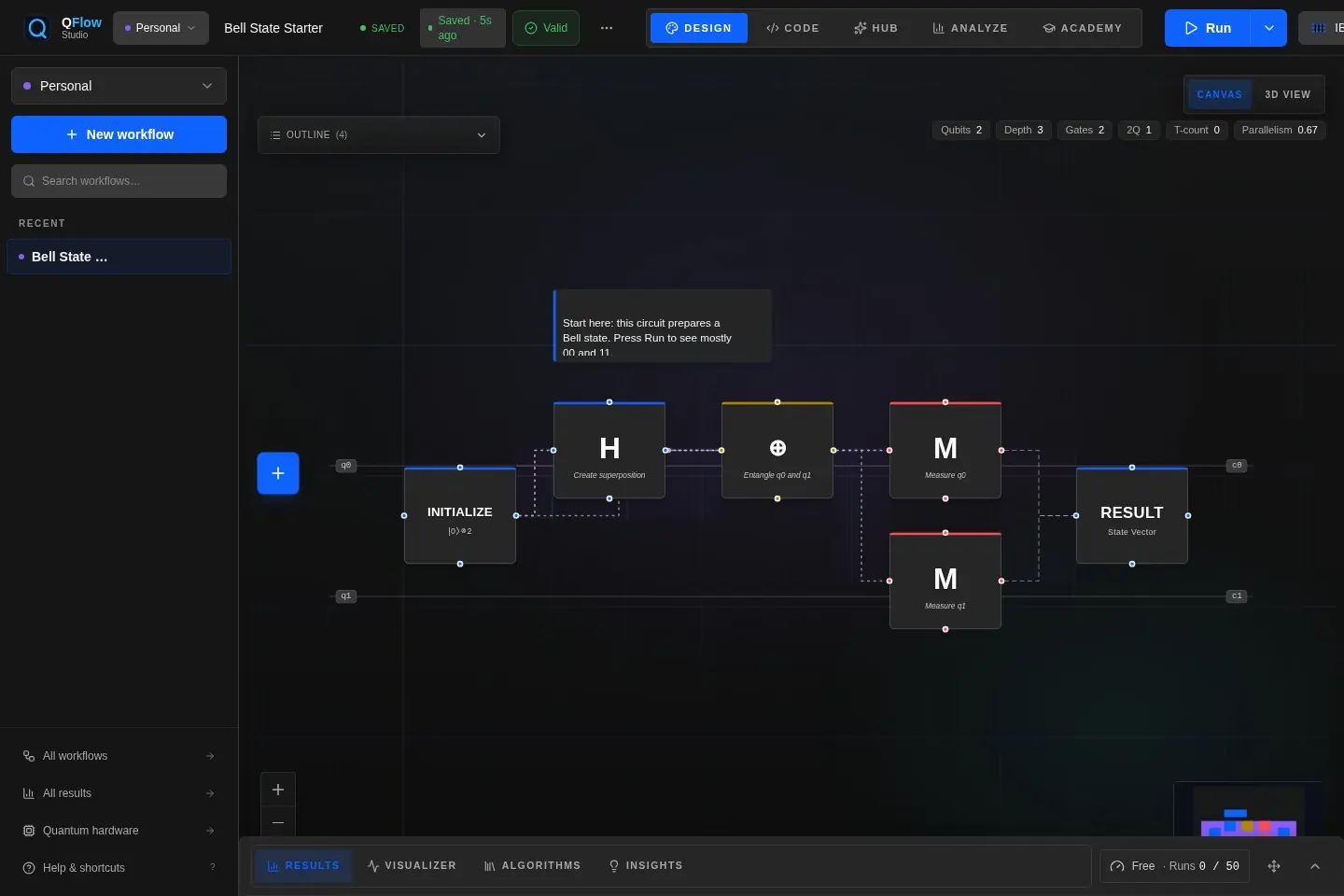
QFlow Studio serves as an authoring and execution surface for quantum workflows without replacing provider SDKs. It helps users define a problem, connect a simulator or backend, store assumptions, run baselines, track compilation, and preserve outputs.
qmesh fits under that surface as the substrate for modality-aware IR, backend abstraction, and signed manifests. QANTIS fits where the output is a decision process that needs risk, optimization, and verification rather than a single benchmark number.
- Store problem statement, Hamiltonian or objective, constraints, seeds, compiler configuration, and provider metadata.
- Run classical and simulator baselines before treating hardware output as meaningful.
- Record mitigation choices, error behavior, backend calibration context, and confidence intervals.
- Make experiment artifacts portable enough for peer review, customer review, and internal regression testing.
Future hardware does not remove today's reproducibility requirements.
Fault tolerance will reduce some classes of error, but it will not remove the need to explain compilation choices, logical resource estimates, classical pre-processing, data movement, and decision relevance.
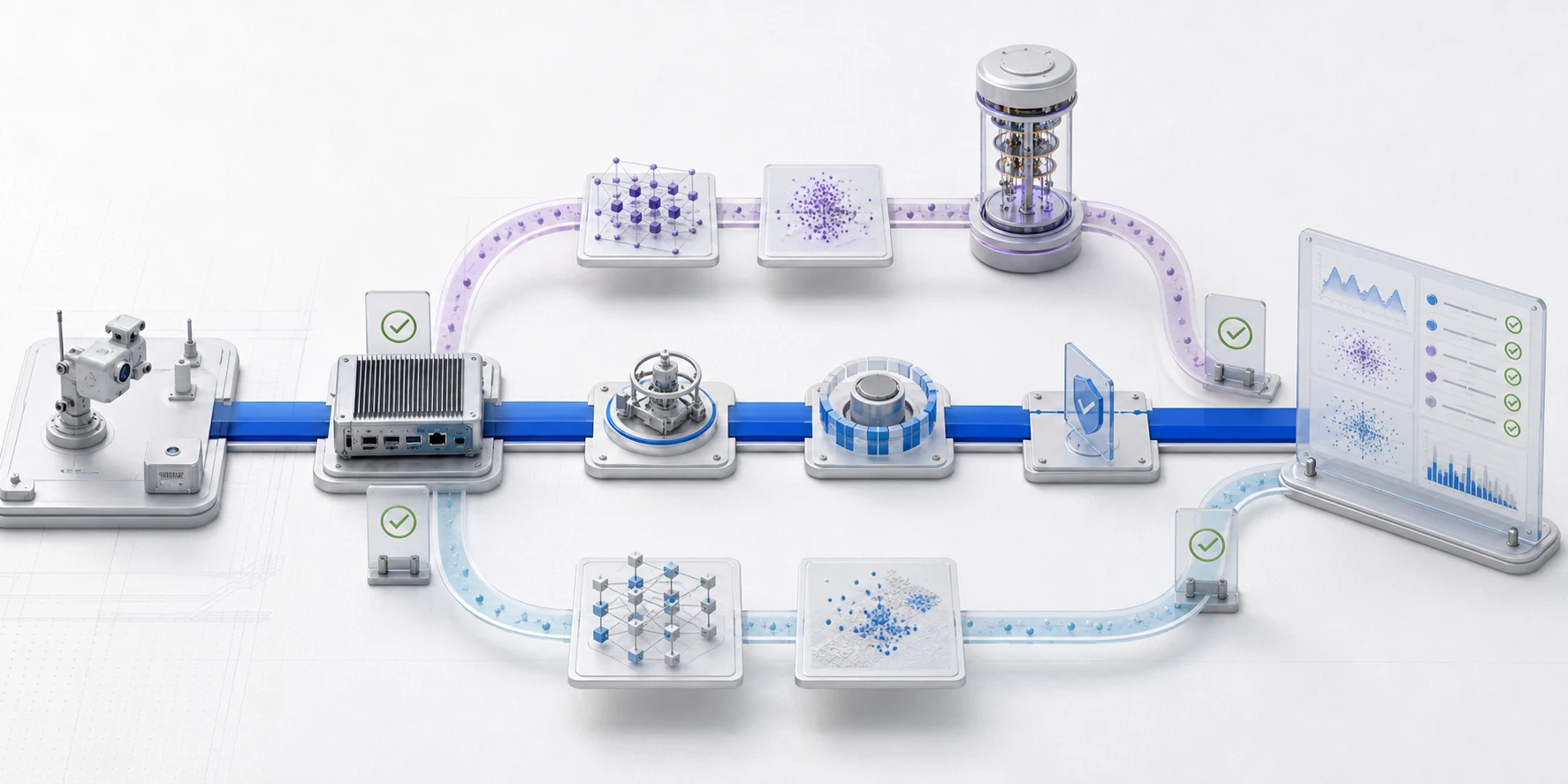
That is why qmesh should keep emphasizing signed manifests and offline-verifiable provenance. The most credible quantum stack is one where the experiment can be inspected even when the backend is external.
- Treat logical resource estimates as first-class outputs, not appendix material.
- Keep physical backend metadata separate from logical algorithm metadata.
- Version the compiler path because small lowering changes can affect resource estimates.
- Preserve negative results; they are useful for crossover maps and customer decision making.
Prefer evidence to inevitability.
The quantum market is full of inevitability language. A more defensible engineering path is to make quantum work inspectable, comparable, and decision-ready.
QFlow, qmesh, and QANTIS can connect fault-tolerant workflow planning, hybrid quantum-classical orchestration, signed manifests, and reproducible decision evidence.
Compiler drift and metadata conflation destroy comparability.
Most quantum evidence failures are not dramatic. They are quiet omissions that surface months later, when a result needs to be defended in front of a customer, a reviewer, or a program office. Designing the record structure against known failure modes is cheaper than reconstructing context after the fact.
The most common failure is compiler drift. A small change in the lowering path can shift logical resource estimates and alter results without any change to the problem definition. If the compiler path is not versioned inside the record, two runs that look identical are not comparable.
The second family is metadata conflation. When physical backend metadata is mixed with logical algorithm metadata, a result becomes bound to one hardware generation and loses value the moment the roadmap advances. Separating the two layers is what lets an experiment survive hardware transitions.
- Compiler drift: unversioned lowering changes silently alter resource estimates between runs.
- Metadata conflation: physical and logical metadata merged, tying results to a single hardware generation.
- Missing baselines: hardware output treated as meaningful without a classical or simulator comparison.
- Discarded negative results: failed runs deleted, removing the inputs needed for crossover maps.
- Unverifiable external runs: no signed manifest, so nothing can be inspected after the provider changes calibration.
Capture problem, compilation, and execution context in that order.
Teams rarely fail by recording too little in total. They fail by recording the wrong things first. The order that pays off starts with the problem definition, because everything downstream is uninterpretable without it: the problem statement, the Hamiltonian or objective, constraints, and seeds.
The second layer is the compilation record. Compiler configuration, the versioned lowering path, and the resulting logical resource estimates should be captured automatically at run time, not reconstructed from logs. This is where QFlow Studio earns its place as the authoring and execution surface, with qmesh underneath providing the modality-aware IR and signed manifests.
The third layer is execution context: provider metadata, backend calibration state, mitigation choices, error behavior, and confidence intervals. Only after those three layers exist does it make sense to invest in review tooling, because portable artifacts for peer review, customer review, and regression testing are assembled from them.
How to evaluate quantum tooling claims.
The market rewards inevitability language, so vendor material should be read as a claims inventory rather than a roadmap. The test is simple: for each performance claim, ask whether the exact benchmark, the classical baseline, the hardware, the error model, and independent validation are all available. A claim missing any of those elements is a marketing statement, not evidence.
Tooling should be evaluated on the same axis. A credible quantum stack lets an experiment be inspected even when the backend is external. That means signed manifests, offline-verifiable provenance, and artifacts portable enough to hand to a reviewer who has no access to the vendor's infrastructure.
Composability matters as much as capability. qmesh is positioned as a substrate that composes with Qiskit, Cirq, and PennyLane rather than replacing them, and the same standard applies to any tool under evaluation. A layer that locks problem definitions and results into a proprietary format defeats the purpose of keeping records.
- Is the exact benchmark specification published with the claim?
- Is a classical baseline included, with its configuration documented?
- Are hardware, error model, and mitigation choices disclosed?
- Can the result be validated independently, offline, from the artifacts alone?
- Do exported artifacts remain usable outside the vendor's own tooling?
The transition period sets the record requirements.
IBM's roadmap material and NVIDIA's CUDA-Q direction describe the same intermediate state: workloads span QPUs, GPUs, CPUs, simulators, and classical optimizers, and backends change while program records must remain comparable. IBM's five-year investment commitment makes the length of that transition explicit. Records made during this period must outlive the machines that produced them.
That is why logical resource estimates deserve first-class treatment now. They are the one quantity that stays comparable across hardware generations, provided physical backend metadata is kept separate from logical algorithm metadata. Programs that adopt this discipline early accumulate a longitudinal evidence base; programs that do not restart their records with every backend change.
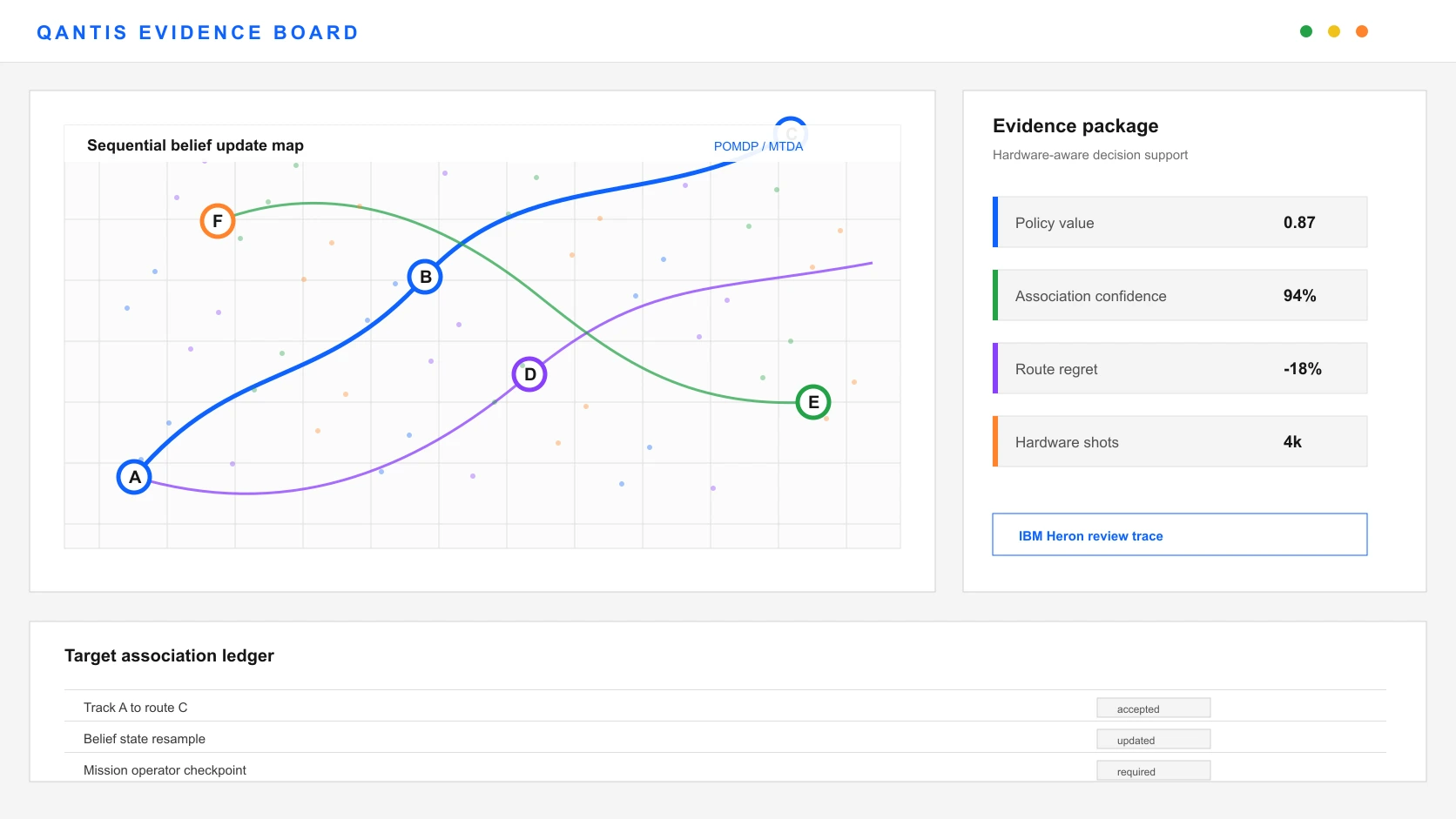
The same logic applies to decisions. Where quantum outputs feed decision systems under uncertainty, the record has to capture decision relevance, not only benchmark numbers. That is the boundary where QANTIS sits, with its Infer, Risk, Optimise, Verify structure, and where a single benchmark number stops being an adequate deliverable.
Operational checklist
Program checklist: reviewable quantum workflow records
Derived from the article's takeaways. Apply these per experiment, not per program phase.
- 01
Capture the problem statement, Hamiltonian or objective, constraints, seeds, compiler configuration, and provider metadata for every experiment.
- 02
Run classical and simulator baselines before treating any hardware output as meaningful.
- 03
Record mitigation choices, error behavior, backend calibration context, and confidence intervals with each run.
- 04
Treat logical resource estimates as first-class outputs and version the compiler path that produced them.
- 05
Keep physical backend metadata separate from logical algorithm metadata.
- 06
Sign manifests and keep provenance offline-verifiable so externally executed runs remain inspectable.
- 07
Preserve negative results as inputs to crossover maps and customer decision making.
- 08
Make experiment artifacts portable for peer review, customer review, and internal regression testing.
- 09
Reject quantum advantage claims that lack the exact benchmark, baseline, hardware, error model, and independent validation.
Practical takeaways
01
Quantum products need reproducible records before they need marketing claims.
02
QFlow Studio should present the full workflow, not only circuits.
03
qmesh should own signed manifests, backend abstraction, and provenance as a product advantage.
04
QANTIS belongs where quantum outputs influence decision systems under uncertainty.
05
Describe fault-tolerant quantum work through resource estimates, manifests, baselines, and reproducible evidence.
RA · Reference annexDefinitions, recurring questions, editorial method, and primary sources.Inspect
The analysis above carries the main reading flow. This reference layer keeps terminology, recurring questions, editorial method, and primary sources available without interrupting the argument.
Terminology
Terms behind Fault-tolerant quantum workflows: why evidence pipelines matter..
- Fault-tolerant quantum computing (FTQC)
- A class of quantum systems that use error correction to run long computations reliably. Current roadmaps, including IBM's, treat it as the target beyond today's noisy devices.
- Logical resource estimate
- The count of error-corrected qubits and operations an algorithm needs, as distinct from the raw physical qubit counts of a specific machine. It is the quantity that stays comparable as hardware generations change.
- Signed manifest
- A cryptographically signed record of an experiment's inputs, configuration, and outputs. It allows a result to be verified offline, without trusting or accessing the backend that produced it.
- Provenance
- The traceable history of how a result was produced, covering assumptions, compilation, execution context, and review. Offline-verifiable provenance means that history can be checked without contacting the original systems.
- Hybrid quantum-classical workflow
- A workload that spans QPUs, GPUs, CPUs, simulators, and classical optimizers rather than running on a quantum processor alone. NVIDIA CUDA-Q is built around this model.
- Error mitigation
- Techniques applied to reduce the effect of hardware noise on quantum results. Mitigation choices change what a result means, so they belong in the experiment record.
- Backend calibration context
- The measured state of a quantum device's tuning at the time of a run. Without it, hardware results cannot be interpreted or reproduced later.
- Crossover map
- An evidence-based view of where quantum methods begin to outperform classical baselines for a given problem class. Negative results are essential inputs to it.
Field questions
Program questions behind Fault-tolerant quantum workflows: why evidence pipelines matter..
Q01Why does progress toward fault-tolerant quantum hardware increase the record-keeping burden instead of reducing it?
Fault tolerance will reduce some classes of hardware error, but it does not remove the need to explain compilation choices, logical resource estimates, classical pre-processing, data movement, and decision relevance. IBM's 2026 roadmap material emphasizes profiling, verification, debugging, and quantum-classical workload tooling alongside the hardware itself. As systems scale, the number of assumptions that must be documented grows with them.
Q02What should a complete quantum experiment record contain to be reviewable?
At minimum: the problem statement, the Hamiltonian or objective, constraints, seeds, compiler configuration, and provider metadata. It should also include classical and simulator baselines, mitigation choices, error behavior, backend calibration context, and confidence intervals. The resulting artifacts should be portable enough for peer review, customer review, and internal regression testing.
Q03Does QFlow Studio replace provider SDKs such as Qiskit?
No. QFlow Studio is the authoring and execution surface for quantum workflows: it helps teams define a problem, connect a simulator or backend, store assumptions, run baselines, track compilation, and preserve outputs. Underneath it, qmesh composes with Qiskit, Cirq, and PennyLane rather than replacing them.
Q04How can a program trust results from an external quantum backend it does not control?
Through signed manifests and offline-verifiable provenance. qmesh uses ed25519-signed manifests with offline-verifiable hash chains, so the experiment record can be inspected and validated even when the backend is external. The record, not the backend operator, becomes the object of trust.
Q05When should a program accept a quantum advantage claim from a vendor?
Only when the exact benchmark, the classical baseline, the hardware, the error model, and independent validation are all available. A claim missing any of those elements should be treated as marketing, not evidence. Running classical and simulator baselines before interpreting hardware output is the internal version of the same rule.
Q06Where does QANTIS fit relative to QFlow Studio and qmesh?
QANTIS applies where quantum outputs influence decision systems under uncertainty, with a decision engine organized as Infer, Risk, Optimise, Verify. QFlow Studio is the workflow and evidence surface, and qmesh is the substrate providing the typed IR, backend abstraction, and signed manifests. The public QANTIS repository is the Community Edition; production modules and benchmark results are held in the private Collaborator Edition.
Editorial record
How Fault-tolerant quantum workflows: why evidence pipelines matter. was checked.
- Editorial owner
- Neura Parse Research
- Last verified
- July 12, 2026
- Method
- Synthesis of the dated primary and official records listed below, checked against the operating question in this note.
- Scope limit
- Planning analysis—not certification, customer performance evidence, procurement advice, or a claim of production readiness.
SRSources reviewed
4 records