
Abstract
Quantum AI is not a magic accelerator. Credible 2026 work connects problem framing, classical baselines, logical resource estimates, quantum execution, AI-assisted interpretation, and decision evidence in one record.
Gap map
Quantum AI review map
A quantum result becomes useful only after baselines, resource estimates, and decision impact are connected.
Problem
- Scientific objective
- Classical baseline
- Error tolerance
- Decision value
Quantum path
- Circuit or Hamiltonian
- Logical resource estimate
- Backend metadata
- Error model
Evidence
- Reproducible manifest
- AI-assisted analysis
- Crossover map
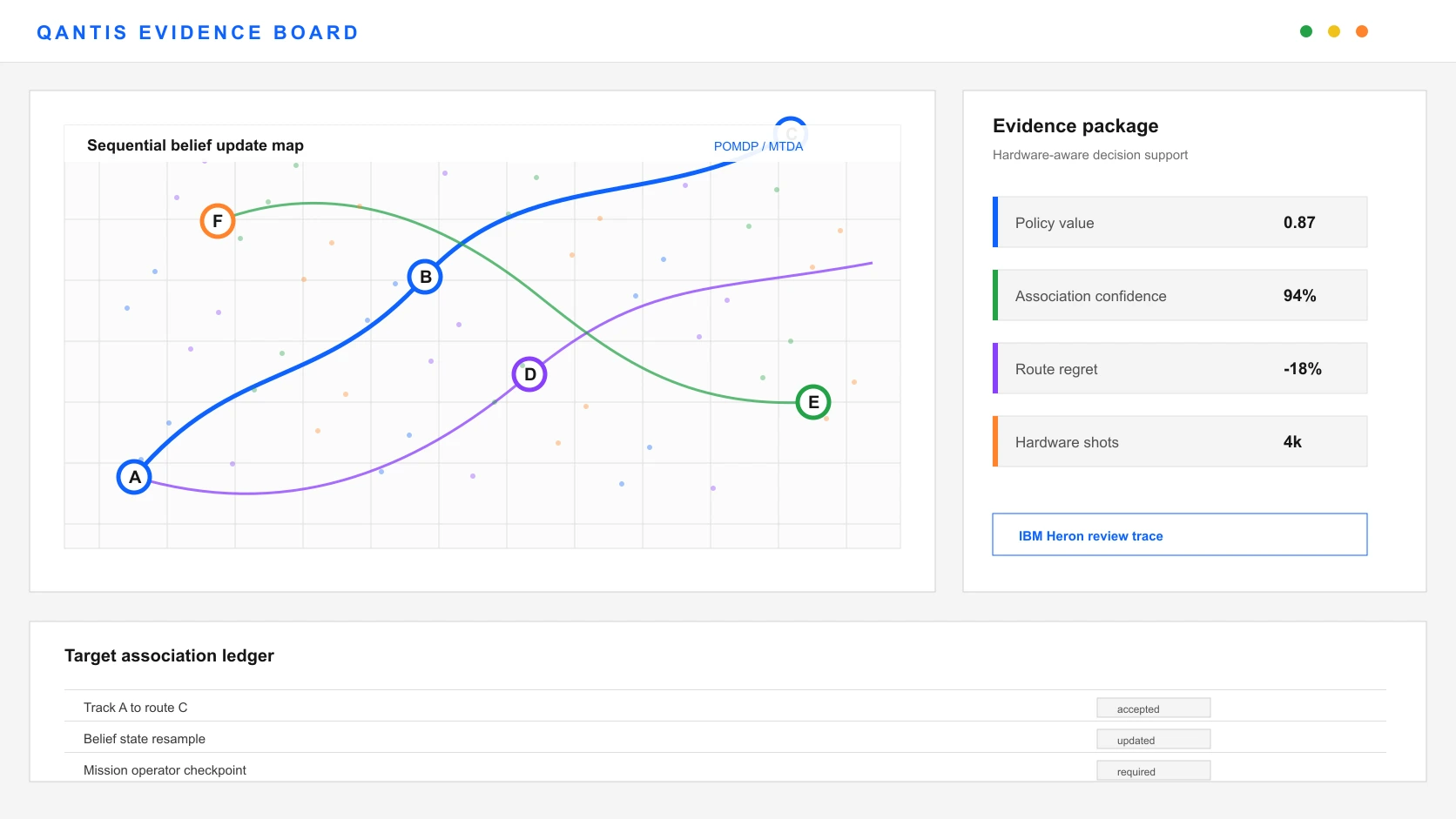
- QANTIS decision trace
Quantum AI is moving from demos to workload accounting.
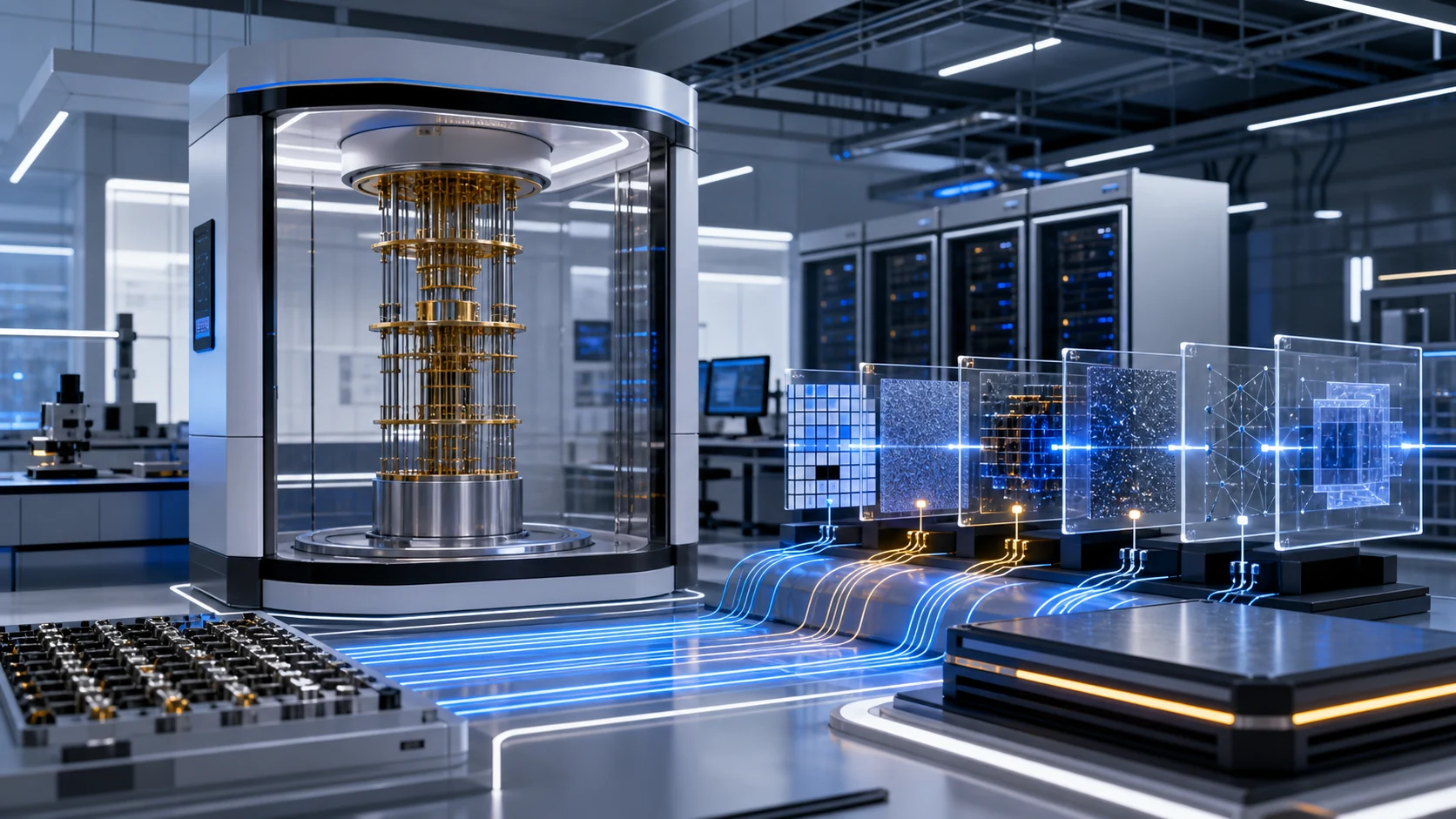
IBM's June 2026 quantum investment signal and roadmap language keep the industry focused on fault-tolerant systems, verification, debugging, and developer tooling. Google's Quantum AI roadmap frames the long path from error suppression and logical qubits toward useful error-corrected computation. NVIDIA CUDA-Q points to the practical software reality: useful quantum workflows span QPUs, GPUs, CPUs, simulators, and classical optimizers.
That combination changes the product question. The question is not whether quantum computing and AI can be mentioned together. The question is which subroutine, inside which workflow, improves which decision at which total cost.
TD · Technical depth7 supporting chapters and the working checklist.Read deeper
The hard part is a decision-level crossover map.
Quantum-AI discussions often jump from algorithm family to claimed future impact. The missing layer is a reproducible crossover map that compares classical, quantum-inspired, noisy quantum, and fault-tolerant estimates against the same objective.
For AI and science workloads, that map should include not only runtime. It should include data loading, state preparation, compiler path, logical qubits, T-count or equivalent cost, error budget, classical accelerator time, and the impact of the result on downstream model or scientific decisions.
- Compare against strong classical baselines before any quantum claim is made.
- Keep logical resource estimates visible even when running only simulators or NISQ hardware.
- Record whether AI helps with problem decomposition, ansatz selection, error analysis, or interpretation.
- Treat negative crossover results as useful evidence, not failed marketing.
Make hybrid experiments legible from objective to decision.
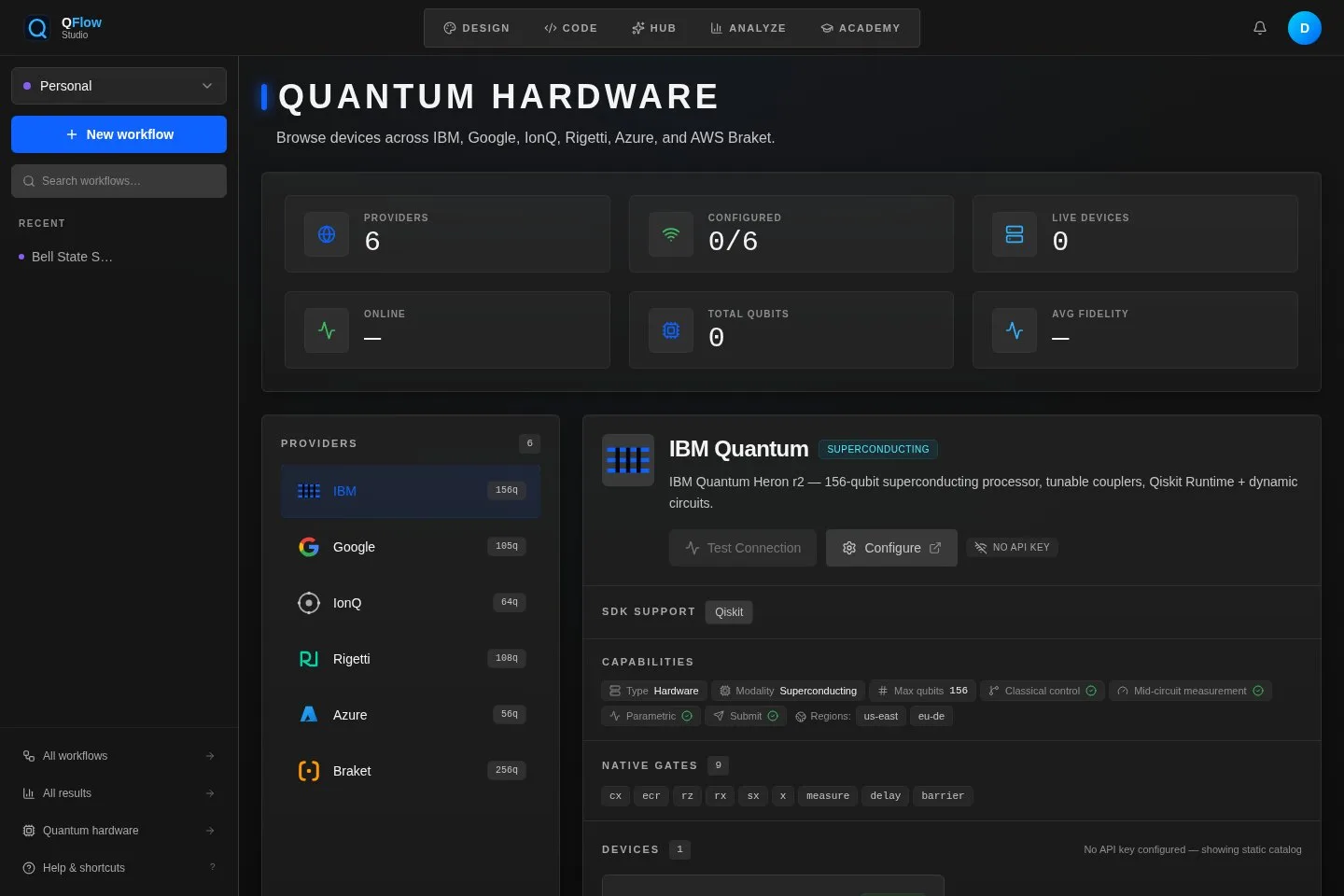
QFlow Studio can be the authoring surface where users define the objective, choose backends, attach baselines, configure resource estimation, and store execution evidence. It should not hide provider SDKs behind a decorative wrapper. It should make the experiment reviewable.
qmesh is the natural substrate for signed manifests, modality-aware IR, backend adapters, and provenance. QANTIS becomes the layer where quantum outputs are translated into decision confidence, risk, and action tradeoffs.
- Save seeds, compiler versions, backend calibration metadata, simulator settings, and model versions.
- Separate physical execution evidence from logical algorithm evidence.
- Use AI assistance for workflow design and analysis, but keep the evidence trail deterministic and inspectable.
- Present the result as a decision aid with uncertainty, not a single number detached from context.
Pick narrow quantum AI targets with measurable value.
Early quantum-AI evaluations should avoid vague enhancement claims. Testable targets include molecular-simulation workflows where AI proposes candidates and quantum methods refine energy estimates, combinatorial workflows where a quantum solver is benchmarked against modern heuristics, or uncertainty-aware systems where a quantum result affects a constrained decision.
Each target should define a minimum publishable artifact: a problem specification, baselines, resource estimates, manifest, error budget, and user-facing evidence page.
A quantum–AI experiment needs a reviewable operating record.
The phrase quantum AI covers very different methods and maturity levels. A useful operating record names the problem, classical baseline, model and circuit, resource estimate, provider context, calibration, result, uncertainty, and decision gate.
QFlow can author and review the workflow, qmesh can preserve the manifest and backend path, and QANTIS can translate a bounded result into uncertainty-aware decision evidence.
Capture manifests, resource estimates, and decision linkage in order.
Start with the manifest. Before any evaluation logic is built, every run should capture seeds, compiler versions, backend calibration metadata, simulator settings, and model versions. This is the cheapest instrument to install and the most expensive to retrofit.
Second, make resource estimation a first-class object. Logical qubits, T-count or equivalent cost, and the error budget should be visible in the same view as the result, even when execution happens only on simulators or NISQ hardware. Physical execution evidence and logical algorithm evidence should be stored separately so the two are never conflated.
Third, instrument the decision linkage. Record which downstream model or scientific decision the result affects, and with what uncertainty. In the Neura Parse stack this maps directly: QFlow Studio authors the experiment, qmesh preserves the signed manifest and provenance, and QANTIS carries the decision trace.
The next phase rewards accounting, not demos.
The vendor direction is consistent. IBM's investment language centers on fault-tolerant systems, verification, debugging, and developer tooling. Google's roadmap runs from error suppression and logical qubits toward useful error-corrected computation. NVIDIA CUDA-Q assumes hybrid execution across QPUs, GPUs, CPUs, and simulators as the default shape of a workload.
For a program lead this means the review question keeps sharpening: which subroutine, inside which workflow, improves which decision at which total cost. Teams that hold reproducible crossover maps can answer that question again each time hardware or compilers change, without rebuilding the experiment. Teams that hold only demo results start over.
The practical posture is narrow targets with measurable value: molecular simulation workflows where AI proposes candidates and quantum methods refine energy estimates, combinatorial workflows benchmarked against modern heuristics, and uncertainty-aware decision systems where a quantum result affects a constrained choice. Each target carries its minimum publishable artifact. Negative results stay in the record because they price the crossover as precisely as positive ones.
Operational checklist
Program checklist: standing up quantum AI workflow records
Derived from the article's takeaways. The record is the deliverable; each item makes one part of it reviewable.
- 01
Establish strong classical baselines for each candidate workload before any quantum claim enters a review.
- 02
Build a decision-level crossover map comparing classical, quantum-inspired, noisy quantum, and fault-tolerant estimates against the same objective.
- 03
Account for total cost: data loading, state preparation, compiler path, logical qubits, T-count or equivalent, error budget, and classical accelerator time.
- 04
Keep logical resource estimates visible even when execution runs only on simulators or NISQ hardware.
- 05
Record seeds, compiler versions, backend calibration metadata, simulator settings, and model versions with every run.
- 06
Separate physical execution evidence from logical algorithm evidence in the record.
- 07
Confine AI assistance to problem decomposition, ansatz selection, error analysis, and interpretation; keep the evidence trail deterministic and inspectable.
- 08
Log negative crossover results as first-class evidence, not discarded experiments.
- 09
Scope early targets narrowly, such as molecular simulation refinement, benchmarked combinatorial solvers, or uncertainty-aware decision systems, each with a defined minimum publishable artifact.
- 10
Present every quantum result as a decision aid with uncertainty, not a single number detached from context.
Practical takeaways
01
Quantum AI needs crossover maps, not generic acceleration claims.
02
Baselines, resource estimates, and error budgets should be first-class UI objects.
03
QFlow Studio owns hybrid workflow authoring and review.
04
qmesh owns manifests, IR, backend metadata, and provenance.
05
QANTIS owns decision interpretation when quantum evidence changes an action.
RA · Reference annexDefinitions, recurring questions, editorial method, and primary sources.Inspect
The analysis above carries the main reading flow. This reference layer keeps terminology, recurring questions, editorial method, and primary sources available without interrupting the argument.
Terminology
Terms behind Hybrid quantum–classical workflows: what a reviewable experiment record contains..
- Crossover map
- A reproducible comparison that shows, for one fixed objective, how classical, quantum-inspired, noisy quantum, and fault-tolerant approaches compare on total cost and decision value. It identifies where, if anywhere, a quantum path becomes worth running.
- Logical qubit
- An error-corrected qubit assembled from many physical qubits so that computation survives hardware noise. Resource estimates stated in logical qubits describe what an algorithm needs on fault-tolerant hardware, not what today's devices provide.
- T-count
- A cost measure for fault-tolerant circuits that counts the most expensive gate operations, called T gates. It serves as a proxy for how costly an algorithm will be to run under error correction.
- NISQ
- Noisy intermediate-scale quantum, the current hardware regime in which devices run without full error correction. Results from NISQ machines carry hardware noise and require explicit error analysis.
- Error budget
- An explicit allocation of how much error a workflow can tolerate at each stage while the final result still supports its downstream decision. It turns a vague accuracy goal into a reviewable constraint.
- Manifest
- A reproducible record of an experiment covering seeds, compiler versions, backend calibration metadata, simulator settings, and model versions. In the Neura Parse stack, qmesh signs manifests so they can be verified after the fact.
- Ansatz
- The parameterized circuit structure chosen as the starting template for a variational quantum algorithm. Ansatz selection is one place where AI assistance helps without touching the evidence trail.
- Fault-tolerant quantum computation (FTQC)
- The target regime in which error-corrected logical qubits execute long computations reliably. The IBM and Google roadmaps cited in this article are oriented toward this regime.
Field questions
Program questions behind Hybrid quantum–classical workflows: what a reviewable experiment record contains..
Q01What is a quantum AI crossover map and why does a program need one?
A crossover map is a reproducible comparison of classical, quantum-inspired, noisy quantum, and fault-tolerant estimates against the same objective. It covers more than runtime: data loading, state preparation, compiler path, logical qubits, T-count or equivalent cost, error budget, classical accelerator time, and the impact of the result on downstream model or scientific decisions. Without it, a quantum claim cannot be reviewed, only believed.
Q02Do we need fault-tolerant hardware before quantum AI work is worth starting?
No. The credible 2026 work is the record, not the speedup: strong classical baselines, logical resource estimates kept visible even when running only simulators or NISQ hardware, and an explicit error budget. Programs that build this evidence now can reevaluate crossover as hardware matures, and negative crossover results are themselves useful evidence.
Q03How do QFlow Studio, qmesh, and QANTIS split responsibilities in a quantum AI workflow?
QFlow Studio is the authoring and review surface where users define the objective, choose backends, attach baselines, configure resource estimation, and store execution evidence. qmesh is the substrate underneath: signed manifests, modality-aware IR, backend adapters, and provenance. QANTIS sits at the decision end, translating quantum outputs into decision confidence, risk, and action tradeoffs.
Q04Where is AI assistance appropriate inside a quantum workflow, and where is it not?
AI can help with problem decomposition, ansatz selection, error analysis, and interpretation, and it can assist workflow design. The evidence trail itself must remain deterministic and inspectable: seeds, compiler versions, backend calibration metadata, simulator settings, and model versions are recorded, not generated. AI advises; the record verifies.
Q05What is the minimum publishable artifact for a quantum AI experiment?
A problem specification, strong classical baselines, logical resource estimates, a reproducible manifest, an error budget, and a user-facing evidence page. Each narrow target, such as a molecular simulation workflow or a benchmarked combinatorial solver, should define this artifact before execution starts. If the artifact cannot be produced, the experiment is not ready for review.
Q06What do the 2026 signals from IBM, Google, and NVIDIA mean for program planning?
IBM's June 2026 commitment of more than 10 billion dollars targets fault-tolerant systems along with verification, debugging, and developer tooling. Google's Quantum AI roadmap frames the long path from error suppression and logical qubits toward useful error-corrected computation, and NVIDIA CUDA-Q shows that practical workflows already span QPUs, GPUs, CPUs, and simulators. The planning conclusion is hybrid workload accounting, not a bet on a single machine.
Editorial record
How Hybrid quantum–classical workflows: what a reviewable experiment record contains. was checked.
- Editorial owner
- Neura Parse Research
- Last verified
- July 12, 2026
- Method
- Synthesis of the dated primary and official records listed below, checked against the operating question in this note.
- Scope limit
- Planning analysis—not certification, customer performance evidence, procurement advice, or a claim of production readiness.
SRSources reviewed
5 records