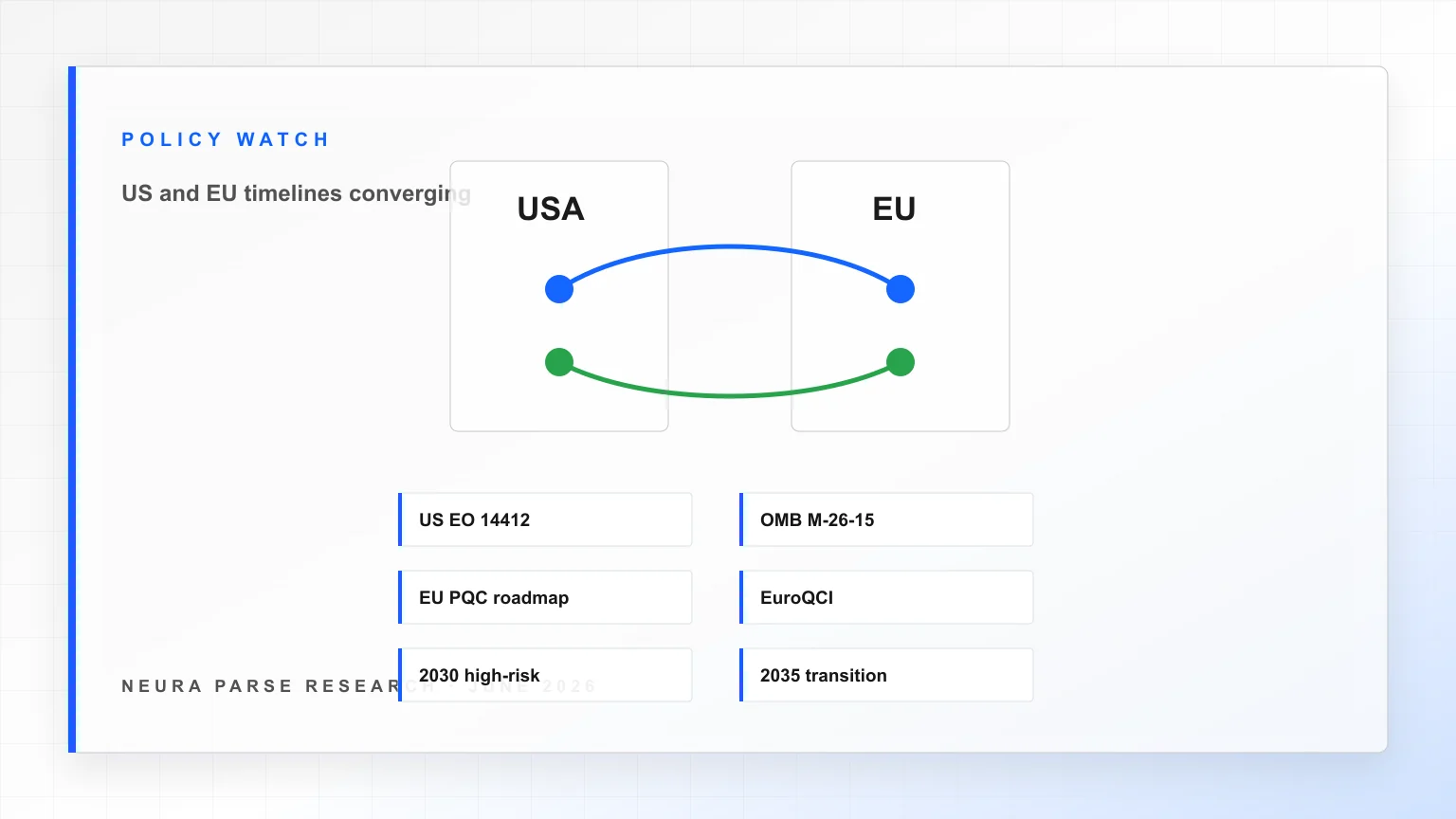
The important 2026 transatlantic story is not a single magic agreement. It is the convergence of public-sector deadlines, procurement pressure, product categories, and critical-infrastructure roadmaps that force enterprises to treat quantum-safe readiness as architecture.
Gap map
Policy-to-architecture map
Transatlantic readiness turns public policy into concrete system-owner work.
United States
- EO 14412
- OMB M-26-15
- CISA product categories
- Federal inventory and migration reporting
Europe
- NIS Cooperation Group roadmap
- Member State synchronization
- EuroQCI
- Critical infrastructure focus
Enterprise response
- Cryptographic inventory
- Risk-tiered roadmap
- Vendor evidence
- Board-level reporting
Policy signal
The U.S. and EU are not waiting for perfect product maturity.
The United States is pushing federal migration from planning into execution through EO 14412 and OMB M-26-15. CISA's January 2026 product categories help buyers identify which hardware and software classes are likely to use or transition to PQC standards.
The European Union is moving through a coordinated roadmap under the NIS Cooperation Group, supported by the Commission. The roadmap creates a synchronized transition view for Member States and connects PQC to broader cybersecurity resilience.
The practical implication for companies is procurement pressure. Even if a business is not a federal agency or EU public body, customers, regulators, prime contractors, and insurers will increasingly ask for cryptographic inventory, vendor status, and migration evidence.
Neura Parse offer
Build a policy-to-product control surface.
Neura Parse can turn policy pressure into an operating surface: discover systems, classify risk, attach standards, create owner workflows, request evidence, approve migration steps, and generate status views for executives and auditors.
The service should sit between security advisory and product implementation. It is not only a report. It is a working control layer that links policy, architecture, vendors, tests, and evidence.
Field rule
Do not claim a transatlantic agreement where the evidence is convergence.
The 2026 evidence points to strong convergence, not necessarily one unified U.S.-EU treaty for every migration detail. That distinction makes the messaging stronger. Neura Parse can say U.S. and EU policy surfaces are aligning around readiness, inventory, and migration pressure without overstating the public record.
That also gives the content a trustworthy tone: cite the official U.S. and EU sources, then explain the architectural work companies must do next.
Practical takeaways
The 2026 policy story is convergence across U.S. and EU readiness signals.
Architecture teams need ownership, inventory, vendor evidence, and deadlines.
Quantum-safe readiness will increasingly affect procurement and regulated contracts.
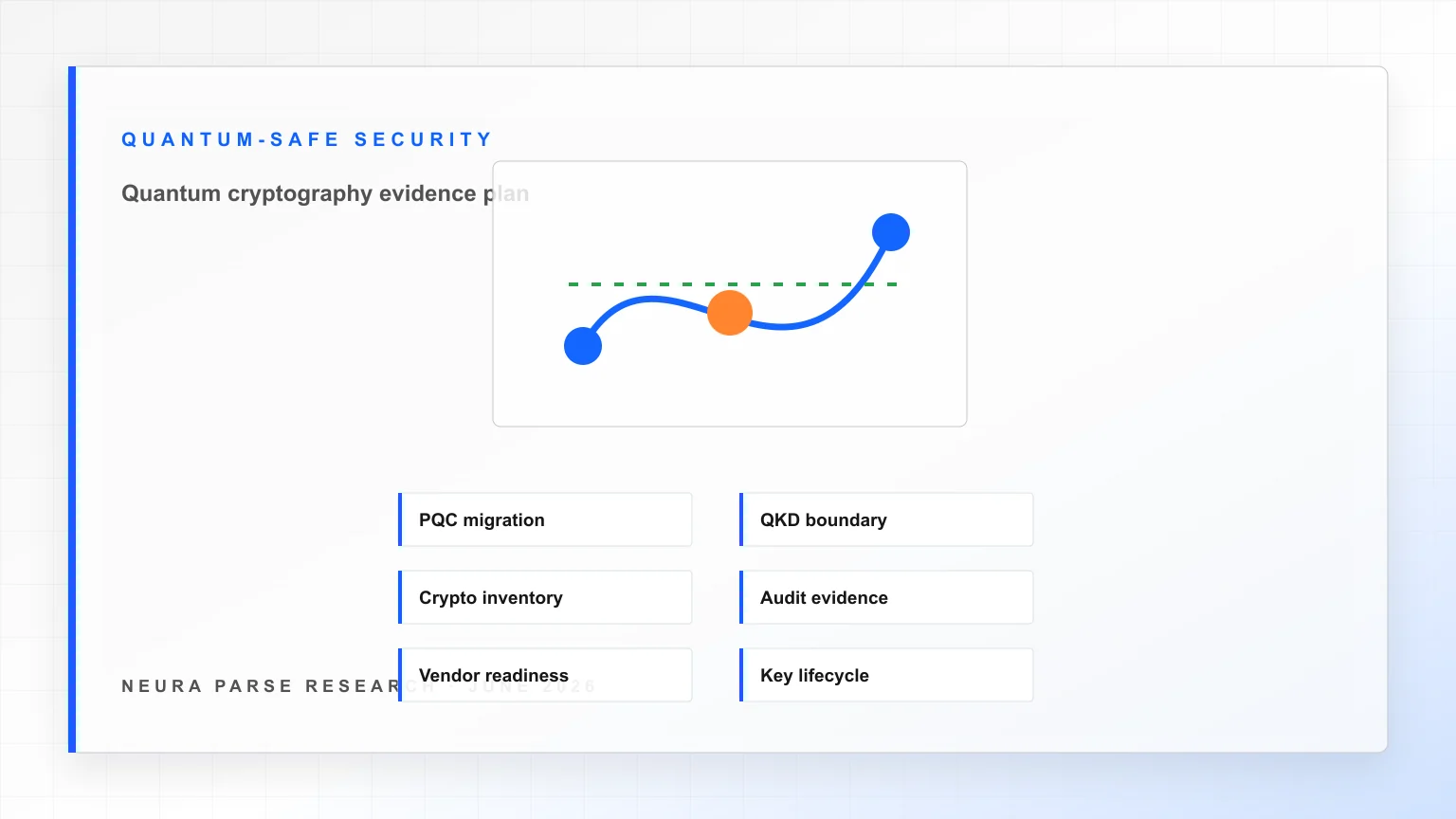
EuroQCI and QKD should be discussed as infrastructure tracks, not replacements for PQC.
Neura Parse should position the offer as policy-to-product execution.
Sources reviewed
Source 01
White House EO 14412: Securing the Nation Against Advanced Cryptographic Attacks
June 2026 U.S. executive order accelerating federal migration to quantum-resistant cryptography.
Source 02
OMB M-26-15: Execution of the Migration to Post-Quantum Cryptography
June 2026 federal execution memo for post-quantum cryptography migration planning and reporting.
Source 03
CISA product categories for post-quantum cryptography adoption
January 2026 guidance for hardware and software categories that use or transition to PQC standards.
Source 04
EU coordinated roadmap for transition to post-quantum cryptography
June 2026 NIS Cooperation Group roadmap for synchronized PQC transition across EU Member States.
Source 05
European Quantum Communication Infrastructure (EuroQCI)
European Commission programme for terrestrial and space-based quantum communication infrastructure.