
Abstract
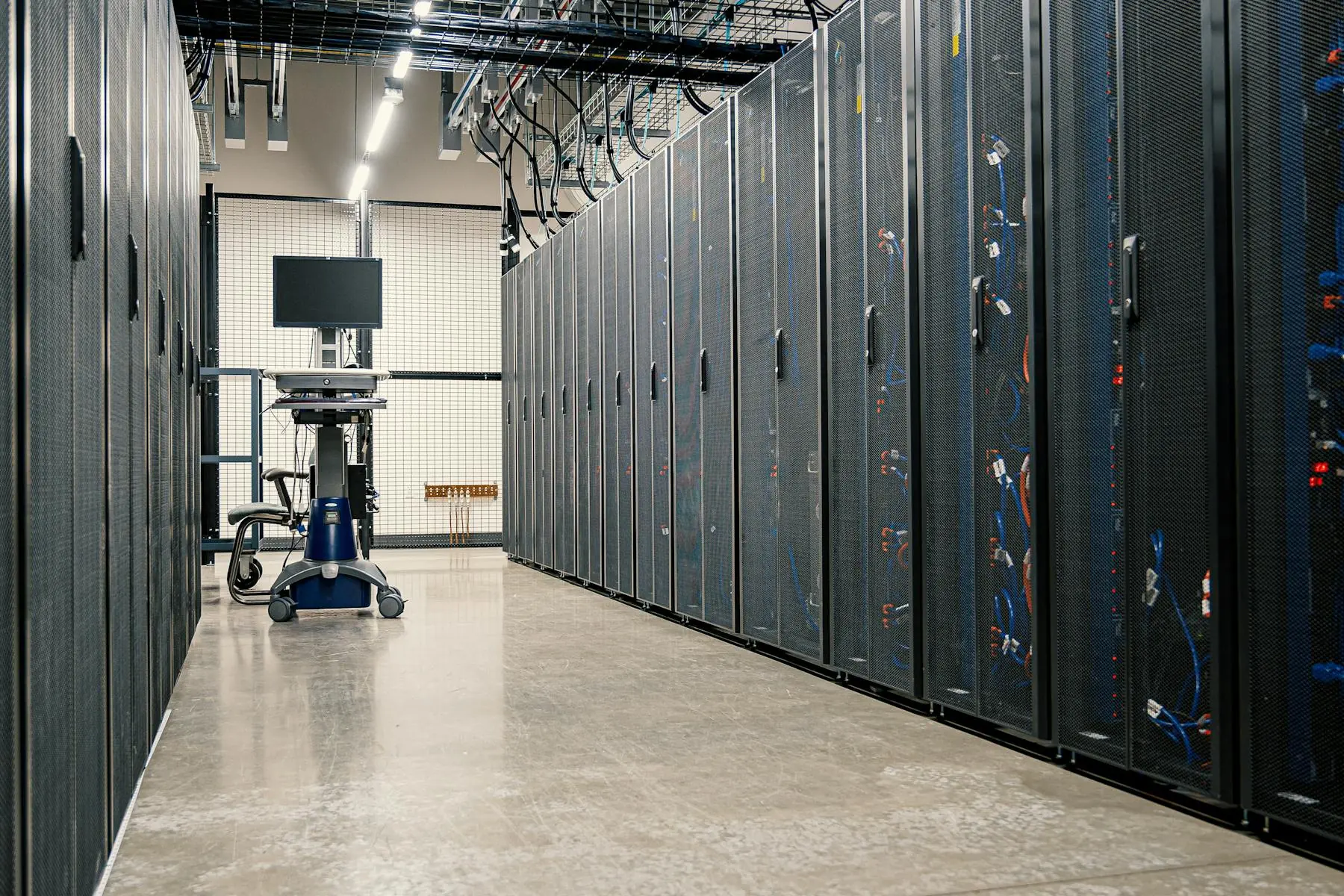
Telecom PQC migration is not a single library upgrade. It crosses SIM/eSIM, OSS/BSS, transport, RAN, core, cloud, devices, certificates, partner interfaces, and long-lived encrypted records.
The first deliverable is a live cryptography map.
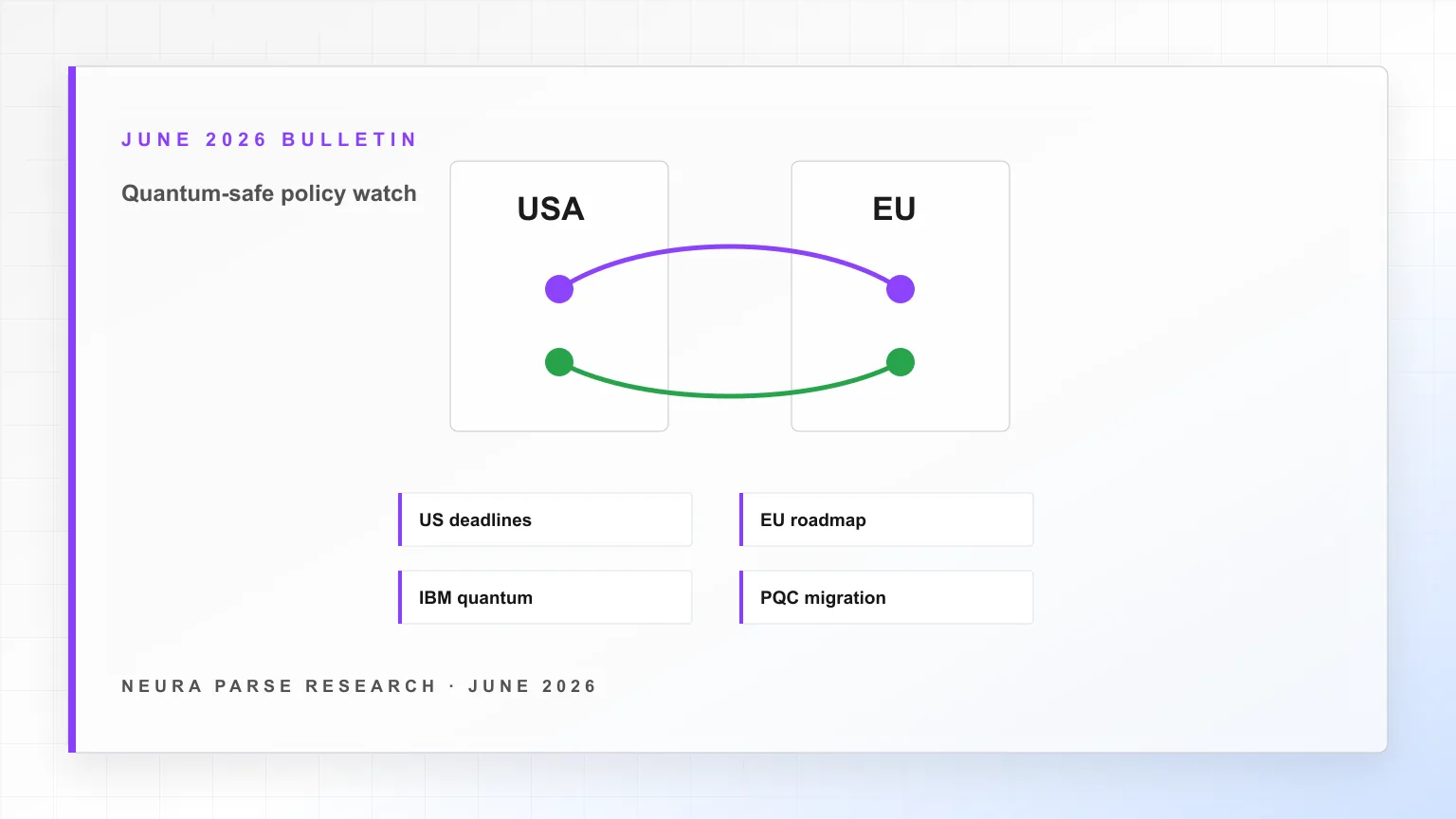
NIST finalized its first post-quantum cryptography standards in 2024. CISA guidance in 2026 pushes critical infrastructure teams to think in product categories and technology surfaces. GSMA publications make the telecom implication direct: the migration must cover networks, devices, protocols, vendors, and long-lived data exposure.
The first useful artifact is therefore not a new cryptographic primitive. It is a live inventory of where cryptography is used, which data needs protection against harvest-now-decrypt-later risk, which components are vendor-controlled, and which upgrade windows are realistic.
TD · Technical depth6 supporting chapters and the working checklist.Read deeper
PQC migration is a programme of dependent tasks.
Every telecom estate has protocol dependencies, certificate chains, HSMs, embedded devices, customer-premise equipment, cloud services, partner interfaces, and regulatory reporting obligations. A migration plan needs sequencing and proof of completion.
NowFlow is a useful product frame because it can turn discovery, classification, owner assignment, vendor outreach, approval, testing, pilot rollout, and evidence capture into a repeatable programme.
- Create an inventory workflow for certificates, protocols, libraries, appliances, SIM/eSIM paths, and partner APIs.
- Classify systems by crypto agility, exposure window, vendor dependency, and operational criticality.
- Run pilot migrations in lower-risk domains before touching core network or subscriber-impacting paths.
- Preserve evidence for auditors: decision records, test results, exception approvals, and rollout state.
Quantum-safe changes must reach devices and field infrastructure.
Telecom PQC work cannot stop at cloud services. Field infrastructure and edge devices often live longer than standard cloud software cycles, and many are difficult to patch once deployed.
NeuraOS can support signed update paths, local policy bundles, cryptographic-module visibility, and secure rollback for edge systems. An operating system does not solve PQC migration by itself, but a disciplined edge runtime makes the broader program easier to inventory, test, and operate.
Turn quantum risk into managed execution.
The strongest program case is operational rather than fear-based: understand the estate, prioritize by exposure and criticality, run pilots, record evidence, and manage exceptions until every dependency is closed.
That operating program connects cryptographic standards with telecom security, vendor management, device lifecycles, workflow ownership, and migration evidence.
Library-only scope, stale inventories, and high-risk pilots.
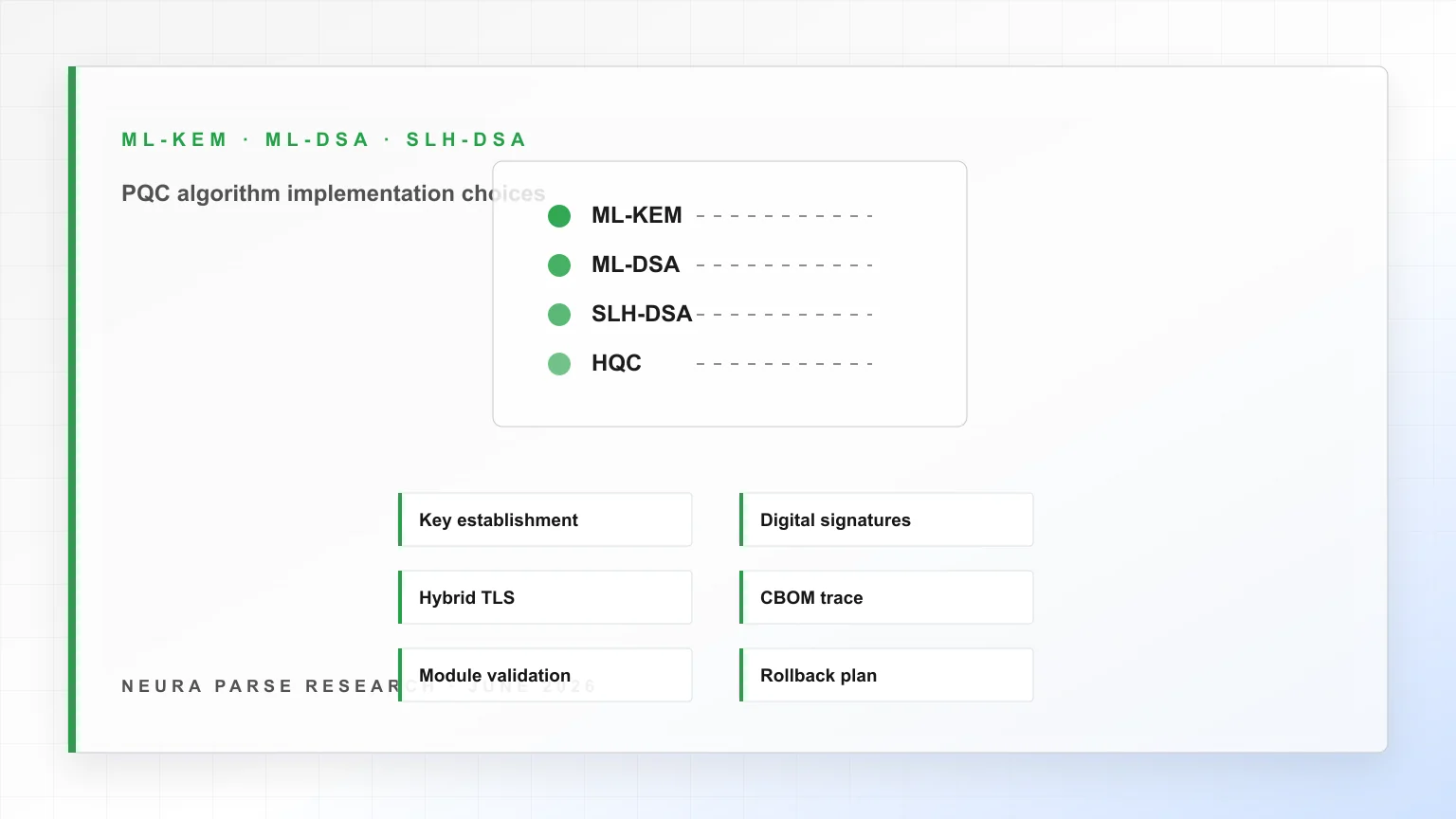
The most common failure is scoping the migration as a software upgrade. FIPS 203, 204, and 205 define the algorithms, but a telecom estate expresses cryptography through certificate chains, protocol endpoints, HSMs, embedded devices, customer-premise equipment, and partner interfaces. A plan that only tracks library versions misses most of the surface.
The second failure is a static inventory. A spreadsheet compiled once decays as certificates rotate, vendors ship firmware, and new partner interfaces come online. The inventory has to be a live artifact with owners and update triggers, or the program ends up sequencing against stale data.
The third failure is learning in the wrong place. Core network and subscriber-impacting paths are the worst domains for first attempts. Run initial migrations where rollback is cheap, prove the procedure, then carry it into critical paths with evidence already in hand.
- Library-only scoping that ignores certificates, HSMs, SIM/eSIM paths, and partner APIs.
- One-time inventories that go stale before sequencing decisions are made.
- Vendor dependencies discovered after migration dates are committed.
- Pilots run on subscriber-impacting paths instead of lower-risk domains.
- Evidence assembled retroactively instead of captured at each decision point.
Vendor evidence is a program dependency, not a procurement afterthought.
Much of a telecom estate is not directly upgradeable by the operator. Appliances, HSMs, customer-premise equipment, SIM/eSIM paths, and cloud services sit on vendor roadmaps the operator does not control. The inventory therefore has to record not only where cryptography lives but who controls each component and what its realistic upgrade window is.
CISA's product-category guidance gives that conversation structure. Instead of asking vendors an open question about quantum readiness, a program can ask which product categories apply, which finalized standards the vendor targets, and when transition support arrives. GSMA's telecom-focused publications, including implementation and prototype guidance, frame the same questions in operator terms.
Vendor responses are program inputs, not correspondence. Record them, date them, and treat gaps as tracked exceptions with owners and review dates. A workflow platform such as NowFlow can hold the outreach, the responses, the approvals, and the exception state in one auditable place.
Measure cryptographic coverage, risk classes, and live decision evidence.
Start where the inventory is weakest. Certificate chains and protocol endpoints are usually the fastest surfaces to enumerate and the first to reveal dependencies nobody had written down. Discovery output should land directly in the live inventory, not in a separate report that drifts from it.
The second instrument is the classification layer. Every system needs recorded values for crypto agility, exposure window, vendor dependency, and operational criticality, because those four attributes drive every sequencing decision that follows. If a system cannot be scored, that itself is a finding with an owner.
The third instrument is the evidence trail. Decision records, test results, exception approvals, and rollout state should be captured as the program runs. Retroactive evidence assembly is slower, less credible, and harder to defend to auditors, and it forfeits the operational visibility that makes exceptions manageable until every dependency is closed.
Operational checklist
Program checklist: quantum-safe telecom migration
Derived from the article's takeaways and the NIST, CISA, and GSMA guidance it cites. Work the list in order; the inventory feeds everything after it.
- 01
Build a live cryptography inventory covering certificates, protocols, libraries, appliances, HSMs, SIM/eSIM paths, cloud services, and partner APIs.
- 02
Score every system for crypto agility, exposure window, vendor dependency, and operational criticality.
- 03
Flag data subject to harvest-now-decrypt-later risk and prioritize its protection paths first.
- 04
Identify which components are vendor-controlled and open structured evidence requests, using CISA product categories as the shared vocabulary.
- 05
Define realistic upgrade windows per domain before committing migration dates.
- 06
Run pilot migrations in lower-risk domains before touching core network or subscriber-impacting paths.
- 07
Assign named owners and approval gates to every migration task, including exceptions.
- 08
Capture decision records, test results, exception approvals, and rollout state as audit evidence at the moment each decision is made.
- 09
Extend the plan to edge and field infrastructure: signed update paths, local policy, and secure rollback for devices that outlive cloud software cycles.
- 10
Review the inventory on a recurring cadence and treat it as a live artifact, not a one-time report.
Practical takeaways
01
Start with cryptography inventory and crypto-agility scoring.
02
Treat PQC as a workflow programme across vendors, products, protocols, and rollout windows.
03
Use NowFlow to manage assignments, approvals, evidence, and exception handling.
04
Use NeuraOS only where secure edge updates and local runtime policy are relevant to the migration scope.
05
Anchor telecom migration in inventory, crypto-agility, standards, vendor evidence, and rollback.
RA · Reference annexDefinitions, recurring questions, editorial method, and primary sources.Inspect
The analysis above carries the main reading flow. This reference layer keeps terminology, recurring questions, editorial method, and primary sources available without interrupting the argument.
Terminology
Terms behind Post-quantum telecom migration starts with a cryptographic inventory..
- Post-quantum cryptography (PQC)
- Cryptographic algorithms designed to remain secure against attacks by quantum computers. NIST finalized the first PQC standards in 2024.
- FIPS 203, 204, and 205
- The first finalized U.S. post-quantum cryptography standards, published by NIST in 2024. They form the algorithm baseline that migration programs target.
- Harvest-now-decrypt-later
- An attack pattern in which encrypted data is captured today and stored for decryption once quantum capability exists. It makes long-lived encrypted records a present risk, not a future one.
- Crypto agility
- A system's ability to change cryptographic algorithms, keys, and certificates without redesign. It is one of the four scoring attributes that drive migration sequencing.
- Cryptography inventory
- A live map of where cryptography is used across an estate, covering certificates, protocols, libraries, appliances, SIM/eSIM paths, and partner APIs. The article treats it as the first deliverable of any PQC program.
- HSM (hardware security module)
- Dedicated hardware that stores cryptographic keys and performs cryptographic operations. HSMs are typically vendor-controlled, which makes them scheduled dependencies in a migration plan.
- OSS/BSS
- Operations support systems and business support systems, the software estate that runs a telecom operator's network management, customer, and billing functions. They carry their own cryptographic dependencies alongside the network itself.
- SIM/eSIM
- Physical and embedded subscriber identity modules that authenticate devices to the network. Their long hardware replacement cycles make them a migration surface that cannot wait for a last-minute swap.
Field questions
Program questions behind Post-quantum telecom migration starts with a cryptographic inventory..
Q01Why does quantum-safe telecom migration start with a cryptography inventory instead of an algorithm upgrade?
Because the migration surface is the whole estate, not one library. Telecom cryptography lives in SIM/eSIM paths, OSS/BSS, transport, RAN, core, cloud services, devices, certificate chains, and partner interfaces, and much of it is vendor-controlled. A live inventory shows where cryptography is used, which data faces harvest-now-decrypt-later risk, and which upgrade windows are realistic. Sequencing decisions made without that map are guesses.
Q02What do the NIST, CISA, and GSMA publications each contribute to a telecom PQC program?
NIST finalized the first post-quantum cryptography standards in 2024, with FIPS 203, 204, and 205 as the algorithm baseline. CISA guidance from January 2026 frames adoption by product categories and technology surfaces, which is useful for vendor conversations. GSMA publications, including the Post Quantum Telco Network Impact Assessment, translate the work into telecom terms: network dependencies, devices, protocols, vendors, migration timelines, and long-lived data exposure.
Q03What is harvest-now-decrypt-later risk and why does it make the inventory step urgent?
It is the risk that traffic and records encrypted today are captured now and decrypted later, once sufficient quantum capability exists. Long-lived encrypted records and long hardware replacement cycles mean the exposure clock is already running before any migration completes. That is why the inventory step, which identifies the affected data and systems, is urgent now rather than a future-facing task.
Q04How should a telecom operator sequence post-quantum migration across its estate?
Classify each system by crypto agility, exposure window, vendor dependency, and operational criticality, and let those four attributes drive the order of work. Run pilot migrations in lower-risk domains before touching core network or subscriber-impacting paths. Treat vendor-controlled components as scheduled dependencies with their own outreach and evidence tracks, and preserve decision records, test results, and exception approvals throughout.
Q05Where do NowFlow and NeuraOS fit in a post-quantum migration program?
NowFlow is an agentic workflow platform, so it can turn discovery, classification, owner assignment, vendor outreach, approvals, testing, pilot rollout, and evidence capture into a repeatable program with human-in-the-loop gates. NeuraOS, a governed edge operating platform, is relevant where the migration must reach field infrastructure: signed update paths, local policy bundles, cryptographic module visibility, and secure rollback. Neither product solves PQC migration by itself; they make the program operable.
Q06What evidence should a PQC migration program preserve for auditors?
Decision records, test results, exception approvals, and rollout state, captured as the program runs rather than assembled retroactively. The record should show the inventory, the classification rationale behind sequencing, vendor responses and open dependencies, and the state of each pilot and rollout window. That evidence trail is what turns quantum risk into managed execution.
Editorial record
How Post-quantum telecom migration starts with a cryptographic inventory. was checked.
- Editorial owner
- Neura Parse Research
- Last verified
- July 12, 2026
- Method
- Synthesis of the dated primary and official records listed below, checked against the operating question in this note.
- Scope limit
- Planning analysis—not certification, customer performance evidence, procurement advice, or a claim of production readiness.
SRSources reviewed
4 records