
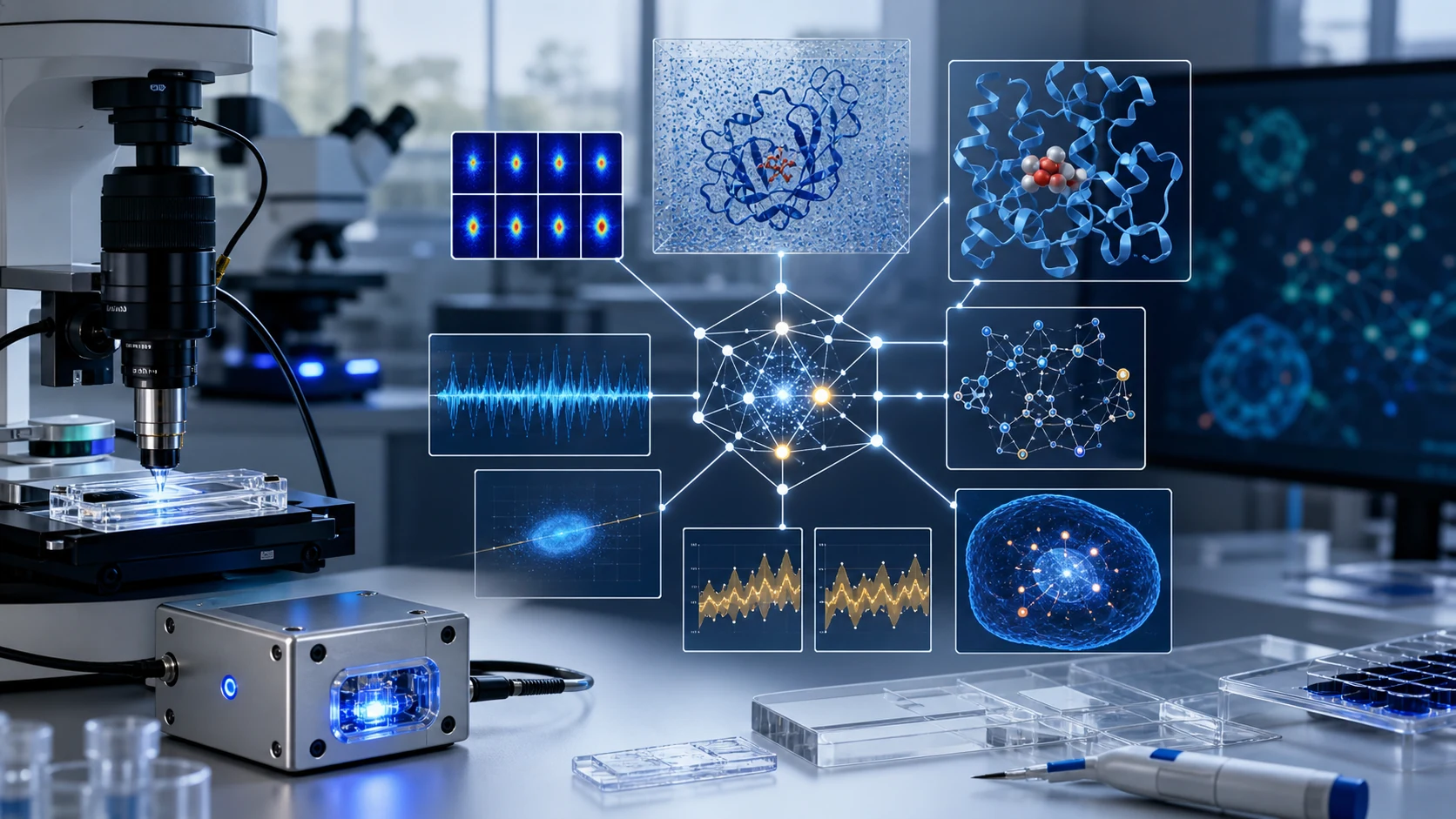
Quantum health should not promise clinical impact before validation. The strong service lane is evidence systems for quantum sensing, biomedical simulation, AI-assisted analysis, and decision support under uncertainty.
Gap map
Quantum health evidence map
Healthcare-facing quantum work must connect measurement protocol, biological endpoint, baselines, and review limits.
Protocol
- Endpoint
- Sample context
- Sensor or simulation
- Calibration
Evidence
- Controls
- Classical baseline
- Noise model
- Reproducibility
Review
- Uncertainty
- Clinical boundary
- Next experiment
- No overclaiming
June 2026 signal
The credible healthcare lane is measurement evidence.
Google's REPLIQA initiative frames quantum computing and life sciences as an applied research bridge. NIH quantum sensing interest shows a related biomedical measurement track. The 2026 quantum biology literature also keeps the bar clear: a serious claim should connect quantum effects to biological function or measurement advantage.
That makes quantum health a careful domain. It can be strategically important, but public messaging must avoid clinical claims until validation exists.
Service pattern
Treat every result as a protocol package.
A useful quantum health engagement should define the endpoint, protocol, sample context, classical baseline, calibration procedure, analysis code, and decision threshold before the experiment is interpreted.
The goal is not to make a dashboard look medical. The goal is to preserve enough evidence that researchers, engineers, compliance reviewers, and healthcare stakeholders can understand what was measured and what was not proven.
- Use QFlow for protocol versioning, baseline runs, sensor metadata, and review notes.
- Use QANTIS for uncertainty, next-experiment recommendations, and decision thresholds.
- Keep privacy, consent, and clinical validation boundaries visible.
- Avoid claims around diagnosis, treatment, or drug discovery acceleration unless validated.
Neura Parse fit
The service is evidence infrastructure for quantum-enabled research.
Neura Parse can position quantum health around research operations: protocol design, evidence packaging, AI-assisted analysis, uncertainty review, and responsible reporting. That fits QFlow and QANTIS without implying a regulated medical device.
The result is a credible bridge between quantum research, AI, and healthcare workflows: useful for life-sciences teams, research groups, and innovation offices that need clarity before making larger investments.
Practical takeaways
Quantum health content should lead with protocols, controls, and uncertainty.
Quantum sensing is a practical near-term lane, but clinical claims need validation.
QFlow can structure experiments; QANTIS can expose uncertainty and next actions.
Healthcare pages must keep privacy and validation boundaries explicit.
Sources reviewed
Source 01
Google REPLIQA quantum biology initiative, May 2026
Google Quantum AI and Google.org research programme for quantum-enabled questions in life sciences.
Source 02
What is quantum biology? PNAS/PubMed, 2026
Perspective defining quantum biology as a field that links quantum effects to biological function.
Source 03
NIH QIS and Quantum Sensing in Biology Interest Group
NIH interest group focused on quantum information science and quantum sensing in biological research.
Source 04
Google Quantum AI roadmap
Milestones from error suppression and logical qubits toward useful, error-corrected quantum computation.