
Abstract
The credible enterprise question is not whether quantum and AI sound powerful together. It is whether a quantum subroutine changes a measurable workflow after classical baselines, cost, error budget, and decision impact are recorded.
Gap map
Quantum AI operating record
Useful quantum AI needs one record across problem framing, baselines, execution, interpretation, and decision impact.
Frame
- Business or science objective
- Classical baseline
- Error tolerance
- Value threshold
Execute
- Quantum circuit or Hamiltonian
- Backend metadata
- Resource estimate
- AI-assisted analysis
Decide
- Uncertainty
- Crossover state
- Reviewer notes
- Investment gate
Quantum AI is becoming a workflow accounting problem.
IBM's June 2026 investment and roadmap messaging keeps attention on fault-tolerant systems, verification, debugging, and developer tooling. Google Quantum AI's roadmap frames the path from error suppression to useful error-corrected computation. CUDA-Q reinforces the operational reality that serious experiments already span CPUs, GPUs, simulators, and QPUs.
That is enough to justify enterprise tracking, but not enough to justify vague advantage claims. A credible quantum AI programme should show exactly what was compared, what resources were assumed, and which downstream decision changed.
TD · Technical depth5 supporting chapters and the working checklist.Read deeper
Start with a crossover map, then decide what to fund.
Most teams should begin with a decision-level crossover map: classical method, quantum-inspired method, simulator result, noisy hardware result, and fault-tolerant estimate compared against the same objective.
The map should include data loading, compilation, logical resources, runtime, error budget, cost, repeatability, and the business or scientific consequence of the result.
- Record negative results as useful evidence.
- Keep resource estimates visible even when the first run is only a simulator.
- Separate AI-assisted interpretation from quantum execution evidence.
- Treat every claim as provisional until the baseline is stronger than the demo.
Separate the experiment workspace, provenance, and decision layer.
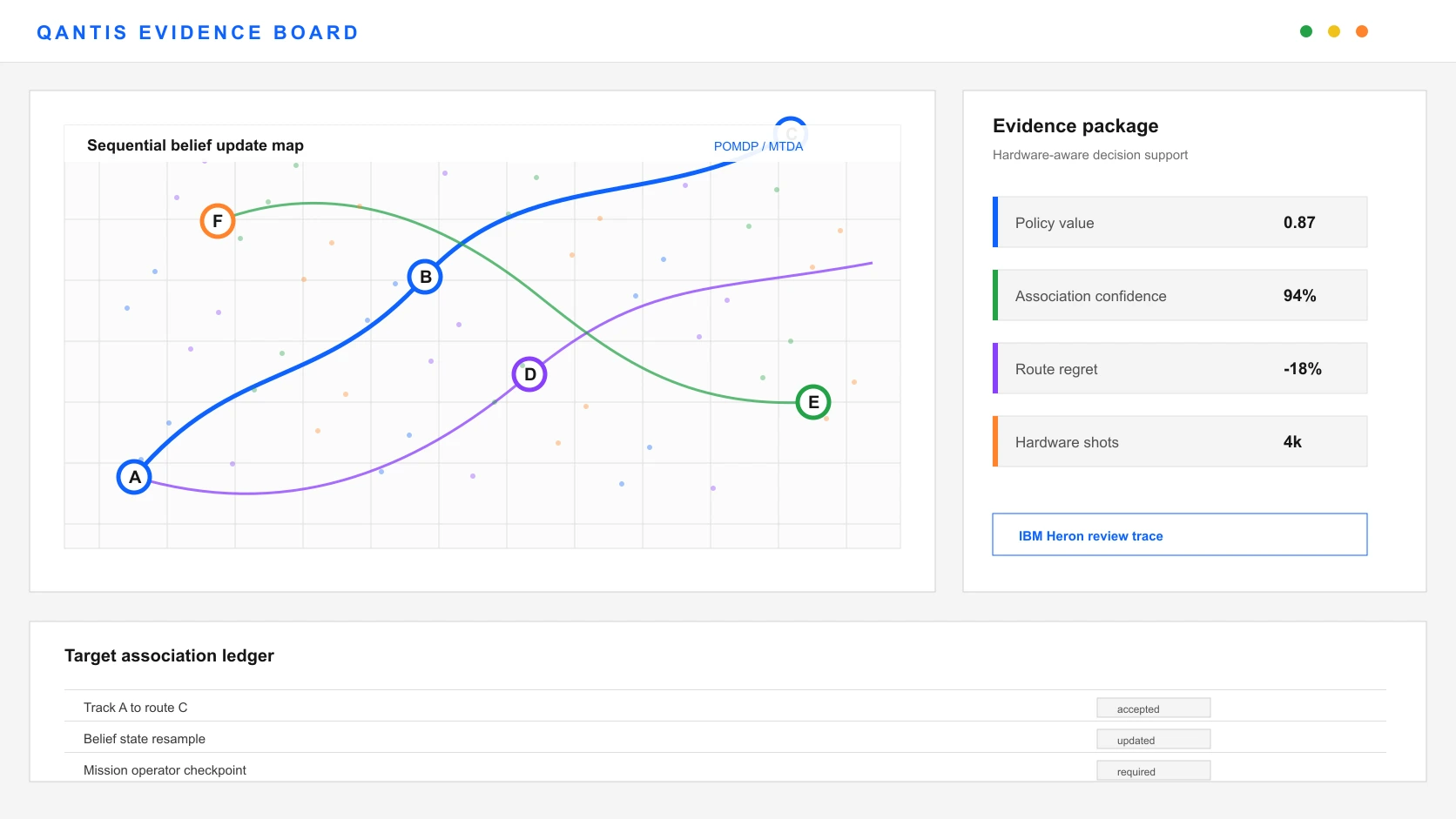
QFlow is the user-facing workspace for experiments, assumptions, providers, backends, costs, and review notes. qmesh is the substrate for manifests, intermediate representation, adapter context, and reproducibility. QANTIS is where uncertainty becomes a decision signal instead of a decorative score.
This evidence model is more useful than a generic quantum-AI claim because it makes experiments reviewable before roadmap or procurement decisions.
Baseline-free demos, resource amnesia, and detached decisions.
The most common failure is the baseline-free demo. A quantum or hybrid result is presented against a weak or unstated classical method, the comparison looks favorable, and the record contains nothing a reviewer can reproduce. The operating record blocks this by requiring the classical baseline and the value threshold in the frame lane before execution starts.
The second failure is resource amnesia. A simulator result is reported without the logical resources, runtime, and error budget the same computation would need on hardware, so the crossover state is unknowable. Keeping the fault-tolerant estimate in the record even at simulator stage is the direct countermeasure.
The third failure is interpretation leakage. AI-assisted analysis is blended into the execution evidence, and a model's reading of the data becomes indistinguishable from what the backend actually produced. The record must keep the two layers separate so each can be audited on its own terms.
The last failure is decision detachment. Experiments accumulate, none of them are tied to an investment gate, and the program cannot say which result changed what. Every entry in the record should end with a decision field, even when the decision is to do nothing.
- Baseline-free demo: a favorable comparison against a weak or unstated classical method.
- Resource amnesia: simulator results reported without logical resources, runtime, or error budget.
- Interpretation leakage: AI analysis blended into execution evidence.
- Decision detachment: experiments that feed no investment gate.
Capture objectives, execution context, and decision gates in order.
Instrument the frame lane before anything else. The objective, the classical baseline, the error tolerance, and the value threshold cost nothing to record and determine whether every later measurement means anything. A program that starts logging circuits before it logs objectives will produce data it cannot interpret.
Instrument execution metadata second. Backend identity, compilation settings, resource estimates, and cost are cheap to capture at run time and nearly impossible to reconstruct later. This is where a substrate like qmesh earns its place: manifests and intermediate representation preserve the context a provider or adapter would otherwise discard.
Instrument uncertainty and decisions last, but do not skip them. Uncertainty only matters once it is attached to an action, which is the point at which QANTIS-style decision evidence becomes useful. Reviewer notes and the investment gate close the loop and turn a pile of runs into an operating record.
The next twelve months reward record keepers.
The public roadmap signals point in one direction. IBM's 2026 material emphasizes verification, debugging, and developer tooling on the way to fault-tolerant systems. Google Quantum AI frames a path from error suppression to useful error-corrected computation. Neither signal promises near-term advantage for a specific enterprise workload.
What the signals do change is the cost of re-evaluation. As hardware and tooling move, a program with a crossover map re-runs the comparison against the same objective and updates the crossover state in one record. A program without one re-litigates the entire question from scratch each time a vendor announcement lands.
The practical posture for the coming year is unglamorous. Keep baselines current, keep resource estimates honest, keep negative results filed, and keep the decision field populated. When a roadmap milestone actually shifts the economics of a workload, the evidence needed to act on it will already exist.
Operational checklist
Program checklist: standing up a reviewable quantum AI effort
Derived from the article's takeaways. Each item maps to a field in the operating record across framing, execution, and decision.
- 01
Define the business or science objective, error tolerance, and value threshold before any quantum run.
- 02
Establish the strongest available classical baseline and keep it in the same record as every quantum result.
- 03
Build a decision-level crossover map: classical, quantum-inspired, simulator, noisy hardware, and fault-tolerant estimate against one objective.
- 04
Record data loading, compilation, logical resources, runtime, error budget, cost, and repeatability for each experiment.
- 05
Keep resource estimates visible even when the first run is only a simulator.
- 06
Separate AI-assisted interpretation from quantum execution evidence in the record.
- 07
Record negative results as evidence and attach them to the crossover map.
- 08
Attach every result to a decision: what changed, who reviewed it, and which investment gate it feeds.
- 09
Track IBM and Google Quantum AI roadmap milestones as inputs to crossover assumptions, not as advantage claims.
Practical takeaways
01
Quantum AI needs baselines, resource estimates, and decision impact in one record.
02
The near-term value is readiness and evidence, not broad acceleration claims.
03
QFlow can own the experiment workspace; qmesh can preserve provenance.
04
QANTIS becomes useful when uncertainty affects an action or investment gate.
RA · Reference annexDefinitions, recurring questions, editorial method, and primary sources.Inspect
The analysis above carries the main reading flow. This reference layer keeps terminology, recurring questions, editorial method, and primary sources available without interrupting the argument.
Terminology
Terms behind Quantum–AI evaluation: baselines, resource estimates, and decision gates..
- Crossover map
- A single comparison of classical, quantum-inspired, simulator, noisy hardware, and fault-tolerant approaches against the same objective, including resources, cost, and decision consequence. It shows where, if anywhere, a quantum method plausibly overtakes the classical baseline.
- Fault-tolerant quantum computation (FTQC)
- Quantum computation that uses error correction to run reliably despite hardware noise. Vendor roadmaps from IBM and Google Quantum AI treat it as the target state for useful, large-scale quantum work.
- Hybrid quantum-classical workflow
- An experiment that spans CPUs, GPUs, simulators, and quantum processors in one pipeline, with classical resources handling most of the computation. CUDA-Q style tooling exists because this is how serious quantum experiments already run.
- Classical baseline
- The strongest available conventional method for the same objective, recorded alongside the quantum result. Without it, an advantage claim cannot be evaluated.
- Resource estimate
- A projection of the logical resources, runtime, and error budget a computation would need at target scale. Keeping it visible even at simulator stage is what makes the crossover state assessable.
- Error budget
- The amount of noise and computational error a result can absorb before it stops supporting the decision it feeds. It is set from the error tolerance defined during problem framing.
- Intermediate representation (IR)
- A structured, tool-neutral encoding of a quantum program between the authoring framework and the backend. Preserving it, as qmesh does with its typed IR and manifests, is what makes an experiment reproducible later.
- QPU
- Quantum processing unit, the quantum hardware component in a hybrid workflow alongside CPUs, GPUs, and simulators.
Field questions
Program questions behind Quantum–AI evaluation: baselines, resource estimates, and decision gates..
Q01Should we fund quantum AI work now or wait for fault-tolerant hardware?
The near-term value is readiness and evidence, not acceleration claims. IBM's June 2026 investment signal and Google Quantum AI's roadmap toward error-corrected computation justify enterprise tracking now. The practical move is to fund a decision-level crossover map that includes a fault-tolerant estimate, so the investment gate is already defined when hardware matures.
Q02What is a decision-level crossover map?
It is a single comparison of a classical method, a quantum-inspired method, a simulator result, a noisy hardware result, and a fault-tolerant estimate against the same objective. It records data loading, compilation, logical resources, runtime, error budget, cost, repeatability, and the business or scientific consequence of the result. Its purpose is to tell leadership where quantum plausibly crosses over and what to fund.
Q03How can we tell whether a quantum AI advantage claim is credible?
A credible claim shows exactly what was compared, what resources were assumed, and which downstream decision changed. Treat every claim as provisional until the classical baseline is stronger than the demo. A program that records negative results as evidence is more trustworthy than one that only reports wins.
Q04Why should AI-assisted interpretation be kept separate from quantum execution evidence?
Because the two layers fail differently. Execution evidence covers the circuit or Hamiltonian, the backend metadata, and the resource estimate, while AI-assisted analysis is a layer on top that can introduce its own errors. Keeping them separate in one record lets reviewers audit each independently and prevents an interpretation mistake from contaminating the hardware evidence.
Q05How do QFlow Studio, qmesh, and QANTIS divide the work in a quantum AI program?
QFlow Studio is the user-facing workspace for experiments, assumptions, providers, backends, costs, and review notes. qmesh is the substrate underneath: manifests, intermediate representation, adapter context, and reproducibility, and it composes with Qiskit, Cirq, and PennyLane rather than replacing them. QANTIS sits at the decision layer, where uncertainty becomes a signal that gates an action or investment instead of a decorative score.
Q06Do we need quantum hardware access before starting a quantum AI program?
No. Serious experiments already span CPUs, GPUs, simulators, and QPUs, which is the operational reality that CUDA-Q style tooling reflects. The guidance is to keep resource estimates visible even when the first run is only a simulator, so simulator-stage work still produces decision-grade evidence.
Editorial record
How Quantum–AI evaluation: baselines, resource estimates, and decision gates. was checked.
- Editorial owner
- Neura Parse Research
- Last verified
- July 12, 2026
- Method
- Synthesis of the dated primary and official records listed below, checked against the operating question in this note.
- Scope limit
- Planning analysis—not certification, customer performance evidence, procurement advice, or a claim of production readiness.
SRSources reviewed
5 records