The practical gap is not knowing that quantum risk exists. It is proving which systems depend on vulnerable cryptography, which replacement standards apply, where QKD is actually justified, and how every migration decision will be audited later.
Gap map
Quantum-safe gap map
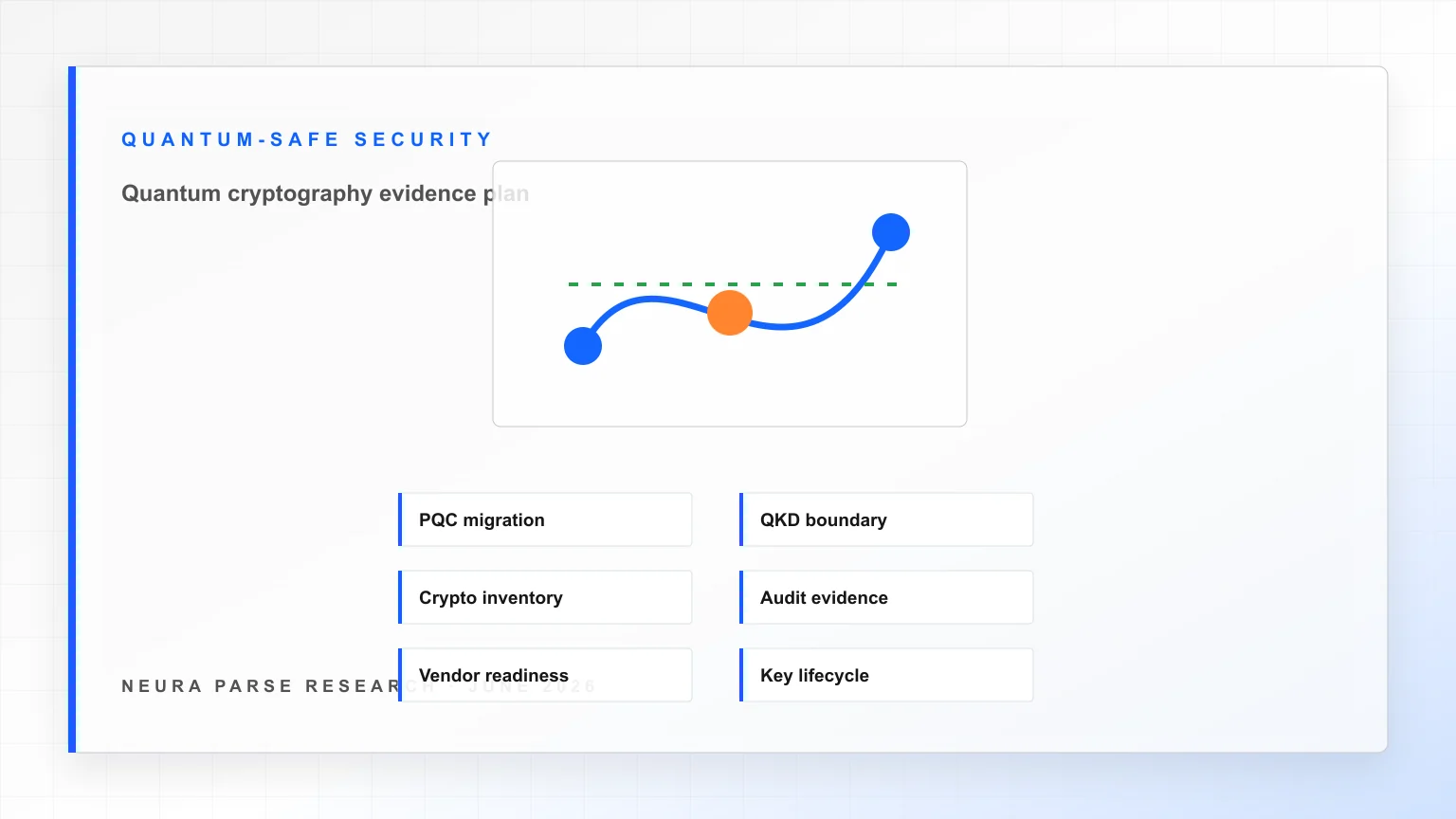
PQC, QKD, inventory, key lifecycle, and audit evidence need to be treated as one migration surface.
Policy pressure
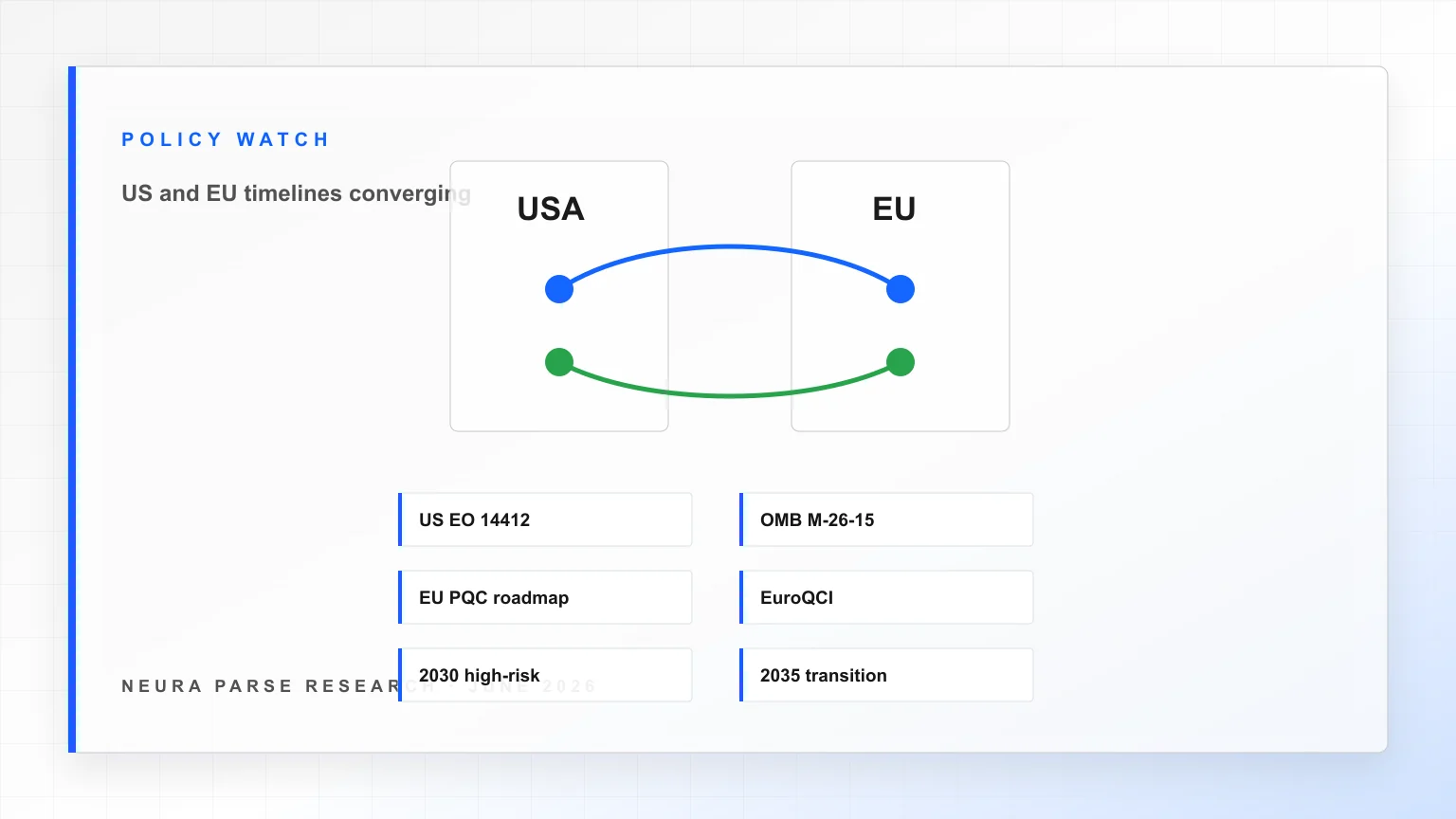
- U.S. EO 14412
- OMB M-26-15
- EU PQC roadmap
- CISA product categories
Technical migration
- Crypto inventory
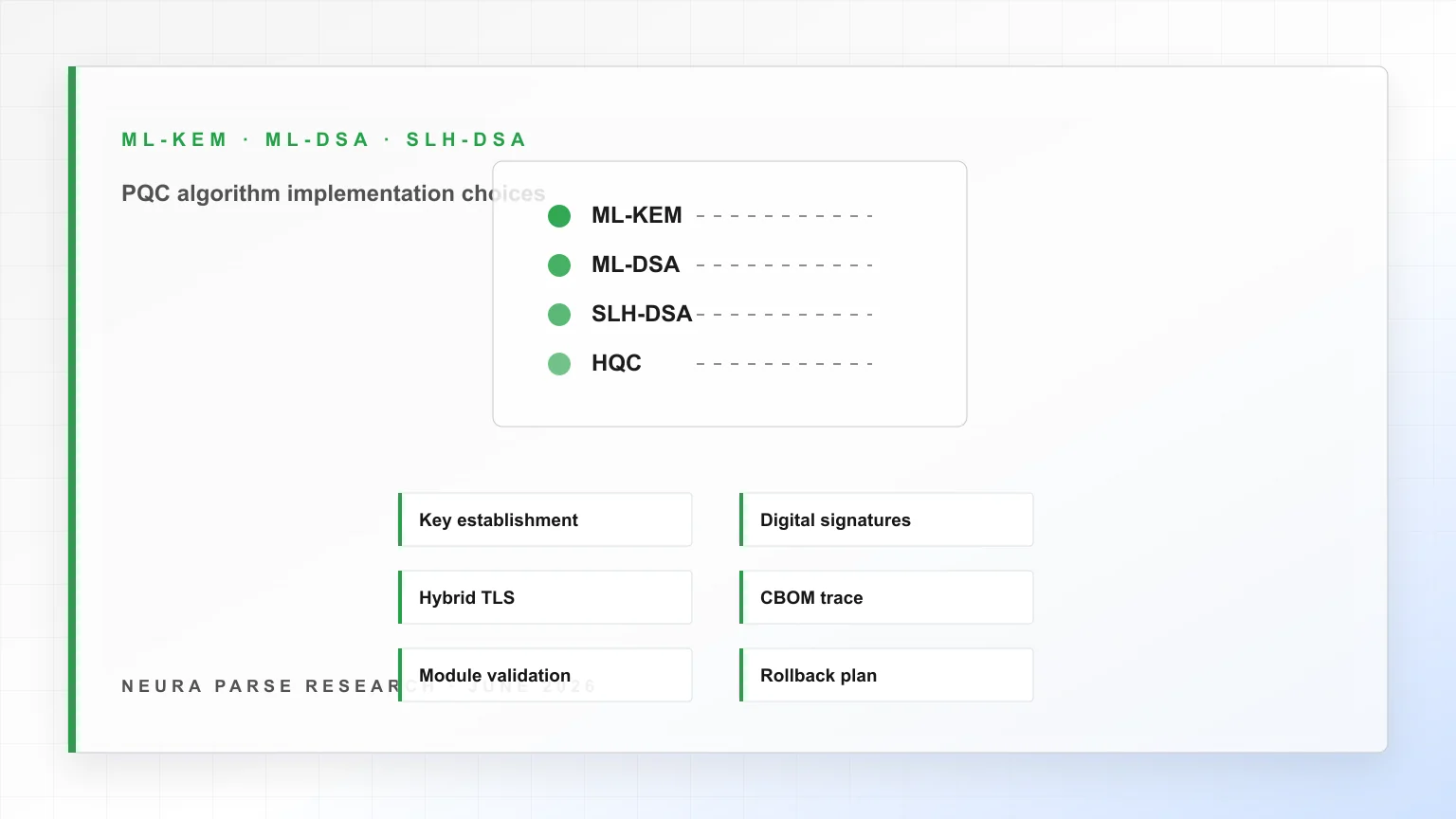
- ML-KEM and signatures
- Hybrid TLS tests
- QKD only where link economics justify it
Neura Parse service angle
- NowFlow migration control room
- QFlow evidence records
- Vendor readiness scoring
- Audit-ready decision trail
June 2026 signal
Quantum-safe security moved from warning to execution.
The June 2026 policy surface is unusually clear. The White House executive order on advanced cryptographic attacks and OMB M-26-15 move U.S. federal agencies toward execution planning for post-quantum cryptography. CISA's product-category guidance gives buyers a practical lens for finding software and hardware that depend on public-key cryptography.
Europe is also moving from principle to roadmap. The NIS Cooperation Group roadmap, supported by the European Commission, creates a synchronized transition path for Member States, while EuroQCI keeps a separate quantum-communication track for infrastructure where physics-based secure links may be justified.
That combination matters. The enterprise question is no longer whether quantum-safe cryptography should be considered. It is how to inventory dependencies, prioritize high-risk systems, test standards, coordinate vendors, and preserve evidence that the transition was controlled.
Terminology
Do not collapse PQC and QKD into the same promise.
Quantum cryptography is often used loosely. For enterprise planning, the useful split is sharper. Post-quantum cryptography is a standards and software migration path: algorithms designed to resist quantum attacks while running on classical computers. Quantum key distribution is a physical-layer communication approach that can be valuable in narrow high-assurance links but is not a general replacement for internet-scale cryptographic migration.
A serious Neura Parse service page should therefore avoid selling QKD as a universal answer. The credible offer is crypto-agility: inventory, algorithm selection, hybrid rollout, vendor validation, policy gates, and evidence retention. QKD can be assessed as a specialized option when link budget, geography, physical control, and compliance value justify it.
- PQC belongs in software, firmware, TLS, VPN, signing, PKI, device identity, and supply-chain validation plans.
- QKD belongs in constrained link assessments where physical infrastructure, trust model, and operational cost can be defended.
- Crypto-agility is the architectural ability to rotate algorithms, certificates, libraries, and policies without rewriting the whole system.
- Evidence is the missing product layer: every migration decision needs owner, source, risk, test state, fallback, and approval status.
Operating model
The migration control room is the product gap.
Most organizations will not fail because they cannot name ML-KEM. They will fail because cryptographic usage is scattered across applications, devices, SaaS contracts, embedded firmware, certificate authorities, VPN gateways, message queues, databases, and partner APIs.
The useful product is a migration control room: discover cryptographic assets, classify risk, assign owners, request vendor attestations, run staged tests, approve cutovers, and export an evidence pack for security, legal, and procurement review.
quantum_safe_readiness = inventory_coverage x algorithm_fit x vendor_status x test_evidence x rollback_confidenceService wedge
Start with the systems that create future liability.
The first delivery wedge should not be a generic PQC workshop. It should be a scoped assessment for long-lived data, identity systems, signing infrastructure, device fleets, regulated customer data, and third-party dependencies that are expensive to update later.
A credible first phase can produce an asset map, a PQC impact score, vendor outreach pack, algorithm decision register, pilot migration candidates, and a board-level timeline aligned to U.S. and EU policy pressure.
- Map harvest-now-decrypt-later exposure and long confidentiality lifetimes.
- Separate key establishment, digital signatures, code signing, device identity, and archival verification.
- Track libraries and vendor products against CISA categories and NIST standards.
- Run pilots with hybrid modes before changing production trust anchors.
Practical takeaways
The 2026 quantum cryptography gap is migration evidence, not awareness.
PQC is the general enterprise path; QKD is a specialized infrastructure assessment.
Crypto-agility requires workflow, ownership, vendor evidence, and rollback paths.
NowFlow can coordinate migration work while QFlow stores evidence and source context.
A strong service offer starts with inventory, high-risk systems, and board-ready execution planning.
Sources reviewed
Source 01
White House EO 14412: Securing the Nation Against Advanced Cryptographic Attacks
June 2026 U.S. executive order accelerating federal migration to quantum-resistant cryptography.
Source 02
OMB M-26-15: Execution of the Migration to Post-Quantum Cryptography
June 2026 federal execution memo for post-quantum cryptography migration planning and reporting.
Source 03
NIST finalized post-quantum cryptography standards
FIPS 203, 204, and 205 establish the first finalized U.S. PQC standards.
Source 04
CISA product categories for post-quantum cryptography adoption
January 2026 guidance for hardware and software categories that use or transition to PQC standards.
Source 05
EU coordinated roadmap for transition to post-quantum cryptography
June 2026 NIS Cooperation Group roadmap for synchronized PQC transition across EU Member States.
Source 06
European Quantum Communication Infrastructure (EuroQCI)
European Commission programme for terrestrial and space-based quantum communication infrastructure.