
Abstract
The useful 2026 question is where each algorithm family belongs, how transition modes are tested, and how a production system can rotate without breaking trust anchors, certificates, firmware, or customer-facing services.
Gap map
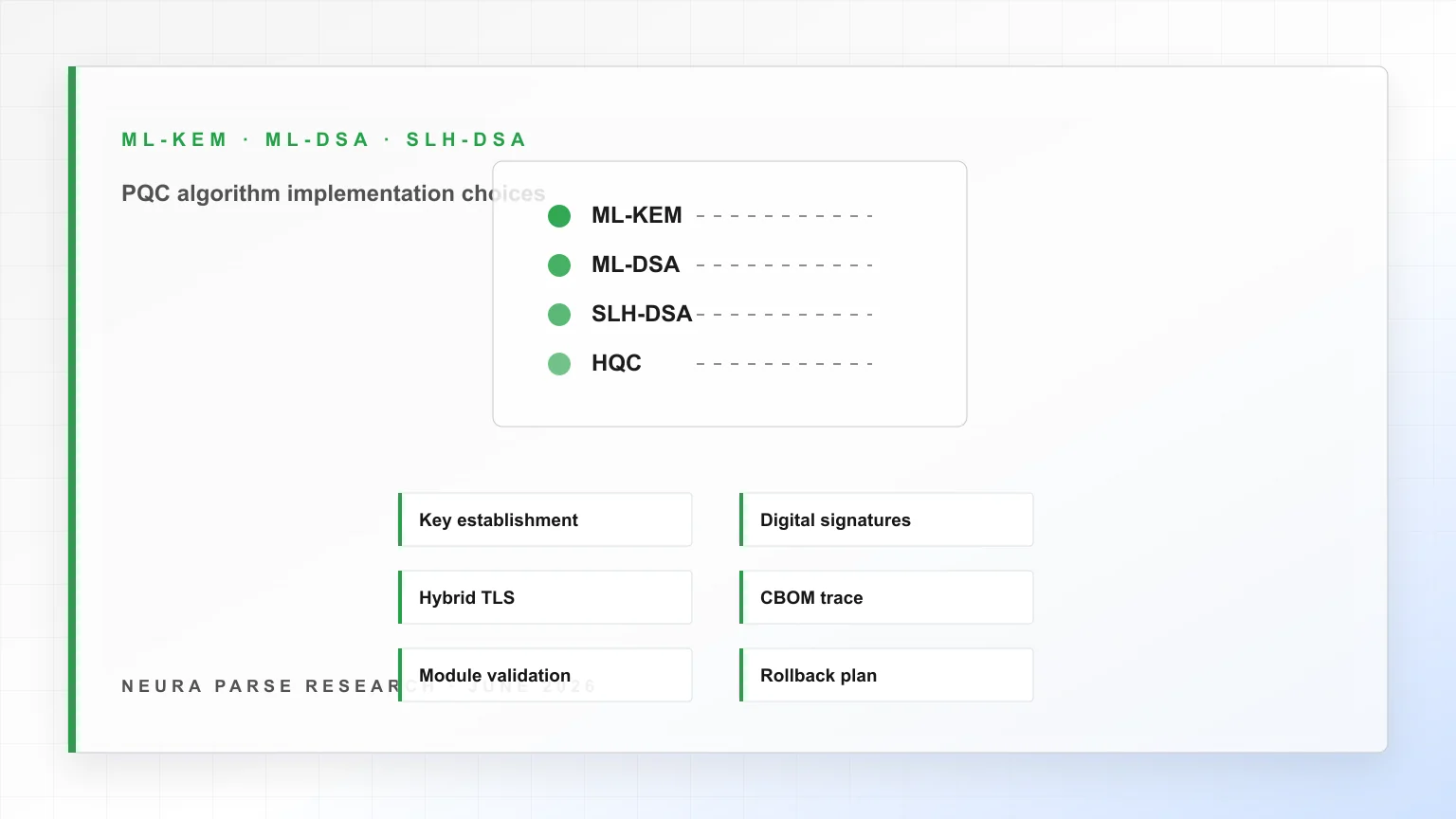
Algorithm placement map
Each PQC family belongs to a different production surface and evidence requirement.
Key establishment
- ML-KEM
- Protocol-specific transition pilots
- Session key negotiation
- Performance and fallback tests
Signatures
- ML-DSA
- SLH-DSA
- Code signing and firmware
- Certificate and document workflows
Evidence layer
- Deployment-map coverage
- Module validation state
- Vendor attestation
- Rollback and revocation plan
The standards now map to deployment choices.
FIPS 203 standardizes ML-KEM for key establishment. That makes it the default starting point for many migration plans because protocols such as TLS, VPN, service-to-service encryption, and secure device onboarding depend on key exchange or encapsulation patterns.
FIPS 204 standardizes ML-DSA and FIPS 205 standardizes SLH-DSA for digital signatures. Those signatures affect a different set of surfaces: code signing, firmware updates, certificate issuance, document signing, audit records, and long-term verification.
NIST's additional selection of HQC as a backup encryption algorithm is a reminder that a migration plan should avoid monoculture. The point is not to chase every candidate at once. The point is to keep an architecture that can rotate when standards and validation states evolve.
TD · Technical depth6 supporting chapters and the working checklist.Read deeper
Map each algorithm family to the cryptographic function it can replace.
Choosing ML-KEM because it is final does not show where it belongs. For each in-scope transaction, first identify whether the cryptographic function is key establishment or a digital signature; then map the protocol, termination points, certificate or signing path, implementation provider, performance constraints, fallback, and replacement boundary.
Keep this placement map deliberately separate from the estate-wide discovery record. The companion cryptographic inventory and CBOM guide owns discovery coverage, field definitions, supplier records, and closure states; this guide owns algorithm role, deployment fit, and the evidence needed to choose among ML-KEM, ML-DSA, SLH-DSA, and future alternatives.
- ML-KEM belongs on key-establishment paths whose surrounding protocol supports it.
- ML-DSA and SLH-DSA belong on signature paths with compatible PKI, firmware, document, or code-signing lifecycles.
- Track HQC as a selected future KEM, not as a final interchangeable deployment target.
- Tie every algorithm choice to validation, interoperability, rollback, revocation, and customer-impact evidence.
Use workflows to make algorithm migration reviewable.
PQC implementation is workflow-heavy. It needs asset owners, security architects, infrastructure teams, application teams, procurement, legal, and vendor managers to work from the same evidence base.
NowFlow can model the migration as a governed operating process: discover asset, assign owner, collect vendor response, choose algorithm path, test hybrid mode, approve cutover, monitor errors, and archive evidence. QFlow can keep standards references, experiment records, and decision evidence attached to the same migration object.
Pilot by trust boundary, not by department.
A useful pilot should cover a complete trust boundary: one internet-facing endpoint, one service-to-service channel, one device or firmware signing path, one internal PKI dependency, and one vendor-managed surface. That gives the team a realistic view of performance, support, monitoring, and rollback.
The pilot should also produce reusable artifacts: a test plan, compatibility matrix, performance baseline, vendor support statement, exception process, rollback evidence, and decision record.
Algorithm-only plans hide fallback, firmware, and validation risk.
The most common failure is treating the algorithm decision as the finish line. FIPS 203, 204, and 205 name the destinations, but production risk lives in the surfaces the standards do not see: load balancers that terminate TLS with their own libraries, embedded firmware whose signature scheme cannot change in the field, backup tools that re-encrypt with defaults nobody reviewed. A plan that only tracks algorithm names will report success while these surfaces stay classical.
Silent fallback is the second failure. A hybrid endpoint that quietly negotiates down to a classical-only exchange looks identical to a working deployment unless negotiated parameters are recorded per session. Performance and fallback tests during the pilot exist to surface exactly this behavior before it reaches a customer-facing service.
Validation lag is the third. An algorithm can be standardized while a specific implementation's module validation state trails behind, and a CBOM that does not track validation state per module will not catch the gap. HQC exists as a backup selection for the same reason: the standards process itself assumes rotation, so an architecture that cannot rotate is already out of alignment.
- Hybrid endpoints that silently fall back to classical-only negotiation.
- Firmware signing paths that cannot rotate keys or algorithms after deployment.
- Modules whose validation state lags the standard they claim to implement.
- Vendor dependencies with no attestation and no stated migration path.
- Cutovers approved without a rollback, revocation, or customer-impact plan.
Measure negotiated algorithms, signature failures, and rollback readiness.
Instrument the negotiation layer before any cutover. For every internet-facing endpoint and service-to-service channel in the pilot, record which key-establishment algorithm was actually negotiated per session, not which one was configured. Fallback events, handshake failures, and latency deltas are the earliest signals that a hybrid mode is not yet production-ready on a given surface.
Instrument the signature surfaces next. Code signing, firmware update, and certificate issuance paths need error monitoring through and after cutover, because verification failures on long-lived artifacts surface late and are expensive to unwind. The rollback and revocation plan is only credible if these paths report failures fast enough to trigger it.
Instrument the evidence layer last but design it first. Every test result, vendor response, and approval should attach to the migration object it concerns rather than scatter across inboxes. In the Neura Parse pattern, NowFlow carries the owners and approval gates while QFlow Studio holds the standards references and test evidence, so the audit trail forms as a side effect of doing the work.
How to evaluate vendors against the standards.
The vendor questionnaire produced by the pilot is the main instrument. It should ask which FIPS 203, 204, and 205 algorithms each product supports, what the module validation state is, whether hybrid modes are available, and what the stated migration path is for the surfaces the vendor controls. Answers should land as CBOM entries with owners and dates, not as attachments in a shared drive.
CISA's product categories for post-quantum cryptography adoption give programs a shared vocabulary for that conversation. Grouping vendor-managed surfaces by product category makes gaps comparable across suppliers and keeps the assessment anchored to public guidance rather than to vendor positioning.
Treat rotation capability as a first-class criterion. A supplier that supports ML-KEM today but has no path to HQC or a future selection binds the program to the monoculture the standards process explicitly hedged against. The evidence to request is attestation of current state plus a stated path for the next transition, tied to the same migration object as everything else.
Operational checklist
Program checklist: PQC algorithm migration
Concrete actions for a program adopting FIPS 203, 204, and 205. Each item should leave an auditable artifact behind.
- 01
Build a cryptographic bill of materials that records library, protocol, algorithm, key length, certificate path, owner, data sensitivity, vendor dependency, and validation state per asset.
- 02
Separate discovery, assessment, implementation, validation, and decommissioning states so migration progress is measurable.
- 03
Map ML-KEM to key-establishment surfaces: TLS, VPN, service-to-service encryption, and secure device onboarding.
- 04
Map ML-DSA and SLH-DSA to signature surfaces: code signing, firmware updates, certificate issuance, document signing, and long-term verification.
- 05
Track HQC as a backup encryption path and verify the architecture can rotate algorithms without redesign.
- 06
Scope the first pilot to one complete trust boundary: an internet-facing endpoint, a service-to-service channel, a firmware signing path, an internal PKI dependency, and a vendor-managed surface.
- 07
Tie every production change to a rollback, revocation, and customer-impact plan before approving cutover.
- 08
Collect vendor attestation and module validation state for every dependency in the CBOM.
- 09
Produce reusable pilot artifacts: test plan, CBOM schema, vendor questionnaire, exception process, risk scorecard, and executive reporting template.
- 10
Run the migration through governed workflows with named owners, approval gates, and archived evidence.
Practical takeaways
01
ML-KEM is the main key-establishment path, but signatures and validation are separate workstreams.
02
Map every algorithm choice to a cryptographic function and complete trust boundary.
03
Transition-mode tests should be tied to trust boundaries and rollback plans.
04
NowFlow can coordinate work across owners, vendors, and approval gates.
05
QFlow can store standard references, test evidence, and migration decisions.
RA · Reference annexDefinitions, recurring questions, editorial method, and primary sources.Inspect
The analysis above carries the main reading flow. This reference layer keeps terminology, recurring questions, editorial method, and primary sources available without interrupting the argument.
Terminology
Terms behind Post-quantum cryptography: where ML-KEM, ML-DSA, SLH-DSA, and HQC fit..
- ML-KEM
- The module-lattice key-encapsulation mechanism standardized in NIST FIPS 203. It lets two systems establish a shared secret key in a way designed to resist attack by quantum computers, which is why it anchors TLS, VPN, and device onboarding migrations.
- ML-DSA
- The module-lattice digital signature algorithm standardized in NIST FIPS 204. It is used to prove that code, firmware, certificates, or documents came from the stated signer and were not altered.
- SLH-DSA
- The stateless hash-based digital signature algorithm standardized in NIST FIPS 205. It rests on a different mathematical basis than ML-DSA, which matters for long-term verification and for avoiding dependence on a single algorithm family.
- HQC
- An encryption algorithm NIST selected as an additional backup for post-quantum key establishment. Its role is to ensure a migration does not depend on one algorithm family and can rotate if circumstances change.
- CBOM
- Cryptographic bill of materials. A structured inventory recording where cryptography is used across an organization, including library, protocol, algorithm, key length, certificate path, owner, vendor dependency, and validation state per asset.
- Hybrid mode
- A protocol configuration, such as hybrid TLS, that runs a classical algorithm and a post-quantum algorithm together during the transition. It lets teams test the new algorithm in production while keeping existing protections and a rollback path.
- Trust boundary
- The line where one system stops implicitly trusting another and cryptography enforces the separation, such as an internet-facing endpoint or a firmware signing path. The article recommends scoping pilots to one complete trust boundary rather than to a department.
- Module validation
- The formal status showing whether a specific cryptographic implementation has been checked against the standard it claims to implement. An algorithm can be standardized while a given module's validation state still lags, so the state must be tracked per module.
Field questions
Program questions behind Post-quantum cryptography: where ML-KEM, ML-DSA, SLH-DSA, and HQC fit..
Q01Should we deploy ML-KEM before we address digital signatures?
ML-KEM under FIPS 203 is the default starting point for most migration plans because TLS, VPN, service-to-service encryption, and secure device onboarding all depend on key exchange or encapsulation patterns. Signatures under FIPS 204 and FIPS 205 affect a different set of surfaces, including code signing, firmware updates, certificate issuance, and long-term verification, and should run as a separate workstream. Sequencing one first does not remove the need for the other.
Q02Why did NIST select HQC when ML-KEM is already standardized?
NIST selected HQC as an additional backup algorithm for post-quantum encryption. The purpose is to avoid algorithm monoculture: a migration plan should keep an architecture that can rotate to a different algorithm when standards and validation states evolve. Programs do not need to deploy every candidate at once, they need to preserve the ability to switch.
Q03What should a cryptographic bill of materials actually record?
For each asset it should identify the library, protocol, algorithm, key length, certificate path, owner, data sensitivity, vendor dependency, validation state, and expected migration path. It should be maintained as a living operating record with separate discovery, assessment, implementation, validation, and decommissioning states, not as a static spreadsheet.
Q04How should we scope a first post-quantum pilot?
Pilot by trust boundary, not by department. A useful pilot covers one internet-facing endpoint, one service-to-service channel, one device or firmware signing path, one internal PKI dependency, and one vendor-managed surface. That gives the team a realistic view of performance, support, monitoring, and rollback, and it should produce reusable artifacts such as a test plan, a CBOM schema, a vendor questionnaire, an exception process, a risk scorecard, and an executive reporting template.
Q05Where do hybrid modes fit, and what should gate a hybrid cutover?
Hybrid TLS or VPN pilots let teams exercise post-quantum key establishment alongside existing session key negotiation, with performance and fallback tests. The inventory should track where hybrid modes are possible and where protocol support is not yet production-ready. Every production change should be tied to a rollback, revocation, and customer-impact plan before cutover is approved.
Q06How does Neura Parse support this kind of migration?
NowFlow, an agentic workflow platform, can model the migration as a governed operating process: discover asset, assign owner, collect vendor response, choose algorithm path, test hybrid mode, approve cutover, monitor errors, and archive evidence. QFlow Studio keeps standards references, experiment records, and decision evidence attached to the same migration object. The quantum-safe security service covers cryptographic inventory, post-quantum migration planning, vendor evidence, and audit-ready migration records.
Editorial record
How Post-quantum cryptography: where ML-KEM, ML-DSA, SLH-DSA, and HQC fit. was checked.
- Editorial owner
- Neura Parse Research
- Last verified
- July 20, 2026
- Method
- Synthesis of the dated primary and official records listed below, checked against the operating question in this note.
- Scope limit
- Planning analysis—not certification, customer performance evidence, procurement advice, or a claim of production readiness.
SRSources reviewed
5 records