Abstract
The important 2026 transatlantic pattern is not a single agreement. It is the alignment of public-sector deadlines, procurement pressure, product categories, and critical-infrastructure roadmaps around quantum-safe execution.
Gap map
Policy-to-architecture map
Transatlantic readiness turns public policy into concrete system-owner work.
United States
- EO 14412
- OMB M-26-15
- CISA product categories
- Federal inventory and migration reporting
Europe
- NIS Cooperation Group roadmap
- Member State synchronization
- EuroQCI
- Critical infrastructure focus
Enterprise response
- Cryptographic inventory
- Risk-tiered roadmap
- Vendor evidence
- Board-level reporting
Public-sector timelines are moving before every product is ready.
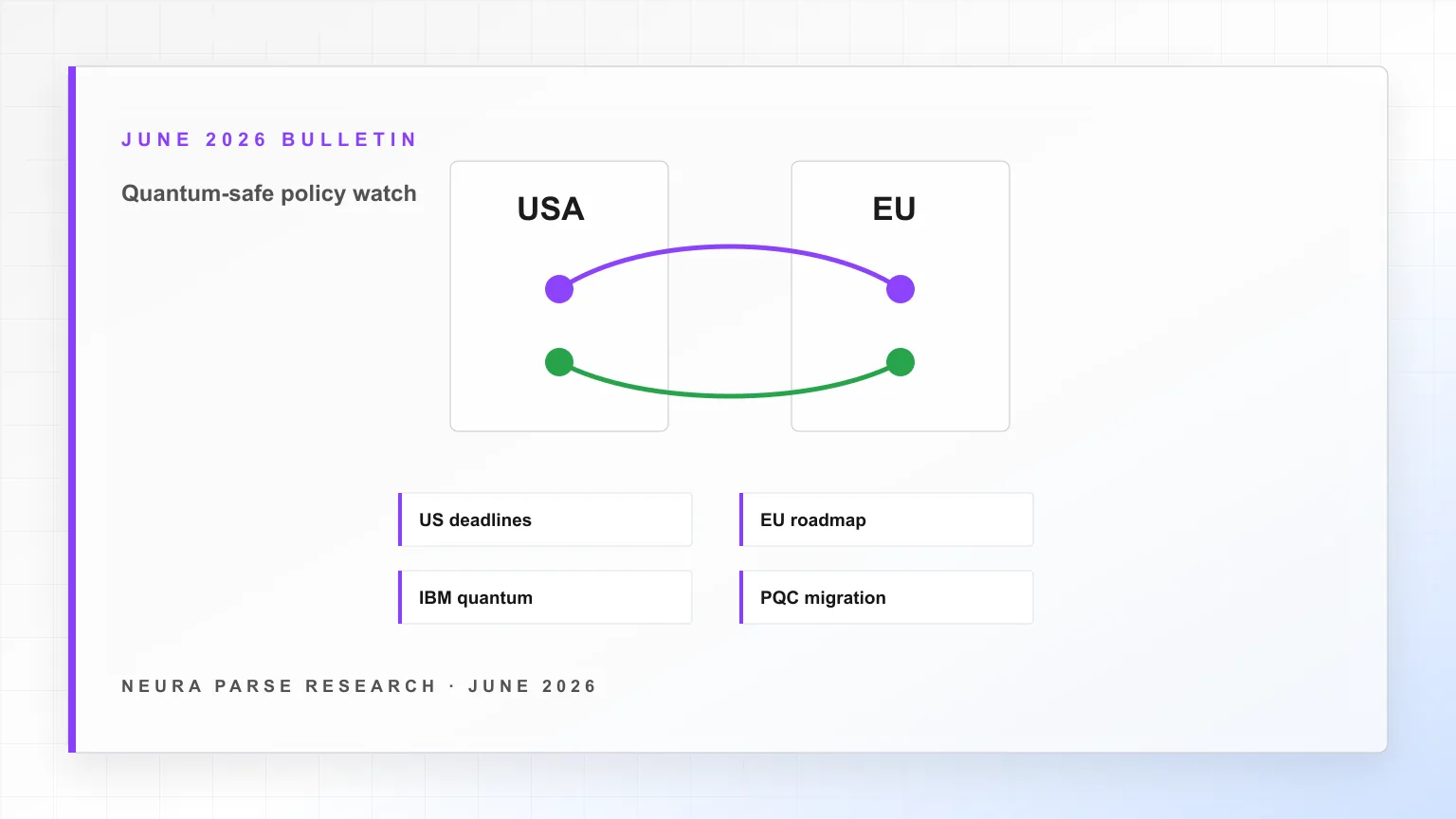
The United States is pushing federal migration from planning into execution through EO 14412 and OMB M-26-15. CISA's January 2026 product categories help buyers identify which hardware and software classes are likely to use or transition to PQC standards.
The European Union is moving through a coordinated roadmap under the NIS Cooperation Group, supported by the Commission. The roadmap creates a synchronized transition view for Member States and connects PQC to broader cybersecurity resilience.
The practical implication for companies is procurement pressure. Even if a business is not a federal agency or EU public body, customers, regulators, prime contractors, and insurers will increasingly ask for cryptographic inventory, vendor status, and migration evidence.
TD · Technical depth6 supporting chapters and the working checklist.Read deeper
Turn policy pressure into an execution surface.
A working operating surface can turn policy pressure into execution: discover systems, classify risk, attach standards, create owner workflows, request evidence, approve migration steps, and generate status views for executives and auditors.
This control layer sits between security advisory and product implementation. It links policy, architecture, vendors, tests, and evidence instead of ending with a static report.
Do not claim a transatlantic agreement where the evidence is convergence.
The 2026 evidence points to strong convergence, not one unified U.S.-EU treaty for every migration detail. U.S. and EU policy surfaces are aligning around readiness, inventory, and migration pressure, but their legal instruments, timelines, and implementation details remain distinct.
Architecture teams should use the official U.S. and EU sources to identify the concrete ownership, inventory, vendor, testing, and migration work that follows.
Failure modes to design against before the program starts.
The first failure mode is the paper inventory. A cryptographic inventory produced once for a compliance request decays as certificates rotate, libraries update, and vendors ship changes. If the inventory is not attached to owners and refresh workflows, it becomes evidence of a snapshot, not of a program. Policy pressure from OMB-style execution reporting rewards inventories that stay current, not inventories that existed once.
The second failure mode is distributed ownership with no accountable owner. Security owns policy, infrastructure owns TLS and VPN, platform owns service mesh, product teams own SDKs, and embedded teams own firmware. When a deadline arrives, each team can show local progress while the system-level migration has no owner. The fix is structural: one program, named owners per artifact class, and an exception process that surfaces gaps instead of hiding them.
The third failure mode is vendor-shaped blindness. Vendor-managed systems cannot be migrated by internal tickets. If evidence requests and renewal terms are not in place early, the program discovers late that its critical dependencies sit on vendor roadmaps it never influenced. The fourth failure mode is messaging: claiming a transatlantic mandate where the record shows convergence, or presenting QKD as a PQC substitute. Both claims collapse under audit and damage the program's credibility.
- Inventory without refresh workflows decays into a compliance artifact.
- Local team progress can mask the absence of a system-level owner.
- Vendor-managed systems need evidence requests and renewal leverage, not tickets.
- Overstating policy alignment or QKD scope invites audit findings.
- Timelines that merge standards readiness with product support hide real risk.
What to instrument first when the program stands up.
Instrument ownership before technology. The earliest useful signal is coverage: what fraction of the cryptographic estate has a named owner for certificates, protocol upgrades, library changes, key lifecycle, and signing systems. This number is cheap to compute, hard to fake, and directly answers the question executives and auditors will ask first. It also exposes the organizational boundaries the migration must cross.
Instrument vendor status second. For every vendor-managed system, track whether an evidence request has been sent, whether a response exists, and whether renewal terms reference PQC transition. CISA's product categories give this tracking a structure: they identify which hardware and software classes are likely to use or transition to PQC standards, so the program can prioritize evidence requests where standards adoption matters most.
Instrument the timeline third. A single completion percentage hides the distinctions that matter. Report standards readiness, product support, pilot success, and production cutover as separate states per system tier. High-risk and long-lived data systems should show movement first. This is the reporting shape that survives contact with board reviews, prime contractor questionnaires, and regulator requests.
The near-term trajectory follows the sources already on the table.
The direction of travel is visible in the cited record without speculation. The U.S. track moves from planning into execution through EO 14412 and OMB M-26-15, which means federal inventory and migration reporting becomes routine rather than exceptional. The EU track runs through the NIS Cooperation Group roadmap, which creates a synchronized transition view across Member States and connects PQC to broader cybersecurity resilience. Neither track requires the other to proceed, which is why convergence is the accurate word.
For enterprises, the practical consequence is that procurement pressure compounds. Each reporting cycle on the public-sector side generates questionnaires, contract clauses, and evidence requests on the private-sector side, moving through primes, regulators, and insurers. Programs that already hold a risk-tiered inventory, vendor evidence, and owner workflows answer these requests from existing artifacts. Programs that do not will build them under deadline pressure, in the least favorable order.
EuroQCI continues as an infrastructure track in parallel. The correct posture is to monitor it as European quantum communication infrastructure while keeping the PQC migration plan independent of it. Architecture teams that keep these lanes separate will produce cleaner evidence and avoid the most common audit finding: a roadmap that conflates standards migration with infrastructure research.
Operational checklist
Program checklist: quantum-safe execution under U.S. and EU policy pressure
Derived from the article's takeaways. Each item maps policy pressure to a named owner, an artifact, or a deadline.
- 01
Assign a single accountable owner for the cryptographic migration program, spanning security, infrastructure, platform, product, procurement, and embedded teams.
- 02
Build a cryptographic inventory covering certificates, protocol upgrades, library changes, key lifecycle, signing systems, and test environments.
- 03
Risk-tier the inventory and sequence high-risk and long-lived data systems before low-impact internal tools.
- 04
Map EO 14412, OMB M-26-15, CISA product categories, and the EU PQC roadmap to the specific systems and contracts they touch.
- 05
Issue vendor evidence requests for vendor-managed systems and tie PQC status to renewal terms, not only internal tickets.
- 06
Build dependency maps across equipment, orchestration, and identity layers for critical infrastructure and telecom estates.
- 07
Publish a leadership timeline that separates standards readiness, product support, pilot success, and production cutover.
- 08
Track EuroQCI and QKD as infrastructure tracks in their own lane, distinct from the PQC migration plan.
- 09
Stand up board-level reporting that presents owners, timelines, vendor status, exceptions, and evidence as auditable artifacts.
Practical takeaways
01
The 2026 policy pattern is alignment across U.S. and EU readiness signals.
02
Architecture teams need ownership, inventory, vendor evidence, and deadlines.
03
Quantum-safe readiness will increasingly affect procurement and regulated contracts.
04
EuroQCI and QKD should be discussed as infrastructure tracks, not replacements for PQC.
05
Translate policy signals into architecture, procurement, migration, and evidence work.
RA · Reference annexDefinitions, recurring questions, editorial method, and primary sources.Inspect
The analysis above carries the main reading flow. This reference layer keeps terminology, recurring questions, editorial method, and primary sources available without interrupting the argument.
Terminology
Terms behind U.S. and EU post-quantum policy: milestones architecture teams should track..
- Post-quantum cryptography (PQC)
- Cryptographic algorithms designed to resist attack by future quantum computers, standardized so they run on today's classical hardware. Migration to PQC is the core requirement behind the U.S. and EU policy moves discussed in this article.
- EO 14412
- The June 2026 U.S. executive order, Securing the Nation Against Advanced Cryptographic Attacks, which accelerates federal migration to quantum-resistant cryptography. It moves the U.S. track from planning toward execution.
- OMB M-26-15
- The June 2026 federal execution memo from the Office of Management and Budget covering post-quantum cryptography migration planning and reporting. It is the mechanism that turns policy intent into agency inventory and reporting obligations.
- CISA product categories
- January 2026 guidance from the U.S. Cybersecurity and Infrastructure Security Agency identifying which hardware and software classes are likely to use or transition to PQC standards. Buyers use the categories to structure vendor evidence requests.
- NIS Cooperation Group
- The EU body through which Member States coordinate cybersecurity work. Its June 2026 coordinated roadmap creates a synchronized post-quantum transition view across Member States, supported by the European Commission.
- EuroQCI
- The European Quantum Communication Infrastructure, a European Commission program for terrestrial and space-based quantum communication. It is an infrastructure track that runs in parallel to PQC migration, not a replacement for it.
- Quantum key distribution (QKD)
- A hardware-based technique for exchanging encryption keys over dedicated quantum links. In this article it is treated as an infrastructure track to assess for fit, not as a substitute for migrating software cryptography to PQC.
- Cryptographic inventory
- A maintained register of where cryptography lives in an organization: certificates, protocols, libraries, key lifecycle, and signing systems, each with a named owner. It is the foundational artifact that policy, procurement, and audit requests all draw on.
Field questions
Program questions behind U.S. and EU post-quantum policy: milestones architecture teams should track..
Q01Does the 2026 alignment between the U.S. and the EU on quantum-safe migration mean there is a formal transatlantic agreement?
No. The 2026 public record shows strong convergence across U.S. executive action, OMB execution planning, CISA product categories, and the EU PQC roadmap, not a single unified U.S.-EU treaty covering every migration detail. Programs should cite the official U.S. and EU sources directly and treat the alignment as readiness pressure, not as one binding instrument.
Q02My organization is not a federal agency or an EU public body. Why do EO 14412, OMB M-26-15, and the EU PQC roadmap still affect my program?
The transmission mechanism is procurement. Customers, regulators, prime contractors, and insurers will increasingly ask for cryptographic inventory, vendor status, and migration evidence, because public-sector deadlines flow down through contracts. A program that cannot produce owners, timelines, and evidence will feel the pressure in renewals and regulated bids before any direct mandate applies.
Q03How do CISA's product categories help a quantum-safe migration program in practice?
CISA's January 2026 guidance identifies which hardware and software classes are likely to use or transition to PQC standards. Buyers can use those categories to structure vendor evidence requests and to decide which parts of the estate depend on vendor roadmaps rather than internal engineering. That separates work the program controls from work it can only track and escalate.
Q04Is EuroQCI or QKD a substitute for post-quantum cryptography migration?
No. EuroQCI is a European Commission program for terrestrial and space-based quantum communication infrastructure, and QKD should be discussed as an infrastructure track. Neither replaces the PQC migration of certificates, protocols, libraries, and signing systems. Treating them as substitutes is a common messaging error that weakens a program's credibility with auditors.
Q05What evidence will auditors, primes, and executives actually expect a quantum-safe program to produce?
The converging requirement is concrete: named owners for high-risk cryptographic systems, a risk-tiered inventory, vendor status and renewal terms for vendor-managed systems, and a timeline that separates standards readiness, product support, pilot success, and production cutover. Board-level reporting should present those elements as evidence, not as narrative status updates.
Q06Where does Neura Parse fit in a quantum-safe readiness program?
Neura Parse operates a quantum-safe security and PQC migration service that inventories cryptography, plans post-quantum migration, assesses QKD fit, requests vendor evidence, and produces audit-ready migration records. It sits between security advisory and product implementation as a working control layer, with NowFlow, an agentic workflow platform, handling owner workflows and approvals, and QFlow Studio packaging reviewable evidence for quantum-safe readiness.
Editorial record
How U.S. and EU post-quantum policy: milestones architecture teams should track. was checked.
- Editorial owner
- Neura Parse Research
- Last verified
- July 12, 2026
- Method
- Synthesis of the dated primary and official records listed below, checked against the operating question in this note.
- Scope limit
- Planning analysis—not certification, customer performance evidence, procurement advice, or a claim of production readiness.
SRSources reviewed
5 records