The useful 2026 question is no longer which PQC acronyms exist. It is where each algorithm family belongs in the architecture, how hybrid modes are tested, and how teams prove that a production system can rotate safely.
Gap map
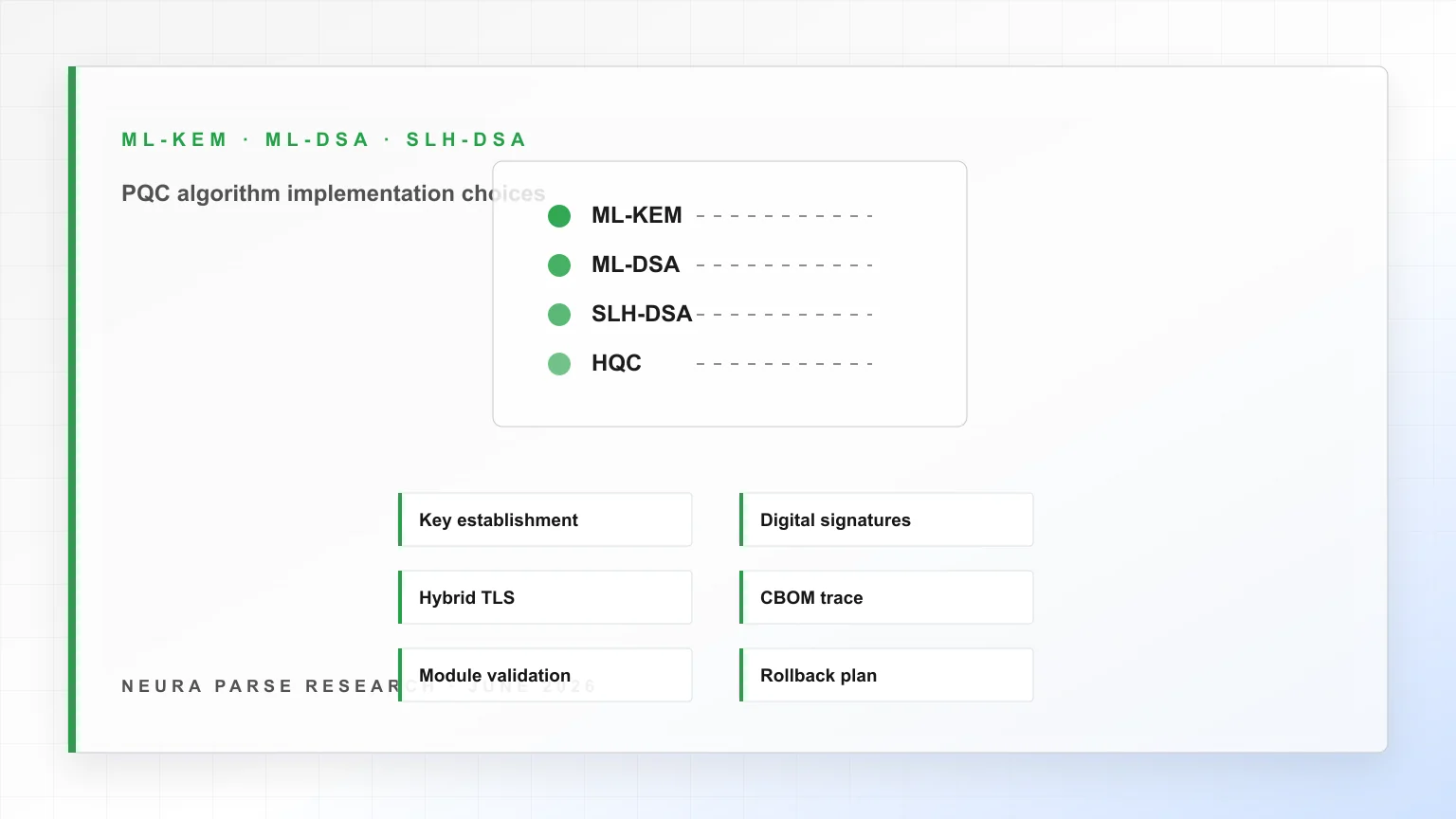
Algorithm placement map
Each PQC family belongs to a different production surface and evidence requirement.
Key establishment
- ML-KEM
- Hybrid TLS or VPN pilots
- Session key negotiation
- Performance and fallback tests
Signatures
- ML-DSA
- SLH-DSA
- Code signing and firmware
- Certificate and document workflows
Evidence layer
- CBOM coverage
- Module validation state
- Vendor attestation
- Rollback and revocation plan
Standards baseline
The algorithm names now map to product decisions.
FIPS 203 standardizes ML-KEM for key establishment. That makes it the spine of many migration plans because protocols such as TLS, VPN, service-to-service encryption, and secure device onboarding depend on key exchange or encapsulation patterns.
FIPS 204 standardizes ML-DSA and FIPS 205 standardizes SLH-DSA for digital signatures. Those signatures affect a different set of surfaces: code signing, firmware updates, certificate issuance, document signing, audit records, and long-term verification.
NIST's additional selection of HQC as a backup encryption algorithm is a reminder that a migration plan should avoid monoculture. The point is not to chase every candidate at once. The point is to keep an architecture that can rotate when standards and validation states evolve.
Implementation trap
A crypto inventory is more important than an algorithm poster.
Security teams can name the algorithms and still miss the risk. Cryptography hides in load balancers, browsers, service meshes, embedded firmware, mobile apps, SDKs, database drivers, certificate authorities, build systems, partner portals, and backup tools.
The first artifact should therefore be a cryptographic bill of materials. It should identify library, protocol, algorithm, key length, certificate path, owner, data sensitivity, vendor dependency, validation state, and expected migration path.
- Treat CBOM as a living operating record, not a static spreadsheet.
- Separate discovery, assessment, implementation, validation, and decommissioning states.
- Track where hybrid modes are possible and where protocol support is not yet production-ready.
- Tie each production change to rollback, revocation, and customer-impact plans.
Neura Parse pattern
Use workflows to make algorithm migration reviewable.
PQC implementation is workflow-heavy. It needs asset owners, security architects, infrastructure teams, application teams, procurement, legal, and vendor managers to work from the same evidence base.
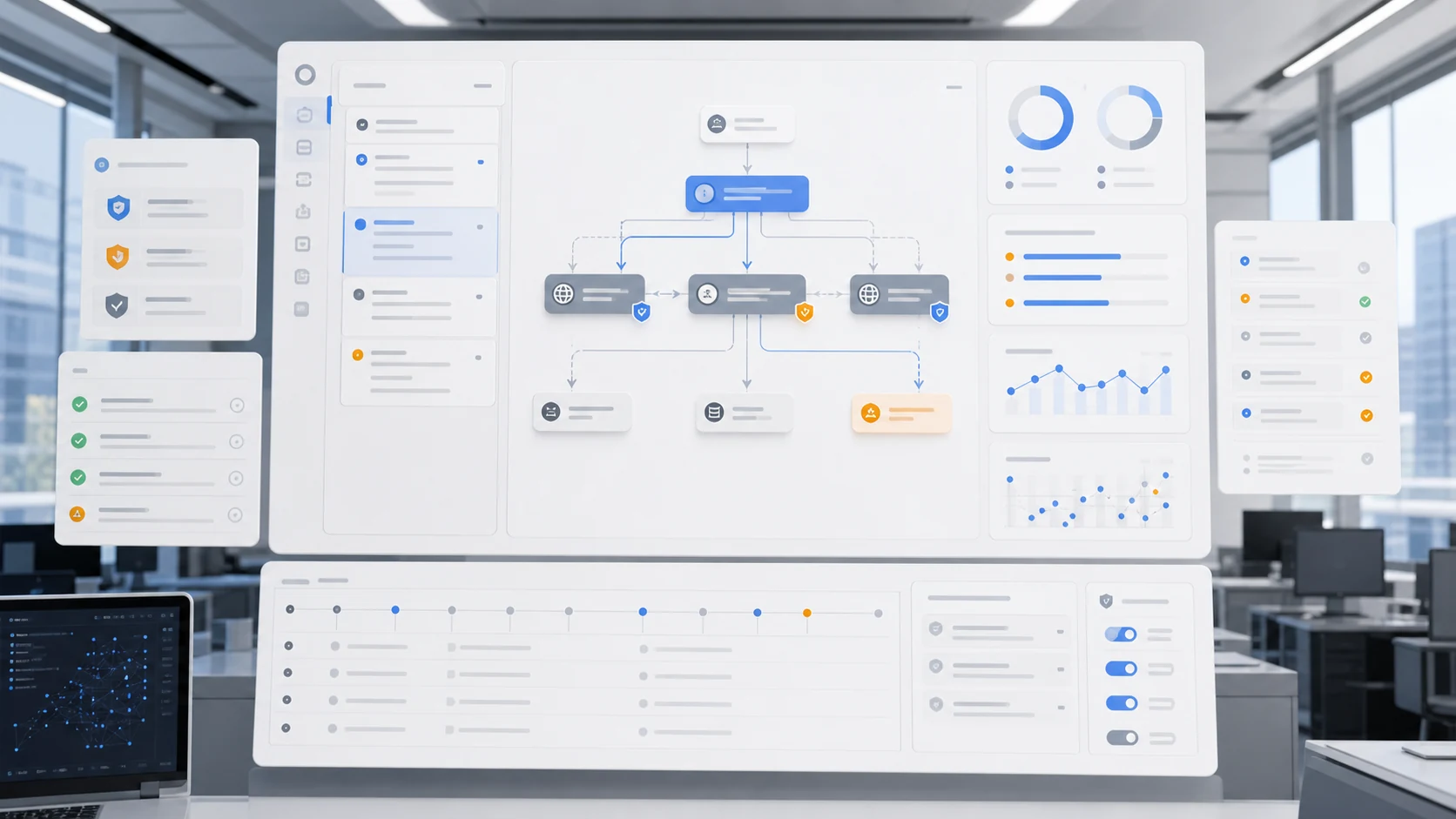
NowFlow can model the migration as a governed operating process: discover asset, assign owner, collect vendor response, choose algorithm path, test hybrid mode, approve cutover, monitor errors, and archive evidence. QFlow can keep standards references, experiment records, and decision evidence attached to the same migration object.
Delivery advice
Pilot by trust boundary, not by department.
A useful pilot should cover a complete trust boundary: one internet-facing endpoint, one service-to-service channel, one device or firmware signing path, one internal PKI dependency, and one vendor-managed surface. That gives the team a realistic view of performance, support, monitoring, and rollback.
The pilot should also produce reusable artifacts: test plan, CBOM schema, vendor questionnaire, exception process, risk scorecard, and executive reporting template.
Practical takeaways
ML-KEM is the key-establishment spine, but signatures and validation are separate workstreams.
A CBOM is the practical starting point for algorithm migration.
Hybrid tests should be tied to trust boundaries and rollback plans.
NowFlow can coordinate work across owners, vendors, and approval gates.
QFlow can store standard references, test evidence, and migration decisions.
Sources reviewed
Source 01
NIST FIPS 203: ML-KEM
Final standard for ML-KEM, the module-lattice key-encapsulation mechanism used for quantum-resistant key establishment.
Source 02
NIST FIPS 204: ML-DSA
Final standard for ML-DSA, the module-lattice digital signature algorithm.
Source 03
NIST FIPS 205: SLH-DSA
Final standard for SLH-DSA, the stateless hash-based digital signature algorithm.
Source 04
NIST selects HQC as an additional PQC algorithm
NIST selected HQC as an additional backup algorithm for post-quantum encryption.
Source 05
CISA product categories for post-quantum cryptography adoption
January 2026 guidance for hardware and software categories that use or transition to PQC standards.