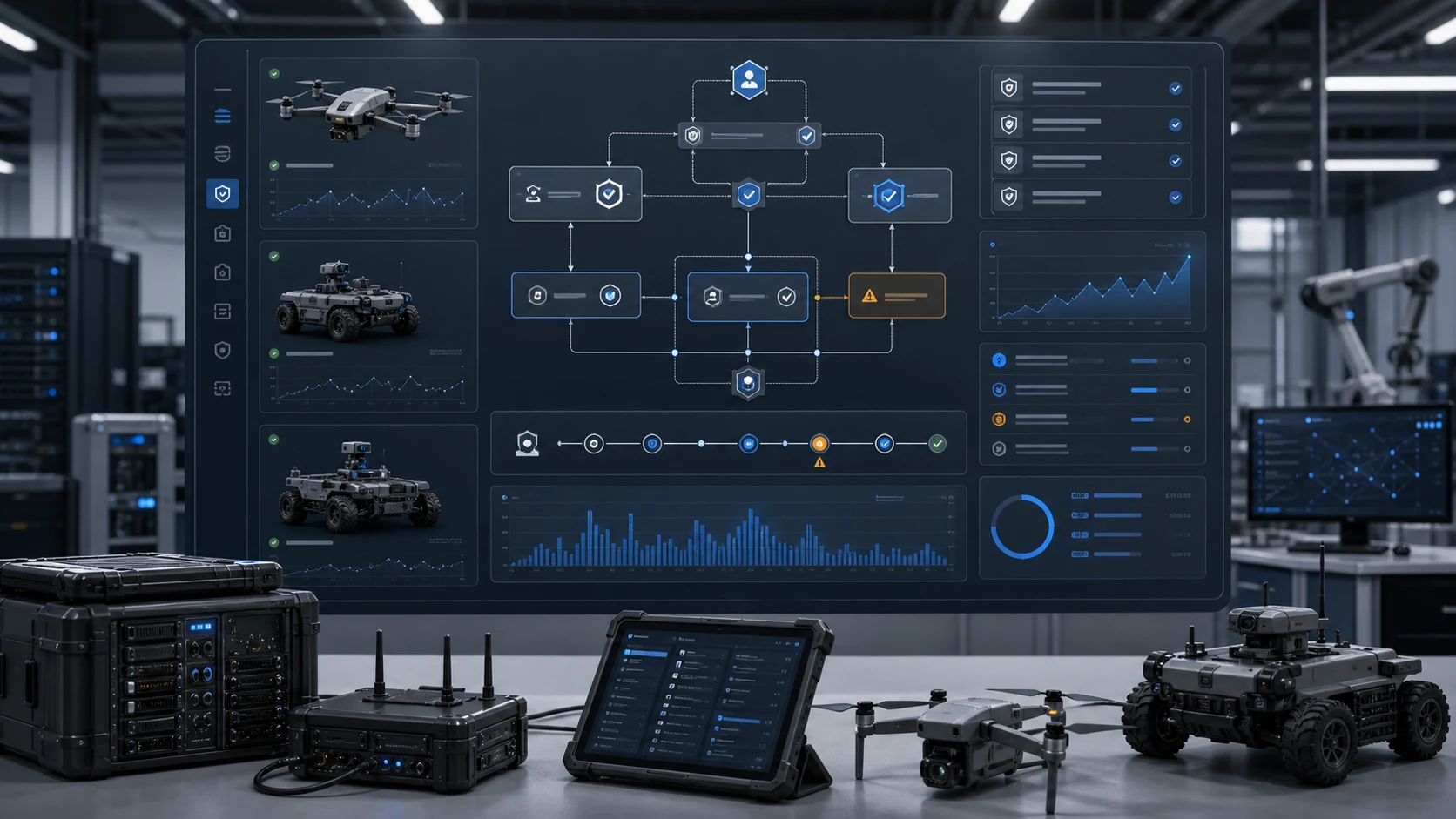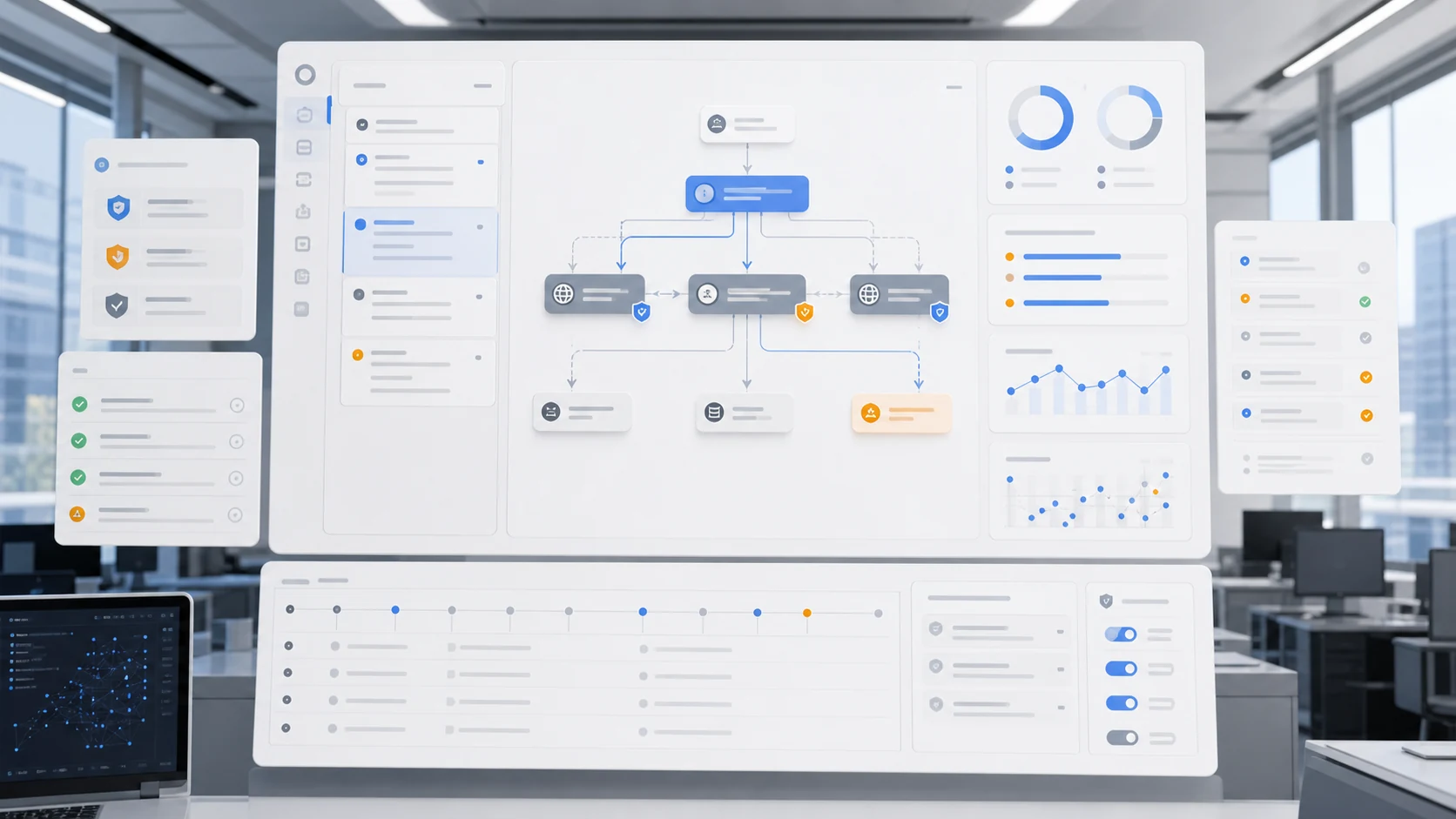
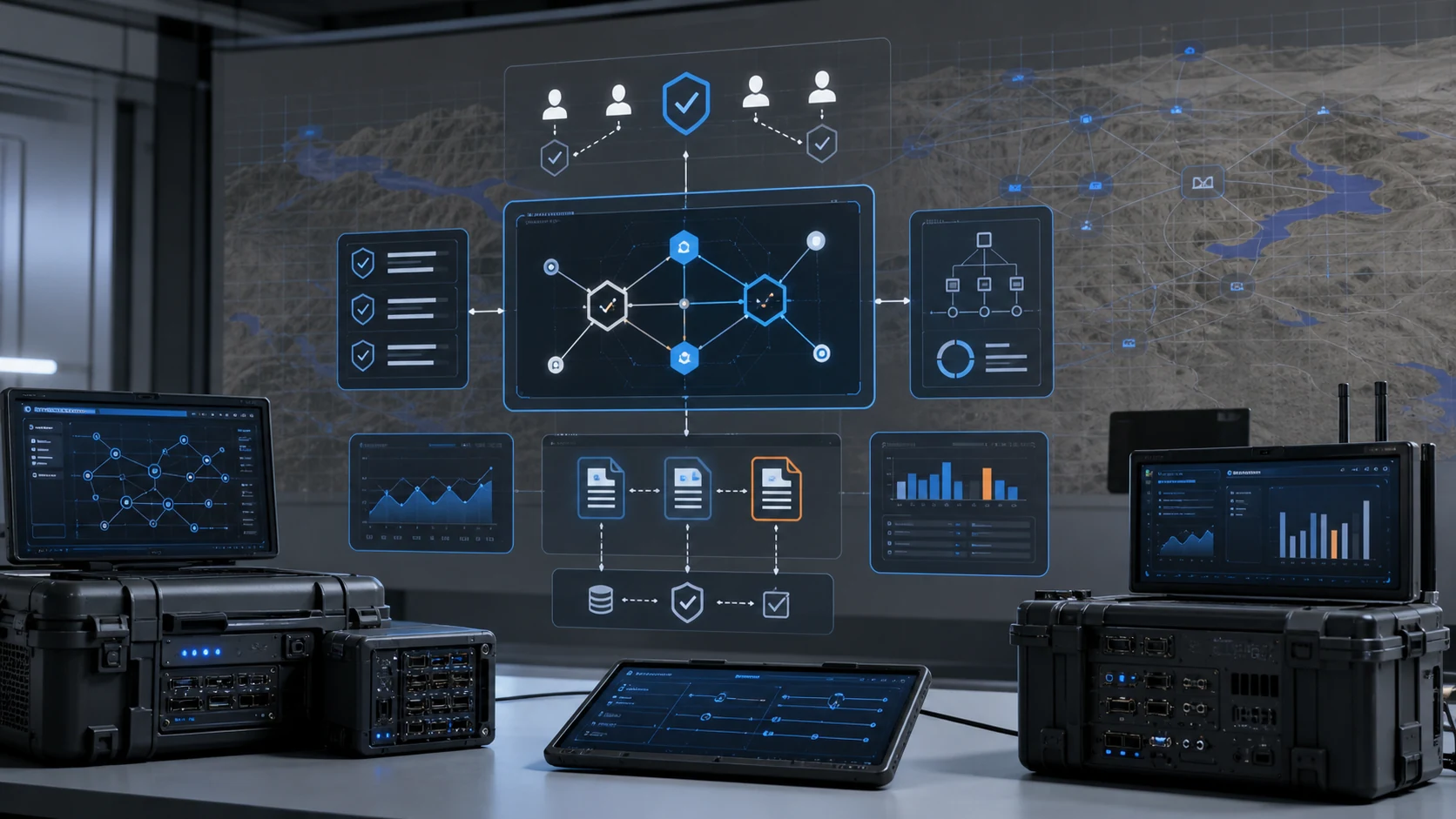
The product gap is not a battlefield agent demo. It is an assurance layer for multi-agent workflows: who can act, what they can touch, how behavior is monitored, and how the system fails safely when communications or context degrade.
Gap map
Defense agent assurance map
Scaling autonomy depends on constraining agent behavior before the runtime reaches the contested edge.
Agent collective
- Local planning
- Shared context
- Tool boundaries
- Emergent behavior risk
Assurance layer
- Authority chain
- Policy envelope
- Telemetry
- Containment and rollback
Edge runtime
- Signed builds
- Offline mode
- Device identity
- Degraded operations
June 2026 signal
Defense AI is moving toward controlled collectives.
DARPA DICE focuses on decentralized AI through controlled emergence, which is exactly the kind of problem that makes conventional single-agent governance insufficient. CLARA points toward high-assurance compositional learning and reasoning. DoD responsible-AI resources and NATO-aligned policy language keep the governance bar high.
Google DeepMind's multi-agent safety and AI control research reinforces the broader technical concern: when autonomous systems interact, population-level behavior and infrastructure security matter as much as individual model quality.
Defensible MVP
Build a sandboxed multi-agent runbook first.
A practical first engagement should avoid operational claims. Start with a sandboxed multi-agent runbook for logistics, maintenance, cyber triage, or simulation support. The benchmark is not mission success. It is trace quality, policy enforcement, containment, and human review efficiency.
The minimum evidence package should include scenario definition, agent roles, permissions, tool calls, policy decisions, telemetry events, human interventions, failure injections, and rollback behavior.
Trend thesis
Assurance is the product moat.
Defense AI will keep attracting autonomy narratives, but the durable product moat is assurance. Systems that can be bounded, inspected, updated, and stopped will be easier to trust than systems that only promise more autonomy.
That gives Neura Parse a clear content lane: high-assurance AI agents for contested-edge workflows, with workflow governance, edge runtime, and decision evidence treated as one system.
Practical takeaways
Defense AI agent content should lead with assurance, not autonomy hype.
Multi-agent systems need collective behavior monitoring and containment.
NowFlow owns approvals, workflow state, and evidence routes.
NeuralOS owns signed edge runtime, device identity, local policy, and rollback.
QANTIS should support uncertainty-aware review, not automated authority claims.
Sources reviewed
Source 01
DARPA DICE: decentralized AI through controlled emergence
Decentralized coordination and local inference control for resilient heterogeneous AI agent collectives.
Source 02
DARPA DICE Q&A, June 2026
June 2026 Q&A for the DICE broad agency announcement.
Source 03
DARPA CLARA high-assurance AI program
Compositional learning-and-reasoning program for high-assurance AI systems of systems.
Source 04
DoD Chief Digital and AI Office Responsible AI resources
Responsible AI strategy, toolkit, and lifecycle resources for AI capability development.
Source 05
Google DeepMind multi-agent AI safety research, June 2026
Funding call and research agenda for sandboxes, network science, infrastructure security, and population-level oversight.
Source 06
NIST AI Agent Standards Initiative, February 2026
AI agent interoperability and security priorities, including identity, authorization, monitoring, and logging.