
Abstract
The NIST post-quantum portfolio is no longer a single list of candidate algorithms. It is a layered standards system: three final FIPS, final KEM guidance, standards still being drafted, signature candidates still under evaluation, and protocols moving on separate clocks.
Gap map
A status gate for every post-quantum claim
Move from publication status to implementation evidence before deciding that an algorithm, protocol, or product is ready for a particular system.
Identify
- Exact document and version
- Key establishment or signature
- Required security property
Classify status
- Final FIPS or SP
- Initial Public Draft
- Selected for a future standard
- Candidate under evaluation
Check ecosystem
- Protocol specification
- Library and module support
- Validation state
- Interoperability evidence
Decide
- Pilot now
- Monitor and prepare
- Do not place in production
- Record review date
The useful 2026 question is not whether an algorithm appears on a NIST page, but what status that page actually assigns.
A standards portfolio contains artifacts with different authority. A final Federal Information Processing Standard specifies an approved algorithm. A final Special Publication can define secure-use guidance. An Initial Public Draft invites refinement. Selection for standardization starts a drafting and review process; it does not finish one. A candidate moving to another evaluation round remains a candidate.
Collapsing those states creates two opposite errors. A team may deploy an experimental construction as if it were settled, or it may delay all preparation because some complementary standards remain unfinished. The safer method is a dated status ledger that records the exact document, its role, publication state, errata, intended system surface, and next review trigger.

TD · Technical depth6 supporting chapters and the working checklist.Read deeper
Three final FIPS answer two different cryptographic jobs.
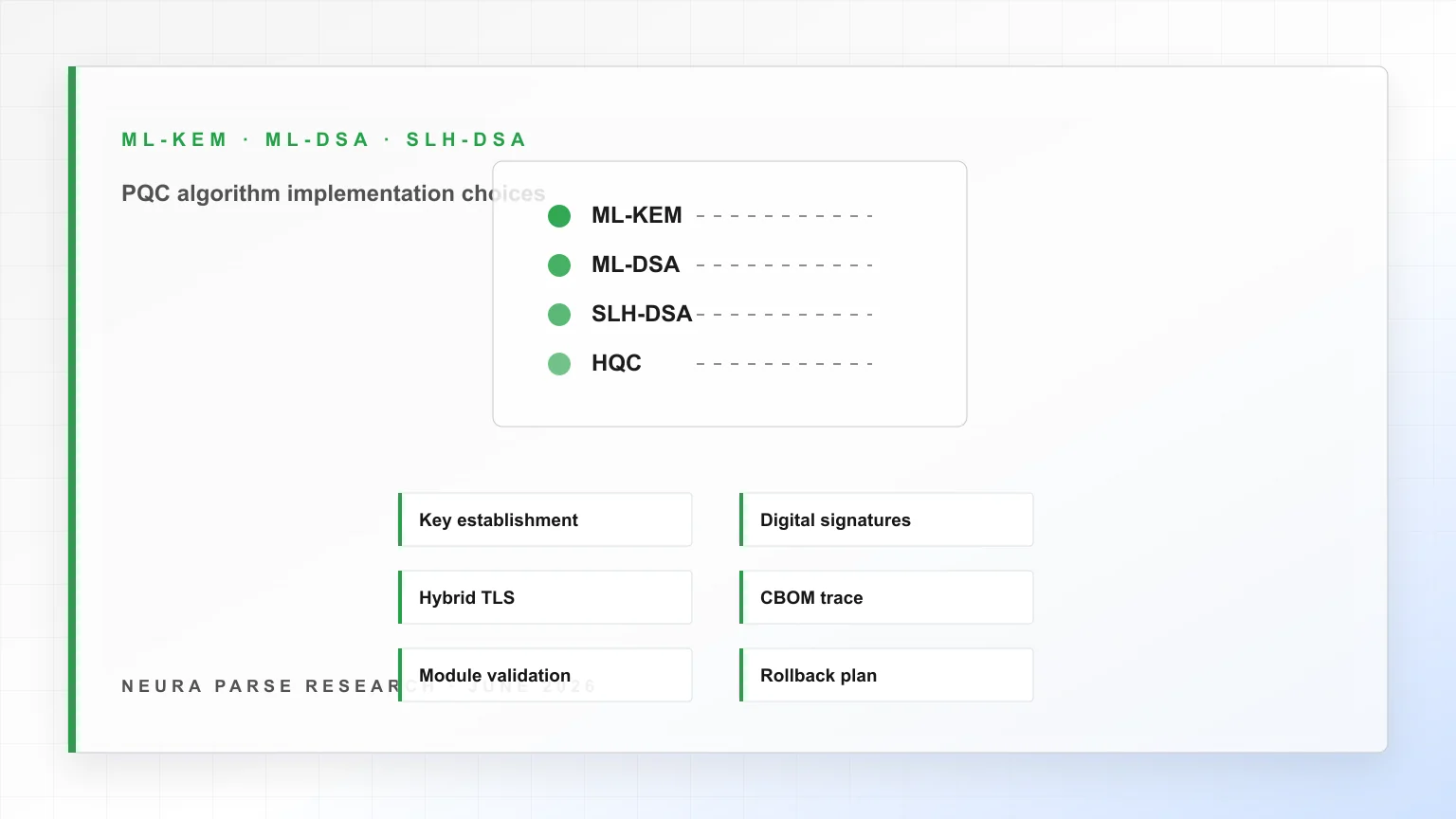
FIPS 203 specifies ML-KEM for key establishment. A KEM lets parties establish a shared secret that can then feed symmetric encryption and authentication. It is not a bulk file-encryption algorithm and should not be described as a drop-in replacement for every use of the word encryption.
FIPS 204 specifies ML-DSA and FIPS 205 specifies SLH-DSA for digital signatures. Signatures support integrity, origin authentication, and verification; they do not provide confidentiality. ML-DSA uses a module-lattice foundation, while SLH-DSA provides a stateless hash-based alternative with different size and performance characteristics. Architecture work must therefore begin by separating key establishment from each signature surface rather than choosing one universal PQC algorithm.
- FIPS 203 / ML-KEM: establish shared secrets for later symmetric protection.
- FIPS 204 / ML-DSA: general post-quantum digital signatures.
- FIPS 205 / SLH-DSA: stateless hash-based digital signatures with a different assumption and operating profile.
- All three were published as final standards on August 13, 2024.
SP 800-227 and the live errata records matter after the algorithm name is chosen.
NIST SP 800-227, finalized in September 2025, addresses how KEMs work, the properties applications rely on, and how implementations should use them securely. That guidance is essential because protocol composition, input validation, key derivation, failure behavior, randomness, side-channel resistance, and lifecycle controls can undermine a mathematically sound primitive.
The FIPS publication pages are also living control points. NIST notes an issue for a future FIPS 203 update and links current errata material; the FIPS 204 page records several minor issues for future correction. These notices do not turn the standards back into drafts. They do mean an implementation team must pin the publication and errata state it tested instead of relying on an undated summary copied from another site.
HQC, FN-DSA, and the additional signature candidates occupy three different unfinished states.
NIST selected HQC in March 2025 as a second post-quantum KEM intended to complement ML-KEM with a different mathematical basis. The selection notice says NIST will draft a standard, publish it for comment, adjudicate feedback, and then publish a final version. Therefore HQC is a selected future standard, not a final FIPS available for an undifferentiated compliance claim in July 2026.
FN-DSA, derived from FALCON, is identified by NIST as FIPS 206 in development. Separately, NIST IR 8610 advanced nine additional digital-signature candidates to a third evaluation round in May 2026. Those candidates may inform future choices, but none becomes approved merely by reaching the next round. An architecture can preserve agility for future diversity without putting non-final candidates into a production baseline prematurely.
- HQC: selected for standardization; final standard still pending.
- FN-DSA / FIPS 206: in development; not one of the three final 2024 PQC FIPS.
- Nine additional signature schemes: third-round candidates under evaluation.
- Planning for diversity is appropriate; presenting unfinished work as approved is not.
Algorithm publication, protocol standardization, product support, and module validation are separate milestones.
A final algorithm does not automatically update TLS, X.509, VPNs, code-signing systems, hardware security modules, certificate authorities, embedded devices, or every cloud service. Each surrounding protocol needs a safe encoding and composition; each library needs a correct implementation; products need integration and lifecycle support; regulated environments may also require algorithm or module validation.
This distinction prevents a common procurement failure: a supplier says that a product supports ML-KEM, while the buyer assumes the relevant protocol path, certificate lifecycle, rollback behavior, and validation scope are all complete. The evidence request should name the exact interface, protocol version, parameter set, build, validation record, interoperability partners, operational limits, and fallback behavior.
deployment_readiness = final_specification × protocol_fit × implementation_evidence × interoperability × operational_controlTurn publication status into one of four bounded actions: deploy, pilot, monitor, or reject.
A standards watch becomes actionable when every item ends in a decision. Deploy is appropriate only when the required standard, protocol path, implementation, validation posture, and rollback controls meet the system's policy. Pilot is for bounded non-production or carefully isolated use where measurements can resolve a known uncertainty. Monitor applies when a needed specification or product is still moving. Reject applies when the proposal misstates status, lacks provenance, or cannot meet the trust boundary.
The same technology may land in different states for different systems. ML-KEM can be a final algorithm baseline while a specific TLS construction remains a draft. A library may implement final ML-KEM but lack the validation a federal acquisition requires. Recording the reason, owner, evidence, and next review date makes that nuance manageable rather than contradictory.
- Name the protected transaction and the property it requires.
- Verify the exact standard and protocol status from the primary publisher.
- Collect implementation, interoperability, performance, failure, and rollback evidence.
- Assign a decision state and an event that will trigger reassessment.
Keep the ledger current as documents, errata, products, and validations move.
A useful ledger includes the canonical source URL, publication date, current status, superseded names, applicable errata, function, parameter choices, protocol dependencies, product and validation evidence, decision owner, last review, and next trigger. A trigger can be a new FIPS draft, final RFC, module certificate, vendor release, cryptanalytic result, or revised policy deadline.
This structure also improves public communication. A dated article can say what was final on July 20, 2026 and link readers to living primary records. It should avoid absolute terms such as unbreakable or future-proof: post-quantum algorithms are designed and believed to resist relevant classical and quantum attacks, but they remain subject to cryptanalysis, implementation failures, and future revision like other cryptography.
Practical takeaways
01
Treat FIPS 203, 204, and 205 as the final NIST PQC algorithm baseline as of July 20, 2026.
02
Separate key establishment from digital signatures before mapping algorithms to systems.
03
Describe HQC, FN-DSA, and additional signature candidates by their actual unfinished status.
04
Verify protocol, implementation, validation, interoperability, and rollback evidence beyond the algorithm standard.
05
Maintain a dated standards ledger with primary links, errata, owners, decisions, and review triggers.
RA · Reference annexDefinitions, recurring questions, editorial method, and primary sources.Inspect
The analysis above carries the main reading flow. This reference layer keeps terminology, recurring questions, editorial method, and primary sources available without interrupting the argument.
Field questions
Program questions behind NIST post-quantum standards in 2026: final, selected, draft, or still under evaluation?.
Q01Which NIST post-quantum standards are final in July 2026?
FIPS 203 for ML-KEM, FIPS 204 for ML-DSA, and FIPS 205 for SLH-DSA are final. SP 800-227 is also final guidance for secure KEM use. Other selections, candidates, drafts, and protocol documents must be described by their own status.
Q02Is HQC already an approved final NIST standard?
No. NIST selected HQC for standardization in March 2025 as a complementary KEM, but the official notice describes drafting, public comment, and adjudication steps that precede a final standard. Selection is not final publication.
Q03Are Kyber and ML-KEM interchangeable names for the same implementation?
No. ML-KEM is the final mechanism specified by FIPS 203. Pre-standard versions commonly called Kyber changed during standardization and can be incompatible with the final ML-KEM specification, so implementations and test vectors must identify the exact version.
Q04Does supporting a FIPS algorithm mean a product is FIPS 140-3 validated?
Not automatically. Algorithm conformance, protocol integration, and cryptographic-module validation are distinct claims. Buyers should request the exact module certificate and operating environment where validation is required, along with protocol and interoperability evidence.
Editorial record
How NIST post-quantum standards in 2026: final, selected, draft, or still under evaluation? was checked.
- Editorial owner
- Neura Parse Research
- Last verified
- July 20, 2026
- Method
- Synthesis of the dated primary and official records listed below, checked against the operating question in this note.
- Scope limit
- Planning analysis—not certification, customer performance evidence, procurement advice, or a claim of production readiness.
SRSources reviewed
7 records