
P01
Sensitive context can leak through a useful-looking use case
Decision questionWhat can be described, shared, processed, and retained in the engagement, and who approves that boundary?
SVQuantum Defense R&D
Build public-safe quantum defense readiness around sensing, secure communications, autonomy assurance, and evidence records.
Defense innovation teams · Aerospace programmes · Dual-use R&D groups

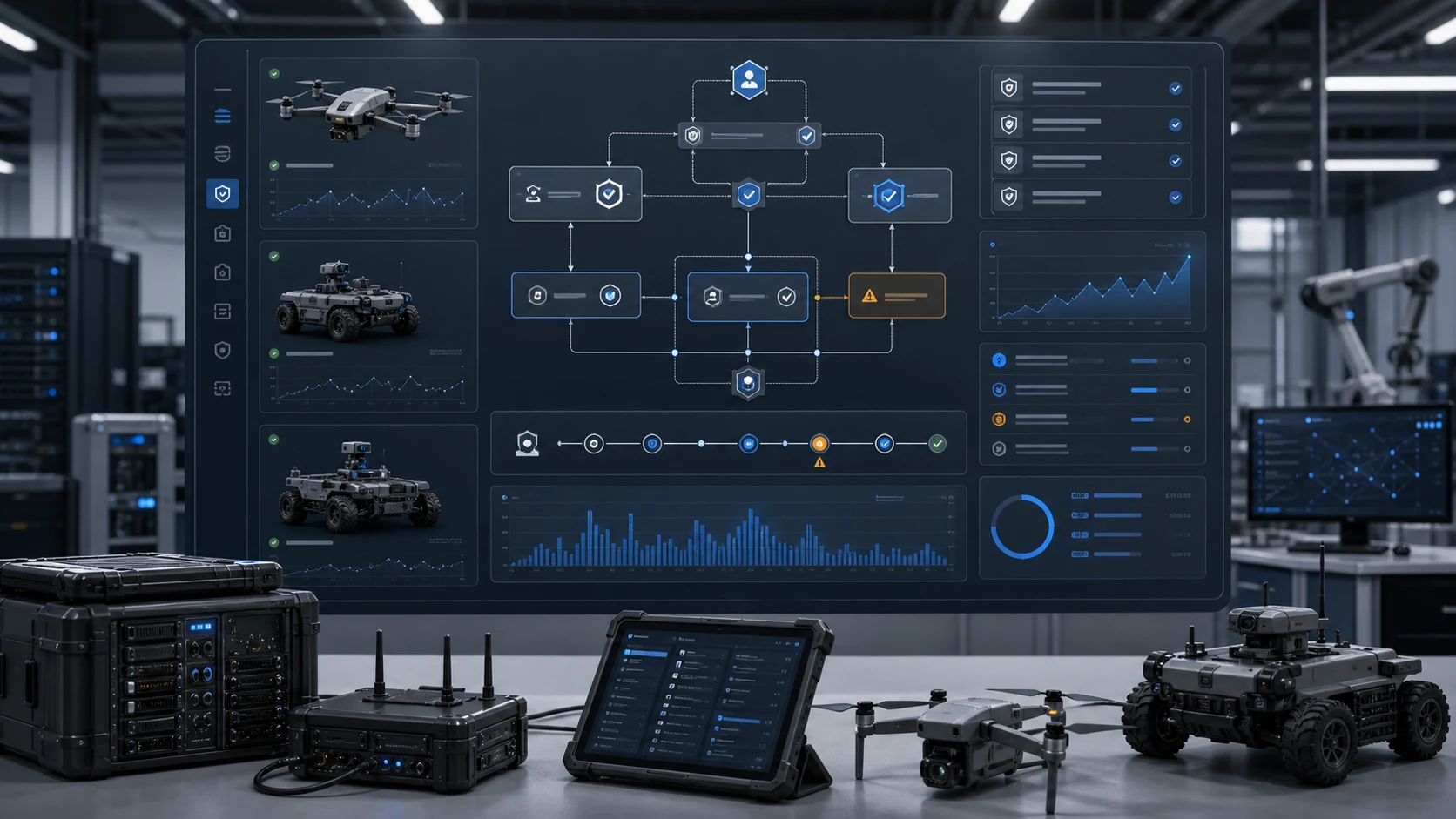
Quantum defense assurance · Engineering workflow study
Quantum defense assurance frames sensing, secure communications, optimization, simulation, edge runtime, and human authority as evidence-rich workflows without exposing sensitive details.
Layer 01
Layer 02
Layer 03
Layer 04
01 · Mission context
Quantum sensing, resilient PNT, secure communications, optimization, and computing are active research areas with different maturity and security boundaries. The engagement creates public-safe problem statements, classical baselines, environmental test evidence, and human review while keeping PQC migration distinct from speculative quantum capability claims.
Public-safe framing
The engagement begins by defining a sanitized user, decision, scenario, classical capability, information boundary, and human authority. Mission locations, platform vulnerabilities, sensor performance, targeting detail, and other sensitive context stay outside the public work, while reviewers receive enough structure to understand the research question and the evidence required for its next programme gate.
P01
Decision questionWhat can be described, shared, processed, and retained in the engagement, and who approves that boundary?
P02
Decision questionWhich environmental and integration conditions must be reproduced before any readiness discussion?
P03
Decision questionWhich human role decides, what evidence is visible, and what happens when the system is uncertain or outside test bounds?
P04
Decision questionIs each security need assigned to a PQC migration path, a separately justified communications experiment, or a non-quantum control?
The portfolio is then separated by maturity. Quantum sensing or resilient-PNT concepts require calibration and environmental evidence; hybrid computing studies require classical baselines and full resource accounting; post-quantum migration follows established security engineering; and specialized communications experiments retain their own physical and trust assumptions. No lane inherits readiness from another.
Sensitive context can leak through a useful-looking use case. Mission details, platform characteristics, sensor performance, locations, vulnerabilities, threat models, and partner data may be sensitive even when the quantum method is public.
Laboratory performance may not survive the platform. Motion, vibration, temperature, magnetic and electromagnetic interference, packaging, calibration, size, weight, power, timing, and maintenance can dominate field utility.
Research output can be mistaken for mission authority. A sensor estimate, optimization result, or AI-assisted interpretation needs uncertainty, provenance, tested envelope, human review, and a disengagement path.
Quantum security contains two different programmes. Standards-based PQC migration protects current systems through cryptographic change; QKD and other quantum communications introduce specialized hardware and network assumptions.
02 · Delivery system
Inputs, outputs, maturity, and the evidence boundary travel together. Capability is never separated from the condition under which it can be accepted.
Define the user, decision, public-safe scenario, authority boundary, information classes, interfaces, classical baseline, maturity, and evidence needed for the next programme gate.
Output · Public-safe problem card · sensitivity map · maturity statement · experiment and review boundary
Compare a sensing, timing, inertial, magnetic, optical, or related concept with classical instruments under defined noise, calibration, motion, interference, packaging, and platform constraints.
Output · Protocol · error budget · calibration record · environmental results · readiness and limitation record
Evaluate a public-safe optimization, simulation, scheduling, or scientific-computing problem against strong classical baselines with full resource, provider, cost, uncertainty, and scaling evidence.
Output · Run manifests · comparison pack · resource estimate · negative findings · next gate
Run a separate cryptographic inventory and migration track, and connect approved research outputs to identity, provenance, human authority, test envelope, release state, exception, and after-action evidence.
Output · CBOM slice · PQC roadmap · evidence schema · approval and exception flow · review pack
Define the user, decision, public-safe scenario, authority boundary, information classes, interfaces, classical baseline, maturity, and evidence needed for the next programme gate.
Compare a sensing, timing, inertial, magnetic, optical, or related concept with classical instruments under defined noise, calibration, motion, interference, packaging, and platform constraints.
Evaluate a public-safe optimization, simulation, scheduling, or scientific-computing problem against strong classical baselines with full resource, provider, cost, uncertainty, and scaling evidence.
Run a separate cryptographic inventory and migration track, and connect approved research outputs to identity, provenance, human authority, test envelope, release state, exception, and after-action evidence.
03 · System boundary
The reference architecture links bounded laboratory or simulation work to environmental conditions, hybrid execution, policy, identity, and operator review. Motion, vibration, interference, packaging, calibration, provider context, and failure injection remain attached to results so a promising signal or optimization output cannot silently become operational authority.
Reference layers support scoping. Interfaces, owners, and target-system constraints remain subject to validation.
The user, decision, scenario, data classes, prohibited detail, human authority, classical capability, and acceptance question are recorded before technical work.
Typical elements · Mission thread · sensitivity guide · authority class · baseline · maturity label
Classical references, quantum sensor or circuit concepts, calibration, synthetic or sanitized scenarios, noise, motion, interference, and failure injection form a bounded test environment.
Typical elements · Reference instrument · simulator · shaker or motion profile · EMI context · test card
CPU, GPU, QPU, sensor, edge runtime, workflow, policy, identity, and operator interfaces are explicit so research output cannot silently become command authority.
Typical elements · QFlow run · NeuraOS test runtime · NowFlow approval · QANTIS uncertainty review
Sources, assumptions, calibration, versions, tests, uncertainty, approvals, exceptions, incidents, rollback, lessons, and PQC dependencies remain linked and reviewable.
Typical elements · Manifest · calibration · test result · approval receipt · CBOM · after-action record
Handover records the tested envelope, uncertainty, negative findings, maturity label, approval path, exception, disengagement condition, and next experiment. Public-safe evidence and the separate PQC dependency record support programme review, while classified authorization, platform acceptance, cryptographic approval, and mission decisions remain with the responsible customer and authorities.
04 · Assurance dossier
The primary story remains calm; profiles, scope, handover evidence, and discovery questions stay available as a structured technical annex.
A public sensor concept is compared with a classical reference under defined motion, vibration, temperature, electromagnetic interference, calibration, packaging, and timing conditions.
Sanitized logistics, scheduling, resource-allocation, or scientific instances are evaluated with strong classical solvers and a candidate hybrid method under one resource contract.
A public-safe lab boundary inventories certificates, protocols, software or firmware signing, vendor dependencies, and tests an approved PQC migration pattern with rollback.
Included in this service pattern
Not implied by this page
Handover evidence
The engagement records allowed data and scenarios, prohibited detail, storage and sharing limits, named reviewers, human authority, and an escalation path before execution.
The same scenario, constraints, metrics, environmental conditions, uncertainty method, and resource accounting are used or differences are explicitly justified.
Motion, vibration, temperature, EMI, calibration, packaging, SWaP, timing, maintenance, platform interfaces, and failure behavior are tested or listed as unresolved gates.
The output states maturity, tested envelope, limitations, untested risks, customer authority, and the exact evidence required before accreditation or operational consideration.
Discovery questions
Evidence register
References shape requirements and review questions. Inclusion does not imply certification, endorsement, partnership, or approval by the publisher.
05 · Engagement record
Inspectable outputs close the engagement; related services point only to the next bounded step.
Deliverables
Engagement artifacts
05 records per engagement
Quantum Defense R&D
Create controlled, evidence-rich quantum defense workflows without overexposing sensitive detail.