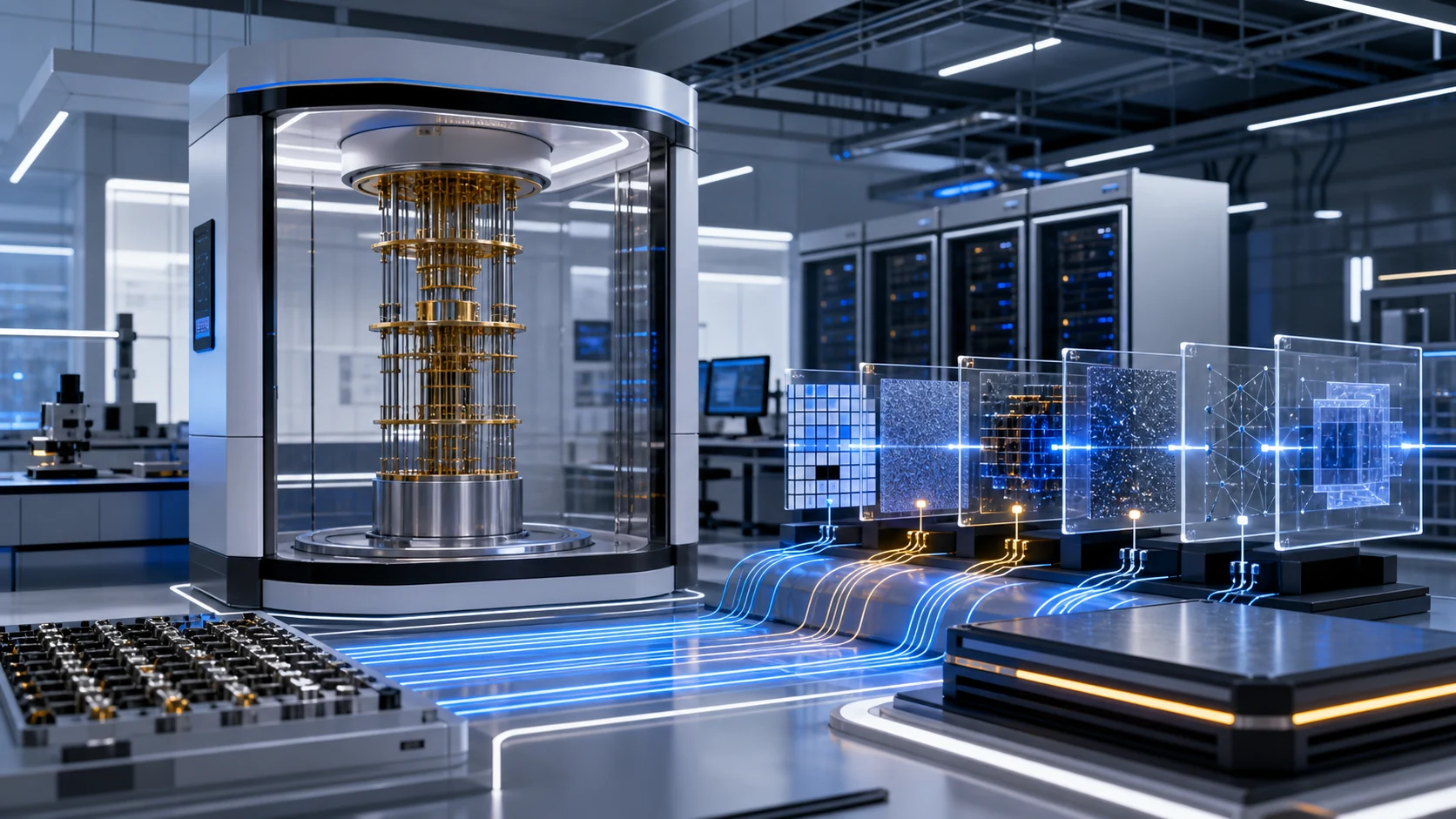

Quantum AI should not be positioned as a magic accelerator. The credible 2026 gap is a pipeline that connects problem framing, classical baselines, logical resource estimates, quantum execution, AI-assisted interpretation, and decision evidence.
Gap map
Quantum AI evidence map
A quantum result becomes useful only after baselines, resource estimates, and decision impact are connected.
Problem
- Scientific objective
- Classical baseline
- Error tolerance
- Decision value
Quantum path
- Circuit or Hamiltonian
- Logical resource estimate
- Backend metadata
- Error model
Evidence
- Reproducible manifest
- AI-assisted analysis
- Crossover map
- QANTIS decision trace
June 2026 signal
Quantum AI is moving from demos to workload accounting.
IBM's June 2026 quantum investment signal and roadmap language keep the industry focused on fault-tolerant systems, verification, debugging, and developer tooling. Google's Quantum AI roadmap frames the long path from error suppression and logical qubits toward useful error-corrected computation. NVIDIA CUDA-Q points to the practical software reality: useful quantum workflows span QPUs, GPUs, CPUs, simulators, and classical optimizers.
That combination changes the product question. The question is not whether quantum computing and AI can be mentioned together. The question is which subroutine, inside which workflow, improves which decision at which total cost.
Research gap
The gap is a decision-level crossover map.
Quantum AI content often jumps from algorithm family to claimed future impact. The missing layer is a reproducible crossover map that compares classical, quantum-inspired, noisy quantum, and fault-tolerant estimates against the same objective.
For AI and science workloads, that map should include not only runtime. It should include data loading, state preparation, compiler path, logical qubits, T-count or equivalent cost, error budget, classical accelerator time, and the impact of the result on downstream model or scientific decisions.
- Compare against strong classical baselines before any quantum claim is made.
- Keep logical resource estimates visible even when running only simulators or NISQ hardware.
- Record whether AI helps with problem decomposition, ansatz selection, error analysis, or interpretation.
- Treat negative crossover results as useful evidence, not failed marketing.
Product architecture
QFlow Studio should make hybrid experiments legible.
QFlow Studio can be the authoring surface where users define the objective, choose backends, attach baselines, configure resource estimation, and store execution evidence. It should not hide provider SDKs behind a decorative wrapper. It should make the experiment reviewable.
qmesh is the natural substrate for signed manifests, modality-aware IR, backend adapters, and provenance. QANTIS becomes the layer where quantum outputs are translated into decision confidence, risk, and action tradeoffs.
- Save seeds, compiler versions, backend calibration metadata, simulator settings, and model versions.
- Separate physical execution evidence from logical algorithm evidence.
- Use AI assistance for workflow design and analysis, but keep the evidence trail deterministic and inspectable.
- Present the result as a decision aid with uncertainty, not a single number detached from context.
Research programme
Pick narrow quantum AI targets with measurable value.
The best early Neura Parse content should avoid vague claims about quantum-enhanced AI. Stronger targets include molecular simulation workflows where AI proposes candidates and quantum methods refine energy estimates, combinatorial workflows where a quantum solver is benchmarked against modern heuristics, or uncertainty-aware decision systems where a quantum result affects a constrained choice.
Each target should define a minimum publishable artifact: a problem specification, baselines, resource estimates, manifest, error budget, and user-facing evidence page.
SEO thesis
Own the phrase quantum AI evidence pipeline.
Search interest around Quantum AI is broad and noisy. Neura Parse should use a more precise phrase: quantum AI evidence pipeline. It connects research credibility to product value and avoids implying near-term quantum advantage where the evidence is not ready.
This is also a cleaner link between QFlow, qmesh, and QANTIS: author the experiment, preserve the manifest, and translate the result into decision evidence.
Practical takeaways
Quantum AI needs crossover maps, not generic acceleration claims.
Baselines, resource estimates, and error budgets should be first-class UI objects.
QFlow Studio owns hybrid workflow authoring and review.
qmesh owns manifests, IR, backend metadata, and provenance.
QANTIS owns decision interpretation when quantum evidence changes an action.
Sources reviewed
Source 01
IBM commits more than $10 billion to quantum computing, June 2026
Five-year investment across R&D, manufacturing, M&A, and ecosystem expansion for fault-tolerant quantum systems.
Source 02
IBM Quantum Roadmap 2026
Profiling, verification, debugging, and quantum-classical workload tooling for 2026 and beyond.
Source 03
Google Quantum AI roadmap
Milestones from error suppression and logical qubits toward useful, error-corrected quantum computation.
Source 04
Grand challenges in the applications of quantum computers
Application-driven framing for useful quantum computation across chemistry, materials, optimization, and science.
Source 05
NVIDIA CUDA-Q quantum development platform
Hybrid quantum-classical programming across QPU, GPU, and CPU resources.