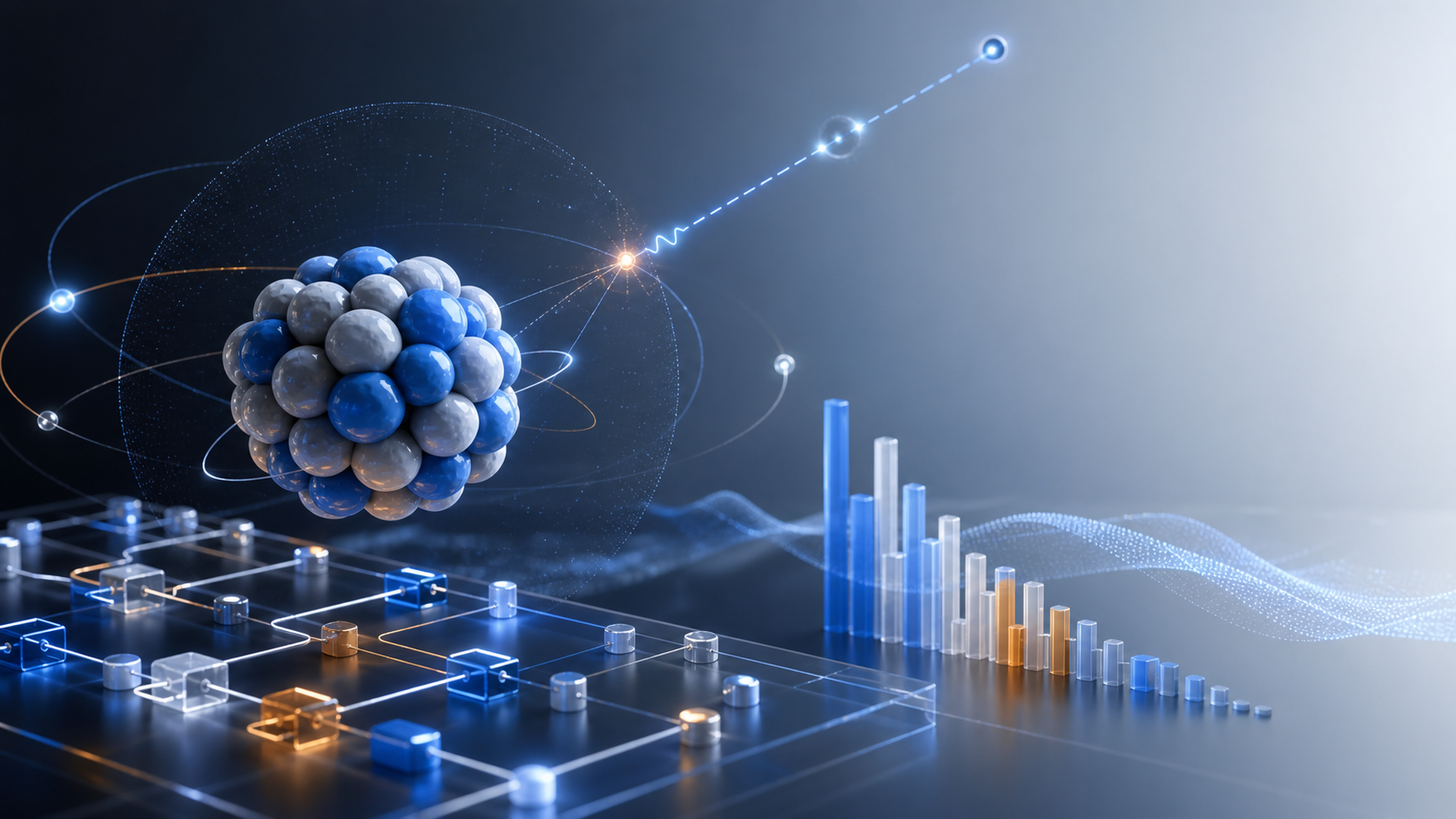
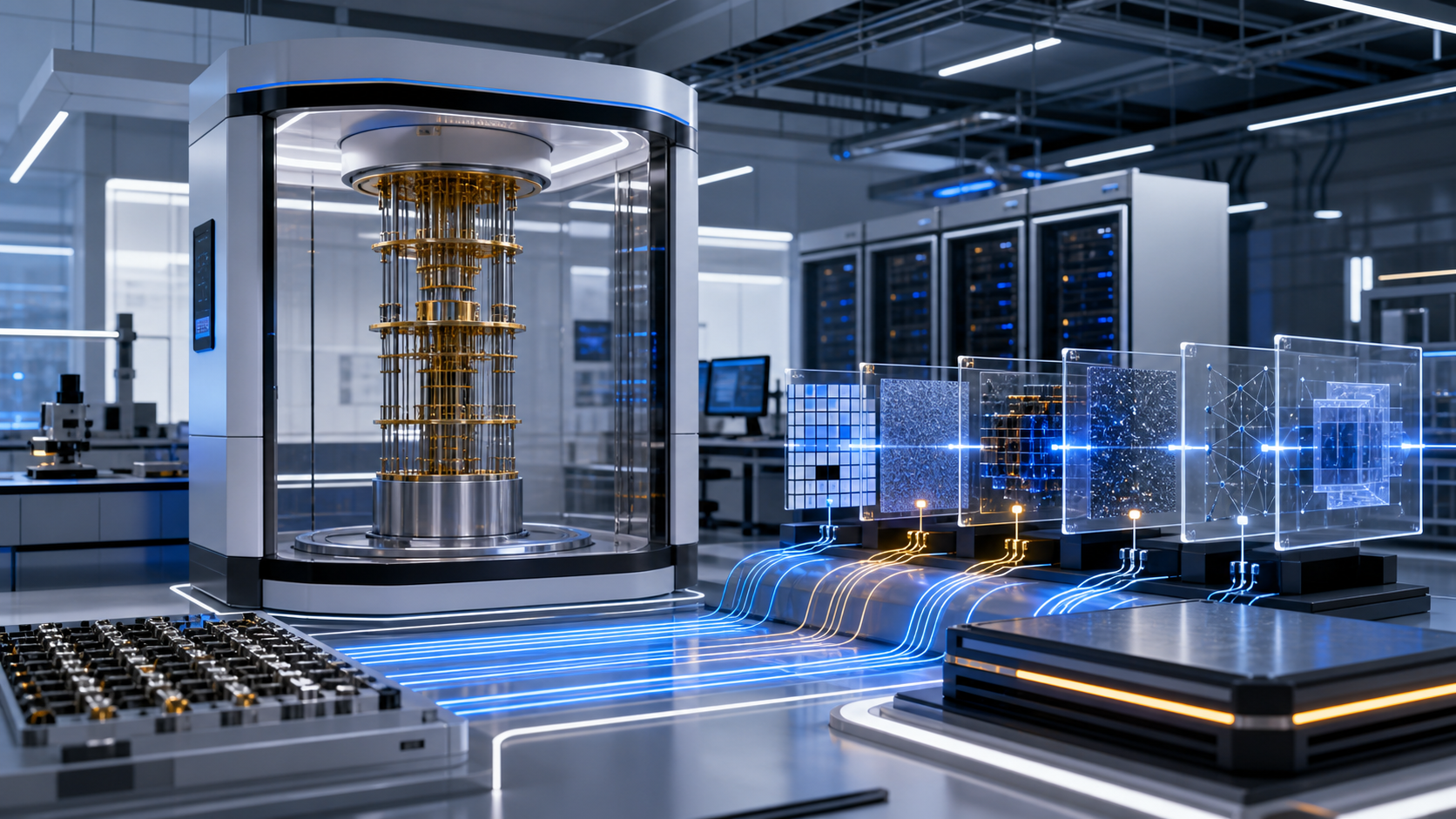
As quantum roadmaps move toward fault tolerance, the software layer must preserve problem definitions, compiler choices, backend metadata, simulation baselines, error behavior, manifests, and decision impact.
June 2026 signal
The roadmaps are getting larger; the evidence burden is getting heavier.
IBM's June 2026 quantum investment announcement reinforces the industry's shift from noisy demonstrations toward large-scale, fault-tolerant systems. IBM's roadmap material also emphasizes the surrounding developer and verification tooling needed to make those systems useful.
NVIDIA CUDA-Q points in the same architectural direction from the hybrid programming side: quantum work is increasingly planned as a workload that spans QPUs, GPUs, CPUs, simulators, and classical optimizers.
The product lesson for Neura Parse is that a quantum application is not only a circuit. It is a reproducible evidence pipeline.
Product layer
QFlow Studio should make every experiment reviewable.
QFlow Studio can be framed as the authoring and execution surface for quantum workflows. The stronger claim is not that it replaces provider SDKs. It should help users define a problem, connect a simulator or backend, store assumptions, run baselines, track compilation, and preserve outputs.
qmesh fits under that surface as the substrate for modality-aware IR, backend abstraction, and signed manifests. QANTIS fits where the output is a decision process that needs risk, optimization, and verification rather than a single benchmark number.
- Store problem statement, Hamiltonian or objective, constraints, seeds, compiler configuration, and provider metadata.
- Run classical and simulator baselines before treating hardware output as meaningful.
- Record mitigation choices, error behavior, backend calibration context, and confidence intervals.
- Make experiment artifacts portable enough for peer review, customer review, and internal regression testing.
Fault tolerance
Future hardware does not remove today's reproducibility requirements.
Fault tolerance will reduce some classes of error, but it will not remove the need to explain compilation choices, logical resource estimates, classical pre-processing, data movement, and decision relevance.
That is why qmesh should keep emphasizing signed manifests and offline-verifiable provenance. The most credible quantum stack is one where the experiment can be inspected even when the backend is external.
- Treat logical resource estimates as first-class outputs, not appendix material.
- Keep physical backend metadata separate from logical algorithm metadata.
- Version the compiler path because small lowering changes can affect resource estimates.
- Preserve negative results; they are useful for crossover maps and customer decision making.
Market message
Sell evidence, not inevitability.
The quantum market is full of inevitability language. Neura Parse has a cleaner lane: build tools that make quantum work inspectable, comparable, and decision-ready.
This gives QFlow, qmesh, and QANTIS a shared SEO story around fault-tolerant quantum workflows, hybrid quantum-classical orchestration, signed manifests, and reproducible evidence.
Practical takeaways
Quantum products need evidence pipelines before they need marketing claims.
QFlow Studio should present the full workflow, not only circuits.
qmesh should own signed manifests, backend abstraction, and provenance as a product advantage.
QANTIS belongs where quantum outputs influence decision systems under uncertainty.
SEO should target fault-tolerant quantum workflows, quantum evidence, and hybrid quantum-classical orchestration.
Sources reviewed
Source 01
IBM commits more than $10 billion to quantum computing, June 2026
Five-year investment across R&D, manufacturing, M&A, and ecosystem expansion for fault-tolerant quantum systems.
Source 02
IBM Quantum hardware and roadmap
Roadmap toward near-term advantage and large-scale fault-tolerant quantum computing.
Source 03
IBM Quantum Roadmap 2026
Profiling, verification, debugging, and quantum-classical workload tooling for 2026 and beyond.
Source 04
NVIDIA CUDA-Q quantum development platform
Hybrid quantum-classical programming across QPU, GPU, and CPU resources.