Abstract
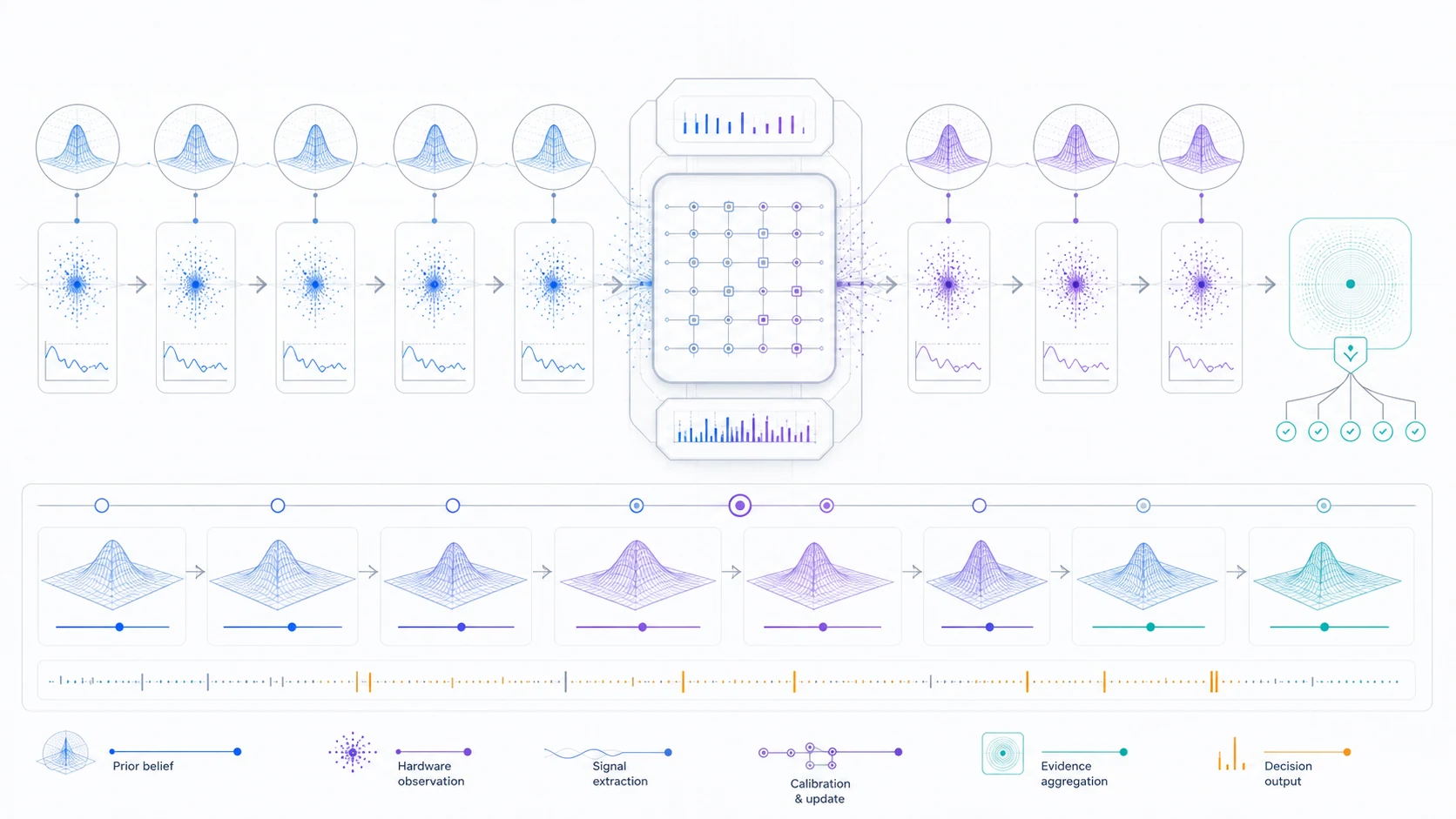
The valuable artifact is the full evidence chain: problem definition, simulator pass, backend metadata, mitigation strategy, output distribution, and decision impact.
Quantum results need reviewable evidence.
IBM's public quantum technology roadmap describes Heron processors, Quantum System Two direction, and a path toward near-term advantage. That does not remove the engineering problem: quantum decision systems need evidence that can be checked, repeated, and compared against classical baselines.
QANTIS and qmesh should therefore be presented as evidence systems. The value is not only a circuit or benchmark, but the full chain of assumptions, execution metadata, mitigation choices, and decision quality.
TD · Technical depth5 supporting chapters and the working checklist.Read deeper
Hybrid architecture remains the practical path.
Classical planning, simulation, and policy logic remain responsible for reliability. Quantum execution is inserted where it can be measured against an explicit decision problem.
The evidence record should therefore preserve the classical formulation, backend and calibration context, circuit or workload version, mitigation choices, resource estimates, output distribution, and fallback decision together. Reviewers can then ask whether the quantum step changed decision quality or cost under the tested conditions, rather than treating provider access or circuit completion as proof of advantage.
Evidence chains break at the joins, not the components.
Most evidence failures are not bad experiments. They are missing links between good artifacts. A run executed without captured backend metadata cannot be repeated under comparable conditions, so its result decays into an anecdote. A mitigation strategy that was applied but never versioned makes two output distributions incomparable even when everything else matches.
Baseline drift is the quieter failure. The classical baseline improves or degrades over time while archived quantum results stay fixed, and every comparison made against the stale baseline is silently invalid. The fix is procedural, not technical: version the baseline with the same discipline as the quantum record, and re-run the comparison when either side changes.
The last failure is silent fallback. A system that reverts to its classical path without recording the event produces decision logs that attribute outcomes to quantum components that never ran. Fallback must be an observable, logged state, visible in telemetry and in the operator interface.
- Backend metadata never captured, so the run cannot be reproduced
- Mitigation parameters applied but not versioned
- Seeds lost, so simulator passes cannot be repeated exactly
- Classical baseline drifts while archived results stay fixed
- Only summary statistics stored instead of full output distributions
- Fallback to the classical path happens without being recorded
Instrument the decision boundary before the circuit.
The first instrumentation point is not the quantum program. It is the boundary where a quantum output enters a decision. If that boundary is not logged, everything upstream is unattributable no matter how carefully the physics was recorded. Start there and work backwards.
Working backwards, the chain assembles in the order this article describes: problem definition, simulator pass, backend metadata, mitigation strategy, output distribution, decision impact. Each link should be a required field in the run record, not an optional annotation. A run missing any link should be marked incomplete by default.
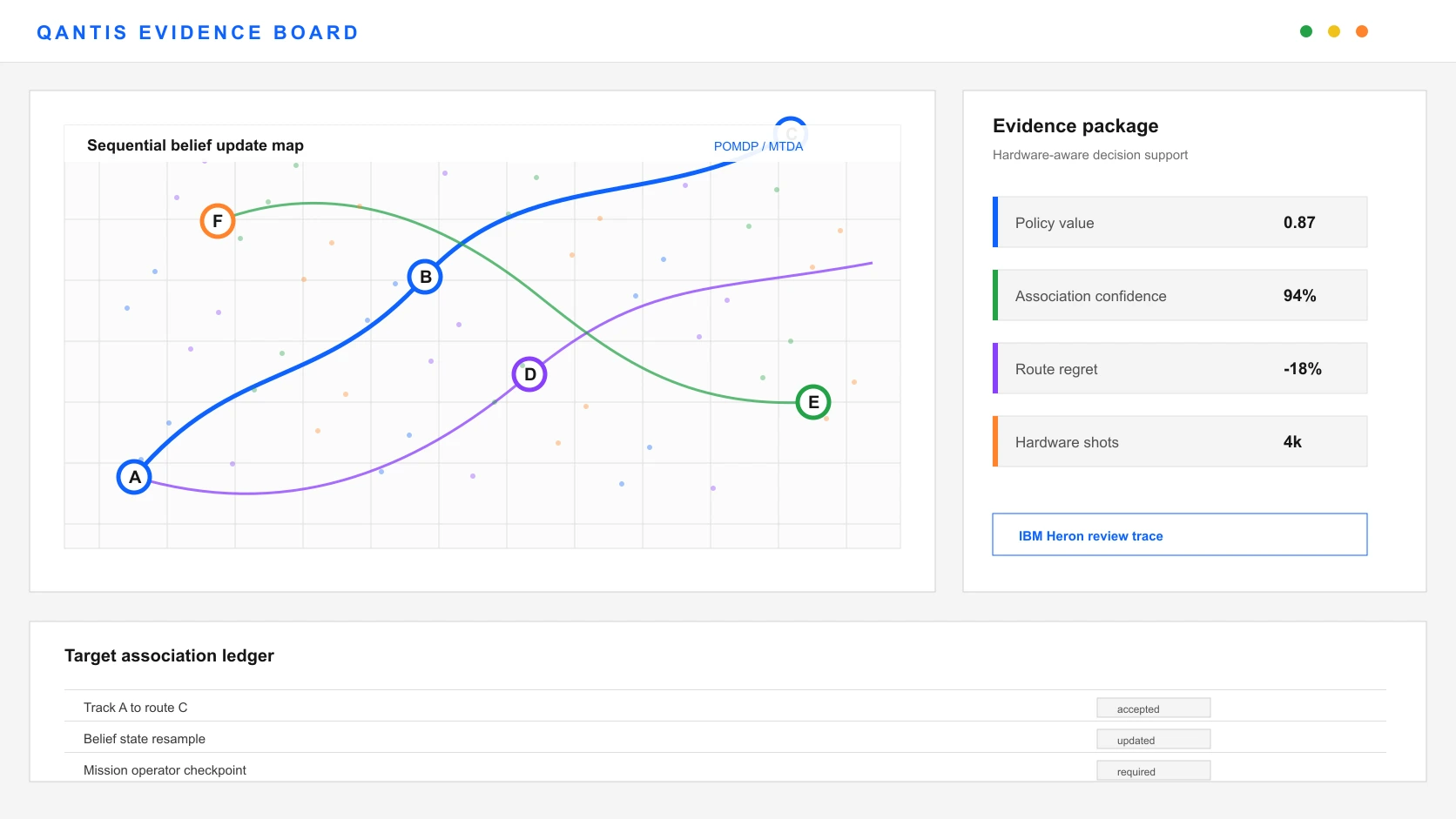
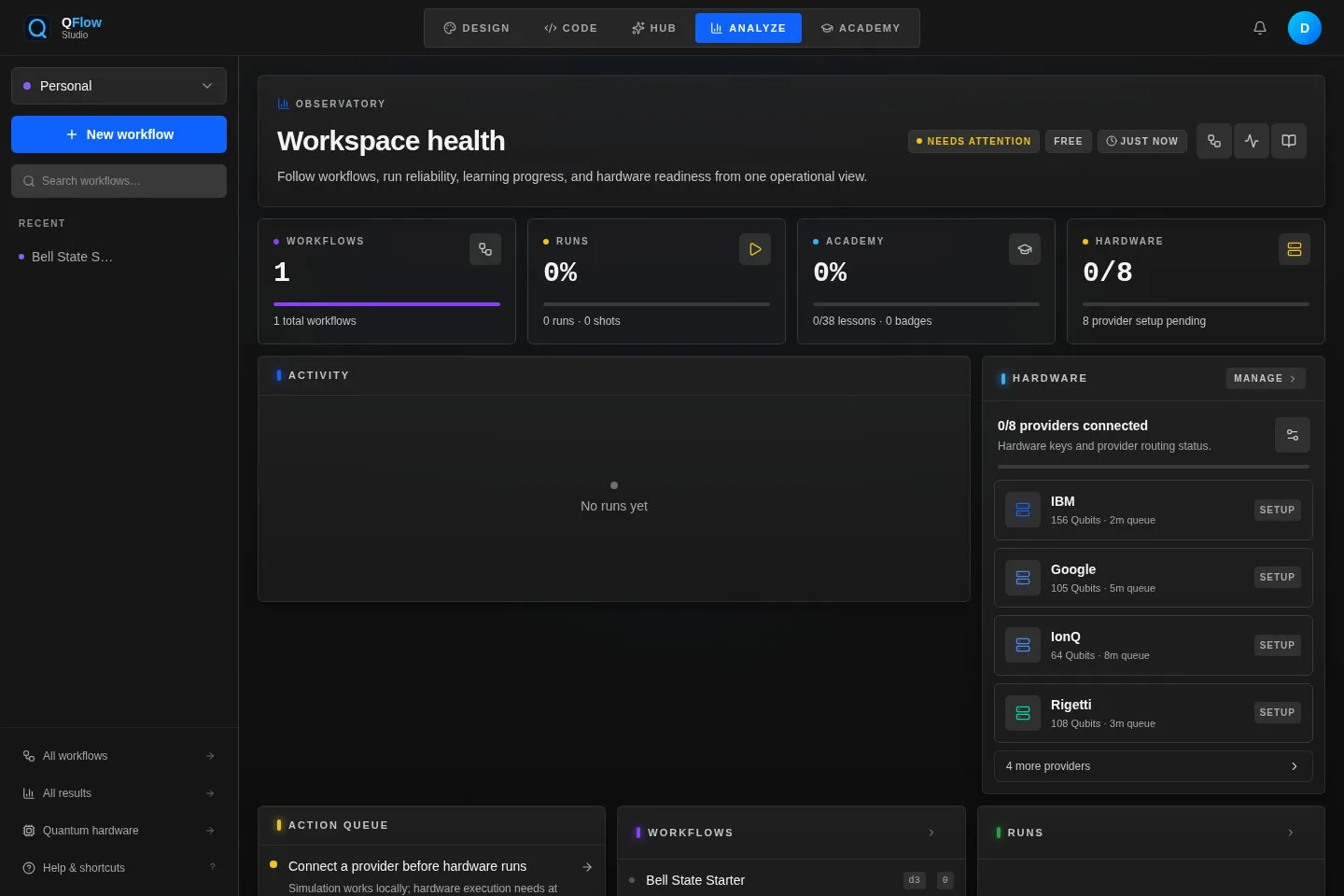
The Neura Parse stack maps onto this order as an integration model. qmesh can provide signed manifests and offline-verifiable provenance for governed future runs. QANTIS structures the decision side around Infer, Risk, Optimise, and Verify, while the latest paper keeps the hardware-tested object narrower: rare-event evidence estimation that returns a posterior to a classical planner. QFlow Studio is where assumptions, baselines, resource estimates, and provider context can become one reviewable record.
Ask vendors for the chain, not the headline.
A benchmark number without its evidence chain is a marketing artifact. The evaluation question is not what score a vendor reports but whether the run behind it can be checked, repeated, and compared against a stated classical baseline. Vendors who can produce the chain will produce it. Vendors who cannot will offer a slide.
The same standard applies in the other direction. The public QANTIS repository is the Community Edition under MIT, a didactic surface, while public benchmark numbers and hardware campaign results are bounded by the linked arXiv records; additional private artefacts are discussed through formal engagements. That separation is not modesty. It is the evidence discipline applied to our own claims, and it is the posture a program should require of every supplier.
- Can the run be repeated on a simulator with disclosed seeds and parameters?
- Is the backend metadata for the reported run available for review?
- Is the mitigation strategy stated, versioned, and separable from the raw result?
- Was a classical baseline run under the same problem definition?
- Are full output distributions available, or only summary statistics?
- Is the claimed decision impact traceable to the recorded output?
Hardware roadmaps reset benchmarks, not discipline.
IBM's public roadmap points toward more capable hardware and near-term advantage. Each hardware generation will invalidate old benchmark comparisons, because those numbers were measured on machines that no longer represent the frontier. What survives generational turnover is the evidence discipline itself: the problem definitions, baselines, and comparison methodology carry forward even when the results do not.
This is the practical argument for hybrid architecture as a standing posture rather than a transition phase. Classical planning, simulation, and policy logic keep the reliability responsibility, so quantum components can be swapped as hardware improves without re-deriving trust from scratch. A program with intact evidence chains can re-run its decision problems on new hardware and read the delta directly.
The organizations that keep a classical baseline close to every quantum result will be the ones able to say, precisely and with records, when quantum insertion started to pay. Everyone else will be arguing from vendor slides. That is the position worth building toward now, while runs are still cheap enough to instrument fully.
Operational checklist
Program checklist: building a quantum evidence chain
Derived from the article's takeaways. Run it before the first hardware execution and re-run it at every program gate.
- 01
Define the decision problem before designing the circuit, and state how success will be measured.
- 02
Run a classical baseline for every quantum experiment and version it alongside the quantum record.
- 03
Require a simulator pass before any hardware execution and archive its output with its seeds.
- 04
Capture backend metadata, seeds, mitigation parameters, and full output distributions for every run, with no optional fields.
- 05
Record the mitigation strategy as an explicit, versioned choice rather than an unstated default.
- 06
Log the decision impact of each result: what the output changed, and what the baseline would have decided.
- 07
Define the classical fallback path, rehearse it, and record every fallback event.
- 08
Expose confidence, uncertainty, and fallback state in the operator interface, not only in telemetry.
- 09
Treat the evidence chain, not the benchmark score, as the unit of review at program gates.
Practical takeaways
01
Keep the classical baseline close to every quantum result.
02
Store manifests, backend metadata, seeds, mitigation parameters, and output distributions.
03
Use quantum acceleration only where the decision problem is explicit and measurable.
04
Explain confidence, uncertainty, and fallback behavior in the user interface.
RA · Reference annexDefinitions, recurring questions, editorial method, and primary sources.Inspect
The analysis above carries the main reading flow. This reference layer keeps terminology, recurring questions, editorial method, and primary sources available without interrupting the argument.
Terminology
Terms behind Quantum decision systems: from experiment evidence to investment gates..
- Evidence chain
- The complete linked record of a quantum experiment, from problem definition and simulator pass through backend metadata, mitigation strategy, output distribution, and decision impact. It is what makes a result checkable and repeatable rather than a one-time claim.
- Error mitigation
- Techniques that reduce the effect of hardware noise on quantum results without full error correction. Mitigation choices change the output, so they must be recorded as part of the result.
- Classical baseline
- The best available conventional solution to the same decision problem, run and stored alongside every quantum result so the comparison stays honest.
- Backend metadata
- The recorded state of the quantum hardware or simulator at execution time, including which device ran the job and under what configuration. Without it a result cannot be reproduced under comparable conditions.
- Output distribution
- The full set of measured outcomes from a quantum run, not just a summary statistic. Quantum results are probabilistic, so the distribution is the result.
- Hybrid architecture
- A system design in which classical planning, simulation, and policy logic carry the reliability responsibility, and quantum execution is inserted only at explicitly measured decision points.
- Classical fallback
- The predefined conventional path a system takes when the quantum component is unavailable or its output cannot be trusted. Every fallback event must be recorded and visible to operators.
- Manifest
- A structured record that pins down exactly what was executed: the program, its parameters, and its dependencies. In qmesh, manifests are ed25519 signed with offline-verifiable hash chains.
Field questions
Program questions behind Quantum decision systems: from experiment evidence to investment gates..
Q01What makes a quantum result reviewable instead of just impressive?
A reviewable result carries its full evidence chain: the problem definition, a simulator pass, backend metadata, the mitigation strategy, the output distribution, and the recorded decision impact. Any single artifact on its own, including a benchmark score, cannot be checked, repeated, or compared against a classical baseline. The chain is the product unit, not the circuit.
Q02Do we still need our classical systems if we adopt quantum decision components?
Yes. Classical planning, simulation, and policy logic remain responsible for reliability, and quantum execution is inserted only where it can be measured against an explicit decision problem. Keep the classical baseline close to every quantum result, and make the fallback path an observable, recorded behavior rather than an assumption.
Q03What exactly should we archive from each quantum experiment?
Store the manifest, backend metadata, seeds, mitigation parameters, and full output distributions, alongside the classical baseline run under the same problem definition. Add the decision impact: what the output changed downstream. If any of these is missing, treat the run as incomplete evidence rather than a partial result.
Q04How do QANTIS and qmesh fit into an evidence-chain approach?
QANTIS is a quantum decision research line organised around inference, risk, optimisation, and verification. In its latest public paper, the hardware-tested role is narrower: rare-evidence estimation returns an ordinary posterior to a classical planner. QANTIS can compose with qmesh so future governed runs carry signed manifests and offline-verifiable provenance. Presented together, the useful object is the chain of assumptions, execution metadata, mitigation choices, posterior checks, and decision impact—not a standalone benchmark.
Q05Does IBM's Heron-era roadmap remove the need for this discipline?
No. The roadmap describes Heron processors, the Quantum System Two direction, and a path toward near-term advantage, which makes quantum work more concrete but does not remove the engineering problem. Production trust still depends on results that can be checked, repeated, and compared against classical baselines. Better hardware changes what is worth running, not what must be recorded.
Q06How should confidence and fallback behavior appear to operators?
In the interface, not only in logs. The system should explain confidence, uncertainty, and fallback behavior directly to the user, so an operator always knows whether a recommendation came from the quantum path or the classical fallback. Silent fallback corrupts the decision record and should be treated as a defect.
Editorial record
How Quantum decision systems: from experiment evidence to investment gates. was checked.
- Editorial owner
- Neura Parse Research
- Last verified
- July 12, 2026
- Method
- Synthesis of the dated primary and official records listed below, checked against the operating question in this note.
- Scope limit
- Planning analysis—not certification, customer performance evidence, procurement advice, or a claim of production readiness.
SRSources reviewed
2 records