Abstract
Reconnection restores a communication path. Recovery still needs an account of what the device received, what it completed and which action is now permitted.
Gap map
Recover the record before releasing another action
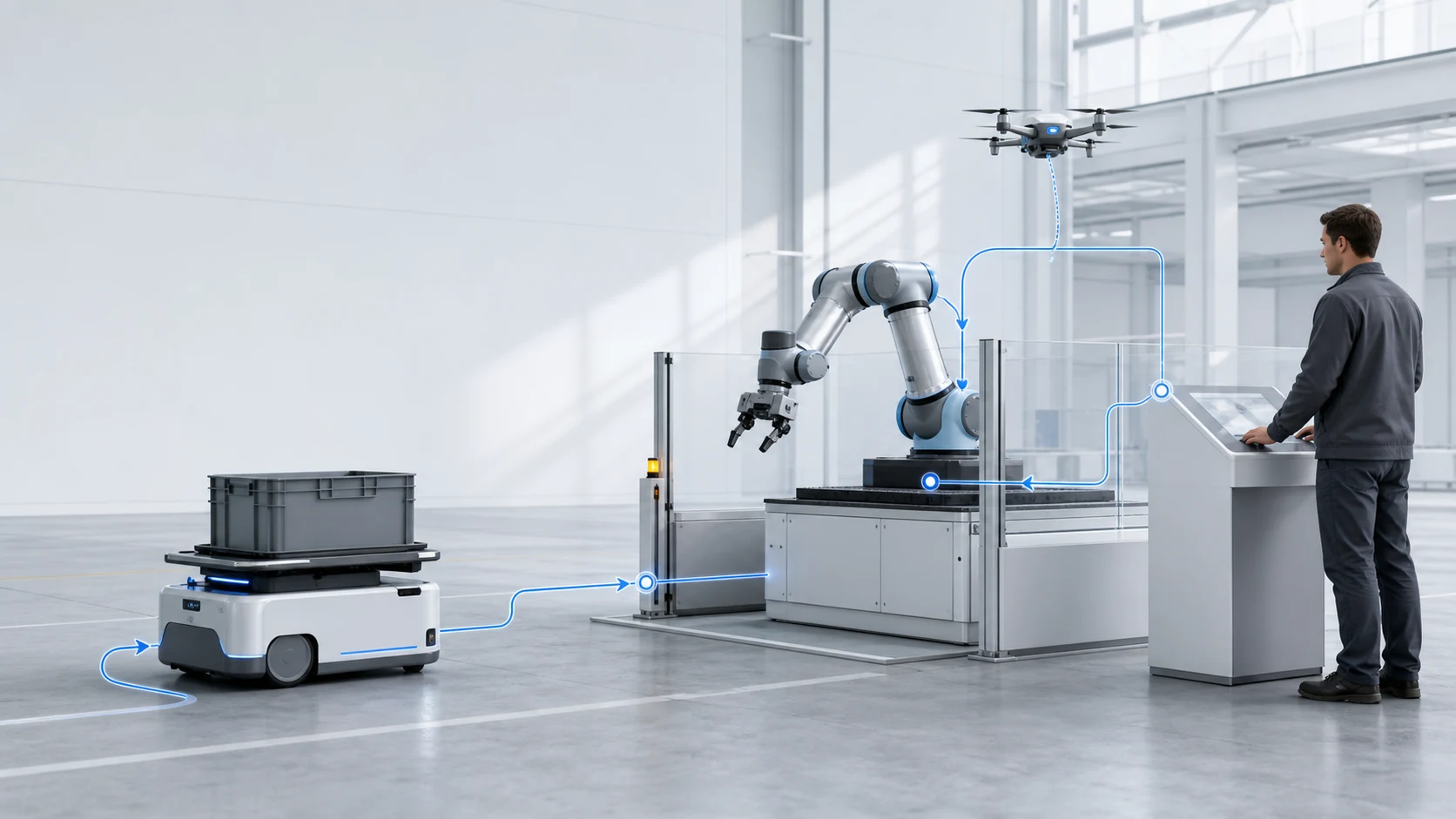
An illustrative supervised recovery path. It does not prescribe automatic physical resumption.
Retain
- Command identity
- Approved intent
- Last confirmed state
Reconcile
- Device receipts
- Outcome evidence
- Resource ownership
Decide
- Confirmed closeout
- Hold for review
- Renewed approval
Name the uncertainty behind the connection icon.
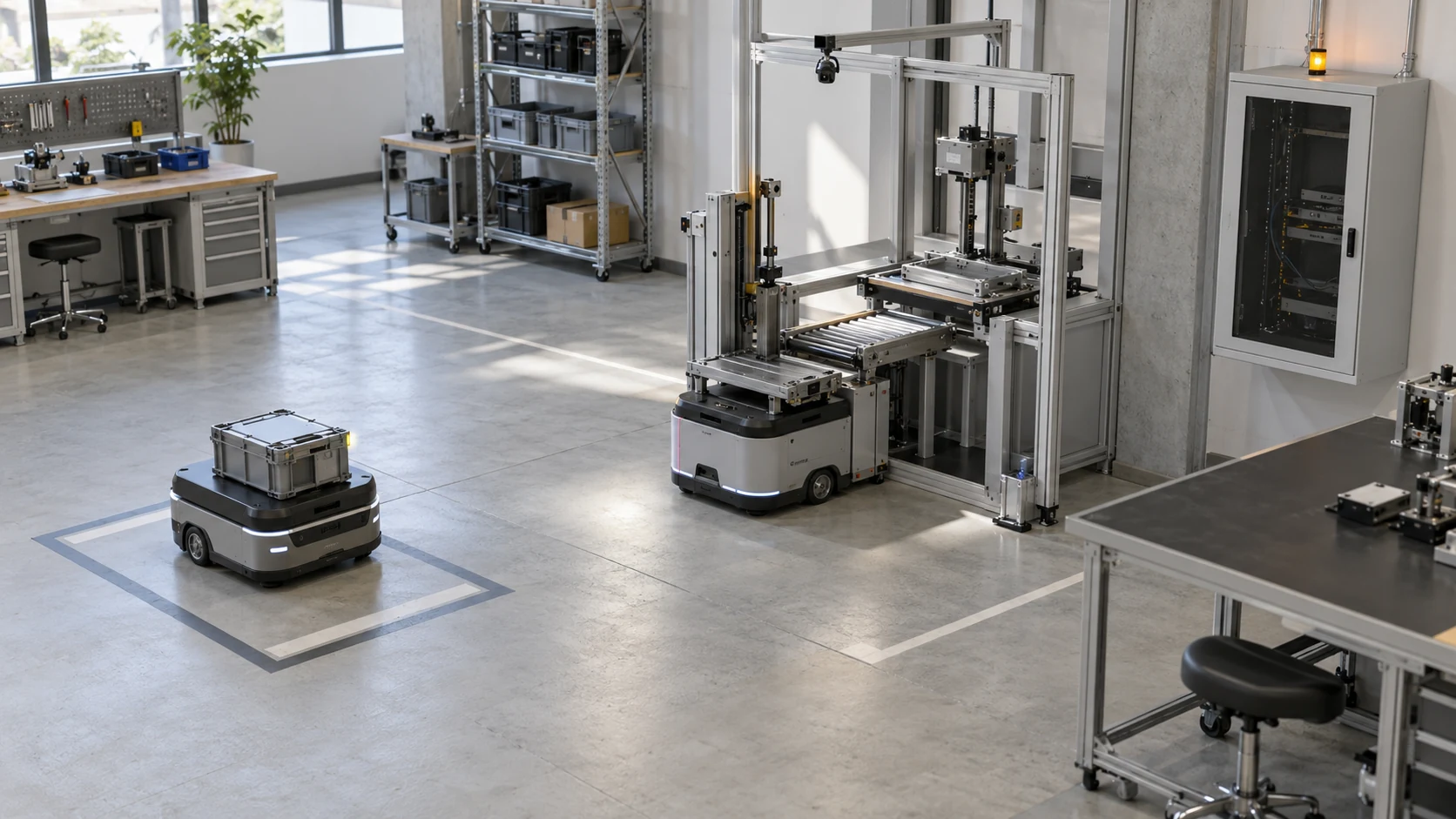
A transport robot is asked to deliver a service kit to a workcell. The connection drops before the sender receives a reply. The request may never have arrived, may be waiting, may be running or may already be complete. A red connection indicator describes a communication condition; it does not select among those task states.
Network intelligence in this mission context means relating delay, loss, jitter, partitions and rejoined links to the evidence available for a task decision. It can inform a recommendation to hold, inspect or seek approval. It does not imply a deployed telecom analytics service, automatic network reconfiguration or knowledge of an unobserved physical outcome.
A retry is another action with its own consequences.
If the first transfer has already happened, another request could duplicate the work. Preserve the original command identity and retrieve the matching retained state and outcome where the agreed interface supports it. Distinguish a repeated delivery of the same command from an independently authorised new task.
RFC 9110 describes why retry safety depends on operation semantics, particularly when a client has not received a response. That HTTP rule is a distributed-systems reference, not a physical execution guarantee. A repeated robot command still needs application-specific admission, durable records and target acceptance; a transport retry policy cannot establish exactly-once action in the world.
Resource ownership can remain uncertain after a lease expires.
Now add a second robot waiting for the same transfer station. The shared record says the first robot owned the resource before the partition. Expiry of that record does not prove that the platform left the station or that its load was removed. Scheduling the second robot on that assumption would convert a data gap into a physical claim.
Keep the last confirmed owner, reservation history and occupancy evidence distinct. If the current ownership or physical state cannot be established, expose the unresolved condition and use the agreed hold or review path. Mission-level task assignment and distributed swarm behaviour raise related questions, but a two-robot handoff is not evidence that a general swarm solution has been validated.
Design the interruption before running the experiment.
A useful controlled study fixes the initial state, task, command authority and expected records. Inject one failure at a named boundary: delay the observation, suppress the acknowledgement, duplicate the request or restart a participant during recovery. Then inspect the event chronology and state transitions against an explicit expected outcome.
Compare variants with the same workload, fault sequence and authority policy. Measure end-to-end timing, recovery-state correctness, duplicate-action exposure, evidence completeness and the human decisions needed. Missing records are findings. A run should not count as a successful recovery merely because the interface becomes green again.
- Before the fault: preserve intent, command identity, release scope and the expected completion evidence.
- During the gap: identify last confirmed state, unavailable evidence and affected dependencies.
- After reconnection: reconcile receipts, outcomes and resource state before another assignment.
- At closeout: retain the operator's decision, unresolved limits and the permitted next action.
Product context and the research still to do.
NODERIQ connects shared context and constraints to advisory task recommendations. NowFlow provides the workflow and human review layer, while NeuraOS supports approved intent, command admission and typed outcomes at the edge boundary. Local device controllers retain motion and safety responsibilities; the mission layer does not inherit them.
NODERIQ-RCN is the separate collaborative research initiative for broader applications and validation. Consortium development and prospective funding routes remain in progress. The candidate host/QEMU experiments described here are proposed studies, not reported results. Physical performance and safety require a separately scoped target integration, measurement and responsible acceptance.
Practical takeaways
01
Lost contact leaves execution uncertain; it does not prove failure or completion.
02
Preserve command identity before considering a repeat request.
03
Treat resource expiry and physical availability as different evidence.
04
Reconnection starts reconciliation; renewed action needs the appropriate authority.
RA · Reference annexDefinitions, recurring questions, editorial method, and primary sources.Inspect
The analysis above carries the main reading flow. This reference layer keeps terminology, recurring questions, editorial method, and primary sources available without interrupting the argument.
Field questions
Program questions behind Network intelligence for robotic mission recovery.
Q01Can a robotic mission resume automatically when the link returns?
Link restoration alone is insufficient. The selected application must establish task state, resource ownership, evidence and valid authority. The supervised pattern here can close a confirmed outcome, hold for review or request renewed approval; it does not prescribe automatic physical resumption.
Editorial record
How Network intelligence for robotic mission recovery was checked.
- Editorial owner
- Neura Parse Research
- Last verified
- October 15, 2026
- Method
- Synthesis of the dated primary and official records listed below, checked against the operating question in this note.
- Scope limit
- Planning analysis—not certification, customer performance evidence, procurement advice, or a claim of production readiness.
SRSources reviewed
1 records