Abstract
Natural language can accelerate the first draft of a quantum workflow, but it cannot make the circuit correct or the route appropriate. QFlow keeps AI output visible as a proposal that must pass circuit, source, route, and evidence review.
Gap map
The QFlow AI draft-to-evidence control loop
AI accelerates proposal creation; technical and operational authority stays with the team.
Ask
- Objective
- Constraints
- Expected behavior
- Required evidence
Draft
- Circuit blocks
- Source changes
- Route note
- Evidence summary
Verify
- Circuit semantics
- Source diff
- Simulator reference
- Unsupported claims
Approve
- Adapter status
- Account and resource scope
- Explicit submit
- Result review
Share
- Raw evidence comparison
- Private-field exclusion
- Reviewer approval
- Provenance
AI Builder proposes workflow changes; it does not turn language into proof.
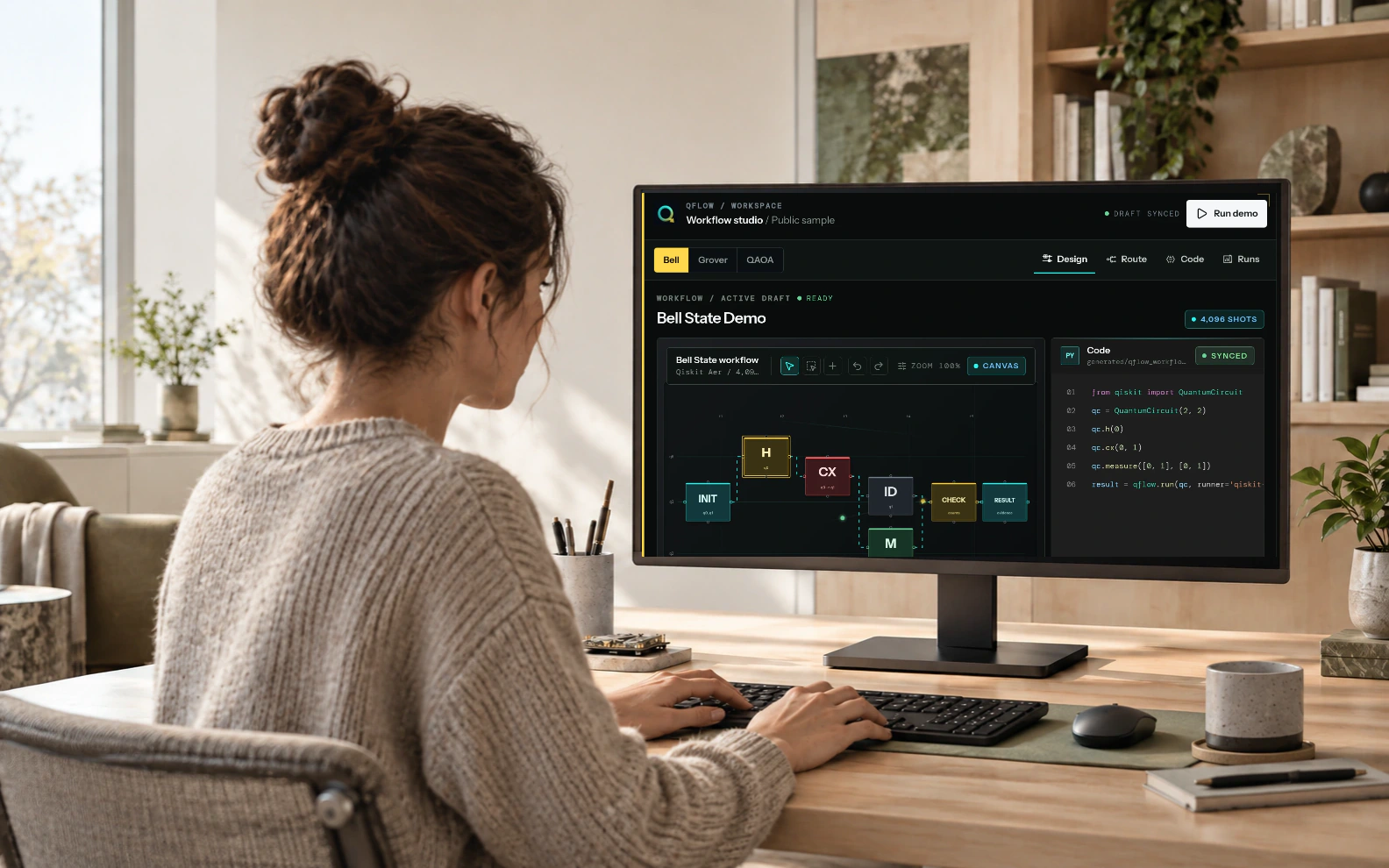
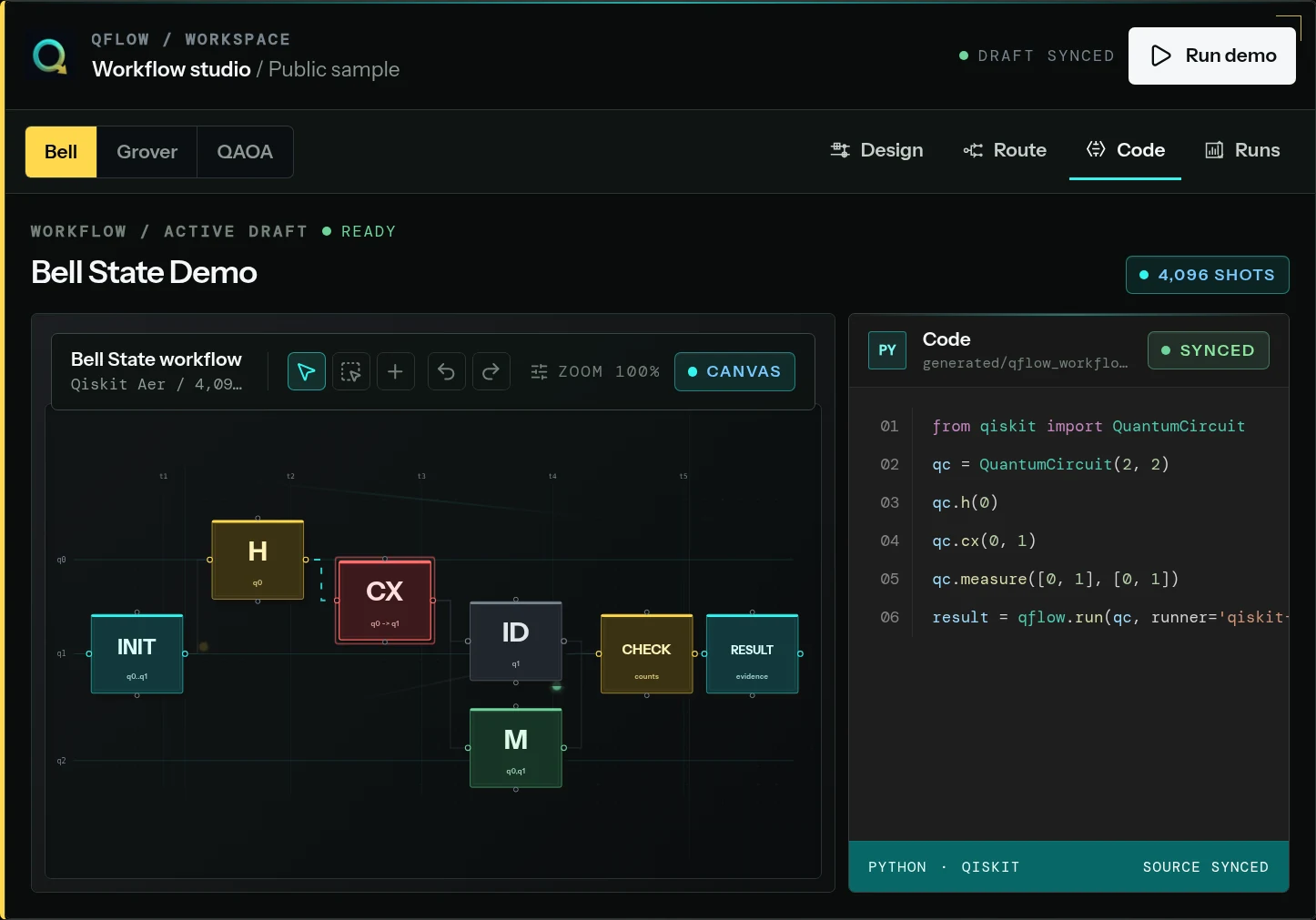
QFlow describes an AI Builder that can draft circuits, route notes, source changes, and evidence summaries from a user request. This can reduce the blank-page cost of starting a Bell, Grover, QAOA, or custom workflow and help a mixed team translate an objective into inspectable artifacts.
Every artifact remains a draft until reviewed. A plausible circuit can encode the wrong oracle, reverse a control, omit a measurement, misuse a parameter, or target an unsupported operation. Fluent language and a clean diagram are not evidence of quantum correctness.

TD · Technical depth6 supporting chapters and the working checklist.Read deeper
A useful request states the problem boundary before asking for gates.
The request should include the objective, input size, expected behavior, simulator or provider preference, source format, and required evidence. It should also state what the assistant must not assume: provider entitlement, unrestricted qubits, arbitrary Python execution, or a claim of quantum advantage.
Ask for the smallest simulator-first draft and an explanation of each block. This makes defects easier to locate and establishes a reference before provider routing. Complex workflows should be decomposed into reviewable components instead of generated as one opaque circuit.
- State the expected distribution, objective, or invariant.
- Set qubit, shot, and route constraints where known.
- Request generated source and a block-by-block explanation.
- Require uncertainty and unsupported assumptions to be named.
Check semantics before being impressed by the diagram.
Review register sizes, initial state, gate order, controls and targets, parameters, measurements, and classical-bit mapping. Algorithm-specific checks follow: a Grover draft needs the intended oracle and diffusion path; a QAOA draft needs a declared cost model, mixer, parameter boundary, and classical objective.
Test the smallest meaningful instance against an analytic expectation or strong classical reference. A simulator result that disagrees should stop the workflow before hardware routing. Agreement is necessary evidence for the draft, not proof that an algorithm will scale or outperform a classical method.
Generated Qiskit, Cirq, or OpenQASM must match both canvas and runtime intent.
QFlow keeps generated source visible beside the workflow. Review imports, registers, operations, parameters, measurements, and framework-specific behavior. Tie the exact executed source snapshot to the run instead of inferring it from the latest editor state.
Generated code deserves normal software checks: version review, deterministic unit cases where possible, dependency scrutiny, and comparison with official SDK behavior. QFlow’s published boundary keeps raw Python off by default, so an assistant should not silently widen a circuit task into arbitrary code execution.
Provider submission is an operational decision AI can prepare but must not take invisibly.
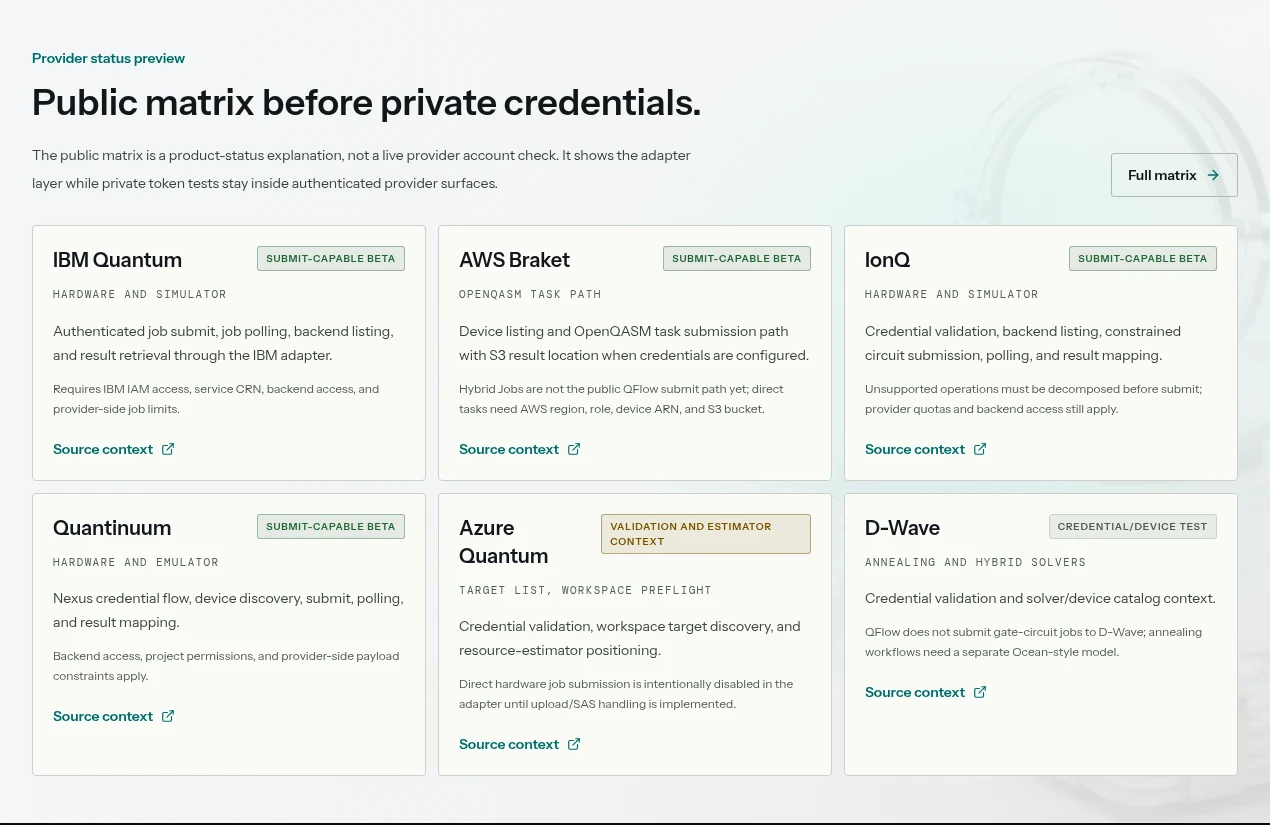
An assistant may suggest a simulator or provider fit. The team must verify adapter status, operations, target access, credentials, region, quotas, queue, expected charges, and why hardware is needed. QFlow’s public matrix makes clear that routes have different implementation levels.
The approval checkpoint should display the workflow version, source snapshot, route, target, shots, and known resource or account implications. A failed preflight remains visible; it must not be silently converted into another execution mode. Provider terms and access remain independent from QFlow.
AI route note + adapter status + account eligibility + resource check + human approval = submit decisionAI can summarize a run, but the summary stays downstream of raw evidence.
Check an AI-written summary against counts, trace, source, route, exports, and reviewer notes. The assistant must not turn finite-shot variation into a causal explanation, call simulation hardware evidence, omit failed attempts, or convert a logical algorithm claim into a runtime advantage.
People also approve shared results. The packet exposes proof required for review while excluding provider tokens, billing state, administrative notes, private users, and raw credentials. AI can help draft the narrative; the artifacts and manifest determine what the narrative may claim.
Measure caught errors and review quality, not only draft speed.
A useful evaluation set includes reversed controls, missing measurements, invalid parameters, unsupported operations, ambiguous provider access, misleading performance language, and summaries that omit negative runs. Measure whether the system surfaces uncertainty and whether reviewers correct the defect before submission.
QuanBench+ and Qiskit HumanEval examine functional correctness in generated quantum code, reinforcing a practical point: fluent code generation needs task-specific execution tests and human review. A trustworthy assistant makes the workflow more inspectable; it does not hide judgment behind polished output.
- Track draft acceptance only after technical review.
- Record common correction categories and false-confidence patterns.
- Test preflight against unsupported or unavailable routes.
- Compare summaries with raw result packets.
- Re-evaluate prompts and checks when SDK or provider behavior changes.
Practical takeaways
01
Use AI Builder to accelerate quantum workflow drafts, not certify correctness.
02
Verify circuit semantics against a small analytic or classical reference before routing.
03
Inspect generated source and attach the executed snapshot to the run.
04
Keep provider submission and evidence sharing as explicit human approvals.
05
Evaluate AI assistance through error detection, provenance, and review quality rather than speed alone.
RA · Reference annexDefinitions, recurring questions, editorial method, and primary sources.Inspect
The analysis above carries the main reading flow. This reference layer keeps terminology, recurring questions, editorial method, and primary sources available without interrupting the argument.
Field questions
Program questions behind AI-assisted quantum programming needs a draft, verify, approve loop..
Q01Can AI build a quantum circuit in QFlow Studio?
QFlow’s AI Builder can draft a circuit and related source, route notes, and evidence context. The output remains a proposal that people must verify against the objective, circuit semantics, generated source, and simulator behavior.
Q02Can QFlow AI submit a quantum job automatically?
The documented operating model keeps provider submission as an explicit human decision. The team verifies route status, account access, target support, shots, resource implications, and the exact source snapshot before submitting.
Q03How should AI-generated Qiskit code be tested?
Review registers, operations, parameters, measurements, dependencies, and target assumptions; run the smallest meaningful simulator case against an analytic or classical reference; then tie the approved source snapshot to the execution record.
Q04Can AI write the evidence summary?
It can draft one, but a reviewer must compare every claim with raw output, source, route, trace, failures, exports, and limitations before approving a share-safe packet.
Editorial record
How AI-assisted quantum programming needs a draft, verify, approve loop. was checked.
- Editorial owner
- Neura Parse Research
- Last verified
- July 20, 2026
- Method
- Synthesis of the dated primary and official records listed below, checked against the operating question in this note.
- Scope limit
- Planning analysis—not certification, customer performance evidence, procurement advice, or a claim of production readiness.
SRSources reviewed
7 records