Abstract
The cloud-to-edge loop is now the product: train, simulate, evaluate, package, deploy, monitor, and roll back across real devices.
Robotics products need a cloud-to-edge loop.
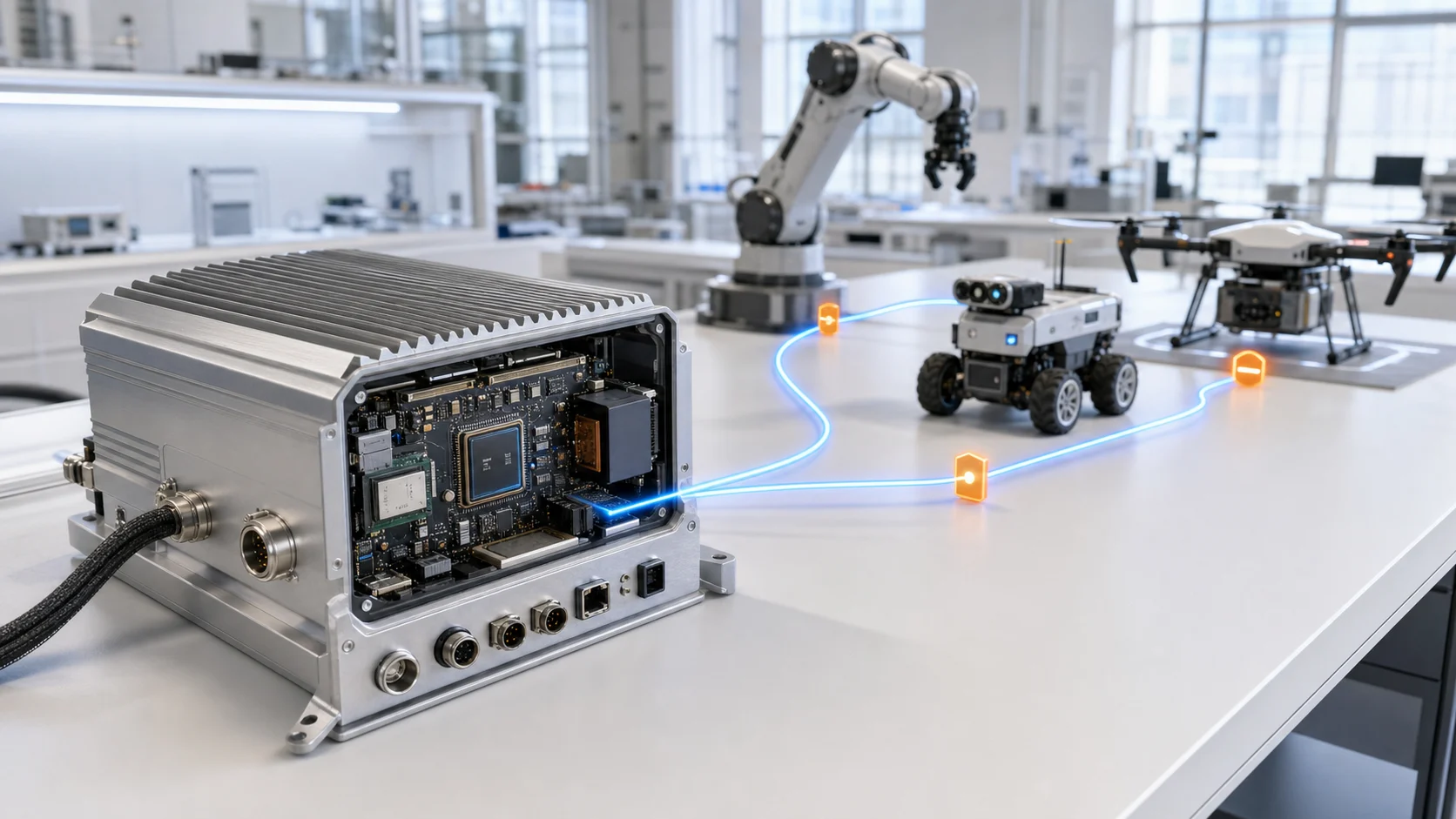
NVIDIA's physical AI, Jetson, Isaac, Cosmos, and GR00T direction points to a larger architectural shift: robotics products need a development loop that spans training, simulation, packaging, deployment, monitoring, and improvement.
NeuraOS sits in the critical operational layer. It needs to manage inference backends, real-time control, hardware acceleration, secure communication, telemetry, OTA updates, and rollback behavior.

TD · Technical depth5 supporting chapters and the working checklist.Read deeper
Maintenance belongs in the first architecture pass.
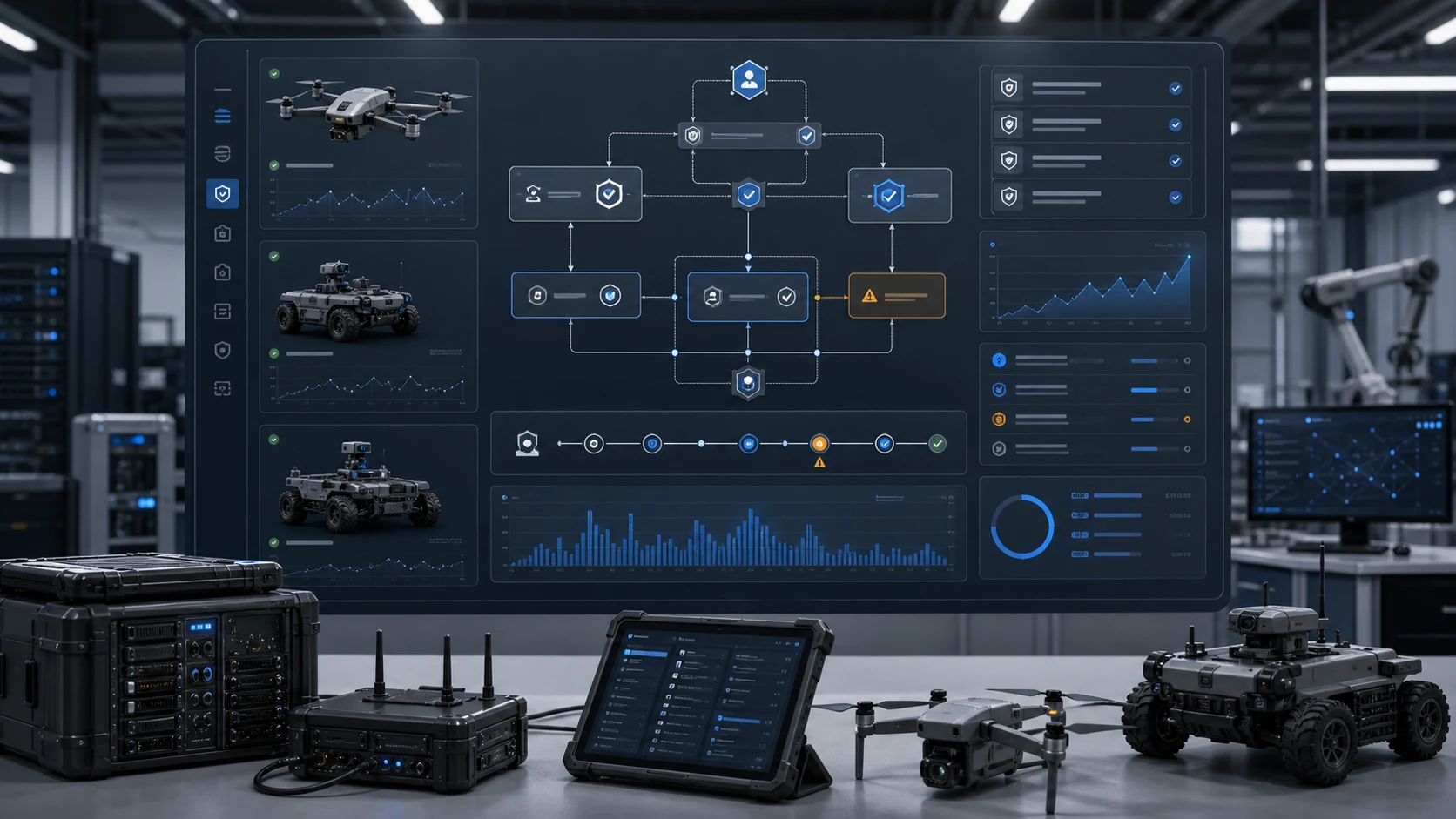
Versioned builds, device identity, signed packages, resource budgets, and observability should appear before the first pilot. A model that cannot be safely shipped is still a research artifact.
The fleet plan also has to account for hardware variants, thermal and power limits, intermittent connectivity, failed installations, and devices that miss an update window. Cohorts, health gates, pause conditions, rollback, and field-service ownership turn a promising edge model into something an operations team can support after the demonstration crew leaves.
The failure modes that separate fleets from demos.
A demo fails once, in front of an audience, and gets retried. A fleet fails continuously, in the field, in ways nobody is watching. The design question is not whether devices will degrade but which degradations the architecture absorbs without physical intervention. Most of the failure modes worth designing against are operational, not algorithmic.
Update failure comes first. A partially applied package, a device that loses power mid-write, or a model that passes evaluation but regresses on one hardware revision each produce a device that is neither the old version nor the new one. Signed packages, versioned builds, and rollback to a known-good image turn these from field incidents into logged events.
Connectivity failure comes second. Devices that assume the cloud fall over when the link drops, and links drop in real facilities. The offline requirement is not a preference, it is the condition under which the fleet must still meet its latency and control obligations. Sensor degradation comes third: noisy sensors are the normal case, so evaluation has to cover degraded inputs, not only clean ones.
- Partial or interrupted updates that leave a device in a mixed state
- Silent model regressions on specific hardware revisions
- Link loss that strands cloud-dependent inference or control
- Sensor drift and noise that push inputs outside evaluated conditions
- Resource exhaustion when new models exceed device budgets
- Unattributable devices when identity is bolted on after deployment
What to instrument before the first pilot.
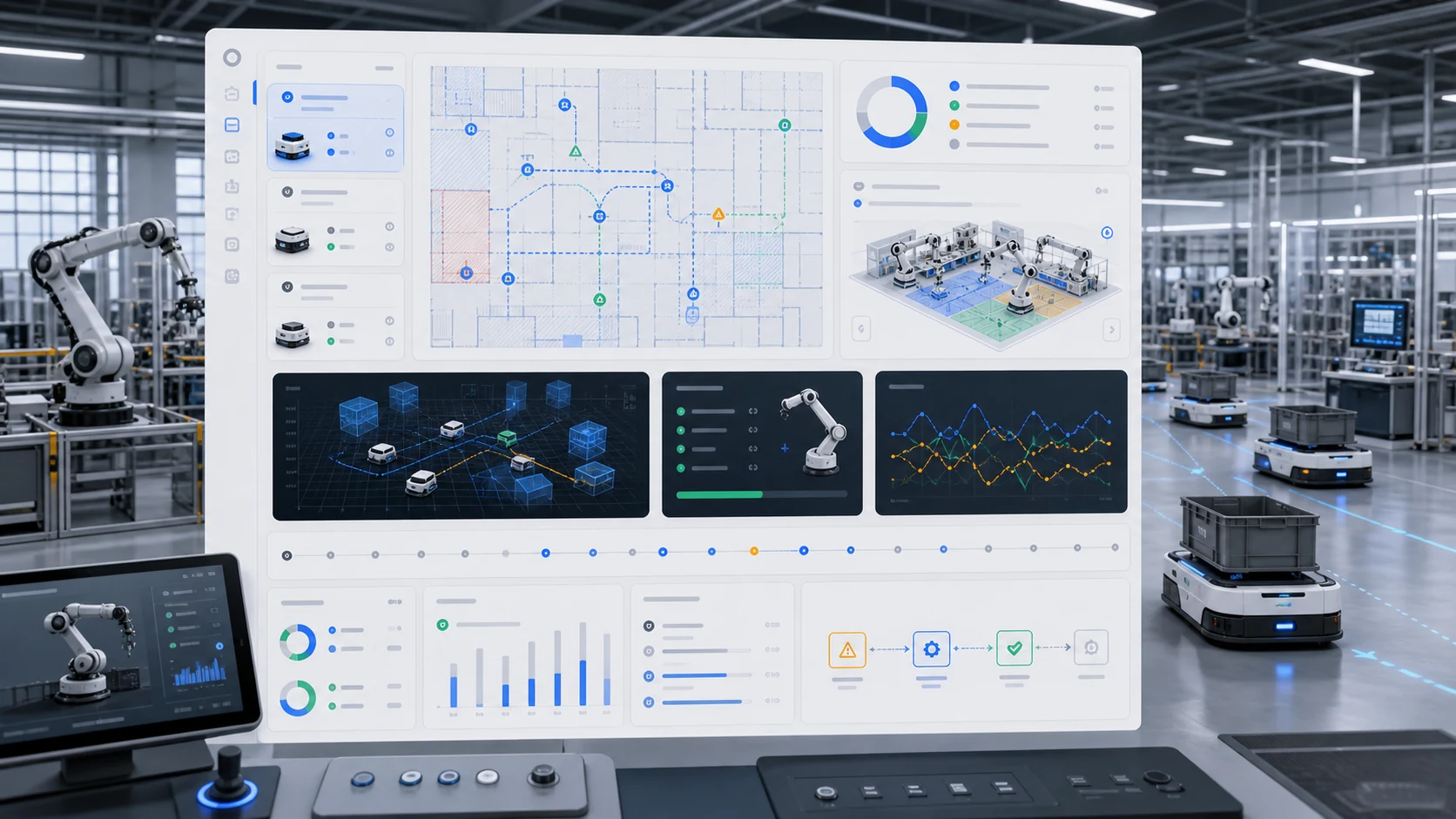
Observability appears in the article's first architecture pass for a reason: a fleet without telemetry cannot be inspected, and a fleet that cannot be inspected cannot be trusted. The open question is order. Instrument the release path before the model, because a bad deployment mechanism corrupts every experiment that runs on top of it.
The minimum viable telemetry set answers four questions: which build each device is running, whether the last update applied completely, whether the device is inside its resource budget, and whether the control path is meeting its timing obligations. Everything else, including model quality signals, layers on after these are reliable. A program that cannot answer the four questions has monitoring, not observability.
Keep model telemetry separate from control telemetry. The article's separation of real-time control paths from exploratory agent behavior applies to instrumentation too: the control loop needs low-overhead, high-priority timing data, while model behavior can be sampled, batched, and shipped opportunistically when connectivity allows. This keeps the observability system itself from becoming a source of timing risk.
- Build version and package signature status per device
- Update outcomes: applied, failed, rolled back
- Resource consumption against declared budgets
- Control-loop timing against real-time deadlines
- Sampled inference inputs and outputs for offline evaluation
How to evaluate the operational layer.
The operational layer described in this article, managing inference backends, real-time control, hardware acceleration, secure communication, telemetry, OTA updates, and rollback behavior, is where robotics programs accumulate hidden risk. Evaluating it means asking deployment questions, not benchmark questions. A runtime that wins on inference throughput but cannot roll back a bad model is the wrong trade for a fleet.
Concrete tests beat datasheets. Push a signed package to a device, cut the power mid-update, and observe what boots. Sever connectivity and verify the control path holds its deadlines. Swap an inference backend and measure how much of the stack has to change; these exercises expose whether maintenance was in the first architecture pass or bolted on.
NeuraOS is built for this layer as a governed edge operating platform for robotics and defence systems. Its current public record uses Linux 6.18 LTS + PREEMPT_RT, ROS 2 Lyrical, current pinned robotics and inference components, signed release identity, independent safety, and evidence by design. The evaluation should focus on the target system: timing distributions, resource behavior, fault containment, sensor validity, command arbitration, recovery, update integrity, and rollback proof—not a retired universal performance counter.
The fleet is the product, and the loop is the program.
The claim that the cloud-to-edge loop is now the product has a program-management consequence: staffing and budget have to follow the loop, not the model. Train, simulate, evaluate, package, deploy, monitor, and roll back is a cycle that runs for the life of the fleet, and every stage needs an owner. Programs that fund only the training stage ship a research artifact, in the article's terms, not a product.
The NVIDIA direction the article cites, spanning physical AI, Jetson, Isaac, Cosmos, and GR00T, signals that the upstream stack is consolidating around this loop. What stays program-specific is the operational tail: device identity, deployment windows, offline behavior in a particular facility, and the rollback policy a particular safety case demands. Those are the parts no upstream platform will do for you.
The practical move is to treat each loop stage as a gate with evidence. A model advances from simulation to hardware validation with a recorded evaluation. A package advances to the fleet with a signature and a rollback plan. A deployment window closes with telemetry that confirms the fleet is healthy. That is how updated, inspected, and trusted becomes a schedule instead of a slogan.
Operational checklist
Program checklist: standing up an updatable, inspectable edge fleet
Derived from the article's takeaways. Work through these before the first pilot, not after the first outage.
- 01
Put model packaging, OTA delivery, rollback, and device identity into the first architecture pass.
- 02
Sign every package and version every build so each device can prove what it is running.
- 03
Set explicit per-device resource budgets and reject models that exceed them.
- 04
Define offline behavior: what the device must keep doing when cloud latency or connectivity cannot be trusted.
- 05
Separate real-time control paths from exploratory agent behavior at the architecture level.
- 06
Instrument the release path first: build versions, update outcomes, resource use, control-loop timing.
- 07
Use simulation and synthetic data for coverage and safety, but gate fleet release on hardware validation.
- 08
Rehearse failure: interrupt an update mid-write and verify the device recovers to a known-good image.
- 09
Treat each stage of the cloud-to-edge loop as an evidence gate before a model or package advances.
Practical takeaways
01
Put model packaging, OTA, rollback, and device identity into the first architecture pass.
02
Design for offline operation when cloud latency or connectivity cannot be trusted.
03
Use simulation and synthetic data where it improves safety, but keep hardware validation in the loop.
04
Separate real-time control paths from exploratory agent behavior.
RA · Reference annexDefinitions, recurring questions, editorial method, and primary sources.Inspect
The analysis above carries the main reading flow. This reference layer keeps terminology, recurring questions, editorial method, and primary sources available without interrupting the argument.
Terminology
Terms behind Physical AI fleets: update, observe, and govern models at the edge..
- OTA update
- An over-the-air update, a software or model release delivered to deployed devices remotely instead of by physical access. For fleets, OTA is the primary release path and must be designed with verification and recovery from the start.
- Rollback
- The ability to return a device to a previous known-good software or model version when an update fails or a regression appears. Reliable rollback turns bad releases into recoverable events instead of field incidents.
- Device identity
- A unique, verifiable identity for each device in a fleet, used to authenticate devices, target updates, and attribute telemetry. Without it, a program cannot state with confidence which device is running which software.
- Signed package
- A software or model package carrying a cryptographic signature that lets a device verify the package came from the legitimate build pipeline and was not altered in transit. Devices reject packages whose signatures do not verify.
- Inference backend
- The software component that executes a trained model on a device's processor, often using hardware acceleration. Supporting multiple backends lets one runtime serve different model formats and hardware types.
- Real-time control
- A control path with hard timing deadlines, where a late response is a wrong response. The article argues this path must be separated from exploratory agent behavior so experiments cannot disturb timing guarantees.
- Telemetry
- Operational data emitted by devices, such as build versions, update outcomes, resource usage, and timing measurements, collected so a fleet can be inspected remotely.
- Synthetic data
- Training or evaluation data generated by simulation rather than collected from physical sensors. The article treats it as a safety and coverage tool that complements hardware validation but does not replace it.
Field questions
Program questions behind Physical AI fleets: update, observe, and govern models at the edge..
Q01What does a cloud-to-edge loop actually cover in a physical AI program?
The loop spans training, simulation, evaluation, packaging, deployment, monitoring, and rollback across real devices. The article's argument is that this loop, not any single model, is the product, so every stage has to keep working for the life of the fleet. Programs that fund only the training stage end up with what the article calls a research artifact, a model that cannot be safely shipped.
Q02Why do OTA updates, rollback, and device identity belong in the first architecture pass instead of a later hardening phase?
Retrofitting them means re-provisioning devices that are already in the field, which is exactly the operation fleets are worst at. Versioned builds, signed packages, device identity, resource budgets, and observability determine whether a bad release is a logged, recoverable event or a field incident. Adding them before the first pilot is cheaper than adding them after the first outage.
Q03How should an edge fleet behave when cloud connectivity is lost or latency spikes?
The article's position is to design for offline operation whenever cloud latency or connectivity cannot be trusted. The device must keep meeting its real-time control obligations locally, with the cloud treated as the path for training, evaluation, and fleet management rather than a dependency in the control loop. Offline is listed as a runtime requirement, not an edge case.
Q04Can simulation and synthetic data replace hardware validation before deployment?
No. The article recommends using simulation and synthetic data where they improve safety and coverage, but keeping hardware validation in the loop. Real facilities introduce noisy sensors and conditions that simulated evaluation does not fully capture, so a model should not advance to the fleet on simulated evidence alone.
Q05Where does NeuraOS fit in this architecture?
NeuraOS sits in the governed operational layer between approved models and physical devices. It provides Linux 6.18 LTS + PREEMPT_RT, ROS 2 Lyrical, current pinned robotics and inference runtimes, workload identity, secure communication, health supervision, signed updates, rollback, and evidence. Primary flight, motion, and emergency-protection loops remain under independently assured deterministic control.
Q06Why separate real-time control paths from exploratory agent behavior?
Real-time control has hard timing deadlines, and exploratory agent behavior is by definition less predictable in both output and resource use. Keeping the two on separate paths means an agent experiment cannot starve or delay the control loop that keeps hardware safe. The separation also simplifies review, because the safety-critical surface stays small and inspectable.
Editorial record
How Physical AI fleets: update, observe, and govern models at the edge. was checked.
- Editorial owner
- Neura Parse Research
- Last verified
- July 12, 2026
- Method
- Synthesis of the dated primary and official records listed below, checked against the operating question in this note.
- Scope limit
- Planning analysis—not certification, customer performance evidence, procurement advice, or a claim of production readiness.
SRSources reviewed
3 records