Abstract
Useful agents need controlled execution spaces, tool contracts, policy, and visible work history. The product layer is the chain of action, not the prompt box.
Agents need a runtime surface.
OpenAI's 2026 Responses API direction and hosted execution work make one thing clear: useful agents need controlled execution spaces, tool contracts, and a route from instruction to verified action. AWS is hardening AgentCore around managed harnesses, policy controls, gateway execution, and faster development paths.
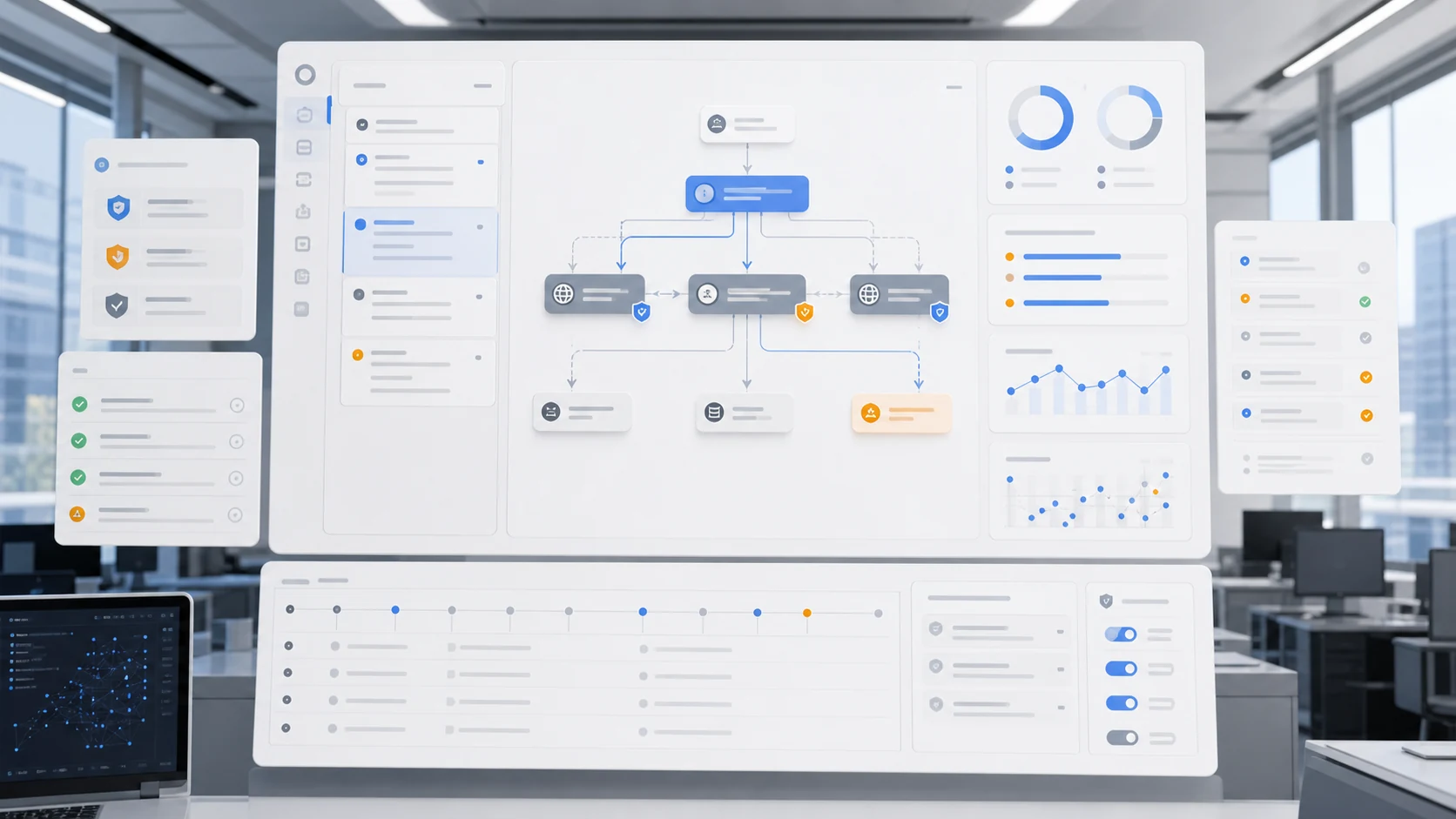
NowFlow maps to this requirement: teams need more than an empty prompt box. They need a workflow graph that can call tools, route approvals, preserve context, expose APIs, and be audited after the fact.

TD · Technical depth5 supporting chapters and the working checklist.Read deeper
The UX must show the chain of work.
Every trigger, tool call, source, approval, and output needs a visible place in the product. Beautiful interfaces matter, but trust comes from making execution readable to engineering, legal, security, and business teams at the same time.
That does not mean showing every trace to every person. Operators need current state, pending approvals, exceptions, and a safe recovery action; engineers need tool arguments, latency, policy decisions, and retry history; reviewers need the source and authorization chain. A shared execution record can support those different views without forcing one dense control panel onto the whole organization.
The failure modes are structural, not model-level.
Most agent failures that matter to a program are not bad model outputs. They are structural: an action executed without a contract, a permission widened by a prompt edit, a retry that repeated a side effect, a memory entry that steered later runs without anyone seeing it. These failures survive model upgrades because they live in the integration layer, not in the model.
The common thread is invisible state. When prompts, permissions, memory, and approvals are bundled in one configuration, no reviewer can say what the system was allowed to do at the moment it acted. That is why the takeaways insist on separation and on recording policy state with every action. An inspectable failure is a defect; an uninspectable failure is an incident.
Design against surface divergence as well. When chat, API, and embedded surfaces are built separately, they drift, and the audit story fractures across three implementations. A single workflow definition deployed to every surface removes an entire class of inconsistency.
- Tool calls that execute outside any contract or log
- Prompt edits that silently change effective permissions
- Retries that repeat side effects because policy state was not recorded
- Memory entries that steer later runs without review
- Approvals that gate the chat surface but not the API surface
- Parallel surface builds that drift from one workflow's intent
Instrument the chain of action before anything else.
The first telemetry a program needs is not token counts or latency. It is the chain of action: trigger, tool call, source, approval, output, in order, per run. If that chain is complete, most other metrics can be derived later. If it is missing, no dashboard can reconstruct what the agent actually did.
Instrument failures before successes. A failed action must carry its inputs, outputs, policy state at execution time, and full retry history. That record is what lets engineering, legal, and security review the same event directly instead of reconstructing it from scattered logs.
Then instrument approvals. Record who approved, what they saw at approval time, and which policy required the gate. Approval telemetry is what lets the human-in-the-loop pattern scale, because it shows which gates catch real problems and which only add latency.
Evaluate vendors on execution governance, not demo quality.
The 2026 platform moves set the baseline. OpenAI's Responses API direction adds hosted execution, and AWS AgentCore now ships managed harnesses, policy controls, and gateway execution. A vendor pitching an agent product below that baseline is selling a chat wrapper.
Diligence questions follow directly from the takeaways. Ask whether tool execution runs through enforceable contracts, whether prompts and permissions are separable and independently versioned, and whether one workflow definition can deploy to API, chat, and embedded surfaces without parallel builds. Then ask to see a failed action: if the vendor cannot show inputs, outputs, policy state, and retry history for a real failure, the audit story is unverified.
This is the standard Neura Parse applies to NowFlow: a workflow graph that calls tools, routes human approvals through in-app flows, email, Slack, or Discord, preserves context, exposes APIs, and remains auditable after the fact.
- Require contract-governed tool execution with inspectable permissions
- Require prompt, permission, memory, and approval layers that version independently
- Require one workflow definition across API, chat, and embedded surfaces
- Require exportable execution history for every run, including failures
- Require approval routing that reaches accountable reviewers where they work
The runtime layer consolidates over the next year.
The direction is consistent across the cited sources. OpenAI is moving execution into hosted environments, and AWS is hardening AgentCore with policy controls, gateway execution, and faster development paths. Expect runtime, policy, and evaluation layers to keep consolidating into managed platforms, the way orchestration once absorbed bespoke deployment scripts.
For buyers, the consequence is a shift in where differentiation lives. Model access is becoming a commodity input. The durable assets are the workflow definition, its tool contracts, and its audit history. Programs that own those artifacts can move between runtimes; programs that embedded their logic in one vendor's prompt format cannot.
For product teams, the chat box becomes a thin client. The same workflow definition should already serve API, chat, and embedded UI, and the pressure over the next year will be to add each new surface a customer asks for without forking that definition. That is the practical meaning of agentic systems becoming product infrastructure rather than a side panel.
Operational checklist
Program checklist: standing up a governed agent runtime
Derived from the article's takeaways. Work the list before the first agent touches a production system.
- 01
Inventory every path where an agent or script can execute an action today, and bring each under a single governed runtime.
- 02
Define a tool contract for every callable action: inputs, outputs, permissions, and failure behavior.
- 03
Separate agent prompts, tool permissions, memory, and approval logic so each can be versioned and reviewed independently.
- 04
Route high-consequence actions through explicit human approval before execution.
- 05
Record inputs, outputs, policy state, and retry history for every action, and make failed actions inspectable first.
- 06
Expose API, chat, and embedded UI from the same workflow definition instead of maintaining parallel builds.
- 07
Make the chain of work readable to engineering, legal, security, and business reviewers, not only to the builders.
- 08
Evaluate hosted runtimes such as the Responses API and AgentCore against your policy and audit requirements before committing workloads to them.
Practical takeaways
01
Treat tool execution as a governed runtime, not a UI feature.
02
Separate agent prompts, tool permissions, memory, and approval logic.
03
Expose API, chat, and embedded UI from the same workflow definition.
04
Make failed actions inspectable with inputs, outputs, policy state, and retry history.
RA · Reference annexDefinitions, recurring questions, editorial method, and primary sources.Inspect
The analysis above carries the main reading flow. This reference layer keeps terminology, recurring questions, editorial method, and primary sources available without interrupting the argument.
Terminology
Terms behind Agentic systems as product infrastructure: runtime, policy, and ownership..
- Agent runtime
- The controlled execution environment where an agent's instructions become actions. It enforces tool contracts, permissions, memory, policy, and approval logic around every run.
- Tool contract
- A defined interface for an action an agent may take, specifying inputs, outputs, and permissions. Contracts make execution enforceable and auditable instead of free-form.
- Chain of work
- The ordered record of trigger, tool calls, sources, approvals, and outputs that produced a result. The article argues this record, not the prompt box, is the surface that earns trust.
- Human-in-the-loop
- A control pattern in which designated actions pause for explicit human approval before execution. In NowFlow, approvals route through in-app flows, email, Slack, or Discord.
- Policy state
- The permissions, constraints, and approval requirements in force at the moment an action executed. Recording it with each action makes failures reviewable after the fact.
- Gateway execution
- Server-side tool execution routed through a managed control point rather than called directly by the agent, as in AWS AgentCore Gateway. It centralizes enforcement and logging.
- Workflow graph
- A workflow expressed as connected steps: triggers, tool calls, conditions, and approval gates. One graph can be versioned, audited, and deployed as a unit.
- Multi-surface deployment
- Exposing a single workflow definition through several product surfaces at once, such as REST API, chat, and embedded UI, so behavior and audit history stay consistent.
Field questions
Program questions behind Agentic systems as product infrastructure: runtime, policy, and ownership..
Q01What is the difference between an agent runtime and a chat interface?
A chat interface is one deployment surface. A runtime is the governed layer underneath it: controlled execution spaces, tool contracts, memory, policy, and a route from instruction to verified action. The core claim of this article is that product value lives in that runtime, not in the prompt box.
Q02How do hosted offerings such as OpenAI's Responses API and AWS AgentCore change what a program has to build?
They confirm the direction rather than remove the work. OpenAI's 2026 Responses API direction adds hosted execution, and AWS is hardening AgentCore around managed harnesses, policy controls, and gateway execution. A program still has to own the workflow definitions, tool permissions, approval logic, and audit trail that sit above those platforms.
Q03What does auditability mean in practice for an agentic system?
Every trigger, tool call, source, approval, and output has a visible, recorded place in the product. Failed actions carry their inputs, outputs, policy state, and retry history so they can be inspected after the fact. The record must be readable to engineering, legal, security, and business teams at the same time, not only to the team that built the workflow.
Q04Why should agent prompts, tool permissions, memory, and approval logic be kept separate?
Each changes on a different schedule and is reviewed by a different owner. A prompt edit should not silently widen tool permissions, and a permission change should not require rewriting prompts. Separation lets each layer be versioned, reviewed, and audited independently, which is what governance requires.
Q05How do human approvals fit into an automated agent workflow without stalling it?
The pattern is selective. Routine actions execute under tool contracts and policy, while designated high-consequence actions pause at explicit approval gates. NowFlow records the accountable owner and decision so the workflow can resume, escalate, or stop through the configured operating path.
Q06Where does NowFlow fit in the agent infrastructure stack described here?
NowFlow is Neura Parse's agentic workflow platform and application layer for governed operations. It expresses agents, tools, conditions, routers, bounded loops, approvals, checkpoints, and failure paths on a visual graph, then exposes the controlled workflow through operator, API, chat, or embedded surfaces.
Editorial record
How Agentic systems as product infrastructure: runtime, policy, and ownership. was checked.
- Editorial owner
- Neura Parse Research
- Last verified
- July 12, 2026
- Method
- Synthesis of the dated primary and official records listed below, checked against the operating question in this note.
- Scope limit
- Planning analysis—not certification, customer performance evidence, procurement advice, or a claim of production readiness.
SRSources reviewed
4 records