
Abstract
A trustworthy visual quantum builder must reveal the source it generates. QFlow uses the canvas for structure and generated code for exact review before routing, execution, export, or collaboration.
Gap map
The visual-to-source verification loop
A change is ready to route only after structure, generated source, and runtime fit agree.
Canvas intent
- Qubit lines
- Gates and parameters
- Controls
- Measurements
Generated source
- Qiskit
- Cirq
- OpenQASM
- Source snapshot
Human inspection
- Bit mapping
- Parameters
- Depth
- Unsupported operations
Route preflight
- Runner
- Target compatibility
- Credential boundary
- Mode
Run evidence
- Trace
- Output
- Exports
- Approved record
Visual quantum programming should reduce orientation cost, not technical accountability.
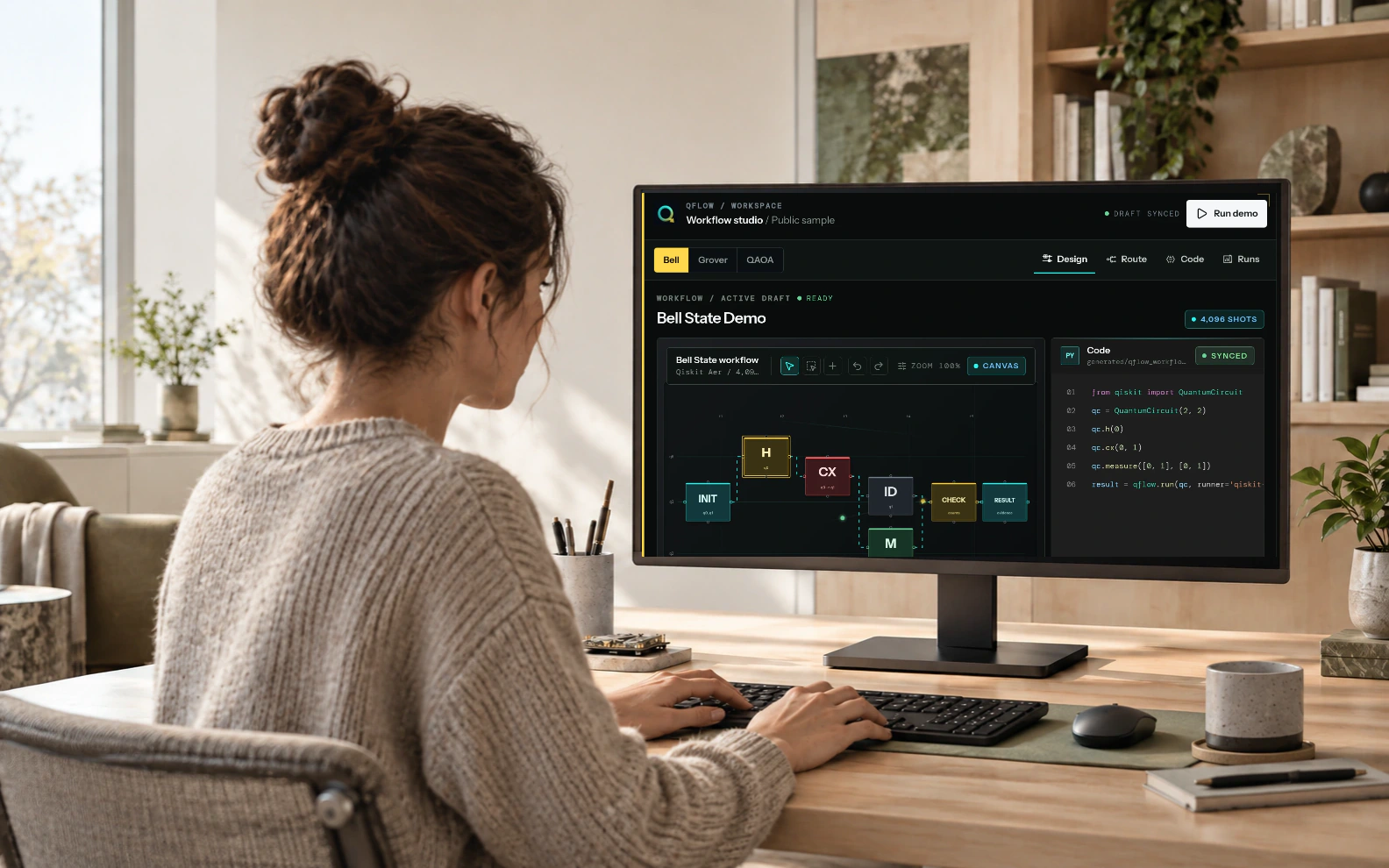
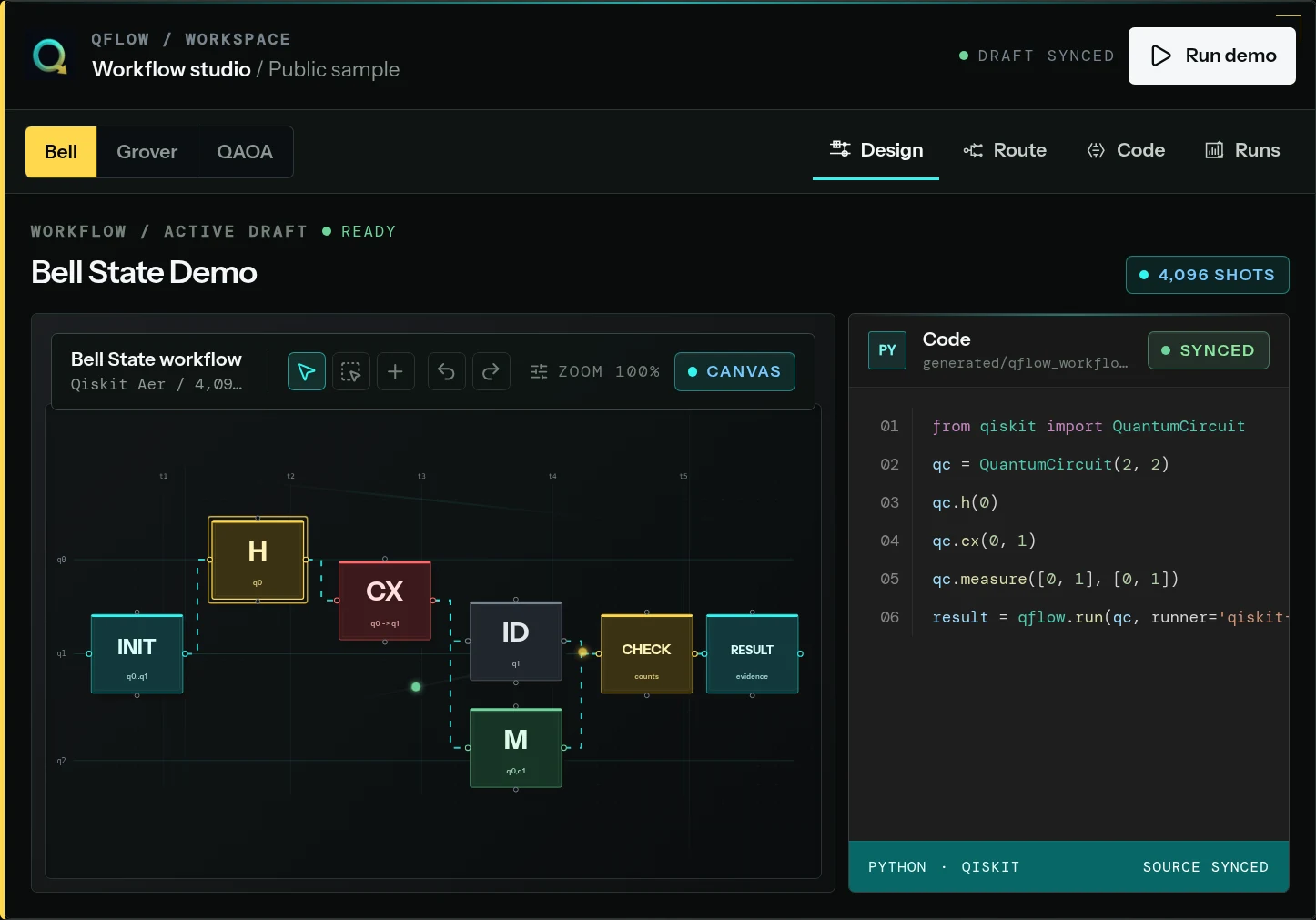
A canvas makes qubit flow, gate order, control relationships, and measurement easier to scan. It can help a learner understand a Bell circuit or help a mixed team discuss a workflow before every participant is fluent in one SDK. That benefit disappears if the generated implementation remains hidden.
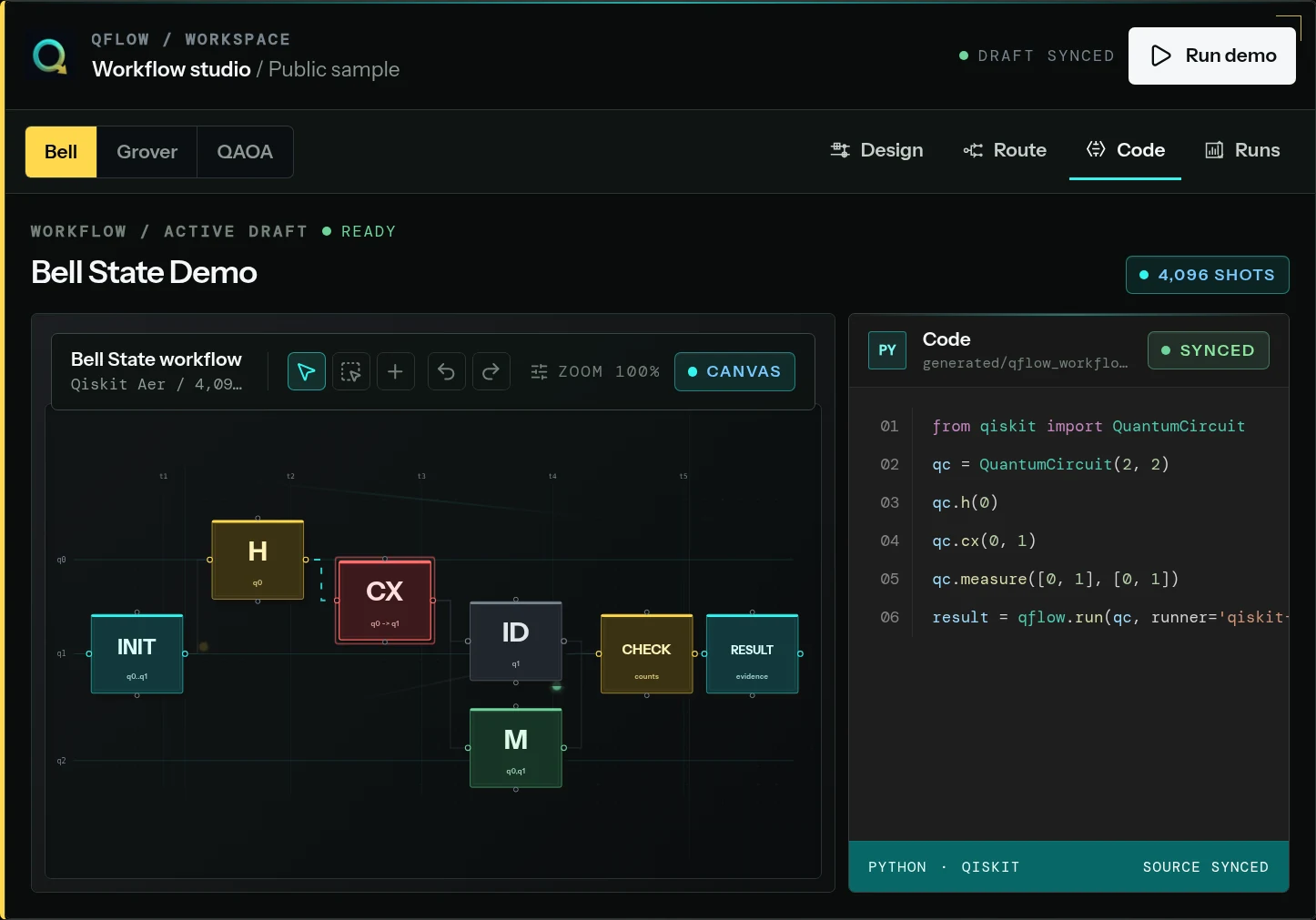
QFlow treats generated code as another view of the same workflow. The canvas communicates structure and intent; Qiskit, Cirq, and OpenQASM expose executable or portable representations. The team remains responsible for checking that those views agree.
TD · Technical depth6 supporting chapters and the working checklist.Read deeper
Every meaningful visual edit should have a source consequence a reviewer can locate.
Changing a target qubit, rotation angle, control relationship, measurement mapping, conditional block, or operation order can materially change a circuit. After a change, the reviewer should return to the source view and identify the corresponding expression. If the consequence cannot be explained, the workflow is not ready to run.
Reusable components and blueprints need the same discipline. They can accelerate assembly, but inserted operations, parameters, assumptions, and validation warnings should remain visible in the expanded workflow and generated source. Reuse should shorten repetitive work without creating an opaque macro layer.
Generated Qiskit supports exact circuit review and SDK-oriented collaboration.
The Qiskit view lets developers inspect register construction, gate calls, measurements, and parameters in familiar Python-oriented form. It also creates a handoff between visual exploration and teams that manage experiments through repositories, notebooks, or provider-native development patterns.
Generated source should still pass ordinary engineering review. Confirm the circuit, dependency expectations, target support, transpilation assumptions, and result-handling path. A generated file is not automatically correct because it parses or compiles.
- Check quantum and classical register sizes.
- Confirm control and target order.
- Inspect parameter units and values.
- Verify measurement-to-classical-bit mapping.
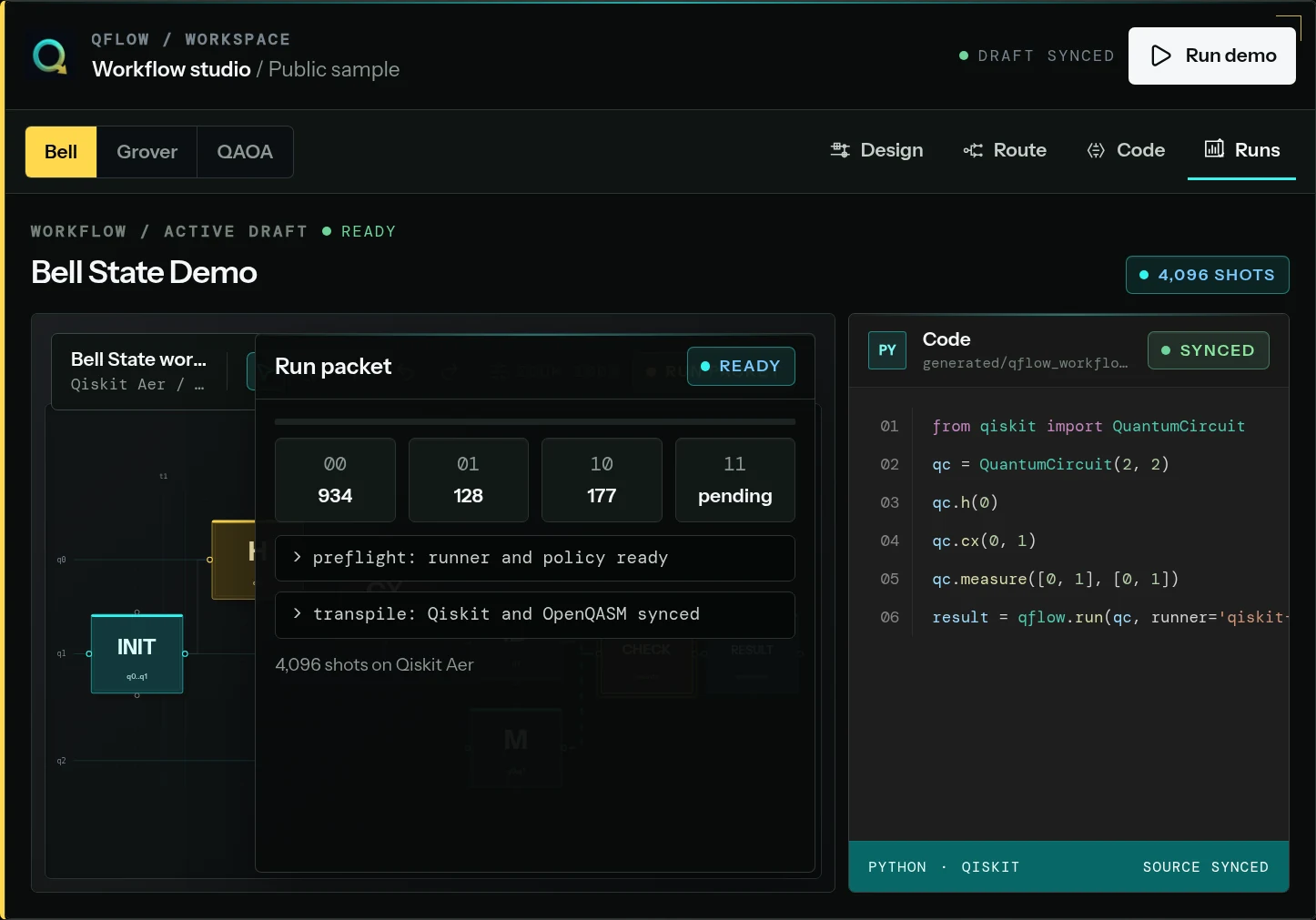
- Attach the executed source snapshot to the run.
OpenQASM is a portable workflow artifact, not universal execution equivalence.
OpenQASM is useful for inspecting circuit structure in a language designed for quantum programs and for moving supported descriptions between tools. In QFlow, its strongest value is remaining attached to the same visual record and run evidence as the generated SDK source.
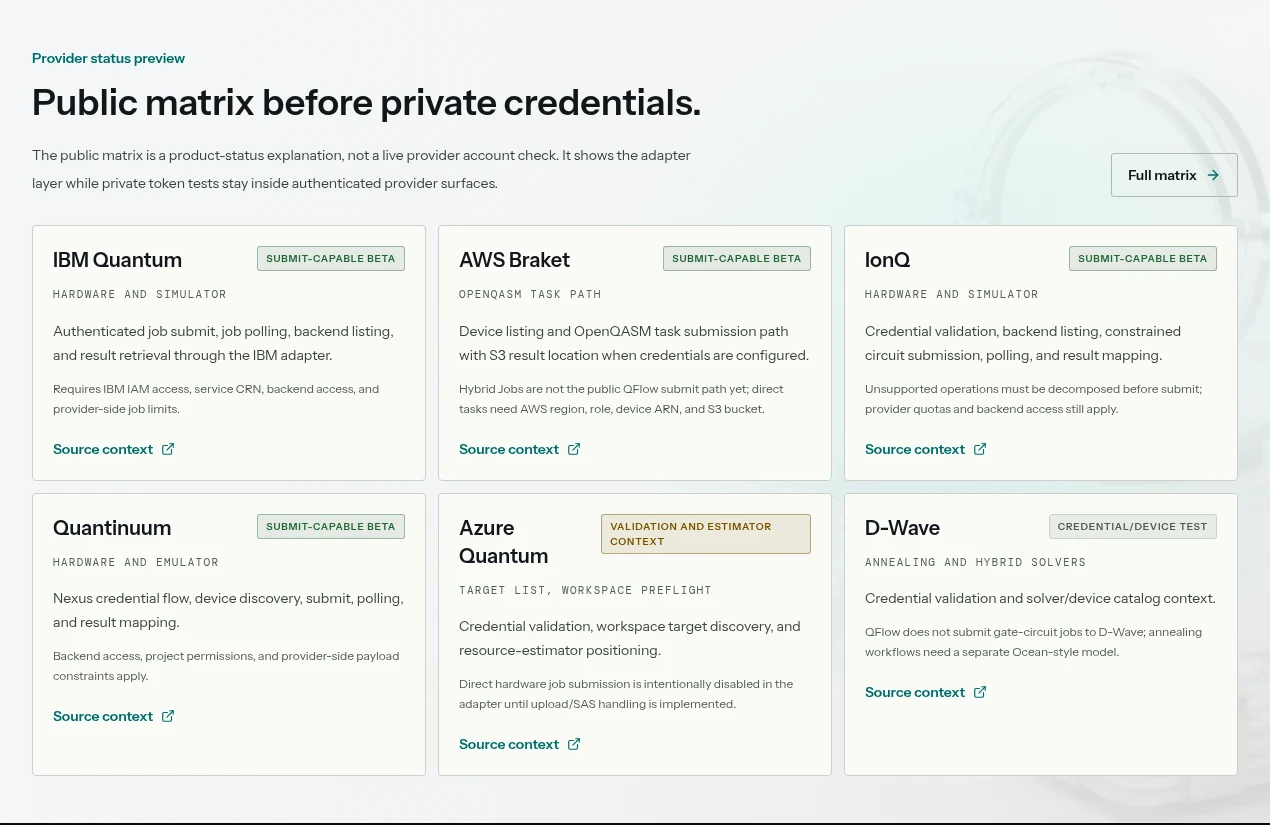
Portability has limits. Supported language versions, instruction sets, control-flow features, timing semantics, calibration extensions, and compiler behavior differ across tools and providers. A successful export does not prove every target will accept or execute the circuit identically.
Version, review, test, and attach generated quantum code like ordinary source.
A practical loop is canvas edit, source diff, structural check, simulator run, expected-result comparison, route preflight, explicit submission, and evidence review. The workflow record preserves the relationship among these steps while a source repository can remain the long-term home for approved exported code.
The record should state when code leaves QFlow, changes externally, and returns through another path. Clear provenance matters more than forcing every developer into one interface. The product is strongest as a shared operating layer between visual, SDK, provider, learner, and reviewer workflows.
canvas edit → source diff → simulator check → route preflight → approved run → evidencePractical takeaways
01
Use the canvas for structure and generated source for exact implementation review.
02
Inspect the source consequence of every material visual edit before running.
03
Treat Qiskit, Cirq, and OpenQASM as complementary representations with explicit execution authority.
04
Do not confuse successful OpenQASM export with universal provider compatibility.
05
Version, test, preflight, and attach generated source to the run record like any other software artifact.
RA · Reference annexDefinitions, recurring questions, editorial method, and primary sources.Inspect
The analysis above carries the main reading flow. This reference layer keeps terminology, recurring questions, editorial method, and primary sources available without interrupting the argument.
Field questions
Program questions behind Visual Qiskit and OpenQASM workflows without losing code-level review..
Q01Is QFlow Studio a no-code quantum platform?
It offers visual authoring, but trustworthy use still requires source and runtime review. QFlow exposes generated Qiskit, Cirq, and OpenQASM so the canvas does not become an opaque no-code boundary.
Q02Does QFlow generate Qiskit code?
Its public documentation describes generated Qiskit source linked to the visual workflow, alongside Cirq and OpenQASM views. A developer must still inspect dependencies, semantics, target fit, and the exact snapshot used for execution.
Q03Does OpenQASM make a circuit portable to every provider?
No. Portability depends on the OpenQASM version, supported subset, operations, control flow, timing, extensions, compilation behavior, and target. Export is an artifact, not a universal compatibility guarantee.
Q04When is a notebook better than QFlow Studio?
A notebook can be the simplest tool for a solo, short-lived SDK experiment. QFlow adds value when the brief, visual model, source, route, run history, learning flow, exports, and evidence must remain connected across people or reviews.
Editorial record
How Visual Qiskit and OpenQASM workflows without losing code-level review. was checked.
- Editorial owner
- Neura Parse Research
- Last verified
- July 20, 2026
- Method
- Synthesis of the dated primary and official records listed below, checked against the operating question in this note.
- Scope limit
- Planning analysis—not certification, customer performance evidence, procurement advice, or a claim of production readiness.
SRSources reviewed
7 records